


Before you use equity
Check the lender's valuation, the full borrowing required and the repayments on every loan. Keep money aside for buying costs and a cash reserve. Equity can help fund a purchase, but releasing it increases your debt.
Equity can help fund a deposit, but it adds to the debt
If your home has risen in value or you have paid down the loan, you may be able to borrow against part of that equity for your next property. First, find out how much a lender will approve, what the extra borrowing would cost each month and when you could access the deposit money.
Having more equity does not automatically mean you can comfortably spend more. Start with the home you want, the repayments you are willing to pay and the savings you want to keep.
The second property might be your next home or an investment while you stay where you are. If you plan to rent either property out, include its expected rent, vacancies and running costs. The loan purpose and use of the money also matter for tax. Our investment home loan guide covers the investment pathway.
Total equity and usable equity are different
Total equity is your property's value less the debt secured against it. Usable equity estimates how much additional borrowing your property could support within a chosen lending limit. The lender still assesses the application and its valuation may differ from an online estimate.
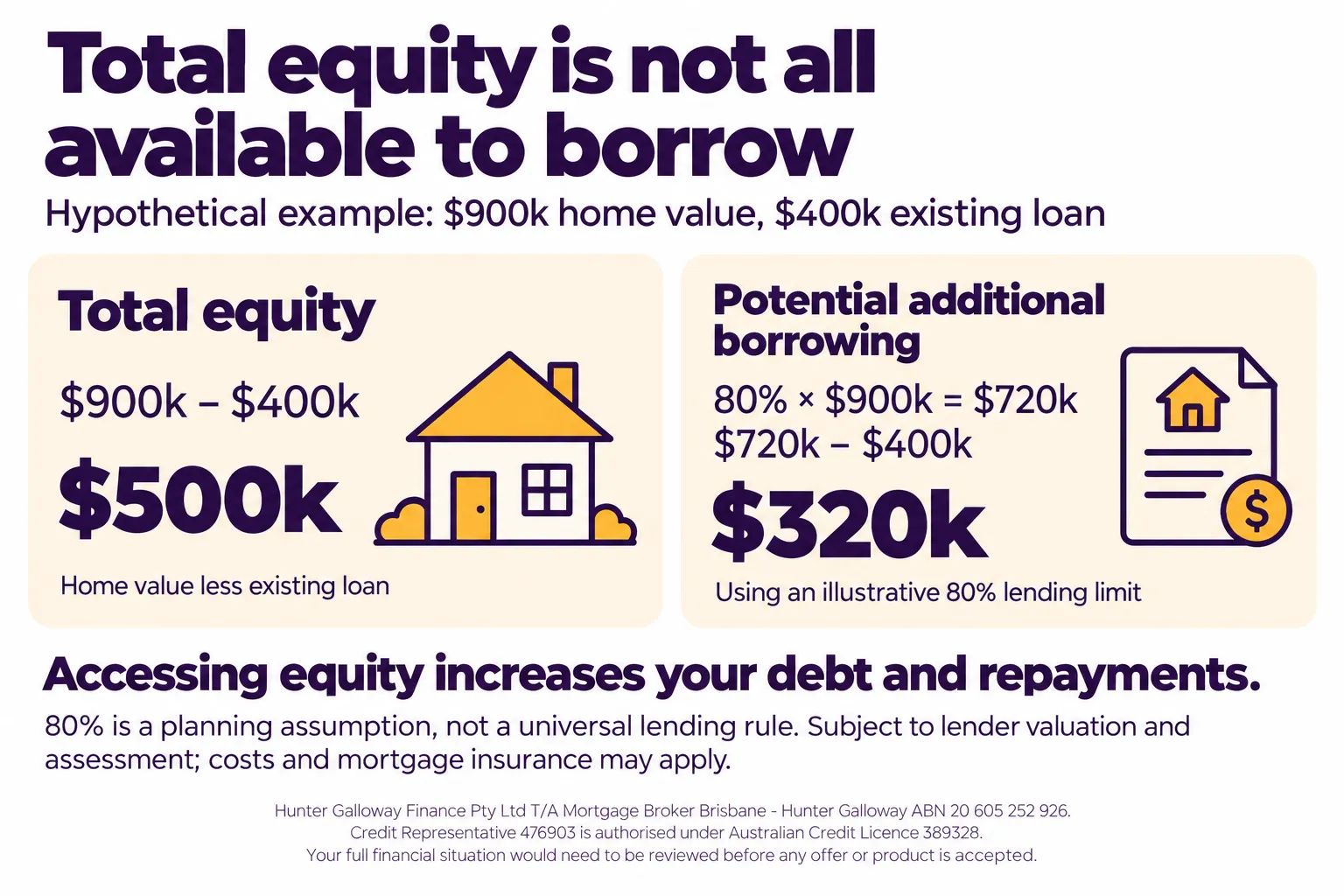
Illustration
Scroll to see more columns
| Illustration | Amount |
|---|---|
| Property value | $900k |
| Existing loan | $400k |
| Total equity | $500k |
| 80% of the property value | $720k |
| Potential additional borrowing at that limit | $320k |
The 80% calculation is a planning assumption, not a universal lending rule. Approval, costs and mortgage-insurance requirements depend on the loan and circumstances. Accessing equity means increasing debt. Use our equity calculator to explore a starting estimate, then confirm the valuation and lending limit with your broker.
Follow the money through the next purchase
You need to fund the purchase deposit and buying costs as well as arrange the main loan. If approved, an equity release may cover some or all of that amount, but you still pay those costs.
This hypothetical example assumes you keep the first property. The allowances show how the figures add up; they are not a quote or duty calculation.
New purchase funding
Scroll to see more columns
| New purchase funding | Amount |
|---|---|
| Purchase price | $1m |
| Buying-cost allowance | $50k |
| Total funding required | $1.05m |
| Proposed loan secured by new property | $800k |
| Further funding required | $250k |
If the full $250k were borrowed against the current property, the existing $400k debt would become $650k. Add the proposed $800k new loan and total debt would be $1.45m. Your repayment assessment needs to cover that total debt, including the $800k loan on the new home.
This example uses no cash contribution towards purchase costs. It doesn't confirm loan approval or set aside money for a cash buffer or unexpected shortfall. You would need to have that buffer available separately. Replace the buying-cost allowance with actual duty, legal, lender and other costs.
Will lenders mortgage insurance apply?
If borrowing goes above 80% of a property's accepted value, lenders mortgage insurance (LMI) may apply. It protects the lender, and its cost depends on the proposed loan and eligibility. Some borrowers or products may qualify for an exception, so ask for the actual treatment of each loan instead of assuming 80% is an absolute limit.
Use our LMI guide and LMI calculator for a starting estimate. Include any premium and fees in the funding plan, and ask whether adding them to the loan changes its LVR or approval conditions. The LVR calculator can help you compare the figures.
Can you buy without using a cash deposit?
Sometimes approved equity borrowing can fund the deposit and costs. You still need enough available security, affordable repayments on the total borrowing and the money released on time.
An equity calculation is not an approved loan, so do not rely on it before committing. Confirm the contract deposit amount and due date before signing. Your sale proceeds or equity release may not be available at that time. Discuss any alternative deposit arrangement with your broker and conveyancer.
If you are selling the existing home, read the buying-and-selling settlement guide. If you need to complete the purchase first, compare bridging finance with your other options.
Keeping the current property means checking both homes

Ask for a repayment schedule covering the original loan, any additional equity borrowing and the new home loan. Include the property's running costs and, if you plan to rent it out, a realistic rental estimate.
Before deciding, work through these questions:
- What can we contribute each month after ordinary household spending?
- What happens during a vacancy or an expensive repair?
- Would we still be comfortable with less overtime, parental leave or higher repayments?
- How much money will remain accessible after the purchase?
- What would change if we sold instead?
See whether to sell or rent out your current home for a fuller comparison. Keep the household cash budget separate from any expected tax result.
Allow for parental leave or a drop in income

If income will fall after you buy, work through that period before committing. This is a separate hypothetical household, not the repayment calculation for the earlier $1.45m borrowing example. The hypothetical budget below includes everyday living expenses, which must be allowed for alongside the property costs. These figures illustrate the calculation; they are not current repayments, an approved loan or a recommended savings target.
Illustrative monthly household cash flow
Scroll to see more columns
| Monthly item | Before leave | During leave |
|---|---|---|
| Take-home household income | $9,500 | $7,000 |
| Rent after vacancy allowance | $2,000 | $2,000 |
| Repayments across all loans | −$5,000 | −$5,000 |
| Property running costs | −$1,000 | −$1,000 |
| Household living costs | −$3,500 | −$3,500 |
| Monthly surplus or shortfall | $2,000 surplus | $500 shortfall |
A $500 monthly shortfall for 6 months needs $3,000 just to cover those listed costs. Moving costs, medical or baby expenses, repairs and a later return to work need their own allowance. Replace every figure with your budget and confirm how the lender will assess the leave and return-to-work income.
Property costs need to cover rates, insurance, management fees and a maintenance allowance. Household costs need to cover your usual bills and any other debt repayments. Allow separately for rental-income tax where payable; this example does not estimate your tax bill or assume a tax refund.
Our parental leave home loan guide explains the income evidence. The cash reserve and the lender's assessment are separate checks.
Loan structure: see which property secures each debt
Ask your broker to draw a diagram showing the proposed loans and the property securing each one. With cross-collateralisation, more than one property secures a loan or lending arrangement. With separate securities, individual properties support separate lending.
The structure can affect what the lender needs when you later sell, refinance or seek a release. Separate securities do not guarantee that no further assessment or valuation will be needed. Weigh up the terms and costs; neither structure is always the better choice.
The diagram should identify the existing home loan, the extra borrowing for the deposit, the new property loan and the property securing each. Read our cross-collateralisation guide for more detail.
How the same borrowing could be secured
Scroll to see more columns
| Debt from the earlier example | Separate securities | Cross-collateralised arrangement |
|---|---|---|
| Existing loan: $400k | Current property | Both properties may secure the lending |
| Equity release: $250k | Current property | Both properties may secure the lending |
| New property loan: $800k | New property | Both properties may secure the lending |
| Total debt: $1.45m | $650k against current property; $800k against new property | $1.45m secured across the properties |
| Later sale or refinance | Check the release and refinance requirements for the affected loan | The lender may reassess the overall security arrangement |
- Separate securities
- Current property
- Cross-collateralised arrangement
- Both properties may secure the lending
- Separate securities
- Current property
- Cross-collateralised arrangement
- Both properties may secure the lending
- Separate securities
- New property
- Cross-collateralised arrangement
- Both properties may secure the lending
- Separate securities
- $650k against current property; $800k against new property
- Cross-collateralised arrangement
- $1.45m secured across the properties
- Separate securities
- Check the release and refinance requirements for the affected loan
- Cross-collateralised arrangement
- The lender may reassess the overall security arrangement
This uses the same $900k current property and $1m purchase as the earlier funding example. The table shows security, not tax deductibility or approval. Ask the lender to confirm its documents and release conditions; account labels alone don't confirm which property secures a debt.
The use of the money matters for tax

Keep clear records of how each borrowing is used. A loan secured against a rental property does not automatically produce deductible interest if the money buys the home you will live in. The ATO illustrates this distinction in its rental-interest guidance.
Before drawing funds or changing the use of your home, ask your tax adviser to review the existing loan history, proposed borrowing and record keeping. Splitting accounts helps identify transactions. It does not change a private purpose into an investment purpose. This is general information, not tax advice.
Compare your current lender with other suitable options

Ask whether a top-up is available with your existing lender and compare that with refinancing your home loan. Include all rates and fees, the loan term, features and any fixed-rate break cost. A different valuation is possible, but another bank is not guaranteed to value the property higher.
Check which valuation the proposed lender will accept before paying for one. Also ask what evidence it needs for the intended use of the additional money. Your broker can help you prepare a complete application. You still need to provide the required evidence.
If a valuation looks low, ask your broker what review process the lender accepts. Check for factual errors and provide relevant comparable sales or property information. Read how to challenge a bank valuation before commissioning another report. The lender may keep the original valuation, and another lender may reach the same result.
A lower valuation changes the equity estimate
Scroll to see more columns
| Planning figure | Value of $900k | Value of $870k |
|---|---|---|
| 80% of accepted value | $720k | $696k |
| Less existing loan | −$400k | −$400k |
| Potential additional borrowing before costs | $320k | $296k |
This hypothetical $30k valuation difference reduces the estimate by $24k at the same 80% limit. It does not change the loan balance or show that another valuation will increase it.
A practical assessment checklist
- Confirm the current mortgage balance and any other debt secured against the property.
- Obtain a realistic value estimate and let the proposed lender determine its valuation requirements.
- Establish the target purchase price and actual buying costs.
- Decide whether the current home will be sold or retained.
- Compare all proposed repayments with your household budget.
- Keep an allowance for planned spending and unexpected costs.
- Confirm the deposit timing and loan conditions before committing.
If the figures are tight, consider a lower purchase price, more savings, reducing debt or selling the existing home. Additional repayments can reduce your loan balance, subject to the product's conditions. Remember that paying cash into the loan also changes how much you have immediately available for the move.
Prepare current loan statements, income evidence, account and debt details, and a realistic household budget. For an investment plan, include a lease or rental appraisal and property-cost estimates. The lender may also ask for the purchase contract, cost estimates or other evidence of what the equity release will fund.
Use the deposit calculator and Queensland stamp duty calculator to organise the purchase figures, then confirm the actual costs with your conveyancer. Our rental research guide explains how to investigate likely rent.
What can improve your equity position?
Reducing the loan balance through affordable extra repayments or a lump sum can increase equity. Check fixed-loan limits and fees first, and keep enough accessible cash for the move and unexpected costs. A shorter term can reduce debt faster but requires larger repayments.
Property values can rise or fall. Compare the cost of renovations with your needs and likely value before spending; a renovation does not guarantee an equal increase in valuation. A different bank valuation measures a lender's view of value, rather than creating money or increasing the property's market value.
If the second property will be an investment
Start with your property investment journey or our buy-to-let guide. If you already own investments, review the property portfolio guide. If you will rent where you live and buy elsewhere, see rentvesting. Our negative gearing guide explains why a rental tax loss and your monthly cash shortfall are different. Tax rules changed in 2026. From 1 July 2027, rental losses on an established home bought from 7:30 pm AEST on 12 May 2026 can only be used against residential property income and gains, not your wage. New builds are treated differently, and the 50% CGT discount is replaced with indexation for gains accruing from 1 July 2027. Have your tax adviser run the numbers before you choose the property.

Meet the Hunter Galloway team and talk through the property, income and funding details before choosing a loan.
Questions about using equity
Experience and sources
How this guide was checked
Reviewed 18 September 2026 by Jayden Vecchio.
Worked examples use stated assumptions, not lender quotes or loan approvals. Check the lending, contract and tax details for your own purchase before committing.

Hunter Galloway Finance Pty Ltd is Credit Representative 476903, authorised under Australian Credit Licence 389328.
Sources
- CommBank explains equity and additional borrowing
- Athena's guide to cross-collateralisation
- ATO: rental property interest
- Moneysmart: deposits, LVR and lenders mortgage insurance
- Moneysmart: extra repayments and paying off a mortgage
- ANZ: supplementary loans
- CommBank: home loan application documents
- Moneysmart: switching home loans
- Moneysmart: budgeting for a baby
General information only. Lender policies, rates and fees can change. Applications are subject to the lender's assessment of your circumstances.
Check your second-property plan
Tell us your current loan balance, estimated property value, savings, target purchase range and timing. We can assess the finance options and explain the numbers to check before you commit.
or call 1300 088 065
Your options depend on your circumstances, the property and the lender's assessment. Ask your solicitor and tax adviser about the contract and tax decisions.