


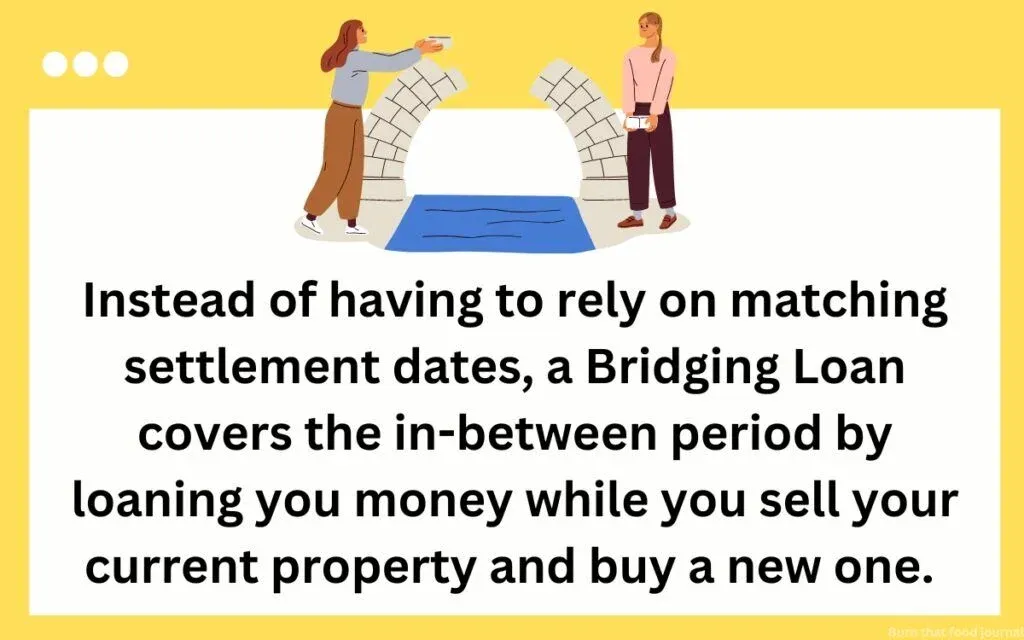
You've found a home you want to buy, but you haven't sold the one you're in. A bridging loan can let you buy first and sell afterwards, so you may be able to move straight from one home to the next.
That convenience costs money. You'll owe more while you own both homes, and a slow sale or a lower price can leave you with a bigger mortgage than you planned. I'd work through those numbers before deciding how much to offer.
How does a bridging loan work?
You buy the new home, then use the money from selling the old one to pay down the borrowing. Until that sale settles, the loan needs to cover your existing mortgage, the new purchase and any costs you're borrowing for. Banks call the highest total your peak debt; interest added to the loan can increase it.
Both properties will usually secure the borrowing. After the sale, the amount still owing is your end debt. That's the mortgage you'll be living with, so its repayments need to fit your budget too.
You won't necessarily make 2 full mortgage repayments while you're waiting to sell. Some lenders require interest payments on the bridge. Others add that interest to the loan instead, which is called capitalising it. That gives you more room in the monthly budget, but leaves more to repay later. Any separate ongoing loan can still have repayments.
Have you already found a buyer?
If your old home hasn't sold, you're usually looking at an open bridging loan. A closed bridge is used when you already have a sale contract and a clearer settlement date. The bank will still look at the sale conditions, because a signed contract doesn't make every delay or risk disappear.
If you've already sold and the dates are only a little out, I'd first ask whether the settlements can be moved to line up. That may save the cost of a bridging loan. Our next-home guide compares buying first, selling first and organising the move.
What would you owe before and after selling?
Say you owe $300,000 on your current home and want to buy another for $600,000. You're putting no cash towards the purchase, and the lender agrees to include the duty in the loan. Your borrowing would add up like this:
| What goes into the loan | Amount |
|---|---|
| Existing mortgage | $300,000 |
| New purchase | $600,000 |
| Subtotal before buying costs | $900,000 |
| Duty, assuming an eligible ordinary home concession | $12,850 |
| Borrowing including duty, before other costs and interest | $912,850 |
What you would owe before selling
Existing mortgage
- Amount
- $300,000
New purchase
- Amount
- $600,000
Subtotal before buying costs
- Amount
- $900,000
Duty, assuming an eligible ordinary home concession
- Amount
- $12,850
Borrowing including duty, before other costs and interest
- Amount
- $912,850
The $12,850 duty assumes you're eligible for Queensland's ordinary home concession and the value used for duty is $600,000. Without a concession, general duty would be $20,025 before any foreign buyer surcharge. Our Queensland duty guide explains which figure to use.
Now sell the old home for $550,000. After $15,750 in selling costs, there's $534,250 to put towards the loan. That brings the $912,850 down to $378,600, before the other costs and interest you've borrowed.
You don't subtract the old $300,000 mortgage again. It's already included in the starting loan above.
What if the sale is lower or takes longer?
Suppose the old home sells for $500,000 instead of $550,000. Keeping the same selling costs, you'd owe $428,600 rather than $378,600, before the remaining costs and interest.
That's another $50,000 on the mortgage. I'd want to know you could manage those repayments before relying on the higher sale price.
Westpac sizes its bridge at 85% of the home you're selling, so a $550k sale gives a $467.5k bridge. At Westpac's current 9.67% starting rate, that adds about $11,400 in interest over 3 months. Keep it for 6 months and that becomes about $24,300, allowing for its 1 percentage point increase after month 3. This assumes interest is added monthly, no repayments and no other rate changes, and excludes fees.
For your move, we'd use the actual lender's rate and compare a quicker sale with a slower one. If interest is added to the balance each month, the cost can build faster because you start paying interest on that added amount as well.
Why the bank's figures might look more cautious than yours
You might expect to sell in 3 months. The bank may still allow for a longer stretch of interest and use less than your hoped-for sale price when working out the loan. That leaves room for a slower sale or a lower offer.
For example, Westpac's next-home guide includes 12 months of interest in its assessment example. That allowance isn't the same as your final interest bill. Westpac's guide uses 85% of the value of the home being sold to work out the bridge. On a $550k value, that's $467.5k, leaving about $445k of ongoing debt before added interest, rather than the $378,600 you'd actually owe after the sale. Using the rates above and adding 12 months of interest puts peak debt at roughly $964k, or about 84% of the combined $1.15m property values. Westpac's lending policy caps peak debt at 80% of the property values, so these numbers wouldn't fit unless you put in some cash or spent less. Ask how interest is charged and what you'd owe if you repaid early. Minimum terms and fees can eat into the saving.
Could bridging work for your move?
Having equity helps, but it doesn't tell you how much you can safely spend on the next home. The bank needs to be comfortable with both properties, the amount you'll owe while you own them, and what will be left after the sale. Having 20% equity in the old home isn't an automatic approval. One thing working in your favour: since 1 February 2026, owner-occupier bridging is exempt from APRA's debt-to-income limit, so the temporary peak debt doesn't count against a bank's high-DTI allowance. The loan you keep after the sale is assessed as normal, with the 3 percentage point buffer. Bridging for an investment purchase gets no exemption.
I would start with your current loan balance, a realistic sale estimate and the price of the home you want to buy. Then I'd add the costs of buying, selling and holding both properties.
From there, we can work out what you need to pay each month before the sale, what the repayments look like afterwards, and how much savings you have if the move takes longer. Your income, living costs and other debts all matter. The bank will use values it accepts for both properties, which may differ from an online estimate.
Your job, the property's location and type, whether you're building, and whether a company owns it can change which lenders will consider the loan. So can how much you're borrowing compared with the property values. Our equity calculator gives you a starting estimate; we'd then check which bridging options fit your actual move.
Get the sale plan ready before you buy
Ask your agent for recent comparable sales, a realistic price range and how long similar homes are taking to sell. Our property-report guide explains how sales data can help you test the estimate.
Then put dates against the work: painting or repairs, photos, listing, inspections and settlement. Finding a buyer doesn't stop the interest. You need the sale to settle and the money to reach the loan.
Have your loan statements, income details and sale plan ready for the broker. Depending on the lender and where you're up to, it may also want the agent's appointment, listing or sale contract. We'd work through any conditions you need to meet before buying.
CLIENT STORY · BRIDGING FINANCE
A bank system problem nearly derailed our clients' bridging loan. We pushed it through before finance was due.
Our clients were buying their next home with bridging finance when St George’s application system couldn’t process their legal name. The bank had nearly finished its assessment, but the file had to move to another system and be assessed again. Finance was due just after the Easter break.
We took the problem to St George’s state lead and worked with the assessor to get the application transferred correctly. We supplied the outstanding evidence and kept following up against our clients’ contract deadline. Both loans received unconditional approval before finance was due.
The bank later confirmed settlement of the bridging loan of about $1.06m and the $1.34m ongoing loan. Our clients completed their purchase in 2024 after we helped get the system issue and reassessment worked through in time.
Downsizing or retiring with no loan left afterwards?
If you're downsizing, the sale might pay off the whole loan. Buying first could let you move straight into the smaller home, then prepare the old place for sale without living around the inspections.
Being retired doesn't automatically rule out bridging. Some lenders consider a move with no ongoing loan, while others want you to keep a mortgage with them afterwards. Tell us at the start if you expect to finish debt free.
The sale still needs to cover the borrowing, interest and costs. The lender will assess the application under its own rules, including any payments due before the sale. I'd also leave enough cash for the move and your living costs, rather than assuming all your equity will be available immediately.
Will LMI apply?
Lenders mortgage insurance, or LMI, doesn't automatically solve a borrowing shortfall. Each bridging product has its own limit on how much it will lend against the properties, and some won't go above that limit even if you're willing to pay LMI. We'd check the limit and any insurance cost together.
Which bridging loan would fit your budget?
I'd compare what the move costs over the time you expect to own both homes, then look at the mortgage you'll keep. A cheaper rate after the sale can be outweighed by an expensive bridge beforehand.
| Compare these costs and conditions | What it means for you |
|---|---|
| Bridging rate and fees | How much you pay while you own both homes, including any rate increase. |
| Pay interest monthly or add it to the loan | Either you need cash each month or you owe more when you sell. |
| Sale deadline | How long you have to sell and what happens if you run out of time. |
| Expected sale proceeds | What the bank expects to be left after selling costs. |
| The mortgage after selling | The rate, repayments, term and features you will keep. |
How do you compare bridging lenders?
Bridging rate and fees
- What it means for you
- How much you pay while you own both homes, including any rate increase.
Pay interest monthly or add it to the loan
- What it means for you
- Either you need cash each month or you owe more when you sell.
Sale deadline
- What it means for you
- How long you have to sell and what happens if you run out of time.
Expected sale proceeds
- What it means for you
- What the bank expects to be left after selling costs.
The mortgage after selling
- What it means for you
- The rate, repayments, term and features you will keep.
| Lender | Payments while you wait to sell | What could affect your choice |
|---|---|---|
| CommBank | Interest-only payments during a 12 month bridge. | Existing customers must keep a CommBank loan after selling. New customers need at least $250,000 left owing. |
| Westpac | Interest is added to the bridge, with no repayments on that portion during the approved term of up to 12 months. | The published bridging rate rises by 1 percentage point after 3 months. Allow for repayments on any separate ongoing loan. |
| Brighten Connect | Brighten retains an interest budget, so no repayments are required during the bridging period. | Offers options with no debt left after selling and a bridging term of 6 to 12 months. Check the full fees and what early repayment would cost. |
How the monthly payments differ
CommBank
- Payments while you wait to sell
- Interest-only payments during a 12 month bridge.
- What could affect your choice
- Existing customers must keep a CommBank loan after selling. New customers need at least $250,000 left owing.
Westpac
- Payments while you wait to sell
- Interest is added to the bridge, with no repayments on that portion during the approved term of up to 12 months.
- What could affect your choice
- The published bridging rate rises by 1 percentage point after 3 months. Allow for repayments on any separate ongoing loan.
Brighten Connect
- Payments while you wait to sell
- Brighten retains an interest budget, so no repayments are required during the bridging period.
- What could affect your choice
- Offers options with no debt left after selling and a bridging term of 6 to 12 months. Check the full fees and what early repayment would cost.
If inspections aren't turning into offers, go back to the agent early. Look at buyer feedback, recent sales and whether the asking price needs to change. Then update the loan figures using the price you may actually get.
Talk to the lender well before the deadline if the sale is running late. Extra time isn't guaranteed. Depending on the contract, you could face higher interest, extra payments or the lender taking steps to sell a property to recover the debt.
Keep some cash where you can reach it
Extra repayments can reduce interest, but make sure you can get that money back if you need it. Westpac's bridging product, for example, allows extra repayments but no redraw. I wouldn't put the removalist money or your emergency savings into a loan you can't redraw from.
Check whether an offset is available on the bridge, the ongoing mortgage, or neither. Also allow for valuing both properties, setting up the loan and paying it out. Get the actual fees rather than assuming an early sale means there are no exit costs.
I'd choose the lender with the whole move in mind. Refinancing halfway through would need a fresh approval and a way to repay the existing bridge, so it isn't a fallback I'd rely on.
Can you use bridging finance at auction?
Bridging can help fund an auction purchase, but I'd sort out the finance before you bid. You need to know the price you can go to, whether the bank accepts that property, and what still has to happen before it releases the money. Your solicitor can explain the contract commitments.
A pre-approval alone isn't enough protection for an unconditional auction purchase. You also need a way to pay the deposit when it's due. Money available at settlement may arrive too late for that.
Bridging loan or deposit bond?
A deposit bond deals with the deposit, not the full purchase price. If the seller accepts it and you qualify, it can stand in for cash when the deposit is due. You still need the money to complete settlement.
Before relying on one, find out its fee, expiry date and any extension cost, as well as your obligations under the bond.
Settle the deposit amount and how you'll pay it before bidding. Our auction guide covers what to organise with your broker and solicitor.
When would I consider selling first?
Moving once can be worth paying for. But if the purchase only works with a quick sale at the top of the price range, I'd look at these alternatives before committing:
Selling first gives you a known sale price to work with. You may need to rent or store furniture between homes, so put those costs beside the cost of bridging. A rent-back arrangement may let you stay briefly after selling if the buyer agrees. Have your solicitor set out the dates, rent, insurance and responsibilities.
A longer settlement can give you time to organise the sale or find your next home. For example, an agreed 90-day settlement gives you more room than 30 days, although the other party has to agree and it doesn't guarantee you'll find a home in time.
Settling both properties on the same day can let the sale money fund the purchase. Your conveyancer needs a plan for what happens if one settlement is delayed.
A subject-to-sale offer makes the purchase depend on selling your existing home under the agreed terms. A seller may not accept it, and it isn't the same as a finance condition. Have your solicitor handle the wording.
I'd choose between those options using a sale price you can reasonably expect, plus a lower figure you could still live with. If that lower result leaves the new mortgage too tight, selling first may be the more comfortable move.

Sources and further reading
CBA, Westpac and Brighten bridging details and Queensland duty rates checked on 30 September 2026. Westpac's bridging rate rechecked on 16 October 2026.

More help with buying before selling
- Plan the move
Buying your next home
Compare buying first, selling first and matching the dates.
Read guide - Your equity
Home equity calculator
Estimate the equity before asking a lender to assess the move.
Use calculator - Ongoing repayments
Mortgage repayment calculator
Check repayments on the loan remaining after your sale.
Use calculator - Buying costs
Queensland stamp duty calculator
Allow for duty alongside the new purchase price.
Use calculator - Compare lenders
Westpac home loan review
Read how its bridging option fits alongside its other loan rules.
Read review - Compare lenders
CommBank home loan review
Compare its home loan options and borrower requirements.
Read review
Bridging loan questions
Answers to the questions that come up when you're buying before selling.
Work out whether buying first stacks up
Send us what you owe, what you think your home will sell for and what you'd like to spend next. We'll work through the repayments and selling costs, including what happens if the sale takes longer or brings in less.
or call 1300 088 065
Hunter Galloway Finance Pty Ltd is Credit Representative 476903, authorised under Australian Credit Licence 389328.
General information only. The calculations use assumed figures and rates, not current loan quotes or approval promises. Video rates and lender details may have changed. The loan needs to suit your properties, repayments and sale plan; your solicitor handles the contract conditions and settlement dates.
Client examples are based on real situations. Names and identifying details have been changed.