


Can a guarantor help you buy with no deposit?
A guarantor home loan can let you buy with little or no deposit by using a family member's property as extra security. It may also avoid lenders mortgage insurance (LMI). You repay the whole loan, and the family property is at risk if you cannot meet your obligations.
I start by checking what you can afford from your own income. Then I compare the guarantee with other ways to cover the deposit and buying costs.
How a guarantor home loan works
Your home secures the loan. A parent or another family member accepted by the lender provides extra security to cover the deposit shortfall. They usually keep ownership of their home and do not hand you cash.
You owe the money borrowed, including any buying costs added to the loan. The guarantee gives the bank someone else to call on if you default; it does not reduce your monthly repayments.
You make the repayments
Your accepted income must cover the full loan, existing debts and living costs.
Your family provides security
The lender checks their property, existing mortgage and the amount they agree to guarantee.
The bank approves the release
Your guarantor stays involved until the lender formally releases the guarantee and relevant security.
Watch: how a guarantor home loan works
Zhara bought her first home with her parents' help
Zhara was renting in Brisbane and finding it hard to build a deposit. We helped her use her parents' property as security for a loan covering 105% of the purchase price, including eligible buying costs. She bought without paying LMI.
Her parents' help covered the deposit gap. The lender still assessed whether Zhara could repay the full amount. Borrowing above the price depends on the lender's limits, accepted costs and both properties.

What does the guarantee cover?
Ask for the proposed loan split, guarantee limit and security arrangement in writing. A limited guarantee can cap the family's responsibility, but the documents decide whether interest, fees or enforcement costs sit within that limit or can be added.
For an $800,000 purchase with no cash deposit, the buyer owes $800,000 before costs. The first 80% is $640,000, leaving a $160,000 deposit gap. Those figures explain the deposit gap; they do not set the legal guarantee amount. Lenders calculate the security they need differently.
| Part of the purchase | Amount | Who repays it? |
|---|---|---|
| First 80% of the price | $640,000 | The buyer |
| Remaining 20% | $160,000 | The buyer |
| Total borrowed with no cash deposit | $800,000 | The buyer repays the whole loan |
An $800,000 purchase before buying costs
First 80% of the price
- Amount
- $640,000
- Who repays it?
- The buyer
Remaining 20%
- Amount
- $160,000
- Who repays it?
- The buyer
Total borrowed with no cash deposit
- Amount
- $800,000
- Who repays it?
- The buyer repays the whole loan
The lender may split the borrowing into separate accounts. That can help you track the portion supported by family, but two accounts alone do not prove the guarantee is limited or that it will end when one account is paid down.
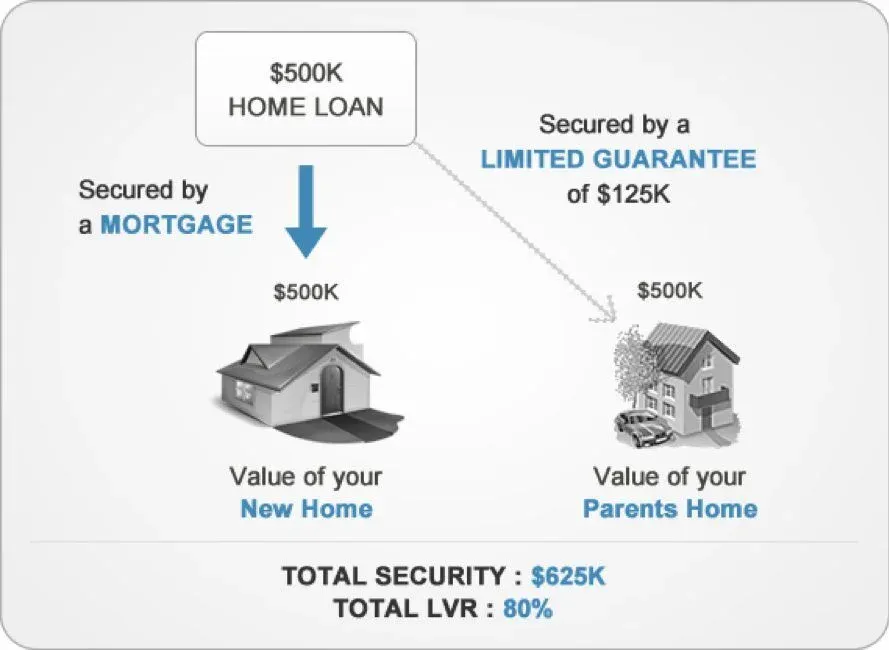
The diagram below uses a separate example: a $500,000 loan for a home valued at $500,000. The lender also accepts $125,000 of security from the parents' property, bringing the total security used in this calculation to $625,000.
Why I compare lenders before you apply
Your own bank may not offer the right guarantee for your family. Even banks that offer one can disagree about who may help, how much security they need and which purchases qualify.
| Lender | What its public guide says | What I check for you |
|---|---|---|
| Westpac | Its Family Security Guarantee may cover the purchase price plus eligible costs. It names parents, legal guardians, siblings and adult children. | The relationship, property ownership and guarantee limit. Investment purchases have extra ownership conditions. |
| CommBank | Guarantor Support can use family property as extra security. The guarantee can cover the whole loan or a smaller amount. | The proposed limit and loan structure. Its Family Security Support requires legal advice and a statutory declaration. |
Two examples of why the lender matters
Westpac
- What its public guide says
- Its Family Security Guarantee may cover the purchase price plus eligible costs. It names parents, legal guardians, siblings and adult children.
- What I check for you
- The relationship, property ownership and guarantee limit. Investment purchases have extra ownership conditions.
CommBank
- What its public guide says
- Guarantor Support can use family property as extra security. The guarantee can cover the whole loan or a smaller amount.
- What I check for you
- The proposed limit and loan structure. Its Family Security Support requires legal advice and a statutory declaration.
These are examples, not a full lender list. Read our Westpac review and CommBank review for more detail. I would compare the current options for your family before choosing a lender.
Guarantor loan requirements
Both the borrower and the proposed guarantor need to fit the lender. I check the family relationship and property early, because a bank can accept the buyer but decline the guarantee.
| Check | What we need to know |
|---|---|
| Your repayments | Income, expenses, dependants, existing debts, credit card limits and credit history. |
| Your cash contribution | Savings, any gift and the money needed for duty, legal fees, inspections and an emergency buffer. |
| The family member | Their relationship to you, property ownership, circumstances and willingness to take on the risk. |
| Their property | Location, value, mortgages and other guarantees or debts secured against it. |
| The purchase | The property type, intended use and any construction or investment conditions. |
What I check before choosing a lender
Your repayments
- What we need to know
- Income, expenses, dependants, existing debts, credit card limits and credit history.
Your cash contribution
- What we need to know
- Savings, any gift and the money needed for duty, legal fees, inspections and an emergency buffer.
The family member
- What we need to know
- Their relationship to you, property ownership, circumstances and willingness to take on the risk.
Their property
- What we need to know
- Location, value, mortgages and other guarantees or debts secured against it.
The purchase
- What we need to know
- The property type, intended use and any construction or investment conditions.
Who can be a guarantor?
Parents are a common option. Some lenders also accept siblings, adult children or other relatives. Retirement or an existing mortgage does not automatically rule someone out, but lender selection matters. Friends and more distant relationships need checking before you rely on their help.
Joint owners, separated parents and family living overseas can need extra checks. Read who can be a guarantor for the relationship and property issues.
Do you still need savings?
Some loans allow no cash deposit if the accepted security is enough. Other lenders want genuine savings or evidence of how you have managed money, such as an acceptable rental history. We need to check both the savings rule and the cash required at settlement.
Allow for transfer duty where payable, conveyancing, searches, inspections and loan costs. Some lenders may finance eligible costs above the purchase price. That is not an allowance for furniture, holidays or spending after settlement.
Our genuine savings guide explains the evidence lenders may ask for.
Does a guarantor increase borrowing power?
A family security guarantee may let you borrow a larger share of the price. Your own income still sets the limit on what you can repay. If the bank assesses that you can afford $450,000, adding a guarantee will not turn that into an $840,000 approval.
I would check debts, credit card limits and the way a lender counts your income if repayments are the obstacle. Our guide to guarantors and borrowing power explains the difference.
Compare a guarantor with other low deposit options
I compare the same purchase price and your available cash across the options. Avoiding LMI can save money, but it is only part of the decision when a parent's home is involved.
| Option | What it changes | What to weigh up |
|---|---|---|
| Family guarantee | Family property provides extra security; little or no deposit may be possible. | The guarantee amount, family risk and release conditions. |
| 5% Deposit Scheme | Eligible buyers can buy with a smaller deposit and no LMI. | Buyer and property eligibility, price caps and cash for costs. |
| Cash gift | A genuine non-repayable gift reduces the amount you need to borrow. | The lender needs evidence of the gift and where it came from. |
| Standard low deposit loan | You contribute the required deposit; LMI or a low deposit charge may apply. | Compare the actual premium, interest rate and total debt. |
| Save more or buy for less | A smaller gap may let you buy without a guarantee. | How long saving will take and whether the lower budget suits you. |
Ways to cover the deposit gap
Family guarantee
- What it changes
- Family property provides extra security; little or no deposit may be possible.
- What to weigh up
- The guarantee amount, family risk and release conditions.
5% Deposit Scheme
- What it changes
- Eligible buyers can buy with a smaller deposit and no LMI.
- What to weigh up
- Buyer and property eligibility, price caps and cash for costs.
Cash gift
- What it changes
- A genuine non-repayable gift reduces the amount you need to borrow.
- What to weigh up
- The lender needs evidence of the gift and where it came from.
Standard low deposit loan
- What it changes
- You contribute the required deposit; LMI or a low deposit charge may apply.
- What to weigh up
- Compare the actual premium, interest rate and total debt.
Save more or buy for less
- What it changes
- A smaller gap may let you buy without a guarantee.
- What to weigh up
- How long saving will take and whether the lower budget suits you.
If you qualify for the 5% Deposit Scheme and have the cash required, I would compare it before involving your parents' home. See guarantor versus the 5% Deposit Scheme for the family risk and cost comparison.
A guarantee does not come with an automatic interest rate discount. Compare the written rate, fees, loan features and amount borrowed. A slightly lower rate on a much larger loan can still mean higher repayments.
Parents who want to own a share, lend money or sell a property to you below market value are making a different arrangement. Our guides to ways parents can help and buying with your parents explain those choices.
If your parents are selling you their property below market value, read our gifted equity guide for the deposit calculation, valuation and family-sale costs.
Borrowing more means higher repayments
On an $800,000 home, a 20% deposit is $160,000 and a 5% deposit is $40,000, before buying costs. A guarantee may reduce the cash you need, but you still repay the extra money borrowed.
- $640,000 loan · 20% cash deposit, before costs$3,903/month
- $800,000 loan · no cash deposit, before costs$4,879/month
- $840,000 loan · no cash deposit, with $40,000 of eligible costs financed$5,123/month
Same $800,000 purchase. Examples at 6.16% p.a., principal and interest over 30 years, rounded to the nearest dollar. Excludes fees and rate changes; this is not a current loan offer. Financing the $40,000 in costs depends on the lender accepting the costs and security.
Cherise's purchase included eligible buying costs
Cherise was trying to buy in Sydney and had a deposit shortfall. Her parents provided security, and her loan covered 105% of the property value, including eligible buying costs, without LMI.
Her example is useful when the deposit is only part of the cash shortfall. I would still show you what must be paid from savings, what the lender will finance and the resulting repayment before recommending the loan.
What your parents are agreeing to
Your parents are accepting a financial obligation. If you cannot repay and the lender enforces the guarantee, they may have to pay the guaranteed debt. Their home can be at risk.
Even when you pay on time, the guarantee can affect their own plans to borrow, refinance, renovate, sell or help another child. I ask about those plans before the loan is structured.
How much could I owe?
Have an independent solicitor explain the limit, any additional costs and when the lender can enforce the guarantee.
What happens to my plans?
Tell us about any sale, retirement, refinance or other family help you expect to need.
How can I be released?
Ask what the bank will check and who must request the release. Do not rely on a verbal promise about a date.
Your parents should receive independent legal advice and have time to decide without pressure. Separate financial advice can help them judge the effect on their own position. If the benefit to you is small or the commitment is uncomfortable for them, I would look at another option.
Legal advice, valuations, mortgage registration and lender fees can add to the cost of setting up or releasing the guarantee. Get a written quote. The risks of going guarantor guide is written for the person offering their property.
How to apply for a guarantor home loan
From the first conversation to settlement
- Check your budgetWe assess your income, debts, expenses and savings, then compare the available low deposit options.
- Check the family propertyConfirm the owners, estimated value, existing loan and other secured commitments. If another lender holds a mortgage, check the proposed security arrangement and any consent required.
- Choose the lender and structureCompare the guarantee amount, property rules, repayments, fees and process for a later release.
- Prepare the documentsProvide identification, income evidence, statements, savings or rental evidence, and the guarantor's ownership and mortgage information.
- Complete approval and adviceThe lender assesses the application and properties. The guarantor obtains independent advice and decides whether to sign.
- Settle and plan the reviewYour solicitor and lender coordinate settlement. Keep copies of the guarantee and agree when to check whether it can be reduced or released.
Pre-approval is conditional. The property, valuation and guarantee still need acceptance, so leave enough time before a finance deadline. A guarantor application can involve an extra property valuation, another bank and independent legal advice.
Removing the guarantor from the home loan
We can review the guarantee as your loan falls or your property value changes. Around 80% loan to value ratio (LVR) is a common point to check: a $640,000 loan against a lender valuation of $800,000 is 80%.
The bank still has to approve the release. It may assess your finances, repayments and the security arrangement. Higher equity does not remove the guarantee by itself, and a higher salary alone does not mean the bank can release the supporting property.
I would work towards removing the guarantee within 5 years where your position allows it, while making sure the family understands it could remain longer. Obtain written confirmation of the release before relying on the parents' property being free. The guarantor removal guide covers the steps, costs and options above 80% LVR.
Frequently asked questions
Related guides
- Home loan guide
Who can be a guarantor?
Check the family relationship, retirement and property rules.
Read guide - Home loan guide
Risks for the guarantor
Understand the obligation before offering your home.
Read guide - Home loan guide
Removing a guarantor
Work out when to request a release and what it costs.
Read guide - Home loan guide
Guarantor or the 5% Deposit Scheme?
Compare the cash needed and family responsibility.
Read guide - Home loan guide
Ways parents can help
Compare a gift, loan, guarantee or shared purchase.
Read guide - Home loan guide
Buying with your parents
Plan ownership and repayments when buying together.
Read guide - Home loan guide
Gifted equity home loans
Buying a family property below market value.
Read guide
Experience and sources
How this guide was checked
I checked the lender and government sources below on 29 September 2026. We confirm the requirements for your loan and property before recommending an application.

Past client outcomes do not establish eligibility for another borrower. Current lender requirements and each family's circumstances need checking. The repayment comparison uses a fixed assumption and excludes fees.
Let us check whether a guarantor loan fits
Tell us your purchase budget, savings and income, plus roughly what your parents' property is worth and what they owe. We can compare the options before anyone agrees to a guarantee.
or call 1300 088 065
General information only. Your circumstances and current lending criteria need to be assessed. Guarantors should obtain independent legal advice before signing; family property transfers also need legal and tax advice.