


Why CommBank can stand out
- 01 / Your study debt
HELP may hurt less
CommBank may assess HELP more favourably when you're close to paying it off. If you're using the 5% Deposit Scheme, check the restriction from 25 September 2026 below.
- 02 / Your cash flow
Up to 99 offsets
An eligible Standard Variable loan can link up to 99 Everyday Offset accounts, useful when you keep bills, tax and savings separate.
- 03 / Your purchase
More ways to buy
Government schemes, Family Security Support and a genuine family gift can all help with the deposit in different ways.
Can you buy without paying off your HELP debt first?
HECS and HELP are names you'll see for government student debt. If it's limiting how much you can borrow, you may be able to keep your deposit savings instead of clearing it.
CommBank has 2 options, depending on how soon you'll repay HELP. I'd check which one fits your loan, especially if you're using the 5% Deposit Scheme.
First-home purchase · Settled July 2026
How our client kept $18k for his deposit and could borrow about $50k more
Our first-home buyer had about $18k left on his HELP debt and was on track to repay it through payroll deductions in roughly 18 months.
The other banks we considered required him to clear the debt first. CommBank's assessment gave him about $50k more borrowing capacity while allowing him to keep the $18k available for his deposit.
He went ahead with the purchase and settled on his first home in July 2026.
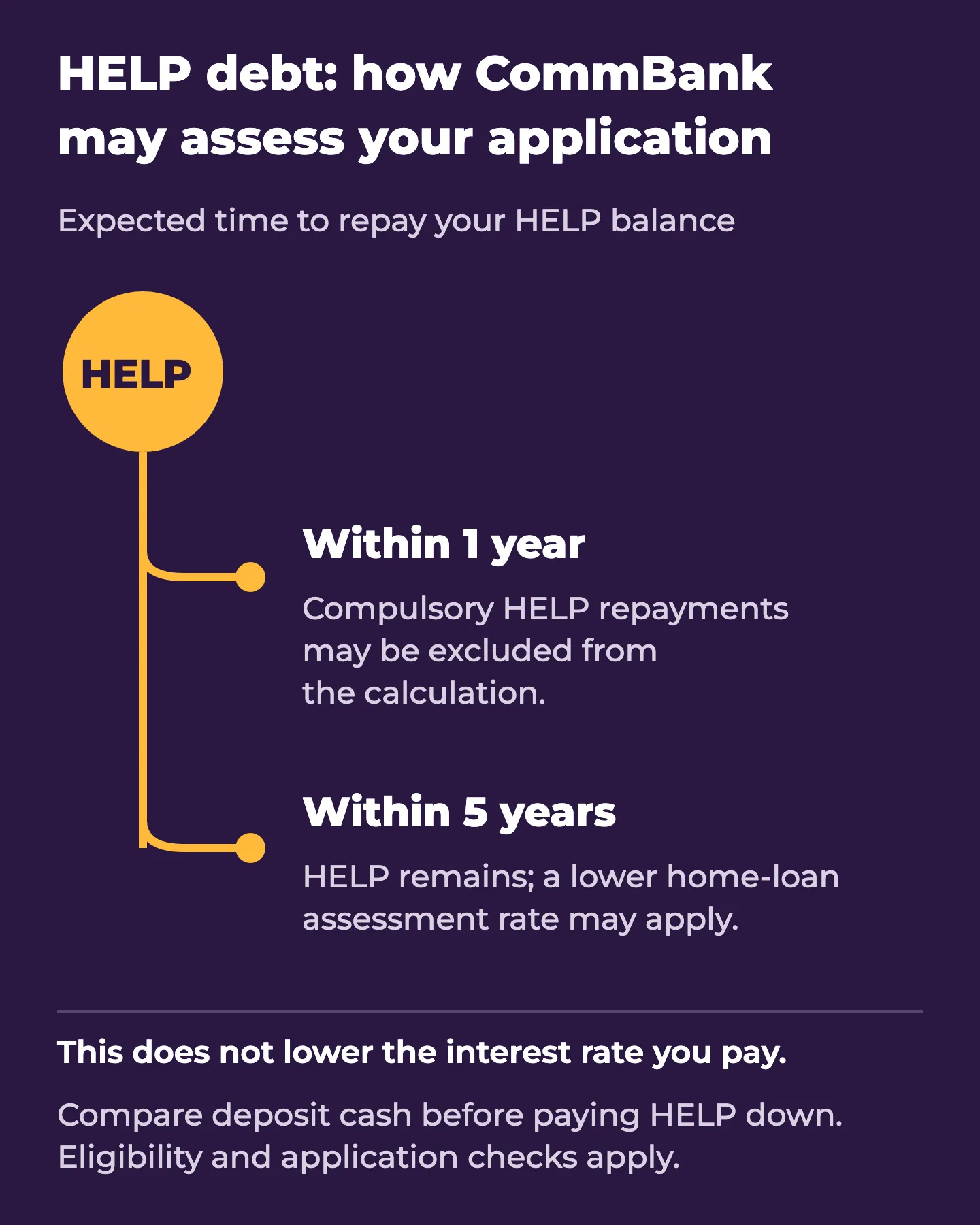
How does CommBank assess your HELP debt?
An assessment buffer is the extra interest rate a lender uses to test whether you could afford repayments. It doesn't change the interest rate you pay.
Expected to clear within 12 months: CommBank may leave your compulsory HELP repayment out of its borrowing calculation. This option remains available under the 5% Deposit Scheme, subject to eligibility checks.
More than 1 year, but within 5 years: CommBank may test your repayments at 1% above the actual loan rate. It still counts your HELP repayment. This can increase how much you can borrow.
From 25 September 2026, new applications under the 5% Deposit Scheme can't use that smaller buffer.
CommBank considers these options when its first calculation doesn't allow you to borrow the amount you need. You'll need evidence of your HELP balance and must have finished, or be close to finishing, your studies. We'll check the remaining eligibility rules before relying on either option.
Our HECS and home loans guide compares other lenders, including NAB and Westpac.
Should you pay off HELP before applying?
Before using your savings to pay down HELP, compare both options. Paying it down may increase your borrowing power, but it also leaves you with less cash for your deposit and purchase costs.
We compare the figures with and without a voluntary repayment to work out which option puts you in a better position to buy.
Could your profession reduce the deposit you need?
Lenders mortgage insurance, or LMI, is a cost that often applies when you borrow more than 80% of the property's value. It protects the lender if the loan isn't repaid.
An eligible profession may let you avoid that cost. We check your exact occupation and registration, then whether you're buying a home to live in or an investment property. Those details determine the limit that may apply.
- 89.99% LVR
Most eligible professionals
You would need slightly more than a 10% deposit, plus purchase costs, at the maximum 89.99% loan limit.
- 94.99% LVR
Selected medical professionals buying an investment property
You would need slightly more than a 5% deposit, plus purchase costs, at the maximum 94.99% loan limit.
- $395 a year
Required package
The Mortgage Advantage package is required for the waiver.
The 94.99% limit is only for selected medical professionals buying an investment property. It does not apply to a home to live in or a refinance.
The required package adds to the cost of the waiver. For comparison, ANZ does not charge an annual package fee for its professional waiver. We compare the rates, fees and other charges before recommending a loan.
Who may qualify?
Who may qualify for a CBA professional LMI waiver?
Scroll to see more columns
| Profession group | Examples in CBA's policy | What CBA still checks |
|---|---|---|
| Doctors, specialists and dentists | Eligible doctors, medical specialists and dentists | AHPRA or other required registration, income, purpose, property and postcode |
| Vets and pharmacists | Eligible vets and pharmacists | AHPRA or other required registration, income, purpose, property and postcode |
| Legal | Lawyers, solicitors, barristers and eligible partners | Current professional standing and usually at least $100k income from the profession |
| Accounting and finance | Accountants, actuaries, auditors, CFOs, finance directors, finance managers and controllers | Eligible CA, CPA, CFA or FIAA membership; IPA membership is not accepted for this offer |
- Examples in CBA's policy
- Eligible doctors, medical specialists and dentists
- What CBA still checks
- AHPRA or other required registration, income, purpose, property and postcode
- Examples in CBA's policy
- Eligible vets and pharmacists
- What CBA still checks
- AHPRA or other required registration, income, purpose, property and postcode
- Examples in CBA's policy
- Lawyers, solicitors, barristers and eligible partners
- What CBA still checks
- Current professional standing and usually at least $100k income from the profession
- Examples in CBA's policy
- Accountants, actuaries, auditors, CFOs, finance directors, finance managers and controllers
- What CBA still checks
- Eligible CA, CPA, CFA or FIAA membership; IPA membership is not accepted for this offer
Your repayments must cover both the loan balance and interest. The waiver is not available for land, construction or applications using fewer income documents. CommBank still checks your income, other debts, property and postcode.
Buying your first home with CommBank
Australian Government 5% Deposit Scheme
If you're eligible, you could buy your first home with a 5% deposit through the scheme. Single parents and legal guardians may qualify with a 2% deposit.
In Queensland, the price cap is $1m in the capital city and designated regional centres, or $700k elsewhere. Check the property's exact postcode.
Have HELP debt too? From 25 September 2026, new CommBank scheme applications can't use the smaller buffer for debt expected to clear in more than 1 year and within 5 years. Compare your borrowing amount under the scheme before setting your purchase budget.
5% deposit purchase · Settled September 2026
How the scheme helped our client buy a $950k home without LMI
Our client was buying a $950k home with a 5% deposit. We helped them arrange a $902.5k loan through CommBank under the Australian Government 5% Deposit Scheme.
The loan settled in September 2026 at 6.20%, with principal and interest repayments.
To see what the scheme changed, we also looked at buying with the same deposit and paying LMI. The premium in that comparison was around $38k. Through the scheme, they didn't have that bill.
They also needed a quick decision and already banked with CommBank. They'd had their everyday account since they were 5. We could convert that account to an offset and link it to the home loan, so their existing banking setup could help reduce the interest they paid.
That's why I check scheme eligibility early. For this buyer, it meant a lower rate than the alternatives we compared and around $38k less to cover in LMI.
Help to Buy: a separate scheme
Help to Buy applications go directly to CommBank. You need to apply through a CommBank Home Lending Specialist; CommBank does not currently accept these applications through mortgage brokers. Our Help to Buy guide explains how the scheme works and who may qualify.
How family or friends can help
Family Security Support
An eligible family member can use their property to provide a limited guarantee for your loan. You still need enough income to afford the repayments yourself.
Property Share
If you're buying with family or friends, Property Share may let you keep separate loan accounts while buying the same property together.
A genuine gift
CommBank may accept a gift from your immediate family towards its 5% genuine-savings requirement. This is the part of the deposit the bank asks you to account for. The option can also apply under the 5% Deposit Scheme, and you will need a gift letter.
You can't combine every option. CommBank Family Security Support (a guarantor home loan) cannot be used with the 5% Deposit Scheme. Property Share also excludes bridging, vacant land and construction.
Self-employed? What does CommBank need?
CommBank needs records that show what you and your business earn. It generally asks for personal and business tax returns, notices of assessment, and profit-and-loss statements and balance sheets prepared by an accountant. It does not have a general low-doc option for borrowers who cannot supply the usual income records.
The standard document list varies by business structure. For example, CommBank lists 2 years of personal tax returns for sole traders and business financial statements showing 2 consecutive years of profit and loss. We'll confirm the records needed for your application.
Check which financial years CommBank needs before gathering the records. Its annual changeover is on 1 March, so the tax returns you used for an earlier application may need updating.
Could your company wage reduce the paperwork?
If you pay yourself a regular salary from your business, CommBank may ask for less paperwork. You'll still need to show that your company is profitable, for example with a business tax return, profit-and-loss statement or accountant's letter.
Can CommBank use 1 year of financial records?
CommBank's option using 1 year of financial records has tighter requirements. You generally need more than 2 years in business, at least a 20% deposit and an active CBA Business Transaction Account. CommBank may use only 90% of the income it assesses.
Other lenders may accept recent Australian Taxation Office (ATO) notices, 1 year of tax returns or evidence of a regular company salary. That can reduce the paperwork compared with supplying complete business financial records.
How much of your income will CommBank count?
Your salary is only part of the picture. CommBank may also count some of your overtime, rent or boarder income. It then checks whether you could afford repayments at a higher interest rate.
In one case, CBA declined our client over a payroll change and we went back and got a formal approval.
How CommBank treats different income types
Scroll to see more columns
| Income | What CommBank may count | What to check |
|---|---|---|
| Permanent base salary | Generally 100% | No set time in role; job and pay must be verified |
| Eligible frontline overtime | Up to 100% | Eligible duties only; otherwise 80% is common |
| Casual or second job | Up to 100% | Usually 6 months in the role or industry |
| Rent | Starts at 90% of rent before expenses | Then deducts actual expenses or 10% of rent, whichever is higher |
| Boarder income | Up to $120 a week | 80% of up to $150 a week, for one eligible arrangement |
- What CommBank may count
- Generally 100%
- What to check
- No set time in role; job and pay must be verified
- What CommBank may count
- Up to 100%
- What to check
- Eligible duties only; otherwise 80% is common
- What CommBank may count
- Up to 100%
- What to check
- Usually 6 months in the role or industry
- What CommBank may count
- Starts at 90% of rent before expenses
- What to check
- Then deducts actual expenses or 10% of rent, whichever is higher
- What CommBank may count
- Up to $120 a week
- What to check
- 80% of up to $150 a week, for one eligible arrangement
If you're an eligible first-home buyer, CommBank may count up to $120 a week you expect to receive from a boarder living with you. You'll need a statutory declaration, a formal signed statement confirming the arrangement. This option isn't available for bridging loans or if you or another applicant already owns an investment property.
Over 50? You may still qualify for a 30-year loan
Being over 50 doesn't automatically mean CommBank will shorten your loan term. A 30-year loan may still be possible if you can show how you'll repay it in retirement.
The bank may ask how you'll cover repayments once employment income stops, or how you'll reduce the debt. That can give you more options than a lender that shortens the term mainly because of age.
What else affects how much you can borrow?
- CommBank generally tests repayments at least 3% above the actual rate. Eligible HELP borrowers may get a smaller buffer. The HELP section above explains when the 5% Deposit Scheme restriction applies.
- CommBank uses your credit card limit when calculating what you can borrow, even if you owe less than that limit.
- Your living costs, dependants and existing loans can still limit how much you can borrow, even if CommBank counts more of your income.
Which CommBank home loan suits you?
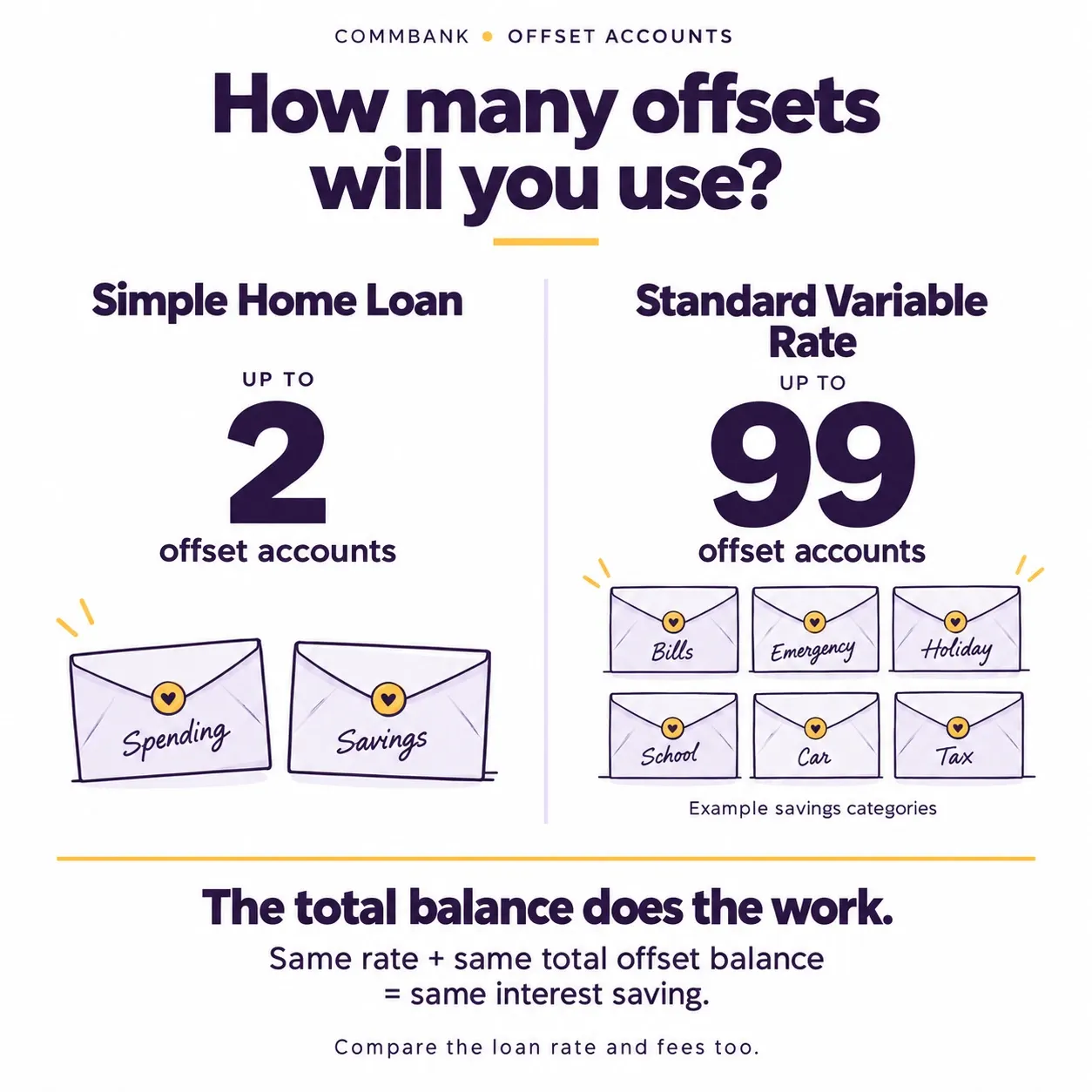
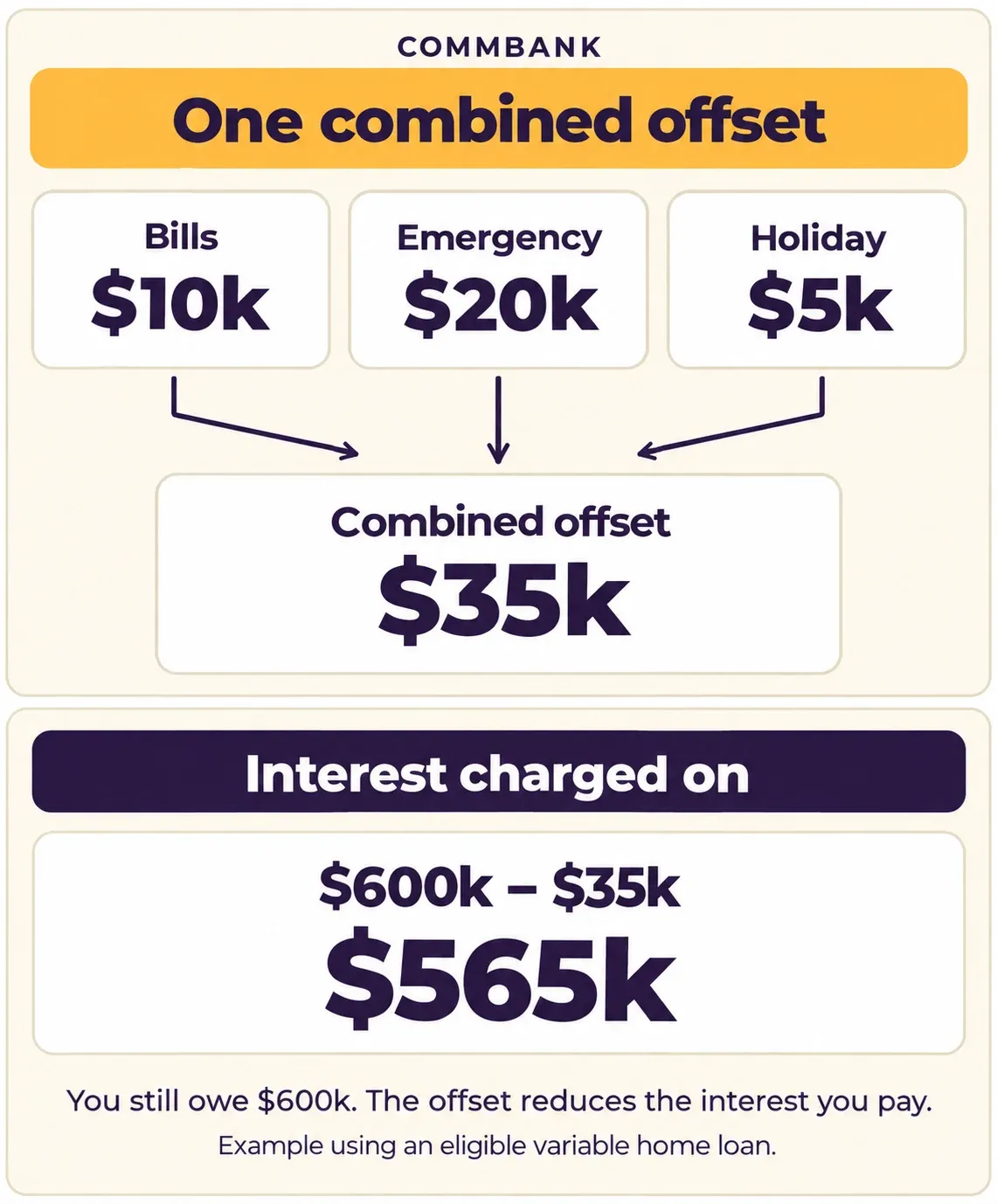
An offset account is linked to your home loan. Its balance reduces the loan amount used to calculate interest.
With a $600k loan and $35k in linked offsets, interest is calculated on $565k. You still owe $600k. Separate accounts can help keep bills, tax and savings apart, but the same total balance saves the same interest at the same loan rate. Compare the rate and fees as well as the number of accounts.
How many offsets you get depends on the loan. An eligible Standard Variable loan in your personal names, not a company or trust, can link up to 99. Simple allows 2. If 2 accounts will do the job, say one for spending and one for savings, I’d compare the total cost of both loans before paying for features you won’t use. You can see where CommBank sits against other lenders in our guide to banks with multiple offset accounts.
| Loan | Could suit you if | Main feature | What to check |
|---|---|---|---|
| Standard Variable Rate | You want the full feature range | Up to 99 offsets | Do the discount and features outweigh fees? |
| Simple Home Loan | You want a simpler variable loan | Up to 2 offsets; unlimited extra repayments | No companies, trusts, splits, land, construction or bridging |
| Digi Home Loan | You want to apply online directly to CommBank | One offset account; unlimited extra repayments | Borrow up to 80% of the property value; no companies, trusts, land, construction or bridging |
| Fixed Rate | You want repayments set for a term | Fixed rate on that portion | No offset; extra repayment limits and break costs |
| Construction | You use a licensed builder | Progress payments; interest only during construction | No owner-builders; timing, valuation and contract rules apply |
| Bridging | You want to buy before selling | Up to 12 months through Standard Variable | Cover both loans; retained savings may help |
CommBank home loan products compared
Standard Variable Rate
- Could suit you if
- You want the full feature range
- Main feature
- Up to 99 offsets
- What to check
- Do the discount and features outweigh fees?
Simple Home Loan
- Could suit you if
- You want a simpler variable loan
- Main feature
- Up to 2 offsets; unlimited extra repayments
- What to check
- No companies, trusts, splits, land, construction or bridging
- Could suit you if
- You want to apply online directly to CommBank
- Main feature
- One offset account; unlimited extra repayments
- What to check
- Borrow up to 80% of the property value; no companies, trusts, land, construction or bridging
Fixed Rate
- Could suit you if
- You want repayments set for a term
- Main feature
- Fixed rate on that portion
- What to check
- No offset; extra repayment limits and break costs
- Could suit you if
- You use a licensed builder
- Main feature
- Progress payments; interest only during construction
- What to check
- No owner-builders; timing, valuation and contract rules apply
Bridging
- Could suit you if
- You want to buy before selling
- Main feature
- Up to 12 months through Standard Variable
- What to check
- Cover both loans; retained savings may help
Digi is only available through CommBank's online application channel. We can't arrange that product through a broker application. Compare its rate, fees and features with the loan you're offered through us.
Digi has a $300 establishment fee. Since 1 October 2026 it has had no monthly loan service fee and no offset feature fee, and the monthly loan-service-fee and loyalty cashbacks have ended. Other charges can still apply.
You can't link an offset to the fixed part of your loan. Company and trust borrowers can't use an offset either.
The everyday banking is a reason people stay
The feedback I hear from clients is that they like using CommBank's app and internet banking. The small things matter when you're using an account every day.
Take tax time. CommBank lets you access online statements for up to 2 years after closing an account. If you're looking for an old statement for your accountant, being able to get it online is useful.
I'd still check what that convenience costs you. An app you like is worth considering alongside the repayments, fees and features you'll use.
CommBank home loan fees from 1 October 2026
- $395 a year
Mortgage Advantage or Wealth Package fee
Compare the rate discount and features with the annual cost.
- Before 1 October 2026
Simple Home Loan fees
Simple charged $20 a month for the loan, plus $10 a month if an offset was linked.
- From 1 October 2026
Simple Home Loan fees now
$10 a month for the loan and no offset feature fee. The monthly CommBank Yello loan-service-fee cashback has ended.
Simple also has a $300 establishment fee, and other charges can apply. There's no offset feature fee, whether you link 1 or 2 offsets.
Rates and discounts depend on the loan and your application. Compare the full cost, including the current fees.
Is the CommBank package worth the fee?
You'll see Wealth Package and Mortgage Advantage in CommBank's information. Wealth Package is for direct customers; Mortgage Advantage is the broker package. The annual package fee is $395. Check the benefits attached to the loan you're considering.
One thing that frustrates me is paying that annual fee when you're using CommBank's professional LMI waiver. If you're a doctor who could qualify with another lender too, I'd compare the ongoing cost before choosing the loan.
For example, ANZ charges $10 a month for each ANZ One offset account on an eligible loan. One account costs $120 a year. That's $275 less than CBA's annual package fee, before comparing rates and other charges.
The features differ, though. CBA's eligible Standard Variable loan lets you link up to 99 offset accounts. That can be useful if you keep tax, bills and savings in separate accounts. If you only want one offset, I'd want to see what else you're getting for the extra cost.
Selling, refinancing or paying off your CBA loan? Our CBA discharge guide explains how to start, what to have ready and how long to allow.
How long does CommBank pre-approval last?
CommBank pre-approval lasts up to 90 days. It may allow one extension of another 90 days after reassessing you, without a new application. You'll need updated financial documents and confirmation that your position hasn't changed.
If you're paid a wage or salary, this usually means fresh payslips and bank statements. CommBank uses the rate current at the extension review, so your borrowing limit may change.
Before an unconditional purchase, CommBank still needs to accept the property and confirm the remaining loan conditions.
Already have an application or Home Seeker pre-approval underway? CommBank says it will honour applications in progress that meet its rules for acceptable changes. We'll check any changes you're planning before you rely on the existing borrowing amount.
How long will a decision take?
I'd check what stage the application has reached before relying on a timeframe. An initial response, an assessed pre-approval and final approval after the property checks are different steps.
If you're working towards a finance deadline, we check the documents and outstanding conditions, then ask about the current queue for your application. Our pre-approval guide explains what to check before making an offer.
What do borrowers say about CommBank?
Most bank reviews online look pretty poor. I don't know many people who go out of their way to write good things about their bank, but they'll happily share a bad experience. I'd still read those reviews. It helps to know what to look for before you let the star rating make the decision for you.
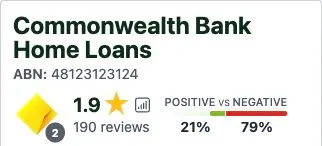
I checked CommBank's home loan reviews on ProductReview and the score was 1.9 out of 5 from 190 reviews. Some borrowers were frustrated with their rate or struggled to get answers from the bank. I also found people who had good things to say about the staff who helped them. I'd read a few of each to get a feel for what went well and where things went wrong.
A 2022 Reddit discussion about CBA's popularity asks why people choose the bank when its advertised rates look expensive. The rates in that thread are old, but the question is still useful: what are you getting for the extra cost?
I'd use those reviews to work out what to ask. If pricing worries you, compare the rate you've been offered and the fees over the same remaining loan term. If communication worries you, ask who will handle your application and what still needs to happen before approval.
Our broker score below assesses the lender's products and lending options. It's separate from the customer rating on ProductReview.
Will CommBank accept the property?
CommBank is generally comfortable with ordinary residential property. The rules get tighter when the deposit is small or the property may be harder to resell.
Houses, townhouses and standard apartments
Established houses, townhouses and standard apartments are usually the simplest fit, subject to valuation and location.
Small or unusual property
Very small units, serviced apartments and dual-key properties can face tighter limits when your deposit is small. The same applies to some ownership arrangements, including company title and stratum title. Ask us to check the property type and title before you rely on your pre-approval.
Construction
You need a licensed builder and a fixed building contract. CommBank also checks what the finished home will be worth. It does not accept owner-builder projects.
See our guide to unusual property home loans.
Other property rules worth checking
- CommBank may count rent from an eligible granny flat where the home and granny flat remain on one residential property title.
- If you're buying or building several homes on one property, check with us early. A larger development may need a commercial loan or another lender.
- For a prefab or modular build, CommBank needs to accept the contract, staged payments and valuation.
Buying before you sell? Can you cover both loans?
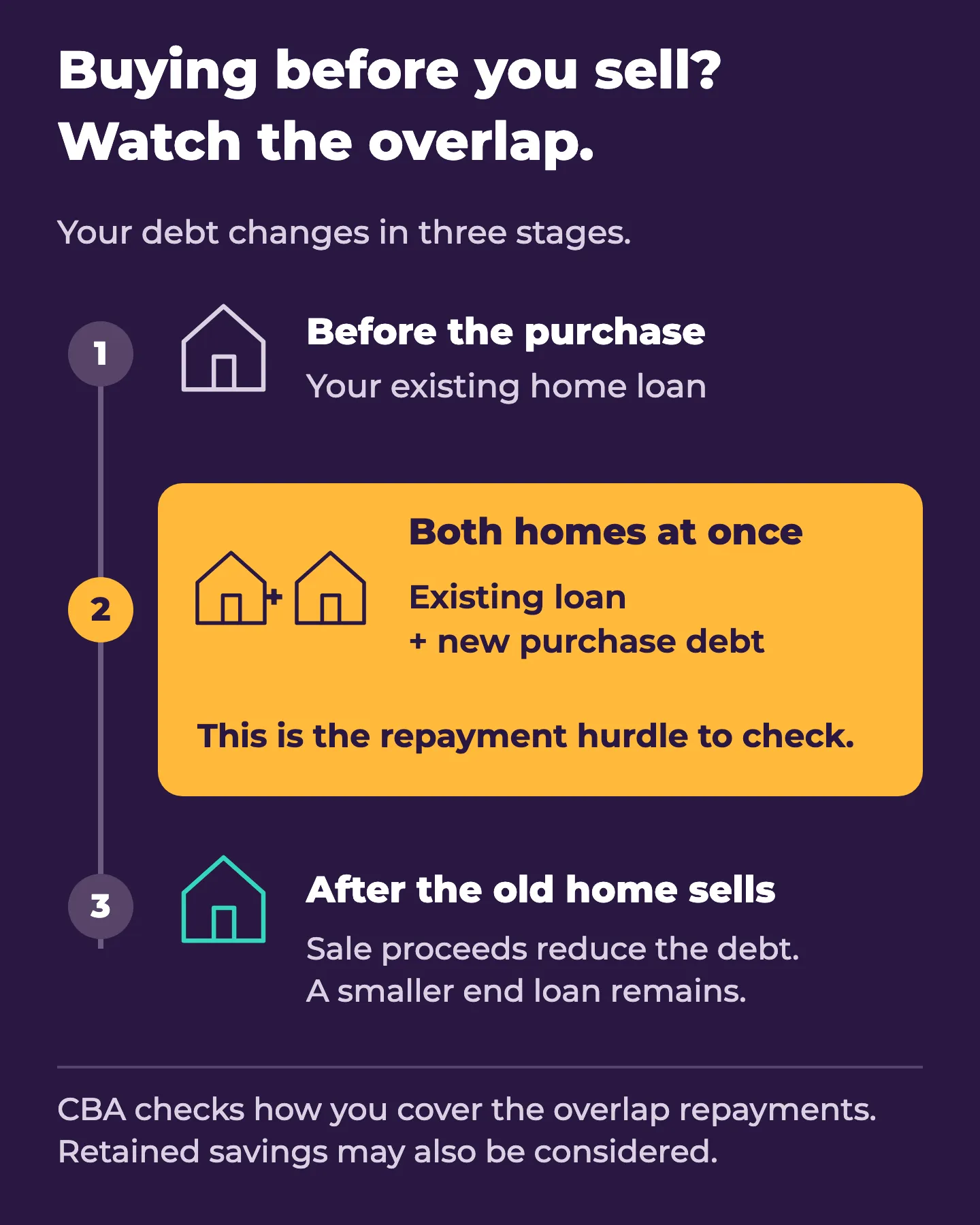
CommBank can provide up to 12 months of bridging finance, but you must show that you can make interest-only repayments on the total debt while you own both properties.
CommBank assesses your existing loan and the new purchase together. It does not only check whether you can afford the smaller loan that would remain after you sell.
If your income does not cover the repayments, CommBank may consider savings you keep aside to cover them until your existing home sells.
Some other lenders may let the bridging interest build up in the loan and assess repayments on the amount expected to remain after you sell.
That can ease the repayments while you own both homes, but the interest still adds to what you owe. We'll compare the costs and sale plan before recommending a lender.
How does CommBank compare with other lenders?
CommBank compared with other lenders
Scroll to see more columns
| What matters | CommBank | What to compare elsewhere |
|---|---|---|
| HELP debt | Within 12 months: repayment may be excluded. More than 1 year, within 5: a smaller buffer may apply.* | Compare how much you can borrow after each lender assesses HELP. |
| Professional LMI waiver | Selected medical, legal, accounting and finance roles; registration and application rules apply. | Other occupation lists and registration rules. |
| Self-employed | Usually needs full business financial records. | ATO notices, 1 year of returns or regular company salary evidence. |
| Offsets | Up to 99 with eligible Standard Variable loans in your own name. | Offset options for companies and trusts. |
| Bridging | Cover both loans. Savings set aside for repayments may help. | Adding bridging interest to the loan; assessing debt left after sale. |
| Owner-builder | Not available | Lenders with an owner-builder policy. |
- CommBank
- Within 12 months: repayment may be excluded. More than 1 year, within 5: a smaller buffer may apply.*
- What to compare elsewhere
- Compare how much you can borrow after each lender assesses HELP.
- CommBank
- Selected medical, legal, accounting and finance roles; registration and application rules apply.
- What to compare elsewhere
- Other occupation lists and registration rules.
- CommBank
- Usually needs full business financial records.
- What to compare elsewhere
- ATO notices, 1 year of returns or regular company salary evidence.
- CommBank
- Up to 99 with eligible Standard Variable loans in your own name.
- What to compare elsewhere
- Offset options for companies and trusts.
- CommBank
- Cover both loans. Savings set aside for repayments may help.
- What to compare elsewhere
- Adding bridging interest to the loan; assessing debt left after sale.
- CommBank
- Not available
- What to compare elsewhere
- Lenders with an owner-builder policy.
*From 25 September 2026, new CommBank 5% Deposit Scheme applications can't use the smaller HELP buffer. The separate 12 month option still has its own eligibility checks.
Hunter Galloway lender rating
CommBank broker score
CommBank scores well because its HELP treatment and product range solve real problems. The score is held back by property restrictions, the financial records required from business owners and its tougher bridging income test.
7.7/10
Strong when the policy fits
Our rating across 6 categories
Score breakdown
Each category is scored out of 10
- Credit policy fitHELP, professional waivers and supported purchase options8.5/10
- Borrowing capacityStrong in the right scenario; income and debts still matter8.0/10
- Property acceptanceBest with standard homes; tighter with a small deposit6.5/10
- Products and featuresExcellent offsets and a broad loan range8.5/10
- Speed and certaintyStrong systems; complexity can add steps7.5/10
- Pricing and servicePersonalised pricing, app and branch network; fees matter7.0/10

Experience and sources
How this guide was checked
Reviewed 22 September 2026 by Nathan Vecchio.
The sources below cover products, offsets, fees, HELP debt, application documents and government schemes. We confirm the current lending rules for your application before recommending a loan.
The September purchase example and rate-review observations come from our broking team. Customer comments describe individual experiences, not lender policy.

Joshua has worked in mortgage broking since 2011 and holds Diploma and Certificate IV qualifications in finance and mortgage broking.
Sources and check dates
- CommBank home loan products
- CommBank: offset accounts, checked 15 October 2026
- CommBank Standard Variable Rate loan
- CommBank Home Seeker pre-approval
- CommBank bridging finance
- CommBank construction lending
- CommBank Australian Government 5% Deposit Scheme
- CommBank Help to Buy
- Official CommBank home loan fee schedule
- CommBank broker credit policy: checked 1 September 2026
- CommBank Simple Home Loan fees and 1 October 2026 changes
- CommBank first-home buyer Q&A (October 2025): public HELP assessment explanation
- CommBank application documents: standard self-employed records and salary verification
- CommBank Digi product, fees and 1 October 2026 changes
- CommBank package fee and package changes
- CommBank online statements, including closed accounts
- ANZ One offset fee
- ProductReview: CommBank home loans, checked 29 September 2026
- Reddit: CBA home loan popularity, discussion from 2022
We check CommBank's latest rules, rates, fees and turnaround times before recommending a loan or helping you apply.
How are we paid?
The lender pays us commission, which we disclose before you proceed. Hunter Galloway is not owned by CommBank.
We compare more than 30 lenders and must put your interests first. Our Brisbane mortgage brokers can compare CommBank with other lenders using your income, deposit and property details.
What home buyers say about us
 Google
“Clear, incredibly responsive and accurate.”
- Google
“Preapprovals done quickly and efficiently.”
- Google
“Reassuring every step of the way.”
CommBank home loan FAQs
Quick answers to the questions we hear most often about CommBank.
Not sure whether CommBank is your best option?
We can check whether CommBank suits your income, deposit and the property you want to buy, then compare it with more than 30 lenders. Start with the amount you want to borrow and what you have saved for the purchase.
or call 1300 088 065
Hunter Galloway Finance Pty Ltd, Credit Representative 476903, is authorised under Australian Credit Licence 389328. General information only; policies, rates and fees can change and your full financial situation would need to be reviewed before any offer or product is accepted.
More help with your home loan
Home loans with HELP debt
See how your HELP debt affects how much you can borrow.
Read guideLMI waivers explained
Check professions, deposits and lender rules.
Read guide5% Deposit Scheme
Understand eligibility, deposits and price caps.
Read guideGuarantor home loans
See how your family could help with a guarantor loan.
Read guideSelf-employed home loans
See which income records different lenders may accept.
Read guideWestpac home loan review
Compare Westpac's bridging loans, income rules and deposit options.
Read review
Client examples are based on real situations. Names and identifying details have been changed.