


Your home buying budget is the loan you can comfortably repay, plus the deposit left after buying costs and a cash reserve. The bank still needs to approve the loan. A bigger deposit can lift your price range without adding to the monthly repayment.
I'd start with what you can afford each month, then check how much of your savings can go towards the home. That gives us a budget to compare with lenders, rather than treating the largest calculator result as a spending target. Our first home buyer guide covers the steps from saving to settlement.
Before setting your offer limit, use our rate-rise budget guide to check how a higher repayment would fit alongside your other bills.
Calculate how much you can borrow
Use the calculator below, or open our borrowing calculator, to estimate your loan amount. Enter your income, living expenses and existing commitments, then check the result against the repayment and deposit examples in this guide. Keep the loan amount separate from the property price.
The result is an estimate. It cannot confirm which parts of your income a lender will accept, whether the property is suitable security or whether you qualify for a low deposit scheme.
An estimate only. Check the loan against your budget, buying costs and the lender's assessment.
How to use the 'how much can I spend on a house' calculator
Start with your regular income and include the expenses that will continue after you buy. Add credit card limits, personal loans and other commitments. If your income changes from month to month, use a sustainable amount and ask us to check how lenders assess it.
Add your rent to the money you regularly save each month for a rough repayment check. Then subtract the new ownership costs and any savings you want to keep making. If you pay $2,400 in rent and save $1,000, some of that $3,400 will need to cover rates, insurance and repairs.
Work out repayments you can live with
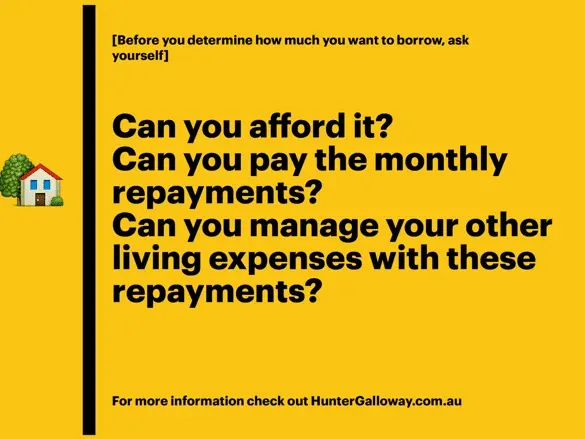
Use take-home pay for your household budget. Subtract normal living costs, other debt repayments, home ownership costs and money for irregular bills and savings. What remains is the amount available for the mortgage.
Review recent statements and look further back for annual expenses such as insurance, school costs, holidays and car registration. Include childcare and any planned reduction in work hours. A budget that only works before parental leave needs another look.

Is the 28% or 30% mortgage rule useful?
A percentage of income can be a quick warning sign, but it is not a universal Australian lending rule or a guarantee of comfort. Two households on the same salary can have very different tax, childcare, debt and living costs. Keep gross income and take-home pay separate when comparing examples.
I'd give more weight to the dollars left each month than to a neat percentage. If the repayment leaves no room for a car repair or a higher insurance bill, lower the price range or build more savings before committing.
What do repayments look like on different loans?
These examples use 6.25% interest over 30 years, with monthly principal and interest repayments. That is a modelling assumption, not a loan offer. For market context, the RBA's published July 2026 average for new owner-occupier principal and interest loans was 6.16%. The RBA raised the cash rate to 4.60%, effective 30 September 2026. Check a current loan quote before using these examples for your own budget.
Monthly repayment examples
Scroll to see more columns
| Loan amount | At 6.25% | At 7.25% |
|---|---|---|
| $300,000 | $1,847 | $2,047 |
| $400,000 | $2,463 | $2,729 |
| $500,000 | $3,079 | $3,411 |
| $600,000 | $3,694 | $4,093 |
| $800,000 | $4,926 | $5,457 |
Figures are monthly repayments, rounded to the nearest dollar. Rates stay constant for each calculation. Fees, LMI and property running costs are excluded. The 7.25% column tests a rate 1 percentage point higher; it is not a rate forecast or the bank's assessment rate. Check your borrowing estimate.
Practise your monthly mortgage payment
If the proposed mortgage payment is higher than your rent, save the difference for 3 months while continuing to pay rent. Also set aside the extra ownership costs you will face. This gives you a practical test and adds to your cash buffer. Our guide to saving for a house deposit can help you turn that target into a savings plan.
For example, if rent is $2,400, the expected mortgage payment is $3,100 and you allow $500 for new ownership costs, practise saving an extra $1,200 a month. Those are example budget amounts; get actual council, strata and insurance figures for the property.
How much money do you need to buy a house?
Your savings need to cover more than the deposit. Keep cash aside for stamp duty, conveyancing, inspections, registration charges, settlement adjustments and moving. Decide what emergency savings you need after settlement before calculating the amount available for the purchase price.
House price budget = a loan you can afford and the lender approves + your deposit towards the price. Your lender's deposit requirement and valuation can impose a lower limit.
A worked example with $120k saved
Suppose you have $120k saved and a $600k loan that fits both your budget and the lender's assessment. You allow $30k for buying costs and keep $20k in reserve. That leaves $70k for the price, giving an initial search budget of $670k.
The loan would be about 89.6% of the price, assuming the lender values the home at $670k. You would still need to check whether LMI applies or an eligible scheme or waiver is available. The $30k cost allowance is an assumption; calculate actual costs for the state, property and buyer circumstances.
What does a bigger deposit change?
A bigger deposit reduces the loan needed for the same home. It can also reduce LMI or improve the available rate. It does not automatically increase the loan your income can support.
Deposit and repayments on a $650,000 home
Scroll to see more columns
| On a $650,000 home | Deposit towards price | Loan before any financed costs | Monthly repayment at 6.25% |
|---|---|---|---|
| 5% deposit | $32,500 | $617,500 | $3,802 |
| 10% deposit | $65,000 | $585,000 | $3,602 |
| 20% deposit | $130,000 | $520,000 | $3,202 |
Each row assumes a 30-year principal and interest loan and excludes buying costs. A 5% deposit loan needs an available lender product or eligible scheme. LMI may apply below 20% unless a waiver or guarantee applies. A lower valuation can mean you need more cash.
Use the deposit calculator and LMI calculator alongside your loan estimate. For a NSW purchase, check the NSW stamp duty calculator and exemptions before treating all your savings as a deposit.

Can the 5% Deposit Scheme or a guarantor help?
The Australian Government 5% Deposit Scheme can help eligible buyers purchase with a minimum 5% deposit and no LMI. It has no income caps or annual place limit. You still need to meet the property price cap, ownership and residency rules, live in the home and qualify for a loan through a participating lender. Not every lender offers the scheme.
Eligible single parents or single legal guardians with at least one dependent child can apply with a minimum 2% deposit. You apply on your own and must meet the scheme's definition of single: being separated but not divorced does not qualify. Other ownership and lender checks still apply. The single-parent scheme rules explain the full criteria.
A family guarantor can help with the deposit gap by offering part of the equity in their home as extra security. That may let you buy with little or no deposit and avoid LMI. You still need enough income to make the repayments yourself. The guarantor's property is at risk if you cannot repay, so get advice before committing.
You can apply to remove the guarantee once the loan can stand on its own. Getting below 80% of the property's value can help, but release is not automatic. The lender may require an updated valuation and a satisfactory repayment history before agreeing.
State stamp duty concessions, cash grants and the federal guarantee are separate benefits. Qualifying for one does not mean you qualify for the others. For example, NSW's duty concession ends at $1 million even if a federal scheme allows a higher property price in your location.
Could a Queensland grant help with your deposit?
Eligible buyers of a new home in Queensland can receive a $30,000 First Home Owner Grant. The $30,000 amount applies to eligible contracts signed on or after 20 November 2023. The total home and land value must be below $750,000; an established home does not qualify. Buyer and residence rules also apply. Check the Queensland Government's grant guidance.
For example, a 10% deposit on a $650,000 new home is $65,000. If your lender accepts the $30,000 grant towards that deposit, you would need another $35,000 for the deposit itself. Buying costs, any LMI and your cash reserve are extra, and the lender still checks the $585,000 loan and its savings requirements. Confirm when the grant is paid before relying on it for money due at signing. The earlier tables exclude grants so you can compare the same starting figures.
How lenders calculate your borrowing power
Banks check your income, expenses and debts, then test the proposed loan at a higher interest rate. APRA's standard minimum buffer is 3 percentage points above the actual rate. A loan at 6.25% would usually be tested at 9.25% or higher. If the lender's minimum assessment rate, sometimes called a floor, is higher, that higher rate applies.
Passing that assessment doesn't replace your own budget. The lender may not allow for every holiday, future school choice or career change you have in mind.
Can a different assessment rate change the result?
Some non-bank lenders use a smaller buffer, such as 2 percentage points above the actual rate. That can change the borrowing estimate, but a higher actual rate or fees may offset the benefit. I'd compare the repayment you will pay and the total costs before choosing a lender because its calculator allows more.
If you already have a home loan, some lenders test an eligible refinance at 1% above the actual rate. These exceptions can require a loan at or below 80% of the property's value, a clean repayment history and little or no extra borrowing. They are not a general first home purchase option. Our refinancing guide covers the checks before switching.
How lenders assess different types of income
How lenders assess common income types
Scroll to see more columns
| Your situation | What to have ready | Why the lender choice matters |
|---|---|---|
| Salary or wages | Recent payslips and employment details | Regular pay is easier to assess, but probation, deductions and other commitments still matter. |
| Overtime, bonuses or commission | Payslips and evidence of earnings over time | Lenders can average variable pay or count only part of it. Regular essential-services overtime can receive more generous treatment at some lenders. |
| Casual or contract work | Earnings history, contracts and employment continuity | The amount counted and the history required vary between lenders. |
| Self-employed | Tax returns, financial statements and current business figures | Some lenders accept 1 year of financials for eligible applicants. Time in business, loan size and the other evidence still matter; 1 year of accounts does not automatically mean a new business qualifies. |
| Rental income | Lease or rental appraisal, rental statements and property expenses | Lenders allow for costs and vacancies. The share of rent counted can differ by lender, postcode and property type; short-stay income can face lower allowances or be excluded. |
| Benefits or child support | Payment history, current statements and evidence payments will continue | The type of payment, how long it will continue and the lender's rules affect the amount counted. |
- What to have ready
- Recent payslips and employment details
- Why the lender choice matters
- Regular pay is easier to assess, but probation, deductions and other commitments still matter.
- What to have ready
- Payslips and evidence of earnings over time
- Why the lender choice matters
- Lenders can average variable pay or count only part of it. Regular essential-services overtime can receive more generous treatment at some lenders.
- What to have ready
- Earnings history, contracts and employment continuity
- Why the lender choice matters
- The amount counted and the history required vary between lenders.
- What to have ready
- Tax returns, financial statements and current business figures
- Why the lender choice matters
- Some lenders accept 1 year of financials for eligible applicants. Time in business, loan size and the other evidence still matter; 1 year of accounts does not automatically mean a new business qualifies.
- What to have ready
- Lease or rental appraisal, rental statements and property expenses
- Why the lender choice matters
- Lenders allow for costs and vacancies. The share of rent counted can differ by lender, postcode and property type; short-stay income can face lower allowances or be excluded.
- What to have ready
- Payment history, current statements and evidence payments will continue
- Why the lender choice matters
- The type of payment, how long it will continue and the lender's rules affect the amount counted.
If your income varies, I'd check how much the lender will count before setting a price ceiling. Bring recent payslips or accounts, including the latest completed year. Our casual employment and self-employed home loan guides explain what to prepare.
For a lender example, our NAB home loan review explains the income documents and self-employed options to check before applying.
Living expenses, credit cards and HECS
Lenders compare your declared living costs with their expense benchmarks and investigate whether the figures are realistic. The Household Expenditure Measure (HEM) is a benchmark, not a budget you should try to copy. Declare what you actually spend and explain any lasting changes.
Unused credit card limits can reduce borrowing capacity because the lender allows for repayments on the available limit. Personal loans, car finance, buy now pay later commitments and HECS/HELP repayments can also affect the result. Ask us to compare the effect of reducing a debt with keeping that cash for your deposit before paying it out.
For a worked example, a lender assessing a credit card at 3.8% of its limit would allow $380 a month for a $10,000 limit, even if you owe nothing. That is an assessment allowance, not your card's actual minimum payment. How much extra you could borrow depends on the rest of the application. I'd check that difference before changing the card limit.
What if your HELP debt is nearly paid off?
If your HELP debt is nearly paid off, ask for it to be checked before using your deposit to clear it. APRA allows banks to consider leaving out HELP repayments when the debt is expected to clear within 12 months through compulsory repayments. It is a lender decision, not an automatic exemption.
Bring your current ATO loan statement and payslips so the lender can check the balance and expected repayments. HELP balances are excluded from APRA's bank reporting measure that compares debt with income, called DTI, but the repayments can still affect how much you can borrow. Those are separate tests. Our HECS and home loans guide explains what to compare before paying extra.
Our CommBank home loan review also explains its approach to HELP debt and the circumstances that need an individual assessment.
Calculate your debt-to-income ratio
Debt-to-income (DTI) compares total debt with gross annual income. For a simple example, a proposed $500k mortgage plus a $20k car loan against $100k income gives a ratio of 5.2. A lender's calculation can also include other credit exposures and its own income treatment.
Since 1 February 2026, APRA has limited banks' lending at DTI of 6 or more to 20% of new owner-occupier lending and, separately, 20% of new investor lending, subject to exemptions. This is a limit on a bank's lending mix, not a promise that you can borrow 6 times income or a blanket ban above it.
Banks also set their own limits, which can change with the loan type and deposit. Non-bank lenders are outside this particular APRA lending-mix limit and some do not use a fixed DTI cap. They still assess whether you can repay. A more flexible DTI rule will not fix a household budget that cannot cover the loan.
Check your credit report before applying
Check for incorrect accounts, missed-payment entries and unfamiliar credit enquiries. You can request free credit reports from the credit reporting bodies. MoneySmart explains how to obtain and correct them.
Accurate negative information cannot simply be removed because it makes an application harder. Avoid lodging several loan applications just to test your borrowing limit; get the likely fit checked first.
Can you buy a house on a $70k salary?
A $70k income may support a purchase, but the price depends on your deposit, expenses, debts, dependants and lender assessment. A published salary multiple is not enough to tell you what you can borrow.
A $400k loan at 6.25% over 30 years costs about $2,463 a month. A $70k gross salary is $5,833 a month before tax, so compare that repayment with your take-home pay after allowing for rates, insurance, strata fees and living costs. If there is little left, I'd lower the price target or build a bigger deposit before committing. These figures don't confirm that a lender will approve $400k.
Singles, couples and different buyer types
Two incomes can help, but a couple earning $120k in total will not necessarily receive the same result as a single applicant earning $120k. Tax, dependants, debts and living expenses change the calculation. A casual worker's or business owner's accepted income may also differ from what appeared in last month's bank deposits.
I'd compare like for like: the same deposit, property price, debts and expenses, with the income split shown for joint applicants. That tells you whether the difference comes from the household budget or from the lender's rules.
If only one partner applies but you share an existing loan, some lenders may count only part of that joint repayment where the other person can demonstrate they can pay their share. The split is not automatically 50/50. We need evidence of both incomes, the debt and who pays what. This changes the borrowing assessment; it does not release either person from their legal responsibility for the joint debt. A separation or change of borrowers needs its own check.

Research suburbs using your whole budget
Look at recent settled sales for the same property type, then compare strata costs, insurance, condition and travel costs. A cheaper apartment with high levies may leave less monthly room than you expect. An advertised price guide is not a valuation or a confirmed sale price.
Keep a short list of homes within both your repayment and cash limits. Check the lender's restrictions on the location and property before you make an offer, especially for small apartments, unusual titles or regional properties. Our home loan pre-approval guide explains what a conditional approval does and does not confirm.
The 5% Deposit Scheme cap is $1 million in Brisbane, the Gold Coast and Sunshine Coast, and $700,000 in other parts of Queensland. Check the exact location in the official property price-cap tool and confirm it with the participating lender. The scheme ceiling is not your spending target; your repayment budget may be much lower.

What if rates rise or your income drops?
Test a higher repayment and a lower income before choosing the top of your price range. On a $500k loan over 30 years, moving from 6.25% to 7.25% increases the monthly repayment from $3,079 to $3,411. The table above lets you compare other loan sizes.
Then test the budget using the income you would receive during parental leave, reduced hours or time between jobs. Set a cash reserve that suits your household. MoneySmart suggests working towards an emergency fund covering 3 months of expenses; some households will need more.

Choose a loan that suits the way you will repay it
Compare the rate, fees and features over a realistic loan term. An offset can reduce interest while keeping savings accessible, but check its cost. A redraw facility has different access rules. Fixed rates give repayment certainty for the fixed period, with limits and possible costs if you change the loan early.
A longer term lowers the scheduled repayment but generally adds interest over the life of the loan. I'd compare the monthly saving and total cost before using a longer term to stretch the house price budget.
How much house can I afford? FAQs
Check your price range before making an offer
Tell us your rough price range, savings, income and other debts. We can help identify what is limiting your budget and what a lender will need to check. We'll explain which documents are needed if you decide to take the next step.
or call 1300 088 065
We will explain your options and any costs before you proceed.

Author and sources
How this guide was checked
Repayment examples use monthly principal and interest over 30 years at the stated constant rates, rounded to whole dollars. Salary examples explain budgeting; they are not lender borrowing-capacity assessments. Lender rules are explained as options to check against the full application, not a promise that a particular loan will qualify.

Sources
- RBA: housing lending rates, July 2026
- APRA: current lending buffer and debt-to-income settings
- MoneySmart: buying a house
- MoneySmart: mortgage calculator
- MoneySmart: credit reports
- MoneySmart: emergency savings
- Australian Government 5% Deposit Scheme
- NSW first home buyer assistance
- APRA: HELP repayments and mortgage assessments
- APRA: changes to HELP debt reporting
- Queensland Government: First Home Owner Grant
- Australian Government: single-parent deposit option
- Westpac: 1 year income assessment for self-employed applicants
General information only. Your financial situation and the property need to be assessed before a loan recommendation or approval.