Use this home loan deposit calculator to see the purchase price your savings could support at a 5%, 10% or 20% deposit. You will also need to allow for buying costs and check whether your income can support the loan. A deposit calculation alone cannot tell you what you can afford.
I'd work out how much cash you want left after settlement before setting a price limit. Having enough to complete the purchase is one thing; being comfortable with the repayments and an unexpected bill is another.
You may not need to save 20%. An eligible 5% Deposit Scheme loan, LMI waiver or guarantor home loan can change the cash you need. Compare how each option affects your deposit before treating the calculator result as your savings target.
How do I use the deposit calculator?
Enter your available cash and select Continue. The result starts with a 5% deposit, then compares 10% and 20% deposit scenarios using the same cash amount. Open Adjust rate and term on the results screen to change the repayment assumptions.
The tool's field asks for cash before stamp duty and other purchase costs. It does not deduct those costs. To get a more useful estimate, first subtract the costs and reserve you need, then run it again with the amount actually available towards the price.
For example, if you have $80,000 saved and set aside $20,000 for quoted buying costs and a reserve, you have $60,000 towards the property. That supports a $600,000 price at a 10% deposit, rather than the $800,000 shown when all $80,000 is used. The $20,000 is an example allowance, not an estimate of your fees.
What do the results include?
The calculator shows the purchase price, loan required, loan-to-value ratio (LVR) and an indicative monthly repayment. Its lenders mortgage insurance (LMI) label is a general indication; it does not price the premium or check a waiver or government scheme.
For example, $30,000 gives these estimates at an assumed 6.25% p.a. over 30 years:
| Deposit share | Purchase price before costs | Loan before LMI | Monthly repayment |
|---|---|---|---|
| 5% | $600,000 | $570,000 | $3,510 |
| 10% | $300,000 | $270,000 | $1,662 |
| 20% | $150,000 | $120,000 | $739 |
These are principal-and-interest examples, rounded to full dollars. The rate is a calculator assumption, not a current lender offer. Fees, LMI, buying costs and future rate changes are excluded. Changing the rate or term changes the repayment, not the purchase price supported by that deposit percentage.
Use how much home can I afford? to assess the wider budget and our mortgage calculator for an initial borrowing estimate. This tool does not check income, debts, dependants, credit history, valuation or scheme eligibility. Its 5% headline is also not a scheme property price cap.
How much deposit do I need to buy a house?
A 20% contribution towards the price generally avoids lenders mortgage insurance. Some buyers can use a smaller deposit through an eligible loan, LMI waiver, government scheme or family guarantee. The amount you need depends on both the lender's requirements and the costs of your purchase.
How do I calculate my house deposit?
For the contribution towards the purchase price, multiply the price by your deposit percentage. A 10% deposit on $500,000 is $50,000. Then add the buying costs you must pay and the reserve you want to retain. Subtract only assistance that has been confirmed and will be available when needed.
The deposit paid under your sale contract is usually part of your contribution towards the price, not another deposit on top. For example, if your total contribution is $80,000 and you have already paid $40,000 under the contract, that leaves $40,000 of your contribution to pay at settlement, plus costs and adjustments. Ask your conveyancer to confirm the settlement statement.
House deposit amount examples
These figures are the deposit towards the price only. They do not include duty, fees, LMI or a cash reserve, and they do not establish loan or scheme eligibility.
| Property price | 5% deposit | 10% deposit | 20% deposit |
|---|---|---|---|
| $300,000 | $15,000 | $30,000 | $60,000 |
| $400,000 | $20,000 | $40,000 | $80,000 |
| $450,000 | $22,500 | $45,000 | $90,000 |
| $500,000 | $25,000 | $50,000 | $100,000 |
| $550,000 | $27,500 | $55,000 | $110,000 |
| $600,000 | $30,000 | $60,000 | $120,000 |
| $650,000 | $32,500 | $65,000 | $130,000 |
| $750,000 | $37,500 | $75,000 | $150,000 |
| $800,000 | $40,000 | $80,000 | $160,000 |
| $850,000 | $42,500 | $85,000 | $170,000 |
| $950,000 | $47,500 | $95,000 | $190,000 |
| $1,000,000 | $50,000 | $100,000 | $200,000 |
How much deposit do I need for a $300,000 house?
A 5% deposit is $15,000, a 10% deposit is $30,000 and a 20% deposit is $60,000. If you qualify for a duty exemption, that removes one cost; you still need to budget for legal work, registration, inspections and moving. Your total savings target needs to cover the costs of the property you choose.
How much deposit do I need for an $800,000 house?
You need $40,000 at 5%, $80,000 at 10% or $160,000 at 20%, before costs. For an eligible NSW first home buyer, an $800,000 home can be exempt from transfer duty. In Queensland, the established-home first home concession ends at $800,000, although the ordinary home concession may still apply.
Using QRO's home concession rates checked on 12 September 2026, duty on an $800,000 home is $21,850 where that concession applies. Eligible Queensland first home buyers purchasing a qualifying new home under a contract dated 1 May 2025 or later can instead receive a full concession. These are different eligibility tests from the federal 5% Deposit Scheme.
How does my deposit affect my LVR and LMI?
LVR is your loan divided by the lender's accepted property value. An $80,000 deposit on an $800,000 purchase leaves a $720,000 loan, or 90% LVR if the valuation is also $800,000. A lower valuation or costs added to the loan can increase that percentage. Check it with our LVR calculator.
LMI commonly applies above 80% LVR unless a waiver or alternative applies. It protects the lender, not you. Our LMI calculator provides an indicative premium; request a lender quote before setting your final savings target. Adding LMI to the loan is subject to the lender's total loan and LVR limits and means paying interest on it.
A larger deposit can improve your loan options, but it does not guarantee the lowest rate. I'd compare the premium, interest rate, fees and repayment together. Our LMI waivers guide and 90% loans without LMI guide explain alternatives to check.
What buying costs should I allow for?
Keep a separate allowance for costs that do not reduce the property's purchase price. Get quotes and a settlement estimate rather than adding a fixed percentage and assuming it will be enough.
| Cost | What to check before committing |
|---|---|
| Transfer duty and government fees | State rules, concessions, transfer registration and mortgage registration. A duty exemption does not automatically remove registration fees. |
| Conveyancing and searches | Contract advice, legal fees, searches, settlement charges and whether disbursements are included in the quote. |
| Building, pest and strata checks | The reports appropriate to the property, their price and any contract deadlines. For units, review body corporate finances and proposed works. |
| Lender costs and LMI | Application or valuation fees, the actual insurance or low-deposit charge, and which amounts can be financed. |
| Settlement adjustments | Your share of rates, water and relevant body corporate charges. Ask the conveyancer for an estimate. |
| Insurance and moving | When your responsibility starts, the cover required, removals, utility connections and any overlap with rent. |
| Cash after settlement | Repairs, essential purchases and a reserve appropriate to your household. This is separate from lender eligibility. |
In Queensland, responsibility for the property usually passes at 5pm on the next business day after the contract date. Confirm your contract with your solicitor and arrange cover in time. Other states and contract types differ. Do not assume insurance starts at settlement.
Our guide to the costs of buying a home helps you build the budget. Any cash grant also needs an eligibility and payment-timing check: it may not be available for the deposit due when you sign. See Queensland's first home owner grant if you are buying or building there.
Is stamp duty part of my house deposit?
It is part of your buying budget, but it does not count as your contribution towards the property's price. Some loan structures may let you fund costs through additional borrowing or equity. That still requires sufficient security and repayment capacity; it is not automatic.
Use our Queensland and national stamp duty calculator or NSW stamp duty guide and calculator as a starting estimate. Have your conveyancer check the applicable rates and eligibility against the official rules below.
First home buyer duty rules by state
This summary was checked on 12 September 2026. It covers the main home concessions, not every vacant-land, off-the-plan or foreign-buyer rule. Contract or settlement dates, ownership history and residence requirements matter.
| State or territory | Main rule to check |
|---|---|
| Queensland | Eligible established homes: no duty up to $700,000, with a reducing first home concession below $800,000. Eligible new homes: full concession from 1 May 2025 without a value cap on the qualifying residence. QRO rules. |
| NSW | Eligible new or existing homes: exemption up to $800,000, concession above $800,000 and below $1,000,000. Revenue NSW rules. |
| Victoria | Eligible homes: exemption up to $600,000, reduced duty above $600,000 and up to $750,000. SRO Victoria rules. |
| Western Australia | For eligible home transactions from 7 May 2026: no duty up to $600,000 and a concessional rate up to $800,000. Vacant land has different thresholds. WA rules. |
| South Australia | Eligible new homes and vacant land to build a home: full relief without a property value cap for contracts from 6 June 2024. Established homes are excluded. A foreign ownership surcharge may remain payable. RevenueSA rules. |
| Tasmania | The established-home exemption for eligible purchases up to $750,000 ended for settlements after 30 June 2026. Do not carry that exemption into a later buying budget. SRO Tasmania rules. |
| ACT | From 1 July 2026, the Home Buyer Concession Scheme has no income threshold or property price cap. Prior ownership and residence conditions still apply. ACT Revenue update. |
| Northern Territory | A specific house-and-land package exemption applies to eligible single-transaction purchases from a building contractor, with contracts through 30 June 2027. It is not a general exemption for every first home. NT rules. |
What if I have less than a 20% deposit?
Check assistance before deciding how much more to save. A smaller deposit can bring the purchase forward, but you need to be comfortable with the resulting loan and cash left over.
The Australian Government 5% Deposit Scheme
Eligible buyers can purchase with a minimum 5% deposit and no LMI through a participating lender. There are no income caps or annual place limits. You must meet the age, citizenship or permanent residency, ownership-history, property-price and owner-occupation rules, as well as the lender's credit requirements. The loan generally requires principal-and-interest repayments.
Eligible single parents or single legal guardians with a dependent child can apply with a minimum 2% deposit under the scheme's separate criteria. The government guarantees part of the loan; it does not pay your deposit or take an equity share. You remain responsible for the loan and buying costs.
Read our 5% Deposit Scheme guide and check the price cap for the property's location. The calculator's 5% result does not establish scheme eligibility. Ask the participating lender how much of your available savings must go towards the purchase before deciding what you can retain.
Help to Buy is a separate shared equity scheme
Help to Buy allows eligible buyers to contribute at least 2%, with the government contributing up to 30% for an existing home or 40% for a new home. The government shares proportionally in gains or losses when you sell or buy out its share.
Income, assets, property limits, Australian citizenship and lender approval conditions apply. From 1 July 2026, the taxable-income caps are $103,000 for an individual or $165,000 for single-parent and joint applications, based on the previous financial year's ATO notice. You must contribute as much as you can reasonably afford and cover buying costs. This calculator does not model shared equity.
Can my occupation reduce the deposit I need?
Some lenders offer occupation-based LMI waivers. Your profession, income, registration, property and requested LVR need checking. Our doctor home loan guide and lawyer LMI waiver guide explain examples; a job title alone is not an approval.
For a lender example, our NAB home loan review explains the professional waiver requirements to compare with your occupation and deposit.
How can a family guarantor help with the deposit?
A family guarantor may provide additional property security to help cover the deposit gap. You still need to afford the repayments, and the guarantor risks their property if you cannot repay. A guarantee's release needs lender approval. The guarantor should obtain independent legal and financial advice before agreeing. Your cash contribution plus the loan must still cover the price and any costs: a guarantee is security, not money paid towards the purchase.
A family gift can also help, but disclose whether it must be repaid and ask what evidence the lender needs. Buying with someone else may combine savings and income, while creating shared debt and ownership obligations. Read our buying with a partner guide before committing.
Our CommBank home loan review explains its family gift and security support options. Check how the money is provided and whether anyone else is taking on a guarantee before choosing a loan.
What counts as genuine savings?
Some lenders need evidence that you have built or held part of the deposit over time. Others may accept an eligible rental history or different deposit sources. A gift, inheritance or sale proceeds do not automatically meet every lender's genuine-savings test.
For example, Westpac's public buying guide mentions a continuous rental payment history over 6 months as possible evidence. That is a lender example, not a rule for every bank. Rental evidence does not replace the money needed to complete the purchase. Our genuine savings guide explains the documents to prepare; see our Westpac review for its wider loan features.

How much deposit do I need for an investment property?
The required deposit depends on the lender, property and your finances. A 20% contribution plus costs is a useful starting comparison because it commonly avoids LMI; a smaller deposit may be available with different pricing or conditions. Do not assume the owner-occupier 5% scheme applies to an investment purchase.
Existing homeowners may be able to use equity to buy another property. Equity can provide security for extra borrowing, but that borrowing adds debt and repayments. It is not free cash, and the lender must approve the valuation and total lending.
Can I buy a home with no deposit?
A suitable guarantor or equity arrangement may reduce the cash deposit needed. It does not remove approval requirements or the need to fund costs. Grants and joint buying also have limits. Our no-deposit home loan guide explains the options and the situations where more savings are needed.
How do I turn the deposit target into a buying budget?
Check the loan you can afford alongside the savings target. Your income, spending, debts and dependants may set a lower purchase limit than the calculator. A large deposit also cannot make an unacceptable property suitable for every lender.
I'd review credit limits, existing repayments and evidence of regular income before asking you to save more. Reducing a debt may help, but using all your cash to repay it can leave a deposit shortfall. Our affordability guide helps compare those choices without relying on a single income-to-loan multiple.
How can I increase my savings?
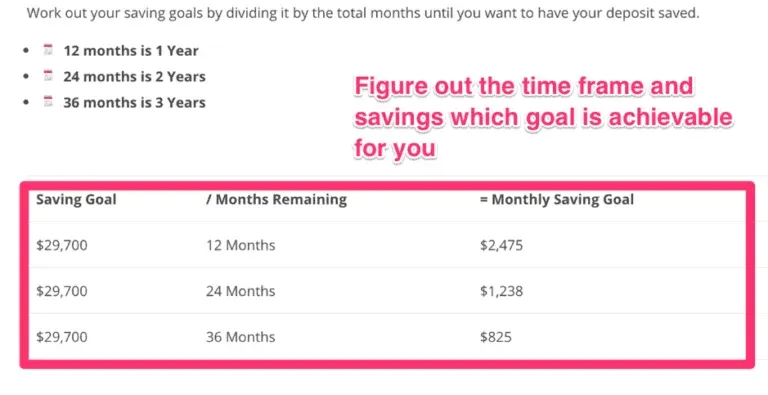
Subtract your current usable savings from the target, then divide the gap by the months available. For a $29,700 gap, that means $2,475 a month over 12 months, about $1,238 over 24 months or $825 over 36 months, before interest. This is a savings example, not a prediction of future property prices.
Automate an amount you can maintain, keep the deposit separate from everyday spending and review recurring costs. Compare the account's bonus-interest conditions and access rules. Closing credit accounts you no longer use may help the loan assessment, but it does not guarantee a particular credit score or borrowing increase.
Our house-deposit savings guide goes into practical changes. The Barefoot Investor account guide explains one way to separate spending and savings. Allow for essential furniture and moving costs rather than assuming you can spend the entire balance at settlement.
Watch our guide to building your home deposit. Check current eligibility and costs using the written guide and official sources below.

Could the First Home Super Saver Scheme help?
The First Home Super Saver (FHSS) scheme lets eligible buyers use certain voluntary super contributions towards a first home. Up to $15,000 of eligible contributions from each financial year can count, up to $50,000 overall per person, plus associated earnings. Release amounts and tax treatment depend on the contribution type; these are not extra contribution caps or permission to withdraw all your super.
Request an ATO determination and check release and contract deadlines before relying on the money. Allow time for payment. Our First Home Super Saver guide links to the ATO process and explains the conditions.
Should I buy with a small deposit or keep saving?
Compare the extra rent and time needed to save against the larger loan, possible LMI and smaller cash reserve if you buy now. Property prices and rates can move either way. A scheme or waiver may remove LMI, but it does not automatically remove a higher repayment or guarantee a lower rate.
For the same $800,000 property, increasing the deposit from 5% to 10% means contributing another $40,000 and borrowing $40,000 less before costs. That is a different comparison from the calculator's cards, which keep your savings fixed and change the property price.
Do I need pre-approval?
A lender assessment can help establish a realistic limit before you make an offer. Pre-approval is conditional: the lender still needs to accept the property and confirm any outstanding requirements. It is not a guarantee that every purchase will be financed.
Before bidding at auction, have your finance and the contract reviewed. Auction contracts commonly lack the protections available in a private sale. In Queensland there is no auction cooling-off period. Read our pre-approval guide and buying at auction guide before committing.
Deposit calculator FAQs
Is $30,000 enough for a house deposit?
It is 5% of a $600,000 property or 10% of a $300,000 property, before costs. Whether it is enough depends on the buying expenses, reserve, loan approval and any scheme or waiver. If $30,000 is all your savings, do not assume all of it can go towards the price.
How much deposit do I need for a $400,000 or $500,000 house?
For $400,000, the deposit is $20,000 at 5%, $40,000 at 10% or $80,000 at 20%. For $500,000, those amounts are $25,000, $50,000 and $100,000. Add costs and check eligibility for the deposit level you choose.
What is a 20% deposit on a $950,000 home?
It is $190,000, leaving a $760,000 loan before any financed costs. That is 80% LVR if the lender accepts a $950,000 valuation, where LMI generally does not apply. Buying costs are additional.
Can I buy with a $10,000 deposit?
That is 2% of a $500,000 home. An eligible single-parent guarantee or Help to Buy application may use a deposit at that level, but the schemes have different conditions and you still need buying costs. A suitable guarantor may be another option. The calculator starts at 5% and does not model these arrangements.
Can I use a personal loan for the deposit?
Some lenders may consider borrowed funds, but the personal-loan repayment reduces the income available for the mortgage and may breach deposit requirements. Disclose the borrowing and have both loans assessed before taking on the debt. Do not assume a personal loan solves a savings shortfall.
Does a gift or rental history count as genuine savings?
It depends on the lender and product. A gift may be accepted as deposit funds while failing a separate savings-history requirement. Eligible rent-payment evidence can sometimes help meet that requirement, but you still need the deposit money. Government rent assistance is income support, not proof on its own that you hold a deposit.
Is the deposit paid to the agent refundable?
The contract, state law, timing and reason for ending the purchase decide this. A holding payment and a contract deposit can have different terms. Cooling-off rights or valid contract conditions may allow a refund, sometimes with a deduction; default can put the deposit at risk and lead to further liability. Have your solicitor check before paying or cancelling.
How much do I need to earn to borrow $800,000?
There is no reliable single salary figure. Lenders assess income, spending, debts, dependants and the proposed loan, using their own criteria. The deposit calculator does not assess these. Have your borrowing capacity checked and compare the repayment with your household budget.
Does the calculator include stamp duty or LMI?
It does not deduct duty or other buying costs, and it does not calculate an LMI premium. The LMI label is an indication based on LVR, not an eligibility check. Use the linked duty and LMI calculators for initial estimates, then request figures for your actual purchase.
Check your deposit and loan together
Send us your savings balance, the amount you want to keep aside, your target price and suburb, and whether you are buying your first home, moving or investing. We can check the deposit, buying costs, suitable loan options and repayments together.
Or call 1300 088 065 to discuss your home loan options.

More resources for homebuyers
- First home buyer guide: plan your purchase from saving to settlement.
- Negotiating the house price: prepare your offer.
- Home loan features: compare what you need from the loan.
- Extra repayment calculator: estimate the effect of paying more later.
- Paying off your home loan faster: compare ways to reduce interest over time.
Sources and checks
Public guidance and calculator examples checked on 12 September 2026. Examples are calculations, not assessed client outcomes or lender offers. State summaries need to be read with the full eligibility rules and the date of your transaction.
Reference links
- MoneySmart: saving for a house deposit
- MoneySmart: buying a house and purchase costs
- Australian Government: 5% Deposit Scheme eligibility
- Australian Government: single-parent deposit option
- Australian Government: Help to Buy
- Australian Government: Help to Buy thresholds for 2026/27
- ATO: First Home Super Saver Scheme
- QRO: first home concession
- QRO: first home new-home concession
- QRO: home concession rates
- Revenue NSW: First Home Buyers Assistance Scheme
- SRO Victoria: first home buyer duty exemption and concession
- RevenueWA: first home owner duty rates
- RevenueSA: first home buyer relief
- RevenueSA: eligible and excluded properties
- SRO Tasmania: expiry of established-home duty relief
- ACT Revenue: changes from 1 July 2026
- NT Government: house-and-land stamp duty exemption
- Queensland Government: insurance when buying a home
- Queensland Government: cooling-off rights
- NAB: professional LMI waiver eligibility
- CommBank: guarantor support, security and risks
- Westpac: buying a house, deposit evidence and conditional approval
General information only. Your financial situation and the property need to be assessed before a loan recommendation or approval.