

Stamp duty can add thousands to the cash you need for your first home. The amount depends on the state, property and your eligibility. This guide explains the concessions and the conditions to check before you make an offer.
What Is Stamp Duty?
Stamp duty is a state-based tax levied on property transactions, including the purchase or transfer of land. While the specifics vary across Australia, the funds collected typically support essential services such as infrastructure, healthcare, and emergency services.
As property prices have risen, so too have stamp duty costs, often catching first home buyers by surprise. Understanding how stamp duty is calculated and the potential savings available through concessions and rebates can significantly impact your home-buying budget.
How Is Stamp Duty Calculated?
Stamp duty calculations differ between states and territories, but common factors influencing the cost include:
- Property Value: Generally, the higher the property's value, the higher the stamp duty. However, some states now offer exemptions that ignore price caps for specific buyers.
- Property Type: Significant differences now exist between new builds, vacant land, and established (existing) homes.
- Buyer Status: First home buyers often qualify for the most aggressive exemptions or concessions.
- Residency Status: Foreign buyers typically face additional surcharges on top of standard rates.
For a qualifying Queensland contract from 1 May 2025, eligible first home buyers pay $0 duty on a new home or vacant land to build their first home, without a property-value cap.
An eligible first home buyer also pays $0 duty on a $450,000 established Queensland home. The result changes if you do not qualify, so check the Queensland duty rules before setting your budget.
Stamp Duty Rates by State and Territory
There is no single maximum dollar amount of stamp duty for each state. A useful estimate needs the property value, transaction date, buyer details and applicable concession. The state sections below explain the first home buyer thresholds.
What Is Stamp Duty Concession?
Stamp duty concession is the discount offered to first-home buyers by the government. These discounts are meant to reduce the cost of buying a home and allow homebuyers to enter the market faster. The eligibility criteria for stamp duty concessions differ from state to state.
You need to fulfil a specific criterion to be eligible for the First Home buyers stamp duty concession in Queensland.
(Don't worry; we cover the other states like NSW and VIC below)
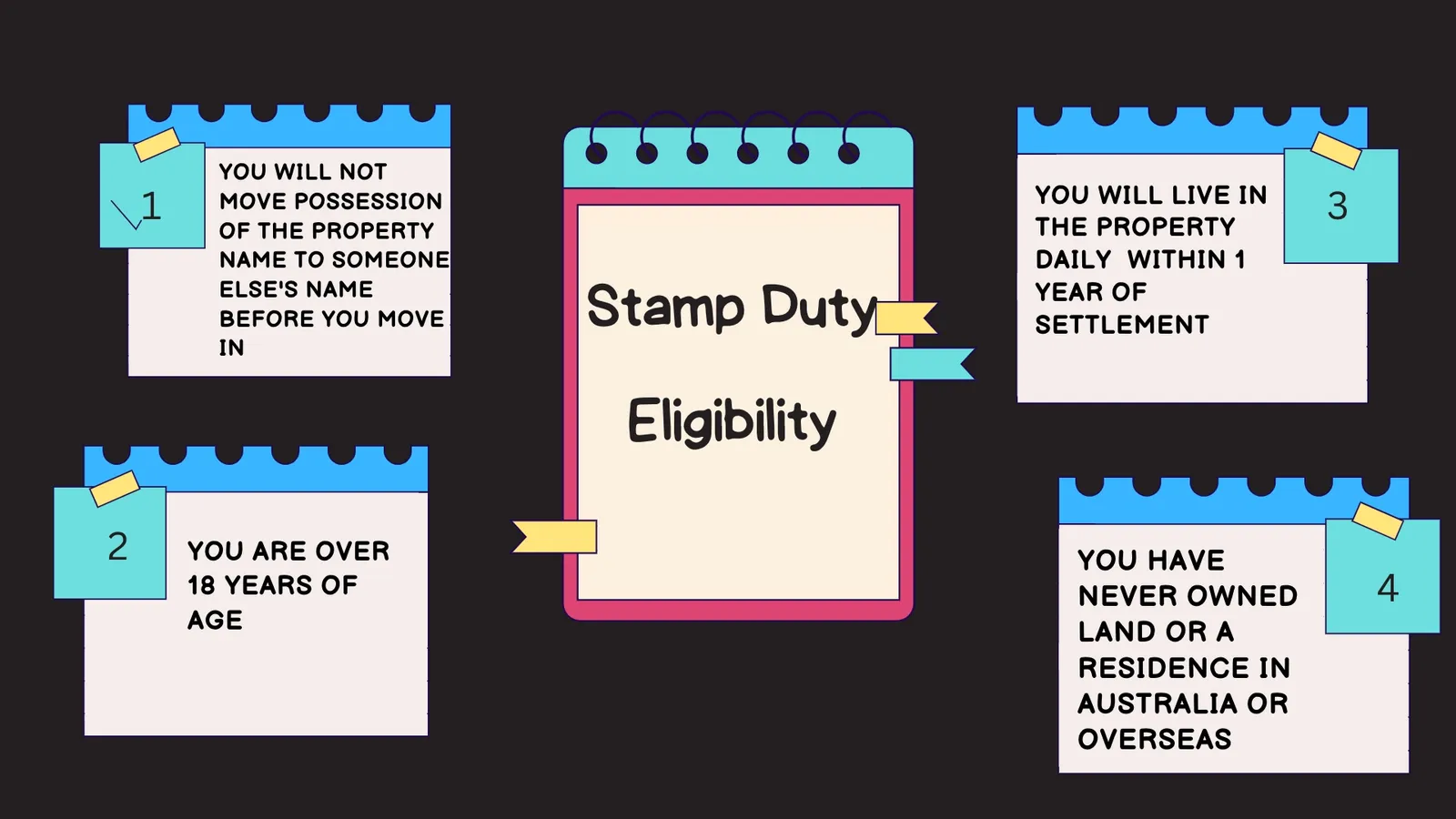
In Queensland, you'll generally be eligible for the first home concession if:
- You are at least 18. For transactions from 1 August 2026, you must also be an Australian citizen, permanent resident or specified foreign retiree.
- You have never held an interest in another residence in Australia or overseas, and have not previously claimed the first home vacant land concession.
You will live in the property daily within one year of settlement
You don't sell or transfer the home before you move in
- For an established home valued above $700,000 and below $800,000, you must pay market value to claim the first home concession.
Read more: Stamp Duty Calculator Queensland
First Home Buyer Stamp Duty Discounts By State

Stamp duty concessions help first home buyers get into the property market faster.
First Home Buyer Stamp Duty Concession QLD
Queensland has introduced major stamp duty reforms to help first-home buyers enter the market sooner.
What Changed on 1 May 2025
- New homes now qualify for a full transfer duty exemption. This means eligible buyers pay zero stamp duty when purchasing a brand-new or substantially renovated property.
- Eligible vacant-land buyers receive a full concession and generally must build and move into their first home within 2 years of settlement.
- There is no price cap on the exemption. Whether the property is $450,000 or $1.2 million, eligible buyers receive the same benefit.
- Eligible established first homes are duty-free up to $700,000. The first home concession reduces above that price and ends at $800,000; the ordinary home concession may still apply.
These changes were introduced under the Revenue Legislation Amendment Act 2025. The goal is to boost new housing construction and increase affordability.
Who Qualifies?
To access the exemption or concession, you must:
- Be at least 18 years old. The government requires all applicants to be legal adults at the time of signing.
- Never have owned residential property in Australia or overseas. Even previous investment ownership can disqualify you.
- Sign the purchase contract on or after 1 May 2025. Earlier contracts cannot be shifted to the new rules.
- Move into the home with your belongings and live there daily within 12 months of settlement. QRO says this deadline cannot be extended.
- Live in the property continuously for at least one year. Breaking this rule could trigger a stamp duty clawback.
- For vacant land, you must generally build and move into your first home within 2 years of settlement, subject to QRO's rules.
Old vs New System: Quick Comparison
| Scenario | Before May 2025 | After May 2025 |
| New home | Concession only up to value caps | Full exemption regardless of price |
| Vacant land | Full exemption or reduced duty, subject to the contract-date value caps | Full duty removal for eligible builds |
| Established home | First home concession | $0 up to $700,000 if eligible; reduced first home concession above that price and below $800,000 |
Estimated Savings
Your saving depends on the property value and the concession. For example, an eligible first home buyer purchasing $400,000 of vacant land under a qualifying contract from 1 May 2025 pays $0 duty. General duty without relief would be $12,425. This is a hypothetical example, excluding registration and other fees.
Additional Tips & Notes
- The separate $30,000 Queensland grant continues for eligible contracts from 1 July 2026. It applies to qualifying new homes valued below $750,000, including land.
- You may rent part of the home after moving in and keep living there, under the applicable QRO rules. Renting out the whole home during the restricted period can affect your concession.
- Make sure you use updated application forms. Using outdated documents can slow down settlement.
- Contracts signed before 1 May 2025 still follow the old rules. Your solicitor or broker can confirm which category you fall into.
New South Wales First Home Buyer Stamp Duty Discounts

New South Wales continues to support first home buyers through the First Home Buyers Assistance Scheme, which offers full or partial transfer duty relief depending on purchase price and contract date.
What First Home Buyers Can Claim
- No stamp duty on homes up to $800,000. This applies to both new and existing homes and eliminates one of the biggest upfront costs.
- Discounted duty on homes between $800,000 and $1,000,000. This concessional rate applies to contracts entered on or after 1 July 2023. Buyers pay a reduced sliding-scale amount instead of the full duty.
- No duty on vacant land up to $350,000. This applies only if the land is used to build a first home.
- Concessional rates for land valued between $350,000 and $450,000. The closer the price is to $350,000, the larger the reduction.
Who Is Eligible?
To use the scheme, you must:
- Be an individual aged 18 or over. Companies and trusts do not qualify.
- Be an Australian citizen or permanent resident. At least one purchaser must meet this requirement.
- You and your spouse or partner must meet Revenue NSW's previous-ownership and previous-benefit tests, even where your partner is not a purchaser.
- The current thresholds apply to eligible transactions from 1 July 2023.
- Move into the property within 12 months of settlement and live there for at least 12 continuous months. Failure to comply may trigger a reassessment.
Why This Matters for Buyers
- The policy removes thousands in upfront costs, helping buyers enter the market sooner.
- However, the $800,000 full exemption cap is increasingly tight in Sydney, where many entry-level homes exceed $900,000. See typical prices in our best suburbs in Sydney guide.
- Buyers purchasing between $800,000 and $1,000,000 will still save money but must budget for a partial duty payment.
Quick Comparison: Current Thresholds
| Property Type | Full Duty Exemption | Concessional Range |
| New or existing home | Up to $800,000 | Above $800,000 and below $1,000,000 (contracts from 1 July 2023) |
| Vacant land | Up to $350,000 | Above $350,000 and below $450,000 |
Victoria First Home Buyer Stamp Duty Concessions
Victoria offers significant stamp duty relief for first home buyers, making homeownership more accessible. Here's what you need to know:
Full Stamp Duty Exemption
- Property Value: Up to $600,000
- Eligibility: First home buyers purchasing a new or existing home or vacant land intended for building their first home.
- Conditions: Must live in the property as your principal place of residence for at least 12 months, starting within 12 months of settlement.
Stamp Duty Concession
- Property Value: Between $600,001 and $750,000
- Benefit: A reduced amount of duty, calculated on a sliding scale.
- Eligibility: First home buyers meeting the same residency and citizenship requirements.
Off-the-Plan Concession
Victoria's temporary concession for eligible strata apartments and townhouses has been extended to 21 April 2027. The property, contract date and construction costs determine the deduction; it is not an automatic deduction of every construction cost or a land-only assessment. See SRO Victoria's current guidance.
Check to see if you are eligible for a home loan
Australian Capital Territory First Home Buyer Stamp Duty Concessions

For transactions from 1 July 2026, eligible Home Buyer Concession Scheme buyers pay $0 conveyance duty with no household income threshold and no property-value cap. Eligible new homes, established homes and vacant residential land can qualify.
This is not limited to people who have never owned a property. Generally, all buyers and their domestic partners must not have held an interest in property anywhere in the world in the previous 5 years, subject to limited exceptions. Buyers must meet the age and individual-buyer requirements, and at least one buyer must meet the occupation rules.
The normal residence requirement is 12 continuous months, starting within 12 months of settlement or the relevant occupancy certificate for vacant land. Use the agreement or contract date to identify the rules, not simply the settlement date.
If you do not qualify, ordinary ACT duty can still apply. Eligible owner-occupier and non-owner-occupier base rates differ. Check ACT Revenue's HBCS guidance and current base rates. Earlier income limits and value caps don't apply to eligible transactions from 1 July 2026.
Northern Territory Stamp Duty Discounts

If you are looking to buy a property in the Northern Territory, it is critical to know that the local tax structure is vastly different from other states.
No General First-Home Buyer Concessions
The former general stamp duty exemptions and concessions, including the First Home Owner Discount (FHOD), have been completely scrapped. Currently, there are no standard stamp duty exemptions or concessions for first-home buyers purchasing established properties or standard homes in the NT.
Instead, the Territory government has redirected its first-home buyer support into direct cash payments, such as the HomeGrown Territory Grant.
What Still Exists: House and Land Package Exemption
While general concessions are no longer available, a separate, highly specific stamp duty relief program called the House and Land Package Exemption (HLPE) remains active.
- Eligibility Period: This applies to valid, single-transaction contracts entered into with a building contractor between 1 July 2022 and 30 June 2027.
- Property Type: The transaction must be a combined package where a building contractor sells you the land and agrees to build, complete, or transfer a brand-new, detached home on that specific lot.
- Eligible packages receive a full duty exemption. Legal, registration and other buying costs can still apply.
- No Property Value Cap: The exemption is not means-tested, and there is no maximum purchase price or value limit on the package.
- Residency Requirement: To keep the exemption, at least one buyer must move into the completed home within 12 months and live there continuously as their primary residence for at least 6 months.
For an ordinary established-home purchase in the NT, budget for duty unless a specific exemption applies. A separate vacant-land purchase and independent building contract do not automatically qualify for the house-and-land package exemption.
Western Australia First Home Buyer Stamp Duty Concessions

For eligible transactions from 7 May 2026, WA's First Home Owner Rate uses these thresholds:
| Purchase | No duty | Concessional band |
|---|---|---|
| New or established home | Up to $600,000 | $600,001 to $800,000 |
| Vacant land | Up to $450,000 | $450,001 to $550,000 |
These replace the earlier $500,000 home exemption and Perth/Peel versus regional concession bands. Applicants still need to meet the applicable first home owner, citizenship or residency, previous ownership and occupation requirements.
The normal occupation period is 6 continuous months, beginning within 12 months of completion. Check RevenueWA's duty fact sheet and our WA first home owner grant guide for the separate grant rules.
South Australia First Home Buyer Stamp Duty
Full exemption for new homes and land
- Eligible first home buyers purchasing a new home or vacant land to build a new home can claim relief. Established homes do not qualify. For contracts from 13 February 2025, previous residential ownership in Australia by you or your spouse or domestic partner can disqualify the claim.
- Property Value Cap: No cap applies for contracts entered into on or after 6 June 2024. This allows flexibility in choosing your property within your budget.
- Residency Requirement: Must reside in the property as your principal place of residence for at least 6 months within 12 months of settlement. This ensures the property is genuinely your main residence.
- Foreign Ownership Surcharge: Stamp duty relief does not extend to the foreign ownership surcharge. Foreign purchasers will still be subject to this additional charge.
Tasmania First Home Buyer Stamp Duty Concessions
Tasmania's published established-home exemption covered eligible homes valued up to $750,000 that settled from 18 February 2024 to 30 June 2026. That is a settlement-date rule.
The SRO Tasmania page confirms that the exemption is not available for transactions settling after 30 June 2026. Do not budget on this exemption for a later settlement without confirmation of further relief. The older 50% concession dates are historical too.
A first home owner cash grant has separate rules and does not automatically remove duty.
How To Apply For Stamp Duty Concessions

The process for applying for first home buyer stamp duty concessions varies slightly by state, but the general steps are similar. Following these steps can make your application smoother.
Step 1: Check Your Eligibility
- Verify that you meet first home buyer requirements in your state or territory.
- Confirm property type, value, residency, and citizenship rules.
- Check the rules for the transaction date, including each buyer's and partner's ownership history.
Step 2: Gather Required Documentation
- Collect personal identification (passport, driver's licence, or birth certificate).
- Provide proof of citizenship or permanent residency.
- Include property details: contract of sale, land title, and settlement information.
- Some states may require additional documents like household income verification.
Step 3: Complete the Application
- Apply through your state's Revenue Office, either online or via a paper form.
- Many conveyancers or mortgage brokers can assist with the application.
- Fill in all details accurately to prevent delays.
Step 4: Submit the Application
- Submit the completed application along with all supporting documents.
- Double-check submission deadlines, as some states require applications before settlement.
Step 5: Await Assessment
- The state Revenue Office will review your application.
- You will be notified if your concession or exemption is approved.
- Confirm the assessment and payment deadline with your solicitor. Do not assume every application will be approved before settlement.
Step 6: Finalise Settlement
- Once approved, your stamp duty payment (or exemption) is applied at settlement.
- Your conveyancer or lender will handle the payment adjustment as part of the process.
Key Tips
- State Variations: Rules, caps, and timelines differ per state, so always check your local Revenue Office.
- Your solicitor or conveyancer can check the duty claim. A mortgage broker can help you budget for the loan and buying costs.
- Plan Ahead: Start early so approvals are ready before settlement.
Stamp Duty Savings Examples

The following are hypothetical illustrations, not client case studies or approvals. They assume the buyer meets all relevant concession conditions, with no foreign surcharge. Registration and other buying costs are excluded.
| Scenario | Duty outcome under the applicable current rules |
|---|---|
| $700,000 NSW first home | $0 under the full exemption |
| $450,000 established Queensland first home | $0 under the full first home concession |
| $400,000 Queensland vacant land, qualifying contract from 1 May 2025 | $0; general duty without a concession would be $12,425 |
| $600,000 Victorian first home | $0 if eligible; an existing tenant means occupation timing needs checking |
| $1.2 million ACT home, eligible HBCS transaction from 1 July 2026 | $0 without an income or property-value cap |
A previous investment property can affect eligibility. An intention to live in the new property does not erase earlier ownership.
Would you like to learn about your situation?
Official Stamp Duty Resources by State and Territory
Use the official rules for your transaction date and circumstances.
- Queensland: first home duty
- Queensland: new home duty
- Queensland: vacant land duty
- NSW: First Home Buyers Assistance Scheme
- Victoria: first home duty
- WA: First Home Owner Rate
- SA: first home buyer relief
- Tasmania: historical established-home relief
- ACT: Home Buyer Concession Scheme
- NT: house-and-land package exemption
BONUS: Can Stamp Duty Fees Be Added To My Loan?

Sometimes buying costs can be funded through an approved loan structure, using enough deposit, equity or acceptable additional security. It depends on the lender's valuation, maximum loan and your ability to repay. There is no universal ban on borrowing for duty, and no guarantee a lender will cover it.
If you use savings to pay duty, less remains for the purchase price. That can mean more borrowing, LMI and interest. Check the full deposit budget and affordability guide. Our NAB and CommBank reviews explain lending features to compare separately from state concessions.
What If The Property Is Already Rented By A Tenant?

Before signing, have your solicitor check the existing lease, vacant-possession terms and the concession's move-in deadline. The tenancy must be dealt with lawfully. A national "tenants can stay for 6 months" rule is not a safe assumption.
Ask whether an existing lease, a renewed lease or renting back to the seller affects the claim. Do not promise extra occupancy simply to secure a lower price without checking the duty consequence.
Frequently Asked Questions About Stamp Duty For First Home Buyers
Next Steps And Getting Your Home Loan
Are you ready to buy a home?
Tell our team your buying location, price range and savings. We can check the loan and cash budget while your solicitor confirms the duty and concession eligibility.
If you want to get started, please give us a call on 1300 088 065 or book a free assessment online to see how we can help.

Our team of home loan experts is here to help you buy a home