Securing a home loan pre-approval is the first step toward buying in Australia, but not all ‘approvals’ are created equal.
This guide, written by an expert mortgage broker in Brisbane, explains how to get a fully-assessed pre-approval that locks in your borrowing power—accounting for interest rate buffers and hidden buying costs—so you can bid at auction with 100% confidence.
What Is Pre-Approval?
A home loan pre-approval is a formal indication from a lender. It shows they are willing to approve your loan for a specific amount. You get this before you find the right property.
Lenders also call this conditional approval, indicative approval, or approval in principle. Some banks even use the term home seeker. Regardless of the name, the purpose is the same.
The "Golden Ticket" for Home Buyers
A pre-approval tells you your exact borrowing power. It means the bank will lend you a specific amount, provided your circumstances stay the same.
- Stronger Offers: You can make offers with shorter finance terms.
- Competitive Edge: You become a more confident buyer in a crowded market.
- Faster Results: Having your paperwork ready helps you buy your dream home sooner.
Important: Pre-approval Is Not a 100% Guarantee
Always remember that a pre-approval is a strong indication, not a total guarantee. A bank is highly likely to approve your loan, but they can still say no.
In some cases, a bank’s credit department does not assess the pre-approval. Additionally, a Lenders Mortgage Insurer (LMI) never assesses a pre-approval. They only review your file once you have found a specific property.
Why Accuracy Matters
Not all pre-approvals are created equal. Some are just system-generated and haven’t been reviewed by a human. For a reliable result, you need a fully assessed pre-approval.
This means an actual credit officer has looked at your payslips and bank statements. Relying on a “coffee shop” approval can lead to your loan being declined later. Always ask your broker if a real person has verified your numbers.
| Feature | Coffee Shop Approval (System-Generated) | Fully Assessed Pre-Approval (Reliable) |
| Who Reviews It? | Automated Computer System | Human Credit Officer |
| Verification | Based on numbers you enter | Checks payslips & bank statements |
| Reliability | Low – often declined later | High – the “Gold Standard” |
| Timeframe | Instant or 24 hours | 3 to 10 business days |
| Auction Safe? | No – extremely risky | Yes – provides maximum confidence |
Why Is Home Loan Pre-Approval Important?
Securing a pre-approval is a vital step in the 2026 Australian property market. It transforms you from a casual browser into a serious, competitive buyer. Here are some of the reasons why it is important to get a home loan pre approval.

Know Your Exact Borrowing Power
Stop guessing your budget and start searching with confidence. A pre-approval tells you exactly how much a bank will lend you. This clarity helps you calculate the precise deposit you need. You will know instantly if you have enough or if you need to save more.
Master Your Budget and Cash Flow
A bank’s maximum loan amount is just a ceiling. You do not have to borrow the full amount. Pre-approval helps you determine a comfortable monthly budget. It also helps you set a “walk-away price” so you never overextend your finances.
Gain a Competitive Edge in the Market
In a high-demand market, speed is everything. Unorganised buyers often miss out on their dream homes. Pre-approval gives you the “negotiating power” to secure a property immediately. You can even offer shorter finance terms, like 7 days instead of 14, to attract sellers.
Protect Your Hard-Earned Money
Not having a pre-approval can be a very costly mistake. For example, winning at auction requires an immediate 5% to 10% deposit. Most Australian states have no cooling-off period for auction purchases.
On a $1,000,000 property, you could lose a $50,000 to $100,000 deposit if the bank later rejects your loan. This often happens due to property type or recent changes in your employment.
Identify Hidden Financial Issues
Pre-approval helps uncover financial red flags you might not notice. We recently helped a client who was a victim of identity fraud. He had a $15,000 default he didn’t know about. Because we caught it during pre-approval, we cleared the fraud before he started bidding.
Stay Safe in a Changing Market
Interest rates remain a critical factor in 2026. If rates rise while you shop, your borrowing capacity could drop significantly.
Additionally, as of February 1, 2026, APRA has activated formal Debt-to-Income (DTI) caps. Authorised lenders (ADIs) are now restricted in how many loans they issue at more than six times your annual income. A fully assessed pre-approval confirms your DTI is within safe limits before you fall in love with a home.
Lock in Your Assessment Rate
Many banks will “lock in” your assessment rate for 90 days. This gives you peace of mind that your budget stays the same. Even if interest rates or APRA regulations shift, your borrowing capacity remains protected for that period.
Pre-approval vs. Your Total Buying Budget
A common mistake for first-time buyers is assuming their pre-approval amount is their total purchase price. In reality, pre-approval only covers the loan amount. You must have additional cash on hand to cover the “hidden” costs of buying a home in 2026.
| Expense Type | Estimated Cost (for $1M Property) | Why You Need It |
| Stamp Duty | $30,000 – $45,000+ (varies by State) | Government tax on property transfer |
| Conveyancing | $1,200 – $2,500 | Legal fees for title transfer |
| Building & Pest | $500 – $800 | To find hidden structural issues or termites |
| Govt Fees | $500 – $1,200 | Registration and mortgage transfer fees |
| Total Cash Buffer | Approx. $35,000 – $55,000 | Essential funds needed on top of deposit |
The Cash Gap: What You Need Beyond Your Deposit
When budgeting for a $1,000,000 home, you should set aside a significant buffer for these essential expenses. These costs cannot usually be added to your loan.
- Stamp Duty (Transfer Duty): This is the largest upfront cost. For a $1m investment property in Queensland, you might pay over $38,000. While first-home buyer concessions exist, they often phase out as the property value nears the $1m mark.
- Conveyancing and Legal Fees: A solicitor or licensed conveyancer manages the legal transfer of the property. In 2026, expect to pay between $1,200 and $2,500 for a standard residential purchase.
- Building and Pest Inspections: Never skip these. A combined report typically costs between $500 and $800. This small investment can save you from buying a home with structural defects or termite damage.
- Mortgage Registration and Transfer Fees: These are government charges to register the change of ownership. Depending on your state, these fees generally range from $500 to $1,200 in total.
Why a Cash Buffer Matters
If you are pre-approved for $800,000 and have a $200,000 deposit, your total budget isn’t necessarily $1,000,000. Once you pay for stamp duty and legal fees, your actual purchasing power might drop to $960,000.
Mortgage broker Tip: We recommend adding a 10% buffer to your estimated buying costs. This ensures that a slightly higher-than-expected legal bill or a complex strata report doesn’t derail your settlement at the last minute.
CASE STUDY: The Cost Of Waiting In A 2026 Market

James is a first-time homebuyer who first spoke with our team in late 2025. He was considering buying a property but felt hesitant. Despite our advice, James decided to wait until mid-2026. He hoped the market would cool down or interest rates would drop.
We explained that applying for a pre-approval immediately could lock in his assessment rate. This would give him a “golden ticket” for a $1,000,000 budget, valid for 90 days. James chose to wait anyway, believing he had plenty of time.
The Hidden Cost of Delay
James contacted us again in April 2026, ready to start his search. However, the lending landscape had shifted significantly in just a few months:
- Rate Rises: Two consecutive RBA rate hikes in February and March pushed the cash rate to 4.10%.
- New APRA Caps: As of February 2026, stricter Debt-to-Income (DTI) caps were enforced.
- The Result: These changes slashed James’s borrowing capacity by over $120,000.
The Final Outcome
Because he waited, James could no longer afford the suburbs he originally targeted. He had to either increase his deposit or settle for a smaller property further away.
Getting a fully assessed pre-approval is vital in a changing market. It protects your budget from sudden policy shifts and rate increases. Don’t let a “wait and see” approach cost you your dream home.
Read More: Brisbane home loans – the definitive guide
When Is The Right Time To Get A Pre-approval?
You should secure your pre-approval before you start attending open homes or talking to agents. While it isn’t a 100% “bulletproof” guarantee, it provides the essential confidence you need to make a serious offer in a competitive environment.

The best time to get a pre approval is before you start your search for houses.
Narrow Down Your Search Early
Getting pre-approved before you browse helps you filter out the “noise.” You will focus only on properties you can actually afford over the long term. This prevents “mortgage shock” later, as you will already understand your future loan repayments and ongoing commitments.
Don't Waste Time on the Wrong Properties
Knowing your maximum budget ensures you don’t chase homes outside your price range. It also prevents you from falling in love with a property that is simply out of reach.
Expert Insight: Lenders have become even stricter with “high-risk” properties. Some banks will not approve loans for high-density city towers, homes under 50sqm, or properties near high-tension power lines. Getting pre-approved early allows your broker to check if your target property type is even acceptable to the bank.
Beat the "Debt-to-Income" Hurdles
As we mentioned before, APRA has implemented new limits on high Debt-to-Income (DTI) lending. Banks are now capped on how many loans they can provide to borrowers seeking more than six times their annual income.
By getting pre-approved early, you ensure your application fits within these new regulatory “buckets” before they fill up for the quarter. This gives you the green light to negotiate with real estate agents, knowing your finance is backed by current 2026 lending standards.
A Tool for Negotiation
Ultimately, a pre-approval is your best bargaining chip. It shows agents you are a “qualified buyer” who can move quickly. In a market where multiple offers are common, being the buyer with “finance ready to go” often wins the deal—even if your offer isn’t the highest on the table.
How To Use Pre-Approval As A Bargaining Chip

In a fast-moving property market, a fully assessed pre-approval is your strongest negotiating tool. It gives you an immediate edge over other buyers. We recommend a strategy called ‘Reduce, Remove, and Replace’ to handle the finance clause in your offer.
The finance clause is your safety net. It protects you if your loan falls through. With a solid pre-approval, you have three powerful options to make your offer stand out.
Option 1: Remove the Clause
You can remove the finance clause entirely to create a “cash-like” offer. This is incredibly attractive to sellers because it signals total confidence.
However, you must be extremely careful. If your loan is not approved, you are still legally bound to the contract. Failing to settle can result in losing your entire deposit. Only take this step after consulting with your broker and solicitor.
Option 2: Reduce the Terms
Standard finance terms in Australia are often 21 days. With a pre-approval, you can often shorten this significantly. You might reduce the timeframe to just seven days.
A shorter term is appealing to sellers because it offers a quicker, more certain sale. Your ability to do this depends on:
- LMI Requirements: Whether you need Lenders Mortgage Insurance.
- Valuation Needs: How quickly the bank can value the property.
- Lender Speed: Current processing times for your specific bank.
Option 3: Replace the Clause
You can replace a broad finance clause with a specific “Satisfactory Bank Valuation Clause.” This protects you in a targeted way.
The contract becomes conditional only on the bank’s valuation. If the valuation comes in lower than the purchase price, you have the option to exit the contract.
Mortgage Broker Brisbane Tip: Always have your solicitor or conveyancer review any contract changes. This ensures your interests are protected and all terms are legally binding.
CASE STUDY: Turning Weak Offers Into A Winning Strategy

Dylan and Kennedy were first-time buyers who spent eight months hunting for a home. Their original broker told them pre-approval wasn’t necessary. He advised them to make offers with a standard 21-day finance clause.
This bad advice cost them dearly. They found three perfect properties, but their offers were rejected every time. In one instance, a seller even accepted a lower offer from a buyer who was already pre-approved.
The Problem: Zero Negotiating Power
Without a formal pre-approval, Dylan and Kennedy’s offers were weak. The 21-day finance clause was a liability. In a competitive market, it gave sellers an easy excuse to choose someone else. They were “spinning their tyres” while prices continued to rise.
The Solution: A Fully Assessed Approval
They were referred to our team at Hunter Galloway. We explained the power of a fully assessed pre-approval and helped them secure one. We then showed them how to use it as a bargaining chip.
When they found their next home, Dylan and Kennedy took a bold approach. They removed all finance clauses, keeping only the building and pest inspection.
The Result: Success in 24 Hours
Their offer was accepted the very same day. By appearing organised and confident, they finally secured their dream home. Their story proves that pre-approval is more than just a piece of paper—it is a tool that wins deals even when others fail.
Check to see if you are eligible for a home loan
What Documents Do I Need To Get A Pre-approval?

Lenders need a “full-picture” view of your life to ensure you can comfortably manage your repayments. Use this checklist to start your journey.
1. Proof of Identity
Lenders must legally verify who you are to prevent fraud. You generally need one primary document or a combination of secondary ones:
- Primary: A current Australian passport or driver’s license.
- Secondary: A Medicare card, birth certificate, or an ATO assessment notice (less than 12 months old).
2. Proof of Income
This is the most critical part of your application. Lenders use these to calculate your borrowing power against current interest rate buffers.
- For Employees: Your two most recent payslips and your latest PAYG Income Statement (from MyGov). A letter from your employer confirming your role and salary is also highly recommended.
For Self-Employed: You will need your last two years of full personal and business tax returns, plus the corresponding ATO Notices of Assessment.
3. Proof of Savings and Expenses
Lenders don’t just look at what you earn; they look at how you spend.
- Bank Statements: Provide at least three to six months of statements for all transaction and savings accounts.
- Genuine Savings: If your deposit is less than 20%, lenders want to see “genuine savings” held for at least three months to prove financial discipline.
- Living Expenses: Be prepared to categorize your spending (groceries, transport, insurance, and even subscriptions like Netflix). Banks now use advanced tech to “scrape” your statements for these details.
4. Details on Existing Debts (Liabilities)
Every dollar you owe elsewhere reduces what you can borrow for a home. You must provide statements for:
- Credit Cards: Lenders assess you on the total limit of the card, even if the balance is zero.
- Personal & Car Loans: Provide the latest statement showing the remaining balance and repayment schedule.
- HECS/HELP Debt: As of 2026, new rules have changed how student debt is indexed, but it still impacts your take-home pay. You must provide an up-to-date HELP balance from the ATO.
- Buy Now, Pay Later (BNPL): Don’t forget to disclose accounts like Afterpay or Zip, as lenders now treat these as formal credit liabilities.
What Is The Pre-approval Loan Process?
The pre-approval journey follows a structured path. While every lender has different requirements, the general steps remain consistent across Australia.
The Standard Industry Steps
- Sign Application: You sign a formal application form provided by your mortgage broker.
- Submit Paperwork: You provide all proof of income, savings, and existing debts.
- Broker Assessment: Your broker reviews your file and recommends the best 2026 loan options.
- Lender Submission: Once you choose a bank, your broker submits your full application.
- Bank Assessment: The lender reviews your file and issues your home loan pre-approval.
The Hunter Galloway "Reliable Approval" Process
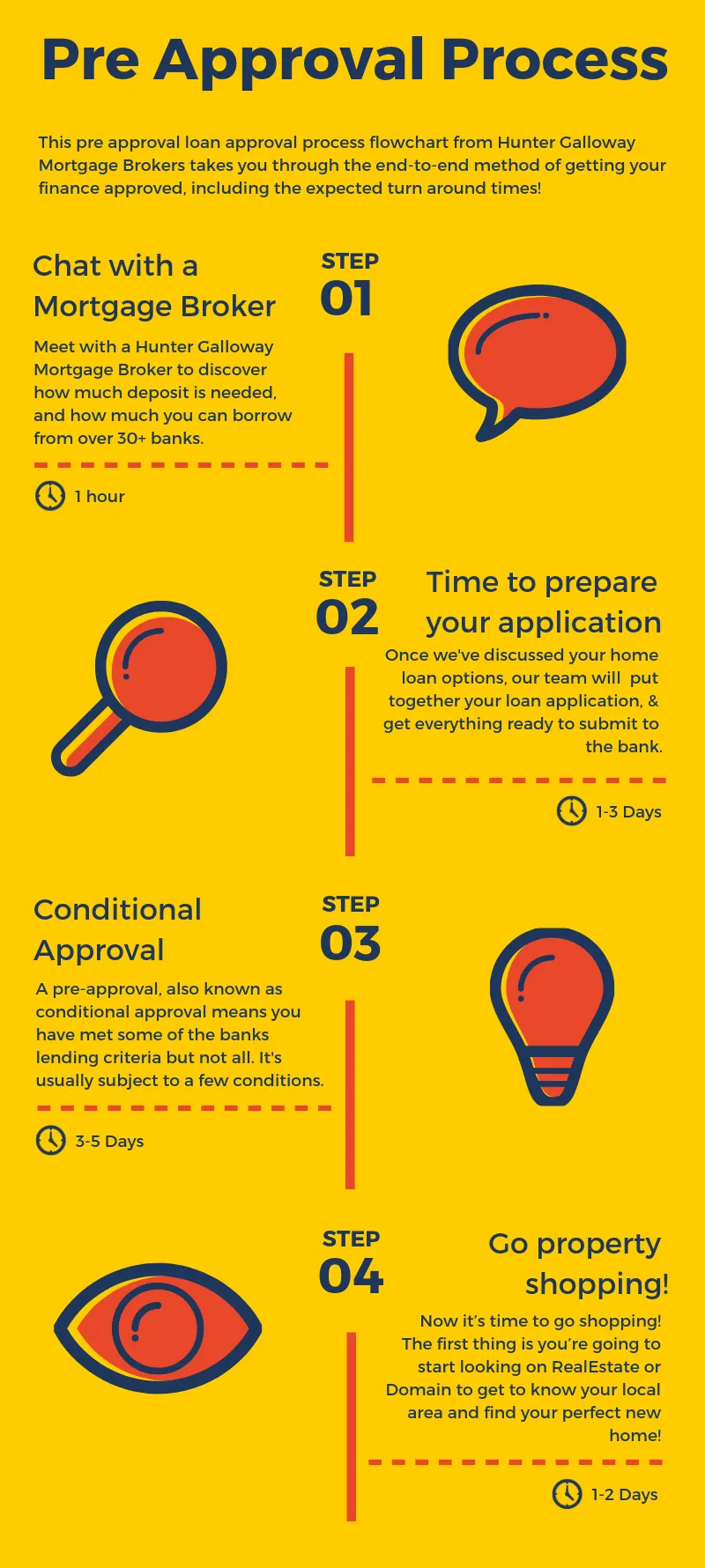
At Hunter Galloway, we don’t just “submit and hope.” We use a rigorous internal system to ensure your pre-approval is actually worth the paper it’s printed on.
1. Initial Strategy Call
We start with a free assessment of your financial goals. During this call, we review your eligibility and confirm you are ready to buy. We’ll help you map out the next steps for your 2026 home-buying journey.
2. Financial Data Collection
Our Credit Analysts will work with you to collect your personal details. This includes employment history, assets, and liabilities. You will submit your supporting documents (payslips, bank statements, etc.) via our secure, encrypted online portal.
3. Deep-Dive Credit Analysis
Our internal team performs a systematic review of three core components:
- Your Credit File: We comb through your credit report to ensure all recorded debts and payment records are 100% accurate.
- Income & Employment: We verify your job type and length of employment to match you with lenders who favour your specific situation.
- The Deposit: We review your total funds, including savings and available 2026 government grants, to ensure you qualify.
4. The Policy Matchmaker
We run your data through our custom loan policy checker. This tool scans over 4,890 data points across our panel of lenders. It accounts for the latest 2026 APRA Debt-to-Income (DTI) caps to find the lender most likely to say “Yes.”
5. Bank Submission and Completion
We send your application to your chosen lender. We manage the back-and-forth with the bank to speed things up, though the process usually takes 1 to 3 weeks. Once finished, we’ll call you to explain your approval conditions and hand over the tools you need to start shopping.
Read More: Home Loan Process: A Step-by-Step Guide
What Are Some Common Approval Conditions?
In almost every case, a pre-approval includes specific conditions. You must meet these requirements before the lender provides unconditional approval. These conditions range from standard bank procedures to specific requests based on your unique profile.

Standard Bank Terms and Conditions
Lenders use conditions to protect themselves during the 90-day approval window. Common requirements include:
- Validation of Details: The bank must verify that all information you provided remains true and correct.
- Supporting Documentation: You must submit any outstanding paperwork. Using a detailed application checklist ensures you don’t miss any critical files.
- Stable Financial Position: The lender assumes your income and expenses will not change significantly before settlement.
- Time Limits: You must typically sign and return loan agreements within 90 days. Failing to do so may require a full revalidation of your finances.
The "Security" Conditions
These conditions relate specifically to the property you intend to buy rather than your personal finances.
- Satisfactory Valuation: This is the most common condition. The bank will hire an independent valuer to ensure the property is worth the price you are paying.
LMI Approval: If your deposit is under 20%, a third-party Lenders Mortgage Insurance provider must also approve the specific property and your profile.
Moving to Full Approval
Once you satisfy every condition, the bank issues the formal loan agreement. This document outlines the final requirements you must meet before the lender makes the funds available for settlement.
Read More: The Complete First Home Buyers Guide to Buying a Home
How Do You Know If You Can Rely on Your Bank’s Pre-Approval?
Not all pre-approvals carry the same weight. In the current Australian lending environment, understanding the difference between a “guess” and a “guarantee” is critical. There are two main types of pre-approvals, and choosing the wrong one can cost you your deposit.

The "Coffee Shop" Approval (Unreliable)
A “Coffee Shop” approval is often a system-generated response. You give the bank a few basic numbers, and their computer spits out a $1,000,000 limit instantly. However, no human has actually verified your financial health.
- The Risk: No one has checked your bank statements for undisclosed debts or gambling habits.
- The Flaw: The system hasn’t confirmed if the bank accepts your specific income type, such as casual or contract work.
- The Verdict: These approvals are highly unreliable and should never be used as a basis for an auction bid.
The Fully Assessed Pre-Approval (Reliable)
A fully assessed pre-approval is the gold standard. In this process, a human credit officer physically reviews your payslips, tax returns, and savings history.
Once they verify your situation is genuine, they issue a formal approval. At this stage, the only major hurdle left is the bank’s valuation of the property you choose. This gives you the confidence to negotiate with sellers, knowing your “funding floor” is secure.
The Gap Between Pre-Approval and Full Approval
It is important to remember that a pre-approval is an indication, not a binding contract. Some lenders perform a credit check but wait until you find a property to verify your documents.
A full mortgage application only happens after you sign a contract of sale. This is when the lender performs a final, 100% check of your income, savings, and liabilities.
Expert Warning: Even with a pre-approval, the lender is under no legal obligation to approve your final loan. If your financial situation changes—or if APRA’s 2026 DTI caps shift mid-search—the bank can still decline your application.
Read More: Loan Declined After Pre-approval | 29 Ways to Get Unconditional Approval
Does Getting A Pre-approval Affect My Credit Score?
The short answer is: it depends on the type of check. It is important to understand the difference between a “soft” and “hard” inquiry in order to protect your borrowing power.
Soft vs. Hard Inquiries
Not all credit checks are equal. Knowing which one your lender uses will help you manage your score effectively.
- Soft Inquiries: These are preliminary checks that do not impact your credit score. They occur when you check your own score or when a lender pre-qualifies you for an offer. In 2026, many fintechs use these to give you an estimate without leaving a mark.
- Hard Inquiries: These happen when you formally apply for a home loan. A lender accesses your full file to make a final decision. A hard inquiry can dip your score by a few points, but it typically recovers within a few months if your other financial habits are healthy.
The "5-Year" Rule in Australia
It is a common myth that inquiries disappear quickly. In Australia, both soft and hard inquiries actually stay on your credit report for five years. While soft inquiries are only visible to you, hard inquiries are visible to every lender who views your file during that period.
Be Strategic with Your Applications
You must be smart about how often you apply. Making multiple formal applications in a short window is a major red flag for banks.
Lenders view “rate shopping” across too many banks as a sign of credit stress. This suggests you might be struggling to get an approval elsewhere. To keep your score strong, work with a broker to identify the single best lender for your needs before hitting the button on a formal application.
Mortgage Broker Brisbane Tip: If you are comparing multiple lenders, try to keep your applications within a tight 14-day window. Some modern credit scoring models may treat these as a single event, though this is not guaranteed across all Australian bureaus.
What Questions Can I Ask to Ensure I Have a Real Pre-approval?
At Hunter Galloway, we prioritize your safety by always requesting a fully assessed pre-approval. If a lender cannot provide this, we will inform you immediately so you can plan accordingly.
To protect your deposit, you must verify the quality of your approval. Ask your banker or mortgage broker these four critical questions:
- “Has a credit assessor personally reviewed my application?” Ensure a human has verified your income against your payslips, rather than just a computer system.
- “What specific conditions remain on my approval?” Knowing your “subject to” list prevents nasty surprises later.
- “Is this approval strong enough for me to bid at an auction?” Auctions are unconditional, so you need a high level of certainty before raising your paddle.
- “Has the Lenders Mortgage Insurer (LMI) reviewed my file?” If your deposit is under 20%, the insurer’s approval is just as vital as the bank’s.
Spotting an "Unreal" Pre-approval
If a lender gives you an “on-the-spot” or system-generated response, be extremely cautious. These “instant” approvals often mean your loan has never actually been assessed by the credit department.
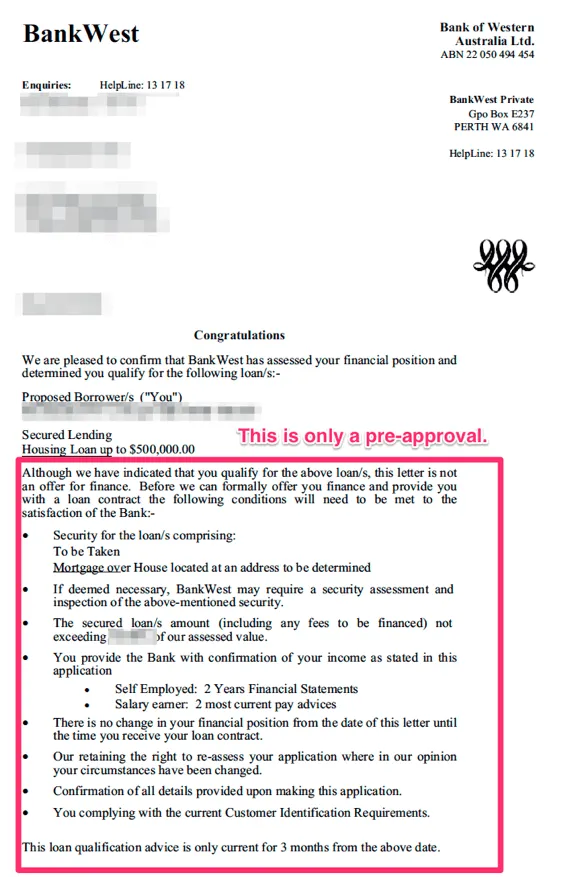
In the example above, the bank accepted the data entered, but no human double-checked the numbers. A common reason for later declines is when an assessor finds that your actual income doesn’t match the system’s entries.
True peace of mind comes from a formally approved loan. This is an application that is not subject to any further personal or financial approval conditions.
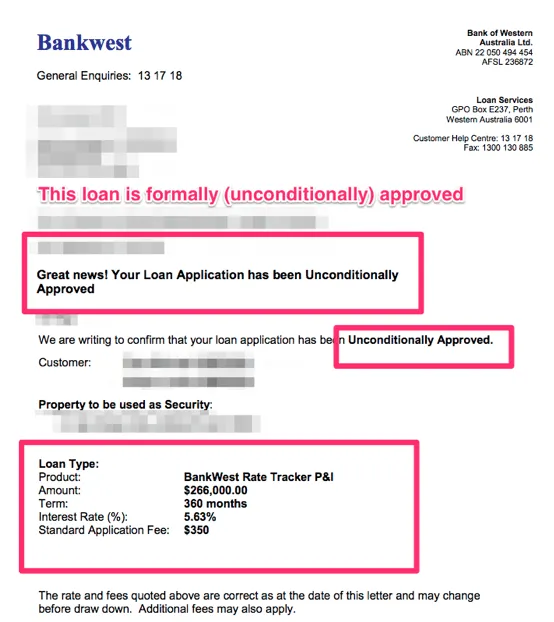
Read More: Loan Declined After Pre-approval | 29 Ways to Get Unconditional Approval
Are There Specific Lenders with Unreliable Approvals?
While you should always ask your broker the critical questions mentioned above, you need to be particularly cautious with certain banks.
Lenders such as St. George Bank, Westpac, ANZ, and NAB are known for providing quick, automated pre-approvals. While these systems might perform a basic credit check and offer an “approval in principle,” they often lack a deep-dive review.
The danger is that the credit department hasn’t actually assessed your documents yet. If a human assessor later finds an issue with your payslips, your gambling history, or your tax returns, the bank can—and often does—change its decision.
Why 2026 Regulations Make Pre approvals Riskier
An automated system might give you a “Green Light” today, but if the bank reaches its quarterly DTI quota by the time you find a house, your final approval could be delayed or denied. A system-generated letter cannot account for these real-time regulatory shifts.
The Hunter Galloway Advantage
At Hunter Galloway, we take a different approach. We work with lenders who prioritize verified pre-approvals. We ensure a human being verifies your income and deposit information before you start house hunting.
If you aren’t sure if your current letter is reliable, don’t risk your deposit. Get in touch with our team today.
- Call us: 1300 088 065
- Enquire online: We will review your approval and provide a professional second opinion.
Would you like to learn about your situation?
What Are Some Common Pre-approval Mistakes?
Even with a pre-approval in hand, certain pitfalls can still derail your home-buying journey. Avoid these five common mistakes to stay on track for a successful 2026 purchase.
1. Confusing Pre-approval with Final Approval
Thinking your pre-approval is the same as formal, unconditional approval is a dangerous assumption. We emphasize this throughout our guides because it is a critical distinction. A final loan offer is always subject to:
- Updated Information: Providing your most recent payslips if your old ones have expired.
- Property Valuation: Ensuring the home you choose is worth the price you are paying.
- Credit Refresh: A final check to ensure you haven’t taken on new debts since your first application.
2. Buying an "Unacceptable" Property
A pre-approval does not mean you can purchase any property on the market. Lenders have strict 2026 guidelines regarding property type and risk. Some banks restrict lending for high-density units, while others won’t touch homes in high-risk bushfire or flooding zones.
As a broad rule of thumb, double-check with your broker before bidding on any property that:
- Is Small: Under 50 square meters of internal living space (lenders like Athena and NAB have strict 40–50sqm cut-offs).
- Is Oversized: Land size exceeding 2 hectares or on a non-standard title.
- Is Rural: Located outside a major town or city.
- Includes “Gimmicks”: Properties with developer incentives like furniture packages or rental guarantees.
- Needs Work: Homes in significant disrepair or needing major structural fixes.

Not all property types are acceptable to banks…
3. Ignoring the Mortgage Insurer (LMI)
This is a major blind spot for many buyers. Even if your bank issues a “golden ticket” pre-approval, you must also pass the Lenders Mortgage Insurance (LMI) check if your deposit is under 20%.
The bank and the insurer are separate entities with different rules. For example, a property near high-tension power lines might be acceptable to your bank, but the insurer could still knock it back. If the insurer says no, the bank’s pre-approval becomes useless.
4. Getting Too Many Pre-approvals
You should only apply for a pre-approval with one bank at a time. In the 2026 credit market, “rate shopping” by submitting multiple formal applications is a red flag.
Each application triggers a “hard inquiry” that stays on your credit file for five years. If you see a better rate elsewhere, you would have to re-apply, which hits your credit score again. It is better to have a broker find the right lender first to protect your file.
5. Letting Your Pre-approval Expire
Pre-approvals do not last indefinitely. Most Australian lenders issue them for 90 days, though some offer 180 days.
If you don’t find a home within that timeframe, you will need to re-apply. This means more wasted effort and another hit to your credit file. If you are reaching your 90-day limit, talk to your broker about a “refresh” rather than starting from scratch.
How To Extend Your Pre-approval (The 90-Day Refresh)
Finding the right home can take time. If your 90-day window is closing, don’t panic. You don’t always need to start from scratch. Most Australian lenders allow for a “maintenance refresh” to keep your budget active.
Expert Tip: Avoid a full re-application by keeping your financial profile identical to your initial submission. If your job, debts, and spending habits stay the same, the extension is usually a simple paperwork update.
The "Maintenance" Check
To refresh your file, banks typically only require your two most recent payslips. This proves your income is stable and matches the original assessment. As long as you haven’t taken on new credit cards or “Buy Now, Pay Later” debts, the bank can often extend your letter for another 90 days with a quick review.
Timing Your Approval with the Market
Australian property markets follow a distinct seasonal pulse:
- The Spring Surge (Sept–Nov): This is the peak selling season. Apply for your pre-approval in August so you are ready the moment the “Spring Stock” hits the market.
- The Autumn Opportunity (March–May): While stock is slightly lower than in spring, competition can be less intense. Getting pre-approved in February puts you ahead of the crowd for the Easter selling period.
Beat the "Peak Season" Backlog
Lenders experience high application volumes during January and August as buyers prepare for the new year or the spring market. By starting your “refresh” or initial application two weeks early, you avoid the seasonal backlog and ensure your finance is ready before your dream home appears.
What’s Next When You Are Pre-approved?
Now that you have your “Golden Ticket,” it is time to go shopping. In a fast-moving property market, being organised is the difference between winning a home and missing out. Follow these four steps to secure your property.
1. Set Your Buying Budget
Your pre-approval gives you a maximum limit, but you don’t have to spend every cent. For example, you might be pre-approved for $1,000,000 but decide your comfortable “walk-away” price is $950,000.
Remember to account for the APRA Debt-to-Income (DTI) caps. If your loan is more than six times your annual income, your budget is more sensitive to rate changes. Stick to a price point that keeps your monthly cash flow healthy.
2. Target Your Search Brackets
Start your search on RealEstate.com.au, Domain, and local agent websites. When setting your price filters, be strategic.
- Broaden the Range: If you are looking for a $1,000,000 home, search between $800,000 and $1,100,000.
- The “Lower-Bracket” Hack: Sometimes, high-value properties appear in lower brackets to attract more bidders. Conversely, reducing your lower limit can reveal hidden gems that others might miss.
- Set Instant Alerts: 2026 stock levels are often low. Set up email notifications so you are the first to view a property the moment it hits the market.
3. Perform Deep-Dive Property Research
Once you find a property you love, verify its value before making an offer. Use tools like Onthehouse and RP Data (CoreLogic) to check recent sales history and suburb trends.
While premium RP Data reports can cost over $40 per property for individuals, our team at Hunter Galloway has full professional access. We are happy to provide these reports to our clients for free. Knowing if a house is overpriced before you bid saves you from a low bank valuation later.
Read more: Property market research tips
4. Make a Strong, Protected Offer
When you are ready to make an offer, do not skip the legal “safety checks.” Even in a competitive market, you must protect yourself.
- Solicitor Review: Always get your conveyancer or solicitor to review the contract before you sign. They will check for unusual clauses or hidden easements.
- Standard Clauses: Ensure your contract includes standard finance and building/pest inspection clauses.
Here at Hunter Galloway, we ensure that our first homeowners have the right terms to be competitive and protect them if anything goes wrong.
Frequently Asked Questions About Pre-approval
What does pre-approval mean for a home loan?
A pre-approval (also called conditional approval or approval in principle) is an official indication from a lender that they are willing to lend you a specific amount. It is based on a preliminary assessment of your income, expenses, and overall financial health.
Does pre-approval guarantee I will get the loan?
No. A pre-approval is a strong indication, not a 100% guarantee. Final “unconditional” approval only happens after the bank performs a satisfactory property valuation and confirms your financial situation remains identical to your initial application.
How do pre-approvals work in 2026?
You provide financial documents to a broker or lender. They calculate your borrowing power using current interest rate buffers and APRA’s 2026 Debt-to-Income (DTI) rules. If you meet their criteria, they issue a letter stating your maximum loan limit.
How long does it take to get a pre-approval?
Turnaround times vary by lender and complexity. In 2026, automated “system” responses can take 1–2 days, while a “fully assessed” approval by a human credit officer typically takes 3 to 10 business days.
How long is a pre-approval valid and can it expire?
Most Australian pre-approvals are valid for 90 days. Some lenders offer 180 days, but you will typically need to provide updated payslips and bank statements after the first 3 months to “refresh” the approval and keep it active.
Is there a fee to get a pre-approval?
Most Australian lenders and mortgage brokers do not charge a fee for a pre-approval. It is generally a free service designed to help you shop with confidence
Will multiple pre-approvals hurt my credit score?
Yes. Each formal application triggers a “hard inquiry” on your credit file, which stays visible for five years. Too many inquiries in a short time can signal “credit stress” to banks. It is best to use a broker to find the right lender first, then apply only once.
Can I get pre-approved if I am self-employed?
Yes. However, self-employed applicants typically need to provide more documentation, including two years of full tax returns and an ATO Notice of Assessment (NOA) to verify income stability.
Do I need pre-approval to make an offer or bid at auction?
Technically no, but it is extremely risky to skip it. In 2026, most agents won’t take your offer seriously without one. For auctions, where bids are legally binding and unconditional, bidding without a fully assessed pre-approval could result in losing your entire deposit.
What happens if I change jobs during my pre-approval?
A change in employment—including moving to a new role or changing from full-time to casual—usually voids your pre-approval. You must notify your broker immediately to see if you meet the lender’s new probation or employment type policies.
Why are some pre-approvals considered "unreliable"?
Many “on-the-spot” pre-approvals are system-generated and haven’t been reviewed by a human. These are risky because a bank can decline the loan later if a human assessor finds issues with your actual documents or the property type. Always aim for a fully assessed pre-approval.
Next Steps And Getting Your Home Loan
If you want to get a pre-approval or buy a home, speak with one of our experienced mortgage brokers to walk you through the next steps of home loans in Brisbane.
At Hunter Galloway, we help home buyers get ahead in this competitive market, and we give you the actual strategies that have helped other home buyers like you secure a property when there have been 5 other offers on the table or give us a call at 1300 088 065.
Unlike other mortgage brokers who are just one-person operations, we have an entire team of experts dedicated to helping make your home loan journey as simple as possible.

Our team of home loan experts is here to help you buy a home in Australia
More Resources For Homebuyers:
- The Complete First Home Buyers guide to buying a home
- Home Loan Process [Step by step guide]
- 22 Mistakes nearly all first home buyers make
- Negotiate the house price with a real estate agent
- Making an offer on a house below asking price
- What is Lenders Mortgage Insurance
- Grants to buy your first home