


Start with your budget and the dates
If you're planning to buy, I'd check your budget and loan options before you sign a contract. If you've already found a property, send us the contract, finance date and settlement date so we can check whether the lender's timing fits. You can apply with a property already under contract; a separate pre-approval isn't always needed.
Home loan approval process flowchart
Still house hunting? Pre-approval may help you set a budget. Already under contract? You can apply for the specific property without a separate pre-approval. Your application and property checks may run together.
- Discuss your budget and plansCheck the deposit, buying costs, repayments and any contract dates.
- Prepare and submit the applicationCompare suitable loans and send the supporting documents.
- Conditional approval or pre-approvalIf issued, check what has been assessed and what remains outstanding. A separate pre-approval is optional when applying for a property already under contract.
- Property and valuation checksThe lender checks the contract and property, including the valuation it will use.
- Unconditional approvalConfirm the written approval and any requirements before funds can be released.
- Loan documentsCheck and sign the offer, complete identity requirements and arrange your cash contribution.
- SettlementThe lender and legal representatives coordinate the funds and property transfer.
- Check the new loanConfirm the first repayment, account access and any offset link.
- Review the loanCheck pricing and features as your circumstances change.
The lender approves the loan. Your solicitor or conveyancer advises on the contract and legal deadlines. Your broker helps prepare and manage the finance application, but cannot promise approval or replace that legal advice.
1. Talk through your plans with a mortgage broker
The first conversation should cover what you want to buy, your deposit and how the repayments would fit your life. Tell us if you're changing jobs, planning parental leave, selling another property or keeping an existing home as an investment.
An online borrowing estimate is useful preparation, but it doesn't establish what a lender will approve. We need to check the income the lender can use, your spending and existing commitments, then compare those with the property and loan you have in mind.
I'd also keep the purchase budget separate from the maximum loan amount. You need money for any duty, conveyancing, inspections and other buying costs, plus whatever reserve you want to keep after moving in.
Before proceeding with a broker, ask which lenders they can compare, why they recommend a particular loan and how they are paid. Moneysmart's broker guide explains the questions to ask and the documents to expect.
For the wider purchase journey, start with how to buy a house.

2. Prepare and submit your application
The lender needs evidence to support the figures in the application. Your document list will depend on your employment, other income and the type of purchase.
| What we need to understand | Documents that may help |
|---|---|
| Your identity | Accepted identity documents, with names matching the application |
| Employment income | Recent payslips and any additional evidence the lender requests |
| Business or self-employed income | Relevant tax returns, notices of assessment and business financials, depending on the lender |
| Deposit and savings | Account statements and evidence of the source of any gift, sale proceeds or other contribution |
| Existing commitments | Home loan, personal loan and credit-card statements, plus details of other credit facilities |
| Household spending | Your expense information and the statements needed to verify it |
| The property | Signed contract of sale, if you've bought, and other property documents where required |
Documents to prepare for your application
Your identity
- Documents that may help
- Accepted identity documents, with names matching the application
Employment income
- Documents that may help
- Recent payslips and any additional evidence the lender requests
Business or self-employed income
- Documents that may help
- Relevant tax returns, notices of assessment and business financials, depending on the lender
Deposit and savings
- Documents that may help
- Account statements and evidence of the source of any gift, sale proceeds or other contribution
Existing commitments
- Documents that may help
- Home loan, personal loan and credit-card statements, plus details of other credit facilities
Household spending
- Documents that may help
- Your expense information and the statements needed to verify it
The property
- Documents that may help
- Signed contract of sale, if you've bought, and other property documents where required
Don't close or alter accounts just to make the application look better without discussing the effect first. Give a complete account of your position, including credit limits and debts you rarely use.
Deposit evidence and genuine savings
The lender may need evidence that part of your deposit is genuine savings: money you have built up or held over time. Ask which funds count and what statements it needs. A gift, sale proceeds and savings can be treated differently.
Some lenders consider a rental payment history when assessing a first-home buyer. For example, Westpac describes savings statements or a continuous 6-month rental payment history as possible evidence. That is a lender example, not a rule for every application. Check the required amount, history and documents before relying on it.
Choosing the loan
The comparison should cover the interest rate, fees, repayment type, offset or redraw features and the lender's policy for your circumstances. The lowest advertised rate may not be available for your deposit, income or property.
Ask what the repayments will be and what changes if rates rise or a fixed period ends. Our guides to home loan features, fixed interest rates and comparison rates explain those choices.
Once you've agreed on the application, it can be submitted with the supporting documents. A missing statement or unexplained deposit can mean another round of questions. Send the full document requested, rather than a cropped balance screenshot.
3. Conditional approval (approval in principle)
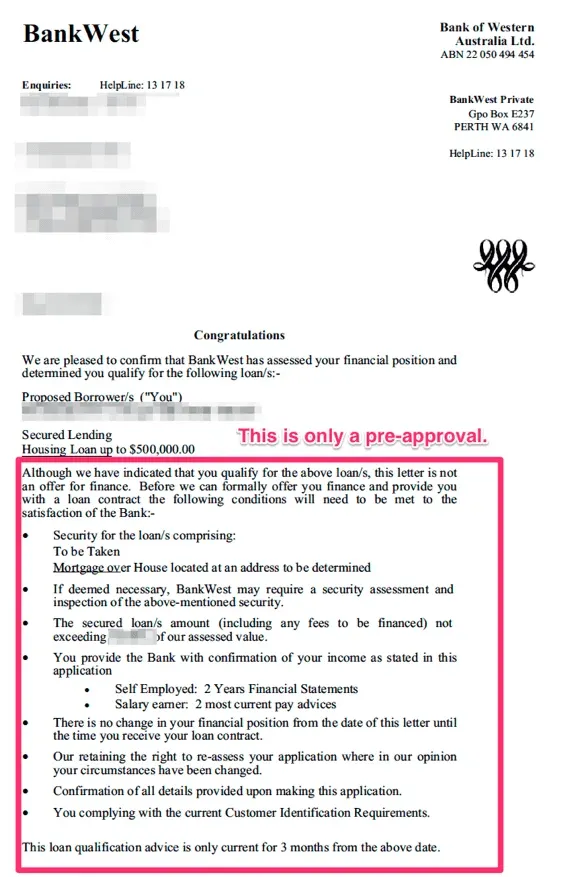
Conditional approval means the lender still has requirements to satisfy. Before you choose a property, it may be called pre-approval or approval in principle. A lender can also issue conditional approval for a specific purchase. The terminology and level of checking vary, so read the actual letter rather than relying on the label alone.
| What you have | What to establish before relying on it |
|---|---|
| Online borrowing estimate | This is a calculation from entered figures, not a lender credit decision |
| Automated conditional result | Ask which documents and details still need to be checked |
| Credit-assessed pre-approval | Confirm what an assessor reviewed, the figures accepted and every remaining condition; the property may still need approval |
What has the lender actually checked?
Online borrowing estimate
- What to establish before relying on it
- This is a calculation from entered figures, not a lender credit decision
Automated conditional result
- What to establish before relying on it
- Ask which documents and details still need to be checked
Credit-assessed pre-approval
- What to establish before relying on it
- Confirm what an assessor reviewed, the figures accepted and every remaining condition; the property may still need approval
Ask your broker: “Has a credit assessor reviewed my documents, and what is still outstanding?” Salary packaging, a novated lease or variable income can change the result if the detail is first checked after you sign a contract.
Check:
- How much the lender has conditionally approved.
- What evidence has been assessed and what remains outstanding.
- Whether the property still needs to be approved and valued.
- The expiry date and what is required if you need more time.
- What you must report if your income, employment, debts or circumstances change.
Pre-approval is not a guarantee that the lender will fund any property up to that price. A particular apartment, postcode or property type may fall outside its policy. Your finances also need to remain acceptable when the lender completes its assessment.
Our pre-approval guide explains what a useful assessment should cover. Westpac's explanation is one example of how a lender distinguishes conditional from unconditional approval.
If lenders mortgage insurance (LMI) is required, ask whether any insurer assessment or acceptance is still outstanding. An issue with the borrower or property can affect the outcome. Helia explains the documentation supporting an LMI assessment. Your broker can check what applies to the proposed loan.
How long does pre-approval take?
Check the time for a credit-assessed decision on your documents, rather than the time for an online estimate. Ask whether the lender has everything it needs and whether the quoted turnaround starts at submission or only once the file is complete. Further questions can extend that estimate.
Before signing a contract or bidding at auction
Have your solicitor or conveyancer explain the finance condition, deadlines and your obligations. Ask your broker to check the proposed property and timing with the lender before you commit.
In Queensland, a successful auction bid generally creates an unconditional contract without a cooling-off period. You can still be required to settle if your finance falls through. That makes preparation particularly important. See the Queensland Government's auction guidance and our buying at auction guide.
4. Give the lender the contract and complete the valuation
Once you have a property, the lender needs to assess the security for the loan. It may use an automated valuation, a desktop assessment or an inspection. The method depends on the property, loan and lender.
A lender valuation isn't a building and pest inspection. It doesn't replace your legal checks, strata enquiries or an assessment of the property's condition.
If an inspection is needed, access can affect timing. An incomplete contract or missing property details can also hold up the assessment.
How long does a property valuation take?
Timing depends on whether the lender can use an automated result or needs a desktop review or inspection. For an inspection, access to the property and the report returning to the lender are separate steps. Ask when the valuation was ordered, whether access is booked and when the lender expects to review the result.
What if the valuation is below the purchase price?
The lender may reduce the amount it will lend. That can leave you needing more cash or a different loan arrangement. Tell your solicitor and broker promptly so they can address their respective parts of the problem before the contract deadline.
The valuation gap and the cash shortfall are different. For example, suppose you buy for $800,000 and plan to borrow $640,000. If the lender accepts a $750,000 valuation and limits this loan to 80% of that value, the maximum becomes $600,000. You need $40,000 more towards the price, although the valuation is $50,000 lower. This illustration excludes buying costs and assumes the lender otherwise approves the loan.
When checking the remaining cash required, subtract the deposit already paid once. Keep duty, legal fees, lender costs and the reserve you want after settlement separate.
If there is evidence that the valuation is wrong, your broker can ask about the lender's review process. Another lender is not guaranteed to value it higher or approve the loan. See how to challenge a bank valuation.
- $800,000
Purchase price
The amount agreed with the seller.
- $750,000
Accepted value
At an illustrative 80% limit, this supports a $600,000 loan.
- $40,000
Extra cash towards the price
Compared with the planned $640,000 loan. Buying costs are additional.
5. Unconditional approval (formal approval)
With formal or unconditional approval, the lender has completed its credit assessment and approved the proposed loan. Check the written approval for the amount, borrower names, property and any requirements that still need to be met before funds are released.
Formal approval is not settlement. You still need to accept the loan offer and complete the lender's settlement requirements.
Send the written outcome to your solicitor or conveyancer. Let them advise whether the contract's finance condition has been satisfied and what notice needs to be given. Don't assume that a message saying “approved” automatically deals with the legal condition.
If your position changes before settlement, tell your broker and lender. New borrowing, a job change or a material change to the information in your application may need reassessment.
How long does it take to get unconditional approval?
Unconditional approval can take days or longer, depending on what the lender has already checked. Canstar's general guide describes outcomes ranging from 1 day to 1 week or more. This is broad context, not a current turnaround quote for your lender or a safe finance-clause deadline.
If your income and documents have already been assessed, the remaining work may be the contract, valuation and final conditions. If the lender still needs to verify income, clarify transactions or obtain an insurer decision, those checks need to be completed too. A valuation being returned does not mean unconditional approval will follow that day.
Ask your broker for the current assessment queue, what is outstanding on your file and the expected date for the next decision. Give them your finance date and settlement date separately. If there may be a shortfall, ask your solicitor about an extension before the finance deadline; the seller does not have to agree.
If the lender changes its answer
Get the reason in writing and compare it with the original pre-approval. Check whether the issue is your income, debts, deposit, the property or a condition that was never resolved. Sometimes nothing has changed in your circumstances; the lender has simply completed a more detailed assessment.
Find the cause before making another application. Your broker can check whether missing evidence will resolve it or whether a suitable alternative lender assesses that issue differently. Keep your solicitor informed of the finance deadline while this happens.
Client example
How Jenny got ready for a $670k pre-approval
Jenny had recently changed jobs, had credit card debt and needed a larger deposit. Over the next few months, she closed her cards, saved more and built up time in the new job. We then helped her get pre-approved for $670k.
After her offer was accepted, full approval came through within 5 days. That was her result; the timing depends on the application, property and lender.
Tell your broker about any changes before you make an offer. If the lender changes its answer, our guide to a loan declined after pre-approval explains the checks to make next.
The loan is approved
Check the lender’s written approval and remaining requirements.
The finance condition is addressed
Your solicitor or conveyancer confirms the contract notice and deadline.
Settlement is completed
Funds are released after the documents and settlement requirements are complete.
6. Review and sign the loan documents
Read the offer before signing. Check the loan amount, term, interest-rate type, repayments, fees and features against what you agreed to apply for.
Make sure you understand any fixed-rate conditions, extra-repayment limits and how an offset account will work. Ask about a detail that doesn't match the recommendation rather than assuming it will be corrected later.
The lender will explain its signing process. Some documents can be signed electronically; others may have witnessing or identity requirements. Follow the instructions for each document and return everything requested.
Missing signatures, incorrect names, an incomplete mortgage document or outstanding identification can delay settlement. Your broker can track the lender's requirements; your solicitor can advise on the legal documents.
7. Prepare for settlement and collect the keys
Your lender and solicitor or conveyancer coordinate the settlement arrangements. You need to know how much of your own money is required, where it must be available and by what date. Confirm the payment instructions directly with your legal representative before transferring a large amount.
Before settlement:
- Confirm the final cash contribution, including any adjustments and costs.
- Complete the lender's outstanding requirements and arrange required insurance. Ask your solicitor when risk passes under your contract; don't assume insurance can always wait until settlement day.
- Arrange the pre-settlement inspection with the agent.
- Check that any linked sale, discharge or other transaction is ready.
- Keep your broker and solicitor informed if something changes.
At settlement, the relevant funds are exchanged and the legal transfer is completed. Wait for confirmation from your solicitor or conveyancer that settlement has occurred before collecting the keys. CommBank's process guide outlines the lender's role in documents and settlement.
If you're refinancing rather than buying, the new lender generally pays out the outgoing loan instead. Discharge requirements and any remaining fixed-rate period can affect timing and cost.
8. Check the loan after settlement
Once the loan is running, check the first repayment date, amount and account it will come from. Make sure you can see the loan in online banking and that any direct debit is active.
If you've chosen an offset account, confirm it is linked to the correct loan and working as intended. Money sitting in an unlinked transaction account won't provide the expected offset benefit. Moneysmart explains what to check.
You don't need to wait for an annual review to raise a problem. Contact your broker or lender if the rate, fees, account setup or repayments differ from what you expected.
9. Review your home loan regularly
Check whether the rate and features still suit you, particularly before a fixed rate ends or when your plans change. You may want an offset, a different repayment arrangement or finance for a renovation.
Start by asking your existing lender for a rate review. Then compare staying on that rate with refinancing over the years you already have left. If the proposed refinance has a longer term, show that option separately: the lower monthly payment may come partly from repaying the debt more slowly.
Include switching costs, any fixed-rate break cost and the features you use. The result may be to stay, switch or wait. Our refinancing guide takes you through that comparison.
An annual review is a useful reminder, but a change in your circumstances may be a better reason to review sooner.
How long does a home loan application take?
There isn't one reliable timeframe for every application. Getting the documents together, the lender's assessment queue, valuation access and settlement preparation are separate parts of the process. Some can happen at the same time.
The useful estimate is the current one for your lender and application. Before relying on a proposed finance date, ask:
| Question | Why it matters |
|---|---|
| Is the application ready to submit? | An indicative queue time doesn't include days spent collecting missing documents |
| Does the lender need more evidence? | Unusual income, business structures or unexplained transactions can require further assessment |
| Has the property been accepted? | A valuation or security issue can change the loan amount or timing |
| Are the loan documents complete? | Approval alone doesn't mean the lender is ready to settle |
| Is there enough time for the legal and settlement steps? | The finance deadline and settlement date are different commitments |
Questions to ask about the lender’s current timing
Is the application ready to submit?
- Why it matters
- An indicative queue time doesn't include days spent collecting missing documents
Does the lender need more evidence?
- Why it matters
- Unusual income, business structures or unexplained transactions can require further assessment
Has the property been accepted?
- Why it matters
- A valuation or security issue can change the loan amount or timing
Are the loan documents complete?
- Why it matters
- Approval alone doesn't mean the lender is ready to settle
Is there enough time for the legal and settlement steps?
- Why it matters
- The finance deadline and settlement date are different commitments
If a deadline is getting close, raise it early. Your solicitor can advise on requesting an extension; the seller does not have to agree. Changing lenders may be an option, but it can also mean starting parts of the assessment again.
What can you do to keep the application moving?
Give your broker complete, current information at the start, and respond to questions promptly. Explain irregular income, large account transfers or employment changes so they can be assessed properly.
Keep your repayments up to date. Discuss a new credit application, major purchase or job change before making it while the home loan is being assessed.
You don't necessarily need a 20% deposit, and a smaller deposit doesn't automatically make an application suitable. The available loan, any LMI or scheme eligibility and the cash needed for buying costs all depend on your situation. Use a current assessment rather than a blanket deposit percentage or genuine-savings rule.
The selling agent represents the seller. Your broker looks after the loan application, and your solicitor or conveyancer advises on the purchase contract. Keeping those roles clear helps you direct each question to the right person.
Frequently asked questions
Related guides
Experience and sources
Sources and assumptions
Reviewed 29 September 2026 by Nathan Vecchio.
Lender assessment, document and settlement requirements vary. Confirm the requirements for your application and obtain legal advice about the purchase contract.
Sources
- Moneysmart's broker guide
- Westpac's explanation
- Queensland Government's auction guidance
- CommBank's process guide
- Moneysmart explains what to check
- Canstar: unconditional approval timing
- Westpac: deposit and rental-history evidence
- Helia: LMI assessment information
- InfoChoice: declined after unconditional approval

Tell us where you're up to
If you're still looking, we can help work through your budget and loan options. If you've signed a contract, send us the dates so we can focus on the finance steps that need to happen next.
or call 1300 088 065
Hunter Galloway Finance Pty Ltd T/A Mortgage Broker Brisbane - Hunter Galloway ABN 20 605 252 926. Credit Representative 476903 is authorised under Australian Credit Licence 389328. Your full financial situation would need to be reviewed before any offer or product is accepted.
Client examples are based on real situations. Names and identifying details have been changed.