


Hunter Galloway can check whether your completed figures or regular company wage fit a standard, fully verified home loan. If you need a low-doc or alt-doc loan, speak with a lender or broker who currently arranges that type of lending.
What does low doc actually mean?
A low doc home loan uses an approved alternative to the usual tax returns and financial statements to verify self-employed income. It is not a no-document loan, and it does not let a lender ignore affordability, credit history or the deposit.
Check whether you need low doc first. Our income and employment guide shows how lenders treat each type of income. If a standard lender can use your completed figures, that is usually the simpler place to start.
Which document route fits?
- Normal home loanCan a lender use the latest completed year, even if 2 years are not available?
- Simpler full verificationCan your own-company wage, notices of assessment or another approved method verify the income?
- True low docIf the usual figures do not work, a lender or broker who arranges low doc loans can check whether BAS, statements or an accountant's verification support the current income.
What do you have available?
Check the standard one-year options before using low doc. One completed year can work with some lenders when the business history and the rest of the application fit.
A regular wage from your own company may fit a simpler full-verification option. Check the company history, your ownership, the wage history and the required ATO evidence.
BAS can support a genuine low doc application with selected specialist lenders. It shows sales activity, not the profit available to repay a home loan.
Business statements or an accountant's verification can be accepted under selected low doc options. The exact period, form and business history still need checking.
Can a normal home loan work first?

You do not automatically need 2 full years of tax returns with every lender. Some lenders have methods that can use the latest completed year, provided the business history, deposit and rest of the application meet their rules.
That can help when:
- the latest year is complete and better reflects the current business
- the business has been trading long enough, but only 1 recent year is relevant
- you changed business setup without changing the work
- a large increase can be explained rather than simply projected
One completed year still needs proper returns, notices of assessment and any required business figures. It is full verification, not low doc.
A shorter document list can still be full verification
Some lenders publish methods that verify income without asking for the full standard set of business returns and financial statements.
For example, a lender may use personal notices of assessment under a specific method. Another may assess a regular wage paid from your own company using payslips and an ATO income statement. Those routes have their own business age, ownership, deposit and income rules.
Fewer documents does not make the loan low doc. The lender still verifies the income under its full-verification policy.
Paying yourself a regular company wage? The self-employed home loan guide explains how lenders assess business income and the documents they may need.
Which documents can a low doc lender accept?
Some specialist lenders accept a declaration of financial position with an approved alternative income document, such as BAS, business bank statements or accountant verification.
| Documents available | What it may help show | What still needs checking |
|---|---|---|
| Accountant verification | An accountant confirms an income figure using the lender's required form or wording. | How long the accountant has acted for you, business age, product limits and the basis of the figure. |
| 6 months of BAS | Recent reported sales and GST activity across part of the financial year. | Business costs, margins, seasonal changes and whether the lender annualises or applies its own calculation. |
| Business bank statements | Recent deposits and trading activity through the business account. | Which deposits are business income, the expenses needed to earn it and the number of months required. |
Which documents can a low doc lender accept?
Accountant verification
- What it may help show
- An accountant confirms an income figure using the lender's required form or wording.
- What still needs checking
- How long the accountant has acted for you, business age, product limits and the basis of the figure.
6 months of BAS
- What it may help show
- Recent reported sales and GST activity across part of the financial year.
- What still needs checking
- Business costs, margins, seasonal changes and whether the lender annualises or applies its own calculation.
Business bank statements
- What it may help show
- Recent deposits and trading activity through the business account.
- What still needs checking
- Which deposits are business income, the expenses needed to earn it and the number of months required.
Each lender sets its own mix of evidence, form and business history, and you need to meet all of it.
For the published evidence options, see Pepper Money’s alternative-document checklist and Resimac’s Prime Alt Doc requirements.
How different lenders approach the documents
I checked 10 lenders for this guide. They use 3 broad approaches when full tax returns are not available.
| Lender approach | What that can mean for you | What needs checking |
|---|---|---|
| Genuine alternative documents Pepper Money and Resimac | BAS, business statements or accountant verification may be used within the lender's conditions. | A low doc lender or broker needs to confirm the exact document option, business history and deposit. |
| Latest-year full assessment may be available ANZ , Bankwest , NAB , Commonwealth Bank , ING and Macquarie | You may not need low doc if a recent completed year fits a full assessment. | I would test the full-doc option first because it may give you a broader choice. |
| Simpler full verification Westpac and St George | The lender still verifies the income using its prescribed evidence. | I check whether your current records fit that method before calling the application low doc. |
How different lenders approach the documents
Genuine alternative documents Pepper Money and Resimac
- What that can mean for you
- BAS, business statements or accountant verification may be used within the lender's conditions.
- What needs checking
- A low doc lender or broker needs to confirm the exact document option, business history and deposit.
Latest-year full assessment may be available ANZ , Bankwest , NAB , Commonwealth Bank , ING and Macquarie
- What that can mean for you
- You may not need low doc if a recent completed year fits a full assessment.
- What needs checking
- I would test the full-doc option first because it may give you a broader choice.
Simpler full verification Westpac and St George
- What that can mean for you
- The lender still verifies the income using its prescribed evidence.
- What needs checking
- I check whether your current records fit that method before calling the application low doc.
Related lender and guide links: Pepper Money · Resimac · ANZ · Bankwest · NAB · Commonwealth Bank · ING · Macquarie · Westpac · St George
What does BAS prove about the business?
BAS can show sales and GST reporting. It does not show every cost needed to keep the business running.
A paving business may receive $200k into the account, then pay for materials, staff, subcontractors, fuel, machinery and insurance. The owner does not earn the full $200k.
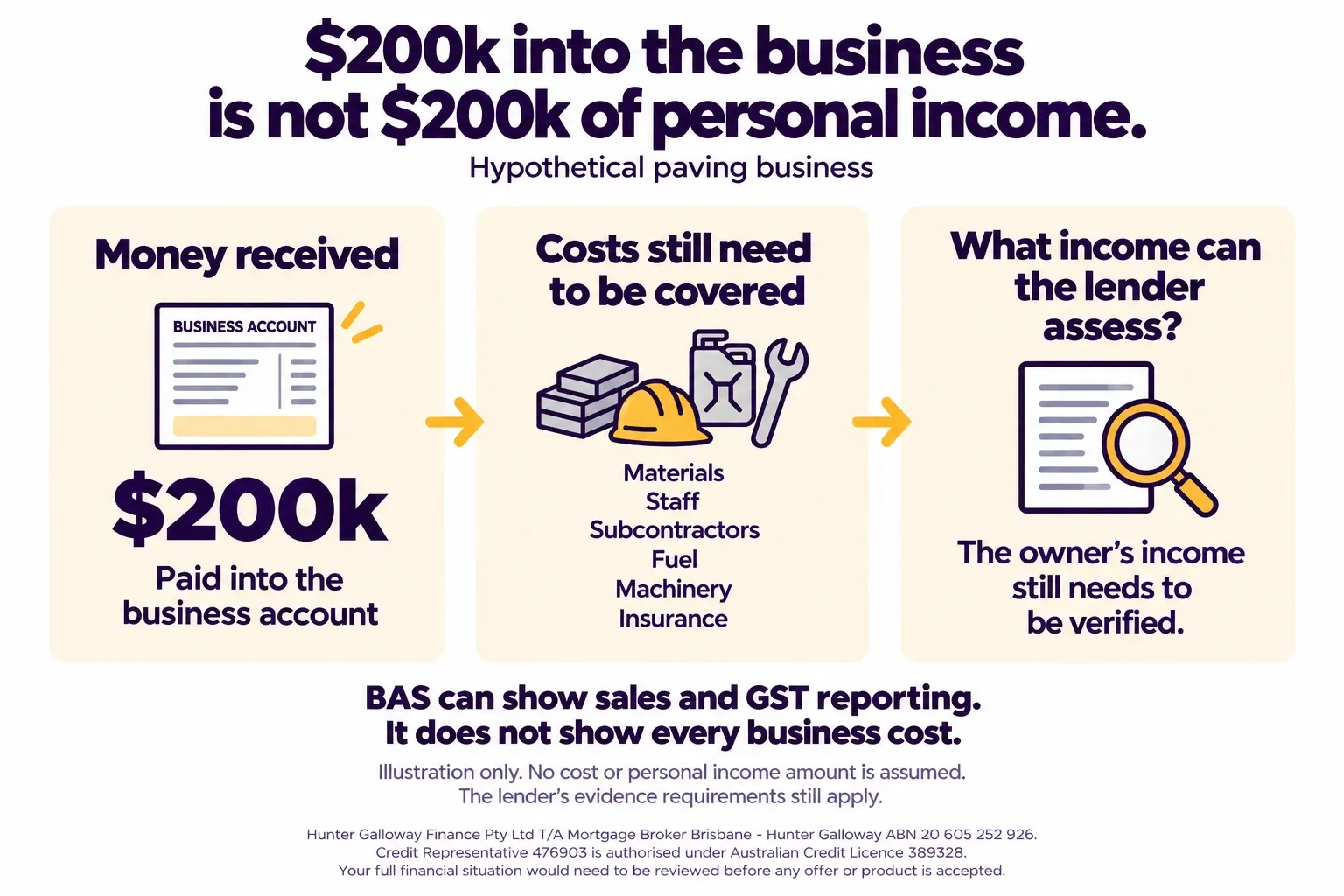
BAS shows sales and GST activity, rather than the profit available for repayments. A specialist lender still needs the supporting documents and checks required for its low-doc product.
When might low doc make sense?
- the business is established but the latest returns are not complete
- the lodged returns no longer reflect a current, supportable level of trading
- you have the BAS, bank statements or accountant evidence a low doc lender accepts
- the deposit, credit history and property fit the available product
- you understand the cost now and have a realistic plan to review the loan later
When it may not solve the problem
- the business is too new for the lender's minimum history
- turnover is high but profit after normal costs is low
- the deposit does not meet the product limit
- recent credit problems place the loan in a different price or policy tier
- the property itself is outside the lender's rules
Check your credit report before applying
Alternative income documents do not remove the credit check. Your report records borrowing, repayments and credit applications. You can request a free copy every 3 months. Check for mistakes before applying and ask the credit reporting body to correct anything that is wrong. See Moneysmart’s guide to credit reports.
Tell the lender or broker about missed payments, defaults and recent applications at the start. They can check the relevant credit criteria before you apply again. The income-evidence question and the credit-history question both need an answer.
What should you compare besides getting approved?

A low doc approval can be useful, but approval is not the whole comparison. I would put these beside the standard-loan alternative:
- interest rate and ongoing fees
- upfront fees or risk fees
- deposit and equity required
- loan features you will actually use
- the income evidence needed now
- what would need to change before a future refinance
I would not promise a particular refinance date. The future application still depends on completed figures, property value, credit conduct, rates and lender policy at that time.
A deposit example
This example assumes an $800k purchase and matching lender valuation. The 80% loan-to-value ratio (LVR) shows the calculation, not a lender offer. Stamp duty and other buying costs are extra; the lender’s actual limit and valuation may differ.
| Item | Amount |
|---|---|
| Property price | $800,000 |
| Loan at 80% LVR | $640,000 |
| Contribution before stamp duty and other costs | $160,000 |
Example purchase at 80% LVR
Property price
- Amount
- $800,000
Loan at 80% LVR
- Amount
- $640,000
Contribution before stamp duty and other costs
- Amount
- $160,000
Ask whether the quote includes lenders mortgage insurance (LMI), a risk fee or another lender charge, and how it is paid. LMI protects the lender if you cannot repay; it does not protect you. See Moneysmart’s explanation of deposits and LMI.
Would a guarantor help?
Ask the proposed lender whether its product accepts a family guarantee before relying on one. A guarantor may have to repay the guaranteed debt if you cannot, and property offered as security can be at risk. The guarantor should get independent legal or financial advice. Read our guarantor home loan guide and Moneysmart’s guide to going guarantor.
Can a new business use low doc?
Low doc does not remove business-age rules. The available specialist options have minimum ABN and GST periods that change by product and credit tier.
Earlier PAYG work in the same industry can still be useful context, especially where you changed from wages to invoicing. It does not automatically override a lender's minimum trading rule.
If you have only been trading for 6 months, your options may be limited, expensive or unavailable for now. I would explain that before an application creates another credit enquiry.
Would waiting put you in a better position?
You can also keep renting or delay buying while you complete the financials and build your deposit. Compare the cost of waiting with the repayments and fees of the available loan. More time may help you prepare a standard application, but it does not guarantee approval or a lower rate.
What happens when you apply?
- Check the document routeCheck whether standard or simpler full-verification evidence fits your situation. If you need a low-doc or alt-doc loan, choose a lender or broker who currently arranges it.
- Gather what the lender needsCollect the required income evidence and supporting documents before submitting the application.
- Compare the complete costCompare the interest rate, fees, deposit requirement and accepted income evidence for the available options.
- Submit and work through the conditionsThe lender assesses the application and may require more information or a property valuation. If it approves, you then need to meet its conditions before settlement.
Can you move to a standard loan later?
Potentially. Once your current returns and financial statements are complete, a standard lender may be able to assess the income through its normal method.
That does not make the refinance automatic. The new lender will still check income, business debts, personal commitments, credit history, property value, loan size and policy at the time.
Questions people ask
Experience and sources
How this guide was checked
Reviewed 18 September 2026 by Nathan Vecchio.
Lender comparisons checked 30 July 2026 and reviewed quarterly. They are a general starting-point view of the lenders named above, not a ranking, a recommendation or credit advice.
The lender sources below explain the difference between standard income verification and alternative documents. We can check whether a standard home loan fits your records and confirm the current requirements before recommending one.

Sources
- Pepper Money: alternative-document income checklist
- Resimac: Prime Alt Doc and supporting forms
- ANZ: company wages and business-owner income documents
- CommBank: simple and standard business-income verification
- NAB: self-employed home loan documents
- Westpac: Fast Track and self-employed assessment
- Moneysmart: Credit scores and credit reports
- Moneysmart: Going guarantor on a loan
- Moneysmart: Save for a house deposit
- Pepper Money: Alternative-document loans and investment purchases
General information only. Lender policies, rates and fees can change. A later refinance needs a fresh assessment and is not guaranteed.
Related guides
Useful calculators
Check whether I can use standard documents first
Tell me how long the business has traded, which returns are complete, whether the company pays you a regular wage and how much you want to borrow. I will check the standard and simpler full-verification options. Hunter Galloway does not arrange low-doc or alt-doc loans.
or call 1300 088 065
Your full financial situation and current lender policy need to be assessed before any loan recommendation.
This is general information, not a loan approval. Lender policy, pricing and document requirements can change, and the lender must assess the full application.