


Why Westpac can stand out
- 01 / Your job
Your profession may cut LMI
If your profession qualifies, you may be able to buy with less than a 20% deposit without paying LMI. Your profession, income and property determine how much you can borrow.
- 02 / Your business
You may need less business paperwork
Fast Track may let you use 2 recent Notices of Assessment instead of full business financial statements. You'll usually need at least 20% deposit or equity.
- 03 / Your first home
Your family may be able to help
An eligible family member may support part of your loan with property equity or a Westpac term deposit. The guarantee is limited to an agreed amount.
Could your profession help you avoid LMI?
Your profession could help you buy with a smaller deposit and avoid LMI. We'll check your registration, income, employment, property and total borrowing before counting on that saving.
| Applicant group | What Westpac may allow | What we'll check |
|---|---|---|
| Doctors, dentists and registered specialists | Up to 95% without LMI | Your registration and property must qualify. The medical-professional package caps the loan at $5m. Combined Westpac Group borrowing above 80% of property value without LMI is capped at $7.5m. |
| Nurses, midwives, pharmacists and selected allied health | Up to 90% without LMI | Your profession must qualify, with at least $90k combined eligible professional income before tax. |
| Legal professionals | Up to 90% without LMI | Eligible qualification or membership, a $120k income threshold and total related Westpac borrowing generally capped at $4m. |
| Accounting and finance professionals | Up to 90% without LMI | Eligible qualification or membership, a $120k income threshold and total related Westpac borrowing generally capped at $4m. |
| Selected senior executives and firm partners | May be considered up to 90% | We'll confirm your employer, position, income and any referral requirements before relying on the waiver. For partners at firms on Westpac's list, a letter or email from the firm can verify your income. |
Westpac professional LMI waivers
- What Westpac may allow
- Up to 95% without LMI
- What we'll check
- Your registration and property must qualify. The medical-professional package caps the loan at $5m. Combined Westpac Group borrowing above 80% of property value without LMI is capped at $7.5m.
- What Westpac may allow
- Up to 90% without LMI
- What we'll check
- Your profession must qualify, with at least $90k combined eligible professional income before tax.
- What Westpac may allow
- Up to 90% without LMI
- What we'll check
- Eligible qualification or membership, a $120k income threshold and total related Westpac borrowing generally capped at $4m.
- What Westpac may allow
- Up to 90% without LMI
- What we'll check
- Eligible qualification or membership, a $120k income threshold and total related Westpac borrowing generally capped at $4m.
Selected senior executives and firm partners
- What Westpac may allow
- May be considered up to 90%
- What we'll check
- We'll confirm your employer, position, income and any referral requirements before relying on the waiver. For partners at firms on Westpac's list, a letter or email from the firm can verify your income.
Compare home loans for doctors across lenders, including registration requirements, deposit options and how medical income is assessed.
Starting hospital work? Our home loans for interns and junior doctors guide explains what your registration, contract and first payslips mean for your loan options. The doctor waiver also covers a build with a licensed builder on a fixed price contract. For a new job, Westpac needs your contract or employer letter and one payslip.
Westpac may also count 100% of overtime and allowances for hospital-employed nurses, midwives, doctors, surgeons and specialists, and for eligible frontline police officers, firefighters, ambulance officers and paramedics. That income check is separate from qualifying for an LMI waiver. Office-based roles and agency staff are excluded, because agency staff aren't employed by the hospital. Your role details and payslips help us check both.
If you're an engineer, IT professional, teacher or Defence Force member, your occupation isn't included in the professional waiver lists we checked. We can compare other lenders' options for your role.
Buying your first home with Westpac
5% Deposit Scheme
Westpac participates in the Australian Government 5% Deposit Scheme. If you're an eligible first home buyer, you can apply with a 5% deposit without paying LMI. If you're an eligible single parent or legal guardian, you can apply with 2%.
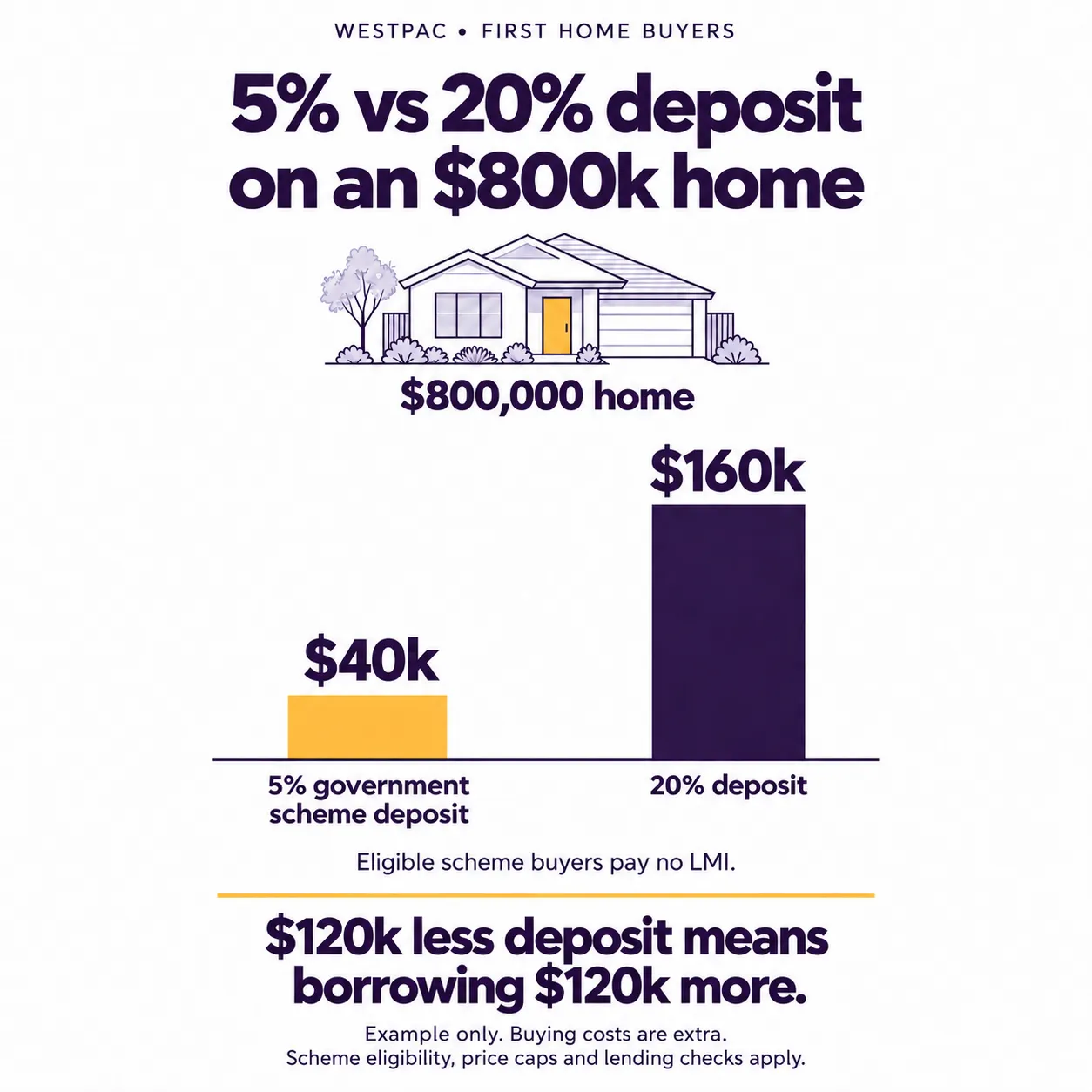
- No income caps, waiting list or place limit under the current scheme.
- You must meet the citizenship or permanent-residency, property, price-cap and owner-occupier rules.
- The loan must be principal and interest for up to 30 years.
- Westpac still completes its normal credit assessment.
- This option can't be used for owner-builder or cost-plus construction, construction on land you already own, debt consolidation, loan increases or a Streamlined Refinance.
Queensland price caps
- $1m
Brisbane, Gold Coast and Sunshine Coast
- $700k
Other Queensland locations
Could family help you buy?
How Westpac's Family Security Guarantee works
- You still need to afford the loanYou must still show that you can afford the loan and meet the normal credit requirements.
- Your family may not need to put their home on the lineAn eligible family member can support part of the loan with equity in their property. On an eligible Westpac loan, cash held in a Westpac term deposit may be used instead. The term deposit must cover the guarantee amount. This may suit a parent who has savings but doesn't want their home tied to your loan. Either way, the guarantee is limited to an agreed amount.
- Your family can apply to release the guaranteeOnce you have enough equity and a satisfactory repayment history, Westpac can consider releasing your family's guarantee. It'll check the property valuation and its current rules first.
Your guarantor may be a parent, step-parent, legal guardian, child, step-child, sibling or step-sibling, provided they meet Westpac's requirements.
Westpac says a guarantee can be up to 50% of the guarantor's security. Guarantors must obtain independent legal advice and should consider independent financial advice.
The guarantee can support an eligible owner-occupied purchase, licensed-builder construction or refinance. It has tighter rules for investment property and can't be used for bridging, owner-builder construction, cash out or debt consolidation. Read our guarantor home loan guide

Self-employed? Which income documents will you need?
Fast Track: use your last 2 tax assessments
If you have 2 recent Notices of Assessment, Fast Track may save you from providing full business financial statements. You'll usually need at least 20% deposit or equity. Westpac still checks the full application and normally won't increase the income figure by adding back business expenses under this option.
Using 1 year of financial records
Westpac may use your latest personal tax return, Notice of Assessment and business returns if you've been trading long enough and that year fairly reflects your business. If your business made a profit, Westpac normally counts 90% of that income. You'll usually need at least a 20% deposit or equity.
Using your full financial records
Westpac usually looks at 2 years of records for a full assessment. It may add back some business expenses, with supporting evidence, when working out your income. This can help if your financial statements give a clearer picture of what you earn than your Notices of Assessment.
We check which income documents Westpac will use before calculating how much you can borrow. Switching methods halfway through can change the income it counts and slow your application. Compare self-employed home loans
Buying before you sell? Westpac may help with the overlap
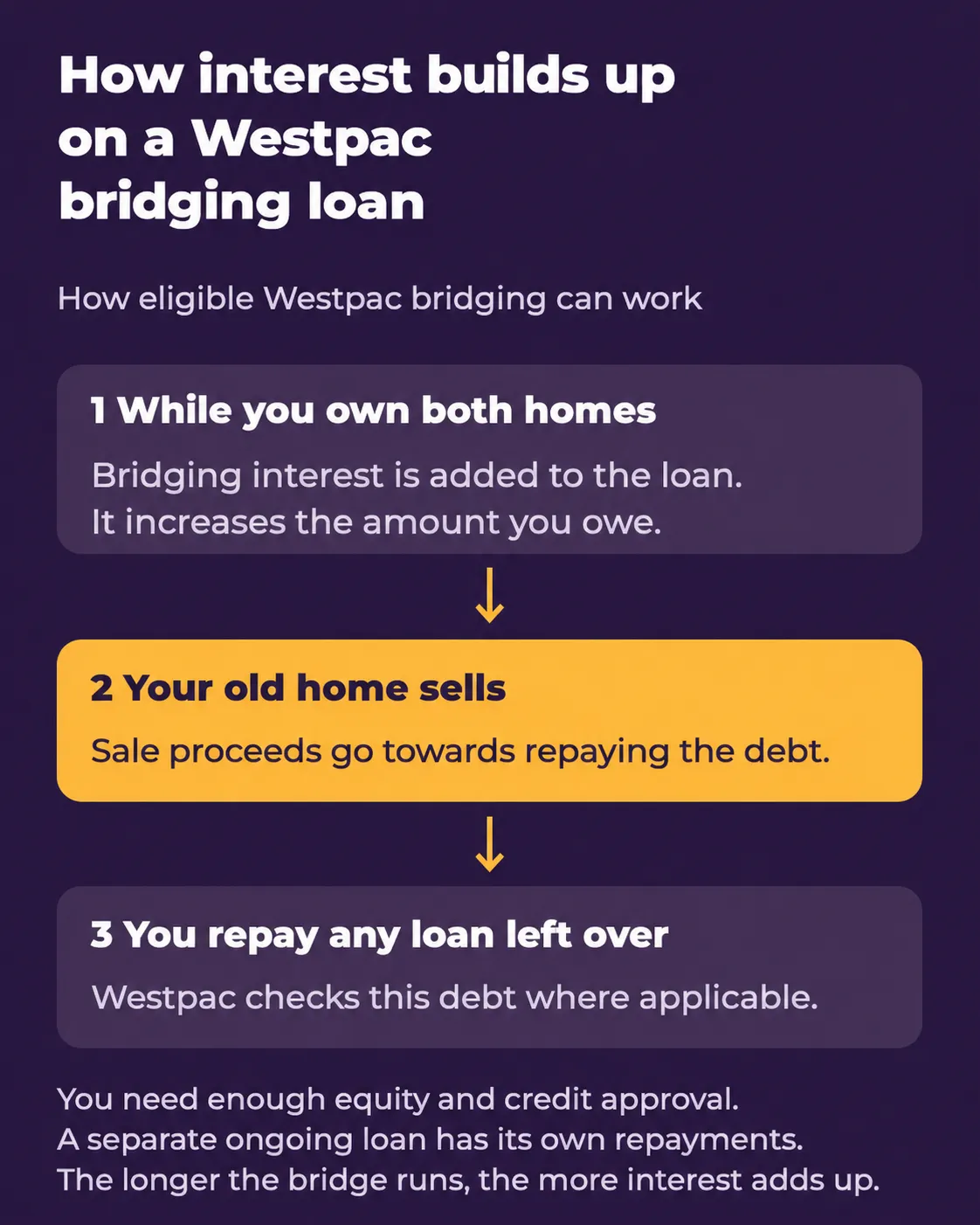
If you have enough equity, Westpac may let you add the interest on your bridging loan to the debt while you sell your current home. It can assess what you can afford using the loan left after the sale, where its policy allows.
This can ease the pressure on your cash flow while you own both homes. You still owe the interest, and a separate ongoing home loan has its own repayments. The longer your bridging loan runs, the more interest adds up.
Owner-occupied bridging
How Anthony bought before selling without paying the bridging interest each month
Anthony found his next home before he had sold his current one. He had enough equity to make the move, but covering a large bridging repayment while waiting for the sale was the challenge.
While he owned both homes: with some lenders, Anthony could have needed to pay about $8,450 a month in bridging interest. That would have put pressure on his cash flow while he waited for his old home to sell.
Westpac added the bridging interest to the loan, so he didn't have to pay it each month. It assessed whether he could afford the smaller home loan that would remain after his old property sold.
After the sale: the ongoing home loan repayment was about $3,090 a month. That was the repayment on the smaller loan, separate from the bridging interest above.
This gave Anthony room to buy his next home and sell his old one without having to cover the bridging interest each month. The interest still added to his debt and had to be repaid.
If you're looking to buy before you sell, we'll work through what you need to pay while you own both homes and what you'll owe after the sale. Your result depends on your circumstances and Westpac's credit approval.
How much deposit or equity will you need?
| Scenario | Maximum share of the property value you can borrow | When LMI applies |
|---|---|---|
| Investment, principal and interest | 95% | LMI applies unless an eligible waiver applies |
| Investment, interest-only | 90% | LMI applies unless an eligible waiver applies |
| Owner-occupied, principal and interest | 95% | LMI applies unless an eligible waiver or scheme applies |
| Owner-occupied, interest-only | 80% | The 80% cap applies even where mortgage insurance is available |
Deposit and equity requirements by loan type
Investment, principal and interest
- Maximum share of the property value you can borrow
- 95%
- When LMI applies
- LMI applies unless an eligible waiver applies
Investment, interest-only
- Maximum share of the property value you can borrow
- 90%
- When LMI applies
- LMI applies unless an eligible waiver applies
Owner-occupied, principal and interest
- Maximum share of the property value you can borrow
- 95%
- When LMI applies
- LMI applies unless an eligible waiver or scheme applies
Owner-occupied, interest-only
- Maximum share of the property value you can borrow
- 80%
- When LMI applies
- The 80% cap applies even where mortgage insurance is available
Westpac uses the lowest limit that applies to your application. Your property, repayment type or other circumstances may mean you need a larger deposit than the table suggests.
What counts as genuine savings?
You'll generally need 5% genuine savings if you're borrowing more than 90% of the property's value, or using the Australian Government 5% Deposit Scheme. Savings held over time, Australian property equity, eligible superannuation, extra loan repayments and qualifying rental history may count.
Where Westpac requires genuine savings, a gift can help cover your deposit and purchase costs but won't satisfy that requirement. Westpac doesn't usually count borrowed money, cash at home, builder incentives, money held in a business account or funds in an overseas bank account. We'll look at where your deposit came from and how long you've held it, then work out what evidence Westpac will need.
How much could you borrow with Westpac?
If you earn overtime or bonuses, or your HELP debt is nearly paid off, Westpac may be worth comparing. How much you can borrow still depends on your household expenses, credit limits and credit history. Westpac also checks whether you could afford repayments at a higher interest rate.
Income Westpac may count
- Bonus: Westpac can count 80% of an eligible bonus. You generally need 2 years with the employer, but bonus payments can cover a shorter period. A bonus shown on your current payslip may count sooner than you expect if the rest of the application fits.
- Frontline overtime and allowances: Westpac may use 100% for eligible hospital staff, police, firefighters and ambulance officers where the income is regular and evidenced.
- Company car: Westpac may add a $5k annual benefit to your income before tax if your arrangement qualifies.
- HELP or HECS: Westpac usually includes the compulsory repayment, but may exclude it when the debt will be cleared within 12 months and the evidence supports that.
- Rent: for an investment property, Westpac normally uses 90% of the gross granny-flat rent.
- Salary packaging: Westpac adds back 100% of your pre-tax deductions to taxable income. A novated lease is added back too, and the lease commitment still counts.
Our nurse salary packaging guide compares how other lenders treat packaging.
Our guide to how HECS affects your home loan explains what to compare before using your savings to pay it off.
Want the loan in one name?
If you and your partner want the home loan in just your name, here's what Westpac will check.
Check who needs to be on the loan
If you want the loan in one name, we need to check that borrower's income, debts and share of household costs. A partner joining as a co-borrower takes on responsibility for the loan and needs a separate assessment.
Westpac may use your share of joint commitments
If your partner isn't applying, Westpac may use your share of joint repayments and household costs when it checks what you can afford. That can help when your partner pays their fair share. Westpac still counts the whole joint debt in a separate check that compares total debt with total income, so it won't improve every part of the calculation.
Why borrowing power can still fall short
The Australian Prudential Regulation Authority (APRA) expects banks to test most new home loans at a rate at least 3% above the actual rate. Since February 2026, banks have also had to limit how much new owner-occupier and investor lending sits at 6 times income or more. These rules don't set your personal limit, but they can reduce how much a bank will lend.
Westpac home loans: Rocket Repay, Flexi First and fixed options
| Product or feature | Useful when | Main catch |
|---|---|---|
| Rocket Repay / Rocket Investment | You want redraw and up to 10 offset accounts. | The $395 annual package needs to earn its keep through pricing and features. |
| Flexi First | You want a simpler variable loan with no monthly fee. | No offset account. We'll explain the extra-repayment and redraw rules for the way you plan to use the loan. |
| Fixed Options | You value repayment certainty for part or all of the loan. | No offset account. We'll explain the extra-repayment limits and when break costs could apply. |
| Construction loan | You're building with a licensed builder and need progress payments. | Contract, valuation, contribution and property rules are stricter than a standard purchase. |
| Sustainable upgrades | You're financing eligible energy improvements. | We'll confirm whether your loan purpose, amount and chosen product qualify. |
Westpac loan products and features
Rocket Repay / Rocket Investment
- Useful when
- You want redraw and up to 10 offset accounts.
- Main catch
- The $395 annual package needs to earn its keep through pricing and features.
Flexi First
- Useful when
- You want a simpler variable loan with no monthly fee.
- Main catch
- No offset account. We'll explain the extra-repayment and redraw rules for the way you plan to use the loan.
Fixed Options
- Useful when
- You value repayment certainty for part or all of the loan.
- Main catch
- No offset account. We'll explain the extra-repayment limits and when break costs could apply.
- Useful when
- You're building with a licensed builder and need progress payments.
- Main catch
- Contract, valuation, contribution and property rules are stricter than a standard purchase.
Sustainable upgrades
- Useful when
- You're financing eligible energy improvements.
- Main catch
- We'll confirm whether your loan purpose, amount and chosen product qualify.
Not sure whether you need an offset? See how an offset account works before comparing the loan features and fees.
At Westpac, your offsets are Choice everyday accounts. You can link up to 10 of them to an eligible Rocket Repay or Rocket Investment variable loan, so bill money and savings can sit apart and still bring your interest down. Flexi First and fixed loans can’t have an offset. To see what other lenders allow and charge, have a look at our list of banks with multiple offset accounts.
If you and your partner are both on the loan, each account can be in either name or held jointly. Anyone who isn’t a borrower can’t be on a linked account.
Wait 2 days after settlement, then link the accounts in the app or online banking. Allow up to 5 business days for the link to start working, and check it’s active before you count on the saving.
Westpac home loan fees and the Premier Advantage package
- $395 yearly
Premier Advantage package
Eligible packaged lending of at least $150k.
- $350
Discharge administration fee
Listed for Rocket, Flexi First, fixed and bridging products.
- $100
Document processing fee
A separate external valuation fee can apply in some cases.
How fast is Westpac?
Westpac's broker service page listed these initial-review times when we checked on 11 September 2026. This is when it starts looking at a complete application. Loan approval comes later.
| Queue | Initial review | What may add time |
|---|---|---|
| Full application: pay as you go (PAYG), self-employed or trust | 1 business day | Missing documents, valuation, credit questions or property checks |
| Pre-approval: PAYG or self-employed | 1 business day | Conditional requirements and later property assessment |
| Application needing a policy exception | 1 to 2 business days | Extra approval level or more evidence |
| Document preparation | 1 business day | Changes to loan structure or borrower details |
When Westpac first reviews an application
Full application: pay as you go (PAYG), self-employed or trust
- Initial review
- 1 business day
- What may add time
- Missing documents, valuation, credit questions or property checks
Pre-approval: PAYG or self-employed
- Initial review
- 1 business day
- What may add time
- Conditional requirements and later property assessment
Application needing a policy exception
- Initial review
- 1 to 2 business days
- What may add time
- Extra approval level or more evidence
Document preparation
- Initial review
- 1 business day
- What may add time
- Changes to loan structure or borrower details
For the 5% Deposit Scheme, Westpac lists 1 business day but also warns that processing may take up to 1 extra business day. We'll check the queue before you rely on a date in your contract.
Can you extend a Westpac pre-approval?
Westpac pre-approval generally lasts 90 days. Westpac says you may be able to extend it for another 90 days if you haven't found a property and your finances haven't changed.
In the broker applications we handle, that extension means starting a new application. Westpac issues a new application number, runs another credit check and needs your documents submitted again, updated where needed.
Some other lenders can extend the original application without a fresh credit check, subject to their rules. If your search is taking longer, speak to us before the 90 days are up so we can organise the next step.
Streamlined Refinance: fewer statements, but you still need to qualify
Westpac may let you refinance without providing the usual 3 months of transaction statements. You still need to prove your income, and Westpac checks your credit history and ability to repay.
If you don't pass its usual borrowing-power check, Westpac may consider testing repayments at 1% above the actual rate instead of 3% above the actual rate. This needs special approval.
There are restrictions on repayments, existing debts and what the new loan can be used for. We'll start with your existing loan, repayments and debts, then work through the conditions below to see whether this option fits.
Already with Westpac? Is your rate still a good fit?
If you have more equity now than when your loan started, Westpac doesn't automatically move you to a better rate bracket. To use that improved equity for pricing, you need to apply for a replacement Westpac loan through an internal refinance.
How the internal refinance works
- Get a new valuationWestpac orders a new valuation and you complete a new home loan application.
- Update your income documentsProvide current payslips or other income documents, then go through a fresh credit assessment.
- Replace your loan if approvedIf approved, Westpac issues new contracts, pays out and closes the old loan, then sets up the replacement loan.
For example: you bought with a 10% deposit under the 5% Deposit Scheme. 2 years later, the loan is down to 70% of the property's value. Westpac still needs the internal refinance before it will use your improved equity for pricing. It generally waives its internal-refinance fees. If your income, expenses or credit position has changed, you may not qualify for the replacement loan. We'll assess whether you qualify for the internal refinance, then compare its costs with the alternatives before recommending it.
Selling, refinancing or paying off your Westpac loan? Our Westpac discharge guide explains how to start, what to have ready and how long to allow.
What we'll check before you commit
Standard homes
An established house, townhouse or standard unit is usually easier to finance, provided Westpac accepts the valuation and title.
Small apartments
Send us the apartment details before you make an offer. We'll check its size, building and postcode, because some units need a larger deposit or a different lender.
Unusual builds
Owner-builder, kit, relocatable, high-density and multiple-dwelling properties may need a larger deposit or another lender.
Apartments and high-density projects
Westpac usually starts at 40 square metres of internal living area, excluding balconies and car spaces. It also checks the postcode, its existing loans in the complex, how the building is used and how easily the property could be resold.
Some units must also appear on Westpac's approved development list. That's why a pre-approval can still fail after you choose an apartment: it checks your finances. Westpac checks the address, building and development later.
Read our guide to high-density apartment rules.
Granny flats, rental income and multiple dwellings
Westpac can consider one or two suitable dwellings on one residential title. To count granny-flat rent, the flat generally needs its own kitchen, bathroom and entrance, with one lease covering the whole property. Westpac can use 90% of eligible rent. Different rules can apply when you live in the main home and receive board.
Separate dwellings and dual-key properties generally need a larger deposit when mortgage insurance isn't used. Three or four dwellings need specialist review, and five or more are outside Westpac's standard home loan rules.
Construction, renovations and extra borrowing
A normal construction loan pays the builder in stages as work is completed. Owner-builder and kit-home projects are much harder to place. For some renovations up to $250k, Westpac may release the money in one amount, provided the loan doesn't need LMI and the current property value is enough.
That $250k figure only applies to this renovation setup.
Temporary visas, expats and foreign income
Westpac can consider some temporary visa holders and eligible Australian or New Zealand expats. Overseas salary income has tighter deposit and currency rules. Overseas business income normally needs separate approval. We check residency, citizenship and income requirements separately before confirming eligibility.
The visas Westpac accepts can change. We'll check your visa, how long is left on it, residency, ownership arrangements and income currency. We'll work through those details and the deposit needed before you make an offer.
Buying from family or sharing ownership
If you're buying with someone else, Westpac generally expects each person on the loan to own at least 30% of the property. If a parent, sibling or other family member will own a smaller share, tell us early. We'll check that ownership split with Westpac before you commit.
When you buy a property from family for less than market value, Westpac may use the valuation instead of the lower contract price to work out your deposit position. We'll look at the family relationship, proposed ownership and contract details first, then work through Westpac's valuation and lending requirements.
When Westpac is stronger, and when to look elsewhere
| Scenario | Westpac fit | Why |
|---|---|---|
| Doctor buying with a 5% deposit | Strong | An eligible professional waiver can remove LMI, subject to the borrower and property rules. Compare the registration requirements with ANZ before choosing a lender. |
| First home buyer under the Scheme cap | Strong | Westpac supports the 5% Deposit Scheme, with access to branches and eligible offset account options. |
| Self-employed with 2 clear, recent Notices of Assessment | Strong | Fast Track can avoid business financial statements when you have at least 20% deposit or equity. |
| Buying before selling with enough equity | Standout | With enough equity, Westpac can add bridging interest to the loan and assess affordability using the loan left after the sale. Some lenders assess the full temporary debt. |
| Buyer of a 38 square metre unit | Weak | Westpac generally starts at 40 square metres of internal living area. |
| Owner-builder or portable home | Weak | Westpac's standard residential policy is restrictive and another lender may fit better. |
| Existing customer whose loan has fallen from 90% to 70% of the property value | Cumbersome | Improved equity doesn't automatically change your pricing. You need to qualify for an internal refinance; Westpac generally waives its fees. See the existing-customer section for the steps. |
When Westpac is stronger, and when to look elsewhere
Doctor buying with a 5% deposit
- Westpac fit
- Strong
- Why
- An eligible professional waiver can remove LMI, subject to the borrower and property rules. Compare the registration requirements with ANZ before choosing a lender.
First home buyer under the Scheme cap
- Westpac fit
- Strong
- Why
- Westpac supports the 5% Deposit Scheme, with access to branches and eligible offset account options.
Self-employed with 2 clear, recent Notices of Assessment
- Westpac fit
- Strong
- Why
- Fast Track can avoid business financial statements when you have at least 20% deposit or equity.
Buying before selling with enough equity
- Westpac fit
- Standout
- Why
- With enough equity, Westpac can add bridging interest to the loan and assess affordability using the loan left after the sale. Some lenders assess the full temporary debt.
Buyer of a 38 square metre unit
- Westpac fit
- Weak
- Why
- Westpac generally starts at 40 square metres of internal living area.
Owner-builder or portable home
- Westpac fit
- Weak
- Why
- Westpac's standard residential policy is restrictive and another lender may fit better.
Existing customer whose loan has fallen from 90% to 70% of the property value
- Westpac fit
- Cumbersome
- Why
- Improved equity doesn't automatically change your pricing. You need to qualify for an internal refinance; Westpac generally waives its fees. See the existing-customer section for the steps.
Read our ANZ review for its medical registration requirements.
We'll compare how much you can borrow, what you'll need upfront and the repayments and fees for the same purchase.
Hunter Galloway lender rating
Westpac broker score
Westpac scores well for bridging, eligible professionals and some self-employed borrowers. Property restrictions and the work involved in getting existing-customer pricing deserve a closer look.
7.4/10
Good for the right scenario
Our rating across 6 categories
Score breakdown
Each category is scored out of 10
- Credit policy fitExcellent bridging, plus good professional and self-employed options9.0/10
- Borrowing capacityBridging can be assessed using the loan left after the old home sells8.0/10
- Property optionsStandard homes are simpler than unusual properties6.5/10
- Product and offset featuresUp to 10 offsets and a broad product range8.0/10
- Application speed and certaintyQuick initial review, but extending a broker pre-approval means a fresh application and credit check6.5/10
- Ongoing pricing and serviceFull service, but existing-customer repricing needs attention6.5/10

Experience and sources
How this guide was checked
Policy reviewed 11 September 2026 by Nathan Vecchio.
We use Westpac's public product information and detailed lending guidelines to compare its loan options. Confirm the current eligibility, fees and requirements for your application before relying on an option.

Joshua has worked in mortgage broking since 2011 and holds Diploma and Certificate IV qualifications in finance and mortgage broking.
This guide is general information only. It doesn't consider your objectives, financial situation or needs, and lender policy can change. Talk to a broker before acting on it.
Sources
- Westpac home loan product information
- Westpac interest rates and pricing
- Westpac refinance process and requirements
- Westpac Premier Advantage Package and offsets
- Westpac home loan fees
- Westpac Family Security Guarantee guide
- Westpac bridging loan and repayment guide
- Westpac self-employed application guide and policy overview
- Westpac healthcare LMI waivers and frontline overtime rules
- Westpac broker service levels and policy highlights
- Westpac broker niche booklet (renovation funding)
- Australian Government 5% Deposit Scheme FAQs
- APRA serviceability buffer explanation
- Moneysmart guidance on switching home loans
Public pages checked 11 September 2026; healthcare LMI waivers rechecked 6 October 2026. Income, bonus, company car, HELP and granny-flat rules use Westpac's broker lending guidelines dated 1 September 2026. Scheme price caps checked 31 August 2026.
Westpac's rules, rates, fees, price caps and service times can change. We confirm the current position before recommending a lender or submitting an application.
What home buyers say about us
 Google
“Clear, incredibly responsive and accurate.”
- Google
“Preapprovals done quickly and efficiently.”
- Google
“Reassuring every step of the way.”
More help with your home loan
- Upfront costs
LMI waivers explained
Check the professions, deposits and lender rules.
Read guide - First home buyers
5% Deposit Scheme
Understand eligibility, deposits and price caps.
Read guide - Family support
Guarantor home loans
See how limited family security can work.
Read guide - Business owners
Self-employed home loans
Compare income methods and documents.
Read guide - Loan features
Offset accounts
Work out whether an offset will save more than it costs.
Read guide - Compare another major
CommBank home loan review
Compare policy, products and borrower fit.
Read review
Westpac home loan FAQs
These are the Westpac questions clients ask us most often.
Not sure whether Westpac is your best option?
We compare Westpac with more than 30 lenders and show you which options fit your income, deposit and property before you apply.
or call 1300 088 065
Hunter Galloway Finance Pty Ltd is Credit Representative 476903, authorised under Australian Credit Licence 389328.
Client examples are based on real situations. Names and identifying details have been changed.