


You've signed the contract. I'd get the deposit, finance and inspection dates in one place now so you know what's due first.
Send the complete contract, including any extra conditions, to your broker and solicitor today. Your broker can start the lender’s remaining checks while your solicitor confirms the contract deadlines. Arrange insurance early too, because responsibility for the property can start before settlement.
The steps below cover the loan, purchase money and checks between signing and getting the keys. Use the Queensland examples alongside your own contract.
Start with the dates in your signed contract
Ask your solicitor to confirm when the contract became binding and which deadlines apply. Add those dates to your calendar, with a reminder early enough to do the work before each deadline.
Start with the dates in your signed contract
Scroll to see more columns
| Date to confirm | Your next action | Who helps |
|---|---|---|
| Initial and balance deposit | Pay the agreed amounts to the verified account and keep the receipts | Deposit holder and solicitor |
| Insurance responsibility | Arrange the cover required from the correct date | Solicitor and insurer |
| Cooling off, if applicable | Get advice promptly if you’re considering withdrawing | Solicitor |
| Finance condition | Provide the contract and documents; confirm approval or any extension before the deadline | Broker, lender and solicitor |
| Building and pest condition | Book the inspection, read the report and decide what to do about findings | Inspector and solicitor |
| Settlement | Finish documents, identity checks and funding arrangements | Broker, lender and solicitor |
- Your next action
- Pay the agreed amounts to the verified account and keep the receipts
- Who helps
- Deposit holder and solicitor
- Your next action
- Arrange the cover required from the correct date
- Who helps
- Solicitor and insurer
- Your next action
- Get advice promptly if you’re considering withdrawing
- Who helps
- Solicitor
- Your next action
- Provide the contract and documents; confirm approval or any extension before the deadline
- Who helps
- Broker, lender and solicitor
- Your next action
- Book the inspection, read the report and decide what to do about findings
- Who helps
- Inspector and solicitor
- Your next action
- Finish documents, identity checks and funding arrangements
- Who helps
- Broker, lender and solicitor
The settlement date is the date agreed in the contract. A 30 day period is common in Queensland, but your purchase may allow more or less time. Work from the signed terms rather than a general timetable.
Find the details you'll need during settlement
Work through the signed contract with your solicitor
- Check the buyer names, property address and title description match the purchase you intend to make.
- Check the inclusions, exclusions and whether you’re buying with vacant possession or a tenant.
- Read the special conditions and any signed changes alongside the printed contract. Ask which extra terms change what you need to do or when.
Cooling off and finance are separate
Many Queensland residential private sales have a cooling off period of 5 business days. Exceptions apply, including auction-related purchases. If you use cooling off to end the contract, the seller may retain up to 0.25% of the price. On a $500k purchase, that is $1,250.
Have your solicitor calculate the deadline and explain the notice required. The period is linked to receiving the fully signed contract, with specific rules about business days. Queensland's cooling off guidance explains the starting point and exceptions.
Cooling off, finance and inspection conditions have separate deadlines. Keep each date on your calendar, along with the action due that day.
Pay the deposit agreed in the contract
Your contract sets the initial deposit, any later balance, when each payment is due and who holds the money. It's commonly held in the agent's or solicitor's trust account until settlement.
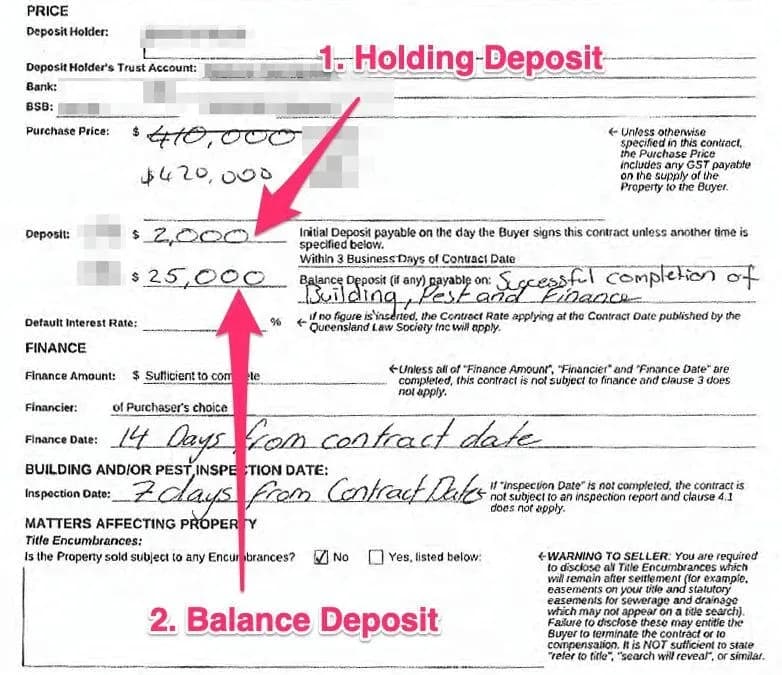
Check the payment details before transferring
Phone the agent or solicitor using a number you've independently verified. Confirm the account name, BSB, account number, reference and amount. Take particular care if an email says the details have changed.
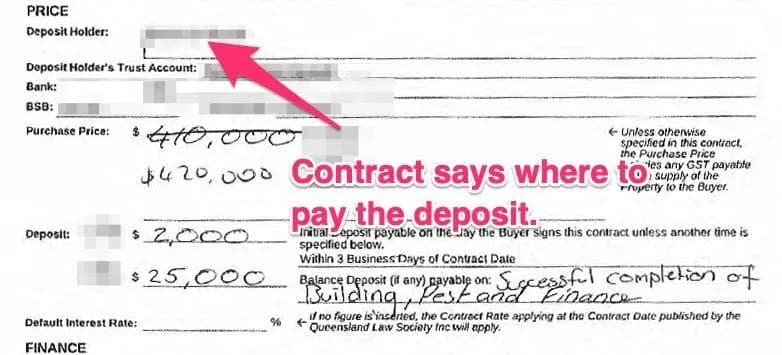
Check your daily transfer limit and allow for the time your bank needs to process the payment. After paying, send the receipt and ask the deposit holder to confirm it arrived. Keep both confirmations with your contract.
If you think a payment will be late, tell your solicitor before the due date. They can explain the consequences and contact the seller's representative where needed. A late payment should be dealt with promptly rather than assuming the contract has automatically ended.
How the contract deposit affects settlement
The contract deposit forms part of what you pay for the property. It reduces the amount still owing at settlement. It may differ from the total cash contribution your lender requires.
For a $500k purchase with a $450k loan, your contribution towards the price is $50k. If you've already paid $10k under the contract, another $40k is needed towards the price at settlement. Duty, fees and adjustments are additional.
This distinction matters when someone asks you to increase the contract deposit. Paying more of the same contribution earlier changes when the cash leaves your account; it doesn't by itself reduce the final loan amount.
Our first home buyer guide explains how the deposit fits into the wider purchase budget.
Arrange insurance straight away
In Queensland, responsibility for the property usually passes to you at 5pm on the next business day after the contract date. Have your solicitor confirm the date in your contract and arrange the cover you need to start in time.
Waiting until settlement can leave a gap between becoming responsible for the property and taking out insurance. The consequences of damage depend on the contract and law, so tell your solicitor immediately if something happens before settlement.
What to confirm with the insurer
- Confirm the property address and the date cover starts.
- Check the building sum insured and what is included.
- Discuss relevant risks and exclusions, including flood cover where appropriate.
- Confirm the lender's requirements and any certificate of currency needed.
- Explain any tenancy, vacancy or planned work that could affect the cover.
Check that the policy is active. An indicative quote alone doesn’t put cover in place. Insurers have different application and payment processes, so confirm what is needed to start the policy.
For a unit or townhouse, ask for details of the body corporate insurance. Find out what it covers and what you need separately for your lot, contents and other risks. Queensland Government insurance guidance explains the general position.
Get your loan formally approved
If we’re arranging your loan, I’ll start with the contract price, the amount you need to borrow and the time left for approval. We’ll check the lender’s remaining requirements and tell you which documents to send next. If another broker is handling your loan, get that list from them now.
A pre-approval is useful preparation. The lender still needs to complete the checks for this purchase, which can include a valuation and updated income or savings documents.
The steps from contract to approval
- Your broker checks the price, proposed loan, contract dates and property details.
- You provide any updated payslips, account statements or other documents requested.
- The lender completes its property assessment and any required valuation.
- You and your broker resolve outstanding questions or conditions.
- The lender issues its approval. Your broker explains it before your solicitor handles the finance notice.

Client story
Rachel and Emma had their application ready before signing
Rachel and Emma had their application assessed and their documents ready before offering on a Brisbane home above $1.7m. After checking the lender's timing, they offered a 5 day finance period and the seller accepted. Their full story shows the preparation that made that deadline possible.
If you've already signed, send us the contract and exact finance deadline. We'll check what the lender still needs and how much time is available.
If the lender asks for a document, return the complete version promptly. A missing page, an unclear transaction or a name that doesn't match can take time to resolve.
Avoid taking on new credit or changing your employment arrangements without discussing the effect on the application. Keep the cash needed for the purchase available until settlement is complete.
If the valuation comes in lower
A lower accepted value can change the loan amount or the cash you need. Your broker should calculate the shortfall and compare the available options before the finance deadline.
For example, if a planned loan is 90% of a $700k property value, it would be $630k. If the lender instead accepts $670k and the 90% limit remains, the loan becomes $603k. That is another $27k cash towards the unchanged purchase price, before costs.
Our valuation guide explains the calculation, and our valuation challenge guide covers the evidence needed when a result appears wrong.
When finance is approved
Have your broker explain the approval and anything still needed for settlement. Your solicitor can then handle the formal finance notice to the seller’s representative. Keep a copy of that confirmation with your contract.
If approval is delayed or declined
If approval is running late, use the steps below to request more time. The seller may agree, refuse or suggest different terms. The current deadline still applies until the extension is agreed.
How to request a finance extension
- Ask your broker what remains outstanding and how much extra time is needed.
- Give that update to your solicitor before the current deadline.
- Have your solicitor send the request in the required form.
- Wait for confirmation of the agreed extension and record the new date.
- Keep supplying the lender's remaining documents while the request is being handled.
Keep the agent informed while the request is considered. If the seller hasn't agreed, get advice before the current deadline so you still have time to act under your contract.
If the loan is declined, your broker may be able to investigate a different lender or structure. At the same time, your solicitor needs to deal with the current contract deadline. A decline doesn’t automatically cancel the purchase or refund the deposit.
Our pre-approval guide explains what can still change after the bank gives an initial borrowing figure.
Get the loan ready for settlement
If we're arranging your loan, send us the signed contract and finance date. We’ll check what the lender still needs and the time available. Keep your solicitor involved for contract notices and extensions.
or call 1300 088 065
Have your signed contract and upcoming dates handy.
Arrange building and pest inspections
Book the inspection early enough to receive the report, ask questions and investigate significant findings before the condition expires. Ask the inspector about availability, what the inspection covers and the cost for that property.
A combined building and pest inspection may be available. Quotes depend on the size, location, access and scope of the inspection, so confirm the fee rather than relying on a general price range.

The report can identify issues you wouldn't see at an open home, including termite damage, moisture, drainage problems and structural concerns. Ask about inaccessible areas and any specialist inspection recommended.
Work out what a finding means before deciding
Read the summary and the detailed findings. Ask the inspector to distinguish immediate safety concerns, structural issues, repairs and ordinary maintenance. Where the cost matters to your decision, obtain an appropriate specialist opinion or repair quote.
What to investigate after the building and pest inspection
Scroll to see more columns
| Finding | What to investigate next |
|---|---|
| Termite activity or damage | Whether activity is current, the extent of damage and treatment or repair needs |
| Movement or structural cracking | Whether an engineer or other specialist should inspect |
| Moisture or leaking areas | The source, affected areas and likely repair scope |
| Roof or deck deterioration | Safety, remaining life and whether repair or replacement is needed |
| Suspected unapproved work | Council records and your solicitor's advice about approvals |
| Electrical or other safety concerns | A suitably licensed specialist's assessment |
- What to investigate next
- Whether activity is current, the extent of damage and treatment or repair needs
- What to investigate next
- Whether an engineer or other specialist should inspect
- What to investigate next
- The source, affected areas and likely repair scope
- What to investigate next
- Safety, remaining life and whether repair or replacement is needed
- What to investigate next
- Council records and your solicitor's advice about approvals
- What to investigate next
- A suitably licensed specialist's assessment
An inspection finding doesn’t automatically require the seller to repair the item or reduce the price. Your report, the contract wording and the action taken before the deadline matter.
Jayden’s experience
What inspections picked up before Jayden bought
Jayden spent more than $2k on inspections across several properties before finding the right home. The reports raised issues including concrete deterioration, water getting through walls and termite damage. One property had water-related work estimated at about $9k.
The value was finding those problems before committing to the purchase. Use the report to understand the work and decide whether the property still suits your budget and plans.
If the report changes your decision
Send it to your solicitor promptly. Explain whether you want to continue, seek an agreed repair or price change, or discuss ending the contract under an available condition.
Get any agreement recorded correctly. Our guide to renegotiating after a building inspection explains how the report and repair information can support the conversation.
Check what the disclosure documents leave for you
Queensland's seller disclosure scheme began on 1 August 2025. Required disclosure is generally provided before the buyer signs, subject to the scheme's exceptions.
If required documents were missing, or information was materially wrong or incomplete, send the details to your solicitor now. A right to terminate may be available before settlement. Different tests and exceptions apply, including what you knew and whether you would have signed had you known the true position. Your solicitor can check the right and give the required notice.
Those documents don’t replace the building inspection or every property search. Ask your solicitor about the checks needed for flooding, approvals, easements, body corporate records and your intended use. Our FloodWise report guide can help with Brisbane flood research.
Sign your loan documents and organise the money
Read and return the loan documents promptly. Check the borrower names, loan amount, rate type, repayments, account details and any conditions still to be met before the lender will release funds.
Complete identity checks and provide the insurance evidence requested. Ask how documents should be signed and returned. If something is wrong, get it corrected rather than changing the document yourself without instructions.
The lender needs time to check the returned documents. Ask your broker to confirm when they have been accepted and whether anything remains outstanding for settlement.
An early finance approval still leaves loan documents, identity checks, cleared funds and insurance to organise. Those steps mattered in Katie’s offer: her 25 day settlement suited the seller’s move. We’ll check how quickly the lender can finish its work so you can plan around your signed settlement date.
Work out the cash needed to complete
Your solicitor will calculate the final amount you need to provide. It includes the unpaid purchase price, costs and adjustments, less the lender's funds and deposit already paid.
How the remaining cash comes to $112k
Scroll to see more columns
| Example settlement calculation | Amount |
|---|---|
| Purchase price | $600k |
| Assumed duty and other purchase costs | $20k |
| Assumed settlement adjustments | $2k |
| Less loan funds | $480k |
| Less deposit already paid | $30k |
| Remaining cash required | $112k |
The purchase-price balance after the loan and paid deposit is $90k. The assumed $22k of costs and adjustments brings the cash required to $112k. The cost figures are example allowances; your solicitor's statement provides the actual amounts for your purchase.
Ask which account should hold the money, when it must be cleared and whether the lender can draw the shortfall from a linked account. Check transfer limits and withdrawal notice periods before the final day.
Our stamp duty guide and buying costs guide explain costs that can sit outside the deposit.
Understand settlement adjustments
Rates, water charges and body corporate levies can cover a period shared between you and the seller. The settlement calculation allocates those amounts under the contract.
If the seller has paid a charge for a period extending beyond settlement, you may reimburse the share that relates to your ownership. Other adjustments can move the figure in the opposite direction. Check the dates and amounts on the statement.
For a tenanted property, ask how rent, the bond, arrears and management arrangements will be dealt with. If you plan to move in, have your solicitor confirm the agreed possession arrangements and what is required under the tenancy.
Complete the final inspection and arrange the move
Arrange the final inspection close enough to settlement to check the handover condition, while leaving time to report problems. Ask the agent about access and take the contract's inclusions list and any written repair agreement with you.
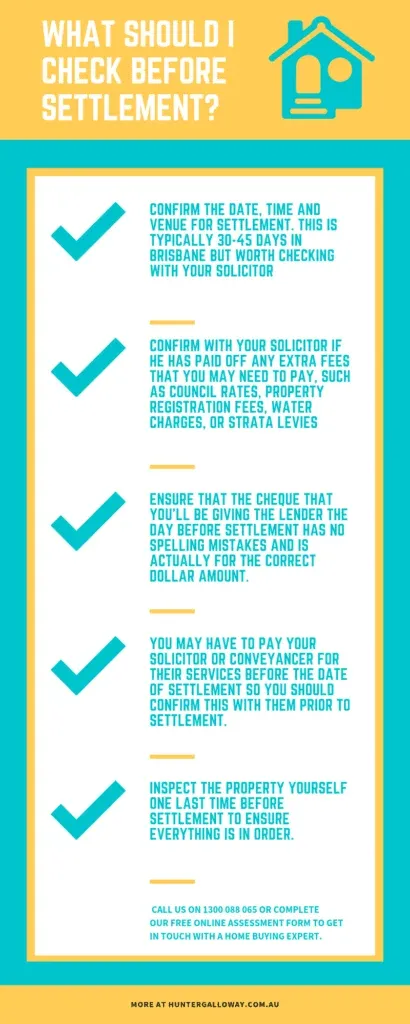
What to test at the final inspection
- Check included lights, fans, air conditioning and appliances where access and conditions allow.
- Run taps and look for leaks, damage or changes since your earlier inspection.
- Test included garage remotes and confirm keys are available.
- Check pool equipment where relevant and included in the sale.
- Confirm agreed repairs have been completed.
- Check that agreed inclusions remain and the handover condition matches the contract.
Take photos of new damage or unresolved issues and send them to your solicitor. They can advise what can be requested before settlement. Avoid withholding funds or delaying settlement yourself without that advice.
Utilities, mail and keys
Book electricity, gas and internet arrangements for the appropriate date. Check connection lead times and any access requirements. Arrange mail redirection and update your address with organisations that need it.
Give yourself some flexibility with removalists. The settlement booking time is not a guarantee you'll have the keys at that exact minute. Confirm who will release them once settlement has completed.
If you want access before settlement, have your solicitor arrange written terms first. Insurance, responsibility for damage, any payment and what happens if settlement is delayed all need to be addressed.
What happens on settlement day?
Your solicitor or conveyancer coordinates the transfer and payments with the lenders and other representatives. Many transactions settle electronically, so you generally don’t attend a meeting to exchange cheques.
The lender releases funds when its settlement requirements are met. Your contribution is applied, the seller's arrangements are completed and the legal transfer is processed. PEXA's buyer and seller information explains electronic settlement.
Wait for confirmation that settlement has completed before collecting keys or moving in. Keep the settlement statement and lender documents with your purchase records.
If settlement is delayed
If settlement looks likely to be late, ask your broker what’s holding up the funds and how long it will take to fix. Give that update to your solicitor so they can deal with the contract deadline.
Standard REIQ contracts have ways to extend settlement, subject to conditions and notice requirements. Your solicitor can check which applies and arrange the notice.
The 2025 REIQ contract also introduced a limited automatic extension where late changes cause an electronic settlement workspace to become unsigned and the required signatures are not restored in time. This is a specific settlement situation, separate from an ordinary request for more time to obtain finance. Queensland Law Society explains the change.
If an extension is unavailable or not used correctly, delay can have serious consequences, including costs or termination rights. Let your solicitor handle the legal response while the broker and lender resolve the funding issue.
If your sale and purchase need to settle together
Tell your solicitor and broker if the money from selling your current home is needed to complete this purchase. The sale proceeds must cover the old mortgage and sale costs before the available balance can fund the next property.
Give them both contracts, the proposed dates and details of any linked refinance. They can coordinate the lender payouts and settlement funds, and identify whether one transaction depends on another.
A delay further along the chain can leave your purchase short of money even when your own loan is ready.
Agree a fallback before moving day: who contacts the other parties, what extension the contract permits and whether you need temporary accommodation. Our simultaneous settlement guide explains the choices when you're buying and selling together.

What if the seller wants to withdraw?
Give the correspondence to your solicitor promptly. The seller's rights, your possible remedies and what happens to the deposit depend on the contract and circumstances.
Avoid agreeing to release the deposit or end the deal before you understand the consequences. Keep records of the communication and costs already incurred, including legal work and inspections.
Your solicitor can explain whether to seek completion, negotiate an outcome or pursue another remedy. A court process has costs and risks, so the appropriate response depends on the particular purchase.
Buying in another state
The steps of finance, inspections, funding and settlement still matter, but the contract process, cooling off and insurance timing differ. NSW generally uses contract exchange; Queensland buyers commonly sign the proposed contract as their offer. Victoria and South Australia have their own disclosure and cooling off rules.
Use a legal adviser experienced in the state where you're buying. Ask them to confirm the binding date, withdrawal rights, deposit obligations, insurance responsibility and settlement notices for your contract.
Questions to ask when buying interstate
Scroll to see more columns
| Where you’re buying | What to confirm with your legal adviser |
|---|---|
| NSW | When exchange occurred, whether cooling off was changed or waived, and what notices apply if settlement is delayed. |
| Victoria | How the signed contract and special conditions deal with a delay, and when to raise final-inspection issues. |
| Western Australia | What the offer and acceptance contract requires if either party can’t settle on the agreed date. |
- What to confirm with your legal adviser
- When exchange occurred, whether cooling off was changed or waived, and what notices apply if settlement is delayed.
- What to confirm with your legal adviser
- How the signed contract and special conditions deal with a delay, and when to raise final-inspection issues.
- What to confirm with your legal adviser
- What the offer and acceptance contract requires if either party can’t settle on the agreed date.
Use the official NSW contracts and deposits guide, Victorian settlement guidance or WA settlement guide as a starting point. Your solicitor can apply the relevant rules to your signed terms and give any notice required.
Our making an offer guide includes a state comparison, and our auction guide covers the different preparation needed before bidding.
Check the remaining steps for my loan
If we're handling your finance, we'll confirm the lender's outstanding documents, valuation and settlement requirements. Keep your solicitor involved so the loan and contract dates stay coordinated.
or call 1300 088 065
Have your signed contract and upcoming dates handy.
Common questions
Experience and sources
Sources and further reading
Queensland Government guidance explains the cooling off, insurance and seller disclosure rules referred to here. The Queensland Law Society source covers the 2025 REIQ settlement extension changes, and PEXA explains how electronic settlement works.

Sources
General information only. Your loan options depend on your circumstances and the lender’s assessment. Get legal or tax advice where relevant to your decision.
Client names and some amounts have been changed for privacy.