
In this Bankwest home loan review, we’re diving into the details that actually matter for 2026—from their 98% LVR options to the unique 40% fixed-rate offset—to see how they really stack up against the Big 4.
Choosing the right lender for your first home isn’t just about chasing the lowest headline rate, and as a mortgage broker in Brisbane, we know that the right policy and tech can save you much more in the long run.
Let’s dive in!
Things Bankwest Are Pretty Good At
Bankwest has been around since 1895 and joined the Commonwealth Bank Group (CBA) in 2008. By 2026, they have evolved into a fully digital bank. They position themselves as a nimble, tech-first alternative to the “Big 4”.
If you are a first-home buyer, you should keep Bankwest on your radar. Here is why.
- Competitive Interest Rates – Bankwest often beats the major banks on price. Since they don’t have expensive branches to run, they pass the savings to you. This allows them to offer aggressive rates to win your business.
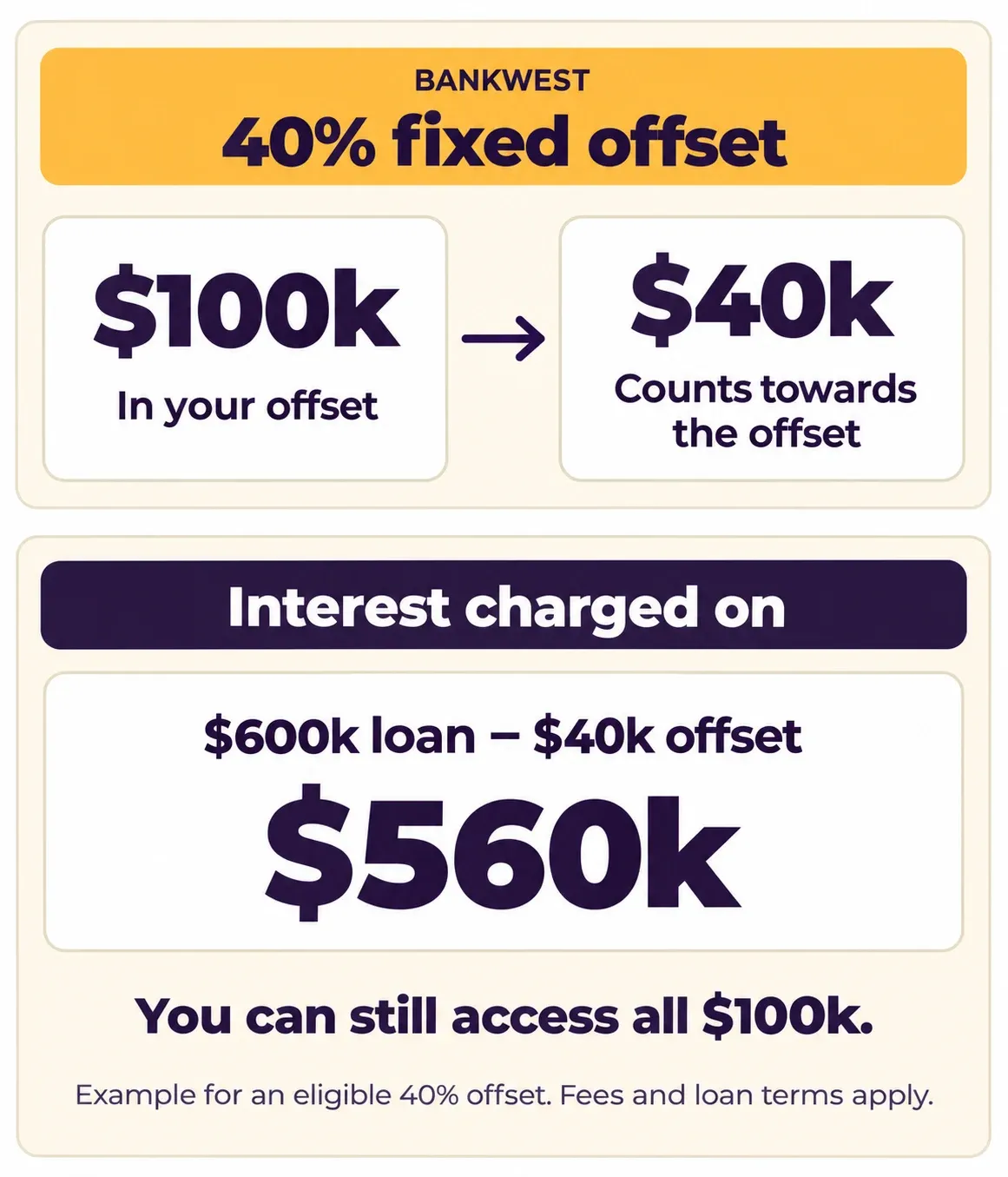
- Smart Loan Features – Their Complete Home Loan package is a standout. It allows for up to 9 offset accounts to help you save on interest. Plus, they offer an offset facility on fixed-rate loans. Note that this is a 40% offset benefit on fixed terms, which is still better than most lenders.
- Low Deposit Options (98% LVR)
This is a massive win for first-home buyers. Bankwest lends up to 98% of the property value (including LMI) for eligible borrowers. You could potentially buy a home with just a 2% deposit plus costs. Most competitors cap this at 95%, giving Bankwest a clear edge. - Top-Tier Digital Experience – Bankwest has gone all-in on digital. Their app is fast, intuitive, and handles almost everything. You can upload docs and track your loan without mountains of paperwork. It is a smooth process for digital-savvy buyers.
- Big Bank Security – You get the speed of a digital lender with the safety net of CBA. Knowing your lender is backed by Australia’s largest bank provides peace of mind. For cash transactions, you can simply use Bank@Post at any Australia Post outlet.
The Bottom Line
Bankwest is a strong contender for first-home buyers and young families. Their ability to lend up to 98% LVR is a game-changer if you have a smaller deposit.
Of course, choosing a home loan is not just about one lender. Let’s see how Bankwest stacks up against the competition on rates, fees, and policy.
Bankwest Vs. The Big 4: How Do They Stack Up?
As a first-home buyer, you are likely weighing up Bankwest against household names like Commonwealth Bank (CBA), Westpac, and ANZ. While the major banks offer extensive branch networks and well-known first-home programs, Bankwest often competes by being more agile on price and features—a critical advantage in today’s rising rate market.
Here is how they compare across the key areas that impact your wallet:
Interest Rates Comparison (The "Rising Rate" Reality)
In a climate of rate hikes, price has become the single biggest deciding factor for most buyers.
- Bankwest: For an owner-occupier with a 20% deposit (80% LVR), variable rates sit around 6.10% p.a. (potentially dropping to ~5.99% p.a. with a larger deposit). Bankwest is aggressively targeting borrowers with lower LVRs to keep their book quality high.
- The Big 4 (CBA, Westpac, ANZ): The majors have passed on recent RBA hikes more fully, with package rates often sitting in the 6.40% – 6.60% p.a. range for similar loans. While they still advertise lower “introductory” rates, these often revert to a much higher standard rate after 1–2 years.
- The Bottom Line: Bankwest currently holds a rate advantage of roughly 0.20% – 0.40% over the majors. On a $500,000 loan, that 0.30% gap saves you about $1,500 in interest in the first year alone—money that is better in your pocket than the bank’s.
Fees and Charges
High fees can eat into the savings from a low rate, but Bankwest structures its fees very similarly to the big banks.
- Upfront Fees: Bankwest often charges $0 upfront (application/valuation fees) if you choose their “Complete Package.” The big banks typically charge ~$600 for application fees unless you catch a specific waiver promotion.
- Annual Package Fees: This is an industry standard. Bankwest charges $395 per year for their package, which is identical to the fees charged by CBA, Westpac, and ANZ.
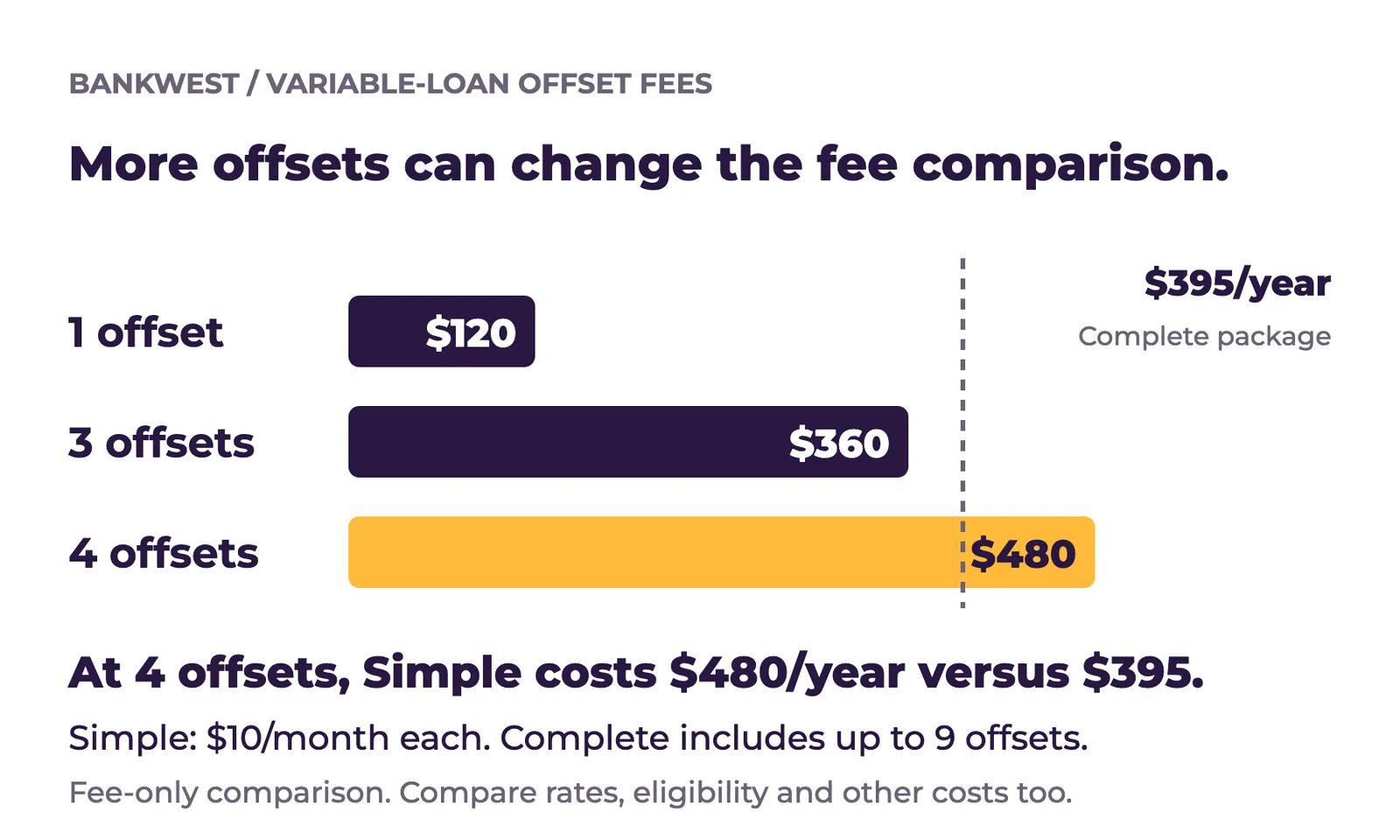
- Offset Fees: If you don’t choose a package, most lenders (including Bankwest and CBA) charge ~$10/month for an offset account. However, most buyers opt for the package to avoid these nickel-and-dime costs.
Features & Flexibility (The "Secret Weapon")
This is where Bankwest differentiates itself most aggressively from the traditional banks.
- Multiple Offset Accounts: Bankwest allows up to 9 offset accounts linked to a single loan. This is perfect for “bucket” budgeters (e.g., separate offsets for Bills, Holidays, Tax). In comparison, CBA and ANZ typically only allow one offset account per loan split. (Note: Westpac has recently upgraded to allow 10 offsets on new packages).
- Fixed Rate Offsets: Uniquely, Bankwest offers a 40% partial offset on fixed-rate loans. Most major banks do not allow any offset functionality on fixed loans. In a volatile rate market, this gives you a rare safety net: you can lock in a rate for stability but still use your savings to reduce interest.
- LMI Capitalisation: Bankwest allows you to borrow up to 98% LVR inclusive of LMI (Lenders Mortgage Insurance). Many other banks cap this at 95%, meaning you might have to pay the LMI difference out of your own pocket—a huge hurdle when cost-of-living pressures are making saving for a deposit harder.
Service & Approval Speed
The trade-off for Bankwest’s features is often physical presence.
- Digital vs. Physical: Bankwest is a digital-first lender with very few branches outside of WA. If you prefer face-to-face service, a major bank like CBA or Westpac is a better fit. However, Bankwest’s app is highly rated for its “Easy Alerts” and self-service features.
- Speed: Bankwest is historically faster with approvals than the big banks, often turning around clear applications in days rather than weeks.
- Policy Wins: Bankwest can be more flexible with overtime income (often using 100% of it if consistent) compared to some majors that shave it down. However, they are stricter on foreign income.
Summary Comparison: Bankwest vs. Major Banks
Feature | Bankwest Home Loans | Major Competitors (CBA, Westpac, ANZ) |
Interest Rates | Lower. Generally ~0.20% – 0.40% cheaper than the majors. | Higher. Often carry a “brand premium” unless negotiated heavily. |
Offset Accounts | Multiple. Up to 9 offsets per loan. | Single. Usually 1 offset per loan (except Westpac). |
Fixed Rate Offset | Yes (Partial). 40% offset benefit allowed on fixed loans. | No. Offsets rarely available on fixed loans. |
Package Fee | $395/year. Standard market rate. | $395/year. Standard market rate. |
LVR Cap (with LMI) | 98%. Can capitalize LMI up to 98% LVR. | 95%. Usually capped at 95% inclusive of LMI. |
Service Model | Digital-First. Great app, fast approvals, few branches. | Omni-Channel. Extensive branch networks for in-person support. |
Bankwest Home Loan Products: Which One Fits You?
Bankwest offers a range of products to suit different borrower needs. For a first-home buyer, the decision usually boils down to a few key choices: Do you want a “no-frills” basic loan or a fully featured package? Do you prefer the certainty of a fixed rate or the flexibility of a variable one?
Here is a breakdown of the main options:
1. Bankwest Complete Home Loan Package (The "All-Rounder")
This is Bankwest’s flagship product and the most popular choice for borrowers who want flexibility. It bundles your home loan with other banking products for a single annual fee of $395.
- Interest Rate Discounts: Package customers access discounted interest rates that are often significantly lower than the standard variable rate. The discount typically scales with your loan size and Loan to Value Ratio (LVR)—meaning larger loans with deposits of 20% or more (80% LVR or lower) often get the sharpest pricing (e.g., variable rates starting from ~5.49% p.a. for 80% LVR).
- Offset Accounts (The Star Feature): You can open up to 9 offset accounts on variable loans at no extra cost. Uniquely, if you fix your loan under the package, you can also access a 40% offset account—a rare feature that allows you to offset some interest even while locked in.
- Credit Card: The package includes an annual fee waiver on eligible Bankwest credit cards. You can choose from options like the Bankwest Qantas Mastercard (for points), the More Mastercard, or the Breeze Mastercard.
- Split Loans: You can split your loan (e.g., part fixed, part variable) to manage rate risk without paying extra fees for each split.
- Construction Perk: If you are building, the package covers fee-free progress payments, saving you money during the build phase.
Best For: Borrowers who want to maximize interest savings using multiple offset “buckets” or those building a home who want to avoid extra transaction fees.
2. Bankwest Simple Home Loan (The "No-Frills" Option)
If you hate fees and want a straightforward loan, the Simple Home Loan is the alternative.
- Zero Ongoing Fees: There are typically no monthly service fees or annual package fees.
- Competitive Rates: The headline interest rate is often very competitive, sometimes matching the package rate for certain LVR tiers.
- Redraw Only: This loan comes with a redraw facility rather than an offset account.
- Note: You can add an offset account to this loan, but it costs ~$10/month. If you need an offset, the math usually works out better to just get the Complete Package.
- Loan Size: This product may accommodate smaller loan sizes compared to the Package (which often requires a minimum of ~$200k).
Best For: First-home buyers on a tight budget who want to avoid the $395 annual fee and are happy to manage their extra repayments via a redraw facility rather than an offset account.
3. Fixed Rate Home Loan
Bankwest offers fixed terms ranging from 1 to 5 years. While you can get this as a standalone loan, most borrowers bundle it into the Complete Package to avoid monthly fees and access the partial offset feature.
- Fees (Standalone vs. Package): If you take a standalone fixed loan (without the package), be aware that a $12 monthly loan maintenance fee applies. Most buyers opt for the package to waive this.
- Offset Account: Uniquely, you can add a 40% Offset Transaction Account to this loan. This allows you to offset some of your interest, even while your rate is locked in.
- Repayment Limits: Unlike variable loans, fixed loans have strict caps on extra repayments. Bankwest allows up to $10,000 in extra repayments per year without penalty.
- Redraw Restrictions: Redraw is unavailable on fixed rate loans. You cannot access any extra money you have paid off until the fixed term ends or you switch to a variable product.
- Rate Revert Warning: The “Comparison Rate” on these loans is often significantly higher than the fixed rate (e.g., ~8% p.a. vs ~5.6% p.a.). This indicates that at the end of your fixed term, the loan will revert to a much higher standard variable rate. You must plan to renegotiate or refinance when your term ends.
4. Construction Loans
If your first home is a new build, Bankwest has a solid construction offering that can be set up under either the Complete Package or the Simple Loan.
- Progressive Drawdowns: You draw down the loan in stages (slab, frame, lock-up, etc.) to pay the builder.
- Interest Only: During the construction phase, you typically pay Interest Only on the amount drawn, keeping cash flow manageable while you pay rent elsewhere.
- Seamless Conversion: Once the house is finished, the loan converts to a standard Principal & Interest loan. Bankwest can usually fund up to 95% of the land + construction costs (inclusive of LMI).
5. Investment Loans
Investors can access the same Complete Package or Simple Loan structures, but with a few key differences:
- Higher Rates: Expect interest rates to be slightly higher (e.g., ~0.20% higher) than owner-occupier rates.
- LVR Limits: Bankwest is generally comfortable lending up to 90% LVR for investment properties (with LMI). Going up to 95% is possible but subject to strict case-by-case approval.
- Interest Only: Investors can apply for Interest Only terms (up to 5 years, renewable to 10), though this will attract a higher interest rate and requires proof that you can afford the loan on a P&I basis.
Quick Summary: Package vs. Basic
Feature | Complete Package | Simple Home Loan |
Annual Fee | $395 | $0 |
Offset Account | Yes. Up to 9 accounts (100% offset). | No. (Redraw only, or pay $10/m). |
Fixed Rate Offset | Yes. 40% offset benefit. | No. |
Credit Card | Free Annual Fee. | N/A |
Best For | Optimizers who want offsets & splits. | Budget-conscious buyers who want $0 fees. |
Refinance Options With Bankwest
If you already have a home loan with another lender and are looking for a better deal—or if you bought your first home a few years ago and want to shake things up—Bankwest is a strong contender for refinancing.
Refinancing to Bankwest typically gives you access to the same competitive interest rates offered to new purchase customers. While “cashback” offers are rare these days, it is always worth asking your broker if there are any quiet promotions running.
Here is how Bankwest handles specific refinance scenarios:
- Debt Consolidation:
If you are juggling a home loan alongside personal loans or credit card debt, Bankwest allows you to consolidate these debts into your mortgage.- The Benefit: This can significantly lower your monthly repayments by applying a home loan interest rate (e.g., ~6%) to debt that might be accruing interest at 18-20%.
- The Catch: You need sufficient equity in your home to cover the extra amount. Bankwest will typically require you to close the credit cards or personal loan accounts being paid off to ensure you don’t rack up the debt again.
- Releasing a Family Guarantee:
A common strategy for first-home buyers is to start with a “Guarantor Loan” (using Mum and Dad’s property as security) and then refinance once they have built up enough equity to stand on their own.- The Process: If your property value has increased or you have paid down enough debt to reach an 80% LVR (Loan to Value Ratio), you can refinance to Bankwest solely in your own name.
- The Outcome: This releases your parents’ property from the mortgage, freeing them from the liability. Bankwest is well-versed in this process and has specific procedures to handle the transition smoothly.
- Internal Refinancing (Product Switching):
If you are already with Bankwest but on an older, higher rate, you don’t always need to leave. You can often request a “pricing review” or switch products internally (e.g., from a basic loan to a package). However, be aware that new customer rates are sometimes sharper than what is offered to existing clients without a bit of negotiation.
Eligibility Criteria: Who Can Get A Bankwest Loan?
Every lender has a specific “ideal borrower” profile, and Bankwest is no exception. As a first-home buyer, knowing these boxes before you apply can help you position yourself for approval or identify areas to fix.
Here are the key requirements you need to meet:
1. Employment Stability
- Bankwest generally likes to see consistency.
- PAYG (Employees): Full-time, part-time, and even casual/contract work is accepted, provided you have a consistent history (usually 6–12 months).
- Self-Employed: You typically need 2 years of trading history, supported by tax returns and profit/loss statements. You must also have had an ABN registered for 2 years (and GST if applicable). Bankwest is rarely a “low-doc” lender; they want the full paper trail.
2. Income & "Serviceability"
- Bankwest calculates if you can afford the loan by subtracting your living expenses and existing debt repayments from your income, then adding a “buffer” to the new loan repayment.
- Overtime & Bonuses: Bankwest is often more generous here than other banks. If your overtime or bonuses are regular and likely to continue, they may use 100% of that income (averaged over the last 6–12 months). Some competitors only use 80% to be safe.
- Debt-to-Income (DTI): If your total debt is more than 7 times your income, expect extra scrutiny. A DTI over 9 is usually a hard “no.”
3. Deposit & Loan-to-Value Ratio (LVR)
- While a 20% deposit is the gold standard to avoid Lenders Mortgage Insurance (LMI), Bankwest is very flexible for first-home buyers.
- Maximum LVR: They will lend up to 95% of the property value.
- LMI Capitalisation: Uniquely, they allow you to add the LMI cost on top of the loan, taking the total Loan-to-Value Ratio up to roughly 98%. This means you can technically get into a home with as little as 5% genuine savings plus costs.
4. Credit History & Score
- You don’t need a perfect 800+ score, but you do need a “clean” file.
- No Red Flags: Defaults, court judgments, or bankruptcies are major roadblocks.
- Repayment History: Under “Comprehensive Credit Reporting,” Bankwest can see if you’ve missed payments on other loans or credit cards in the last 24 months. Aim for at least 6–12 months of perfect repayment history before applying.
- Existing Debts: Be careful with credit card limits. A $10,000 limit card is treated as a monthly debt liability (approx. $300/month) even if you owe $0. Lowering this limit before applying can boost your borrowing power.
5. Residency & Age
- Residency: You must be an Australian Citizen or Permanent Resident (or a New Zealand citizen residing in Australia). Bankwest generally does not lend to temporary visa holders.
- Age: You must be over 18.
- Borrower Type: Loans are generally for individuals, not companies or trusts (for standard residential loans).
Property Criteria
- Sometimes you are eligible, but the property isn’t. Bankwest prefers standard residential homes.
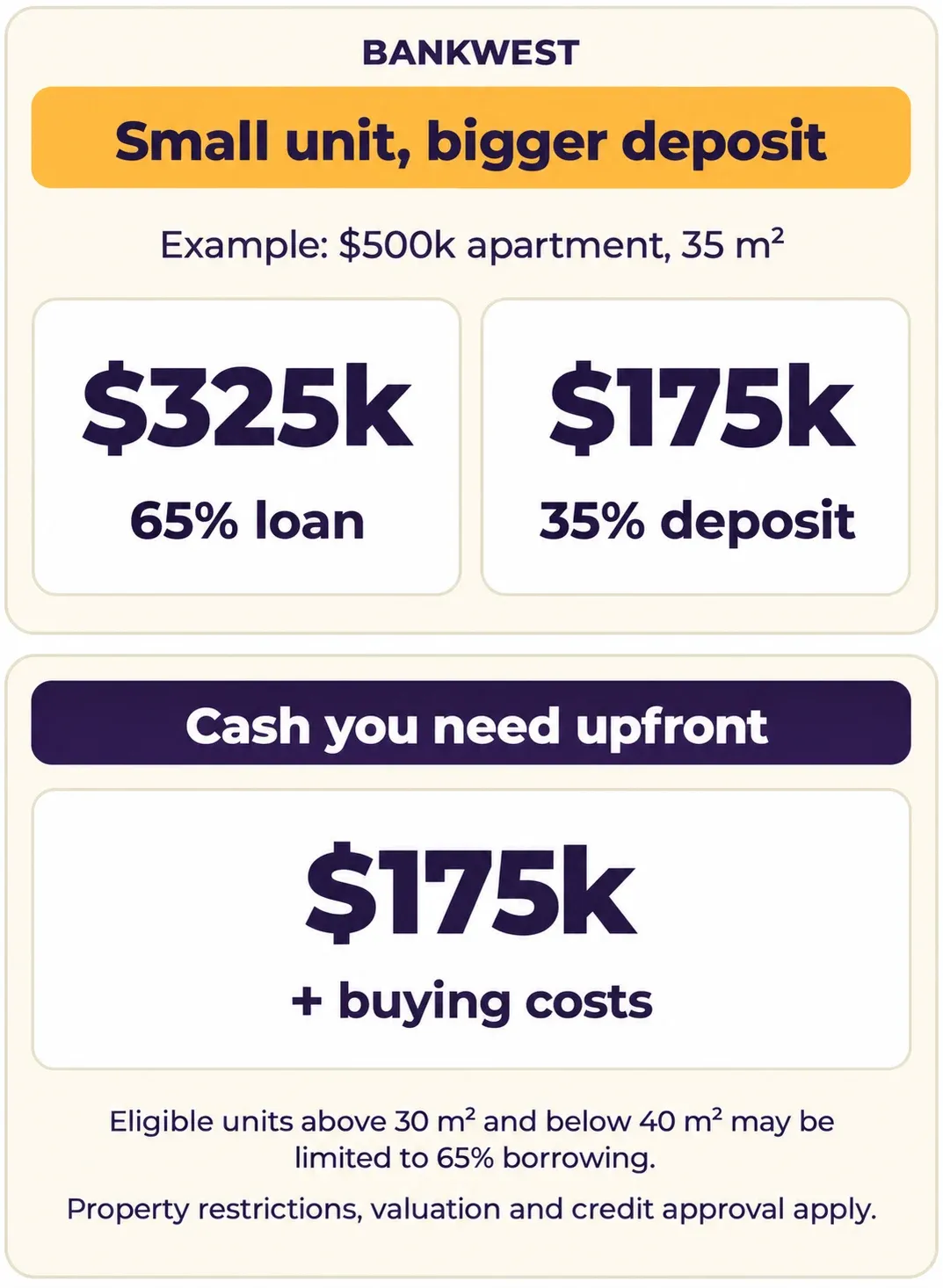
- Size Limits: Apartments generally need to be larger than 40m² (excluding balcony/car space). Tiny “studio” apartments often get declined.
- Location: Properties in very remote towns or “high density” postcodes may have restricted lending (lower maximum LVR).
Quick Checklist: Are You Bankwest Ready?
Criteria | The “Green Light” | The “Red Flag” |
Residency | Aus Citizen / PR / NZ Citizen. | Temporary Visa / Non-Resident. |
Deposit | 20% (ideal) or 5-10% (with LMI). | Less than 5% genuine savings. |
Employment | >6 months in role (PAYG) or >2 years (Self-employed). | Probation / Casual for <6 months. |
Credit | Clean history. Good repayment record. | Defaults, Judgments, excessive enquiries. |
Property | Standard House/Townhouse/Unit (>40m²). | Studio (<40m²), Rural/Remote, Commercial. |
What Documents Do You Need For A Bankwest Application?
Getting your paperwork ready in advance is the single best way to speed up your loan approval. Bankwest needs to verify exactly who you are, what you earn, and where your deposit is coming from.
Here is the essential documentation you will need to provide:
1. Proof of Income (Employees):
- Payslips: You will typically need your 2 most recent payslips. Crucially, these must show your “Year-to-Date” (YTD) income figure.
- Payment Summaries: If your YTD figure on the payslip isn’t enough to prove your annual income (e.g., at the start of a new financial year), Bankwest may ask for your most recent PAYG Payment Summary or Tax Return.
2. Proof of Income (Self-Employed):
- Tax Returns: Bankwest generally requires your last 2 years of personal and business tax returns.
- Notice of Assessment: You will also need the matching Notices of Assessment (NOA) from the ATO for those years.
3. Bank Statements & Expenses:
3 Months History: Be prepared to show 3 months of statements for your main transaction account. Bankwest uses this to verify your salary credits and to cross-check your declared living expenses against your actual spending habits.
4. Rental Income (Investors):
- Evidence: If you have investment properties, you will need a current signed lease agreement. If you are buying a new investment property, a “Rental Appraisal” letter from a real estate agent is sufficient.
- The “Shading” Rule: Note that while you provide the gross rental figure, Bankwest’s system will automatically “shade” this income (usually only counting 80% of it) to allow a buffer for property costs and vacancies.
5. Government & Other Income:
- Family Tax Benefit (FTB): Bankwest accepts FTB Part A and B as income, generally if the children are under a certain age (typically under 11 or 13 depending on the specific policy at the time).
- Maintenance: Court-ordered child maintenance or alimony is accepted if you can show regular payments entering your account over the last 3–6 months.
6. Identification (The "100 Points" Check):
- You must meet the standard 100-point ID check. This usually involves a combination of:
- Primary ID: Current Passport or Birth Certificate.
- Secondary ID: Driver’s License and Medicare Card
Quick Document Checklist
Category | Document Needed |
Identity | Passport, Driver’s License, Medicare Card. |
PAYG Income | 2 x Recent Payslips (with YTD). |
Self-Employed | 2 x Years Tax Returns + NOAs. |
Savings | 3 x Months Bank Statements (Main Account). |
Liabilities | Statements for any credit cards/loans not being refinanced. |
Property | Contract of Sale (if you have already bought). |
Special Schemes & Incentives: How To Save Thousands
Buying your first home in Australia comes with some significant perks that can lower your entry costs. However, not all lenders participate in every government scheme, so it is crucial to know what Bankwest supports.
Here is a breakdown of the available help:
1. Government Grants & Concessions
- First Home Owner Grant (FHOG):
This is a state-government cash grant available if you buy or build a brand new home.- The Benefit: Amounts vary by state (e.g., $10,000 in NSW; $15,000 in QLD).
- Bankwest’s Role: While this is a government initiative, Bankwest can facilitate the application for you. If you apply via a broker or a Bankwest lender, they can structure the loan so these funds contribute towards your settlement costs.
- Stamp Duty Concessions:
As a first-home buyer, you may be eligible to pay $0 or reduced stamp duty, depending on your state and purchase price.- NSW: Full waiver up to $800k; concessions up to $1M.
- VIC: Full waiver up to $600k; concessions up to $750k.
- QLD: Full waiver up to $500k; concessions up to $550k.
- Tip: Always check your state revenue office for the latest thresholds, as these change frequently.
- Federal First Home Guarantee (5% Deposit Scheme):
- Important Note: Bankwest is not a participating lender for the Federal Government’s First Home Guarantee (which allows you to buy with a 5% deposit and no LMI via a government guarantee). If you absolutely need to use this specific scheme, you will need to look at other lenders (like CBA or NAB).
2. Family Guarantee (Bankwest's "Family Security Support")
If you have parents willing to help but who don’t want to hand over cash, Bankwest’s Family Security Support is a powerful option.
- How it Works: Your parents use the equity in their own home to secure the “deposit gap” of your loan.
- Example: Bankwest splits the loan into two parts. Portion A (80% of value) is secured by your new home. Portion B (the remaining 20% + costs) is secured by your parents’ property.
- The Big Benefit: You can borrow up to 100% of the purchase price (plus costs) and pay $0 in LMI (Lenders Mortgage Insurance). This can save you $10,000–$30,000 in upfront insurance fees.
- Limited Liability: Your parents are not guaranteeing the whole loan—only the portion they secure (e.g., the 20% deposit). Bankwest requires them to seek independent legal advice to ensure they understand the risks.
- The Exit Strategy: Once you pay down the loan or your property value rises enough to reach 80% LVR, you can apply to “release” the guarantor, freeing your parents from the mortgage.
3. LMI Waivers for Medical Professionals
Bankwest aggressively targets medical professionals because they are considered “low risk” borrowers. If you work in healthcare, you could save thousands.
- The Perk: Eligible professionals can borrow up to 90% LVR (sometimes higher) without paying Lenders Mortgage Insurance.
- Eligible Professions:
- Medical Doctors (GPs, Surgeons, Specialists)
- Dentists & Orthodontists
- Veterinarians
- Optometrists
- Pharmacists
- Who is Excluded? Currently, Bankwest does not extend this waiver to Nurses, Psychologists, Physiotherapists, or other Allied Health professionals.
- Proof Required: You will generally need to provide your AHPRA registration (or Veterinary Board registration) to qualify.
Case Study 1: Buying With A Small Deposit (Family Guarantee)
The Scenario:
Alex is a 27-year-old first-home buyer living in Brisbane. After renting for several years, he has managed to save $15,000. While that is a great start, it is only 3.75% of the purchase price for the $400,000 townhouse he wants to buy.
The Problem:
- LMI Costs: To buy with such a small deposit, Alex would typically need to pay Lenders Mortgage Insurance (LMI), costing roughly $8,000.
- Shortfall: Even with Queensland’s first-home buyer stamp duty concessions, his $15,000 savings wouldn’t cover the deposit plus the legal fees and moving costs.
- Risk: Another lender offered a 95% loan, but it would have required a personal loan to cover the closing costs, which would have damaged his borrowing power.
The Solution: Bankwest Family Security Support
Alex’s parents own their Brisbane home outright and offered to help. Instead of giving him cash, they agreed to use the equity in their home as security for the “deposit gap.”
Bankwest structured the $410,000 total loan (Purchase Price + Costs) into two parts:
- Loan A (Primary): $320,000
Secured solely against Alex’s new townhouse (80% of the value). - Loan B (Guaranteed): $90,000
Secured by a “limited guarantee” on his parents’ property. This covered the remaining 20% of the purchase price plus the extra costs for stamp duty and fees.
The Outcome:
- $0 Upfront: Alex didn’t have to put any of his own cash into the settlement.
- Savings Preserved: He kept his $15,000 savings to buy furniture and set up an emergency fund.
- $0 LMI: Because the guarantor security brought the bank’s risk down, Alex paid zero Lenders Mortgage Insurance, saving ~$8,000 immediately.
The Exit Strategy (2 Years Later):
The guarantee was never meant to be permanent.
- Growth: Over two years, Alex’s townhouse increased in value to $440,000.
- Repayments: He made extra repayments, bringing the loan balance down to $380,000.
- The Release: Using a work bonus, he paid the loan down further to $352,000 (which is 80% of the new $440k value).
- Result: Bankwest released the guarantee. Alex’s loan now stands on its own, and his parents’ property is completely free from the bank.
Key Takeaway:
A Family Guarantee acts as a “bridge” to get you into the market sooner. It allows you to skip the years of saving for a 20% deposit and avoid wasted money on LMI, all while protecting your cash savings for the things you need.
Case Study 2: High-Income Professional (LMI Waiver)
The Scenario:
Dr. Emily is a 30-year-old junior resident doctor looking to buy her first home in Sydney. She has found a one-bedroom unit for $800,000.
She has worked hard to save $80,000, which is a 10% deposit.
The Problem:
- The LMI Trap: On a standard loan, a borrower with only a 10% deposit would be hit with a hefty Lenders Mortgage Insurance (LMI) premium. On a $720,000 loan, this could cost around $20,000.
- Wasted Cash: Paying this premium would eat into her savings, potentially leaving her short on stamp duty or requiring her to borrow even more.
The Solution: Bankwest Medical Professional Policy
Emily’s mortgage broker identified her as an ideal candidate for Bankwest’s “Medico” policy, which treats medical professionals as low-risk borrowers.
Bankwest offered:
- LMI Waiver: Approval to borrow up to 90% LVR with $0 LMI payable. This is a specific waiver available to doctors registered with AHPRA.
- Rate Discount: Recognizing her strong future earning potential, Bankwest also applied a discretionary discount, offering her a variable rate of roughly 6.00% (lower than the standard variable rate).
The Outcome:
- Optimal Borrowing: Emily decided to borrow 88% of the property value ($704,000). Because she didn’t have to pay LMI, she didn’t need to “cap” the insurance onto the loan.
- Cash Flow: This allowed her to keep enough of her $80,000 savings to comfortably cover the stamp duty and legal fees.
- Massive Savings: She instantly saved roughly $18,000 – $20,000 in avoided insurance premiums.
- Bonus: As part of the Bankwest Complete Package, she opened a Bankwest Qantas Platinum Mastercard (fee-free) to earn points on her daily spending, setting it to auto-pay from her offset account to avoid interest.
Key Takeaway:
If you are a medical professional, paying LMI is often optional. Bankwest’s waiver allows you to enter the market with a 10% deposit while enjoying the pricing and benefits usually reserved for borrowers with a 20% deposit.
The Bankwest Home Loan Application Process
Applying for a home loan can feel like a mountain of paperwork, but with Bankwest, it follows a fairly predictable four-step journey. Knowing what happens next can save you a lot of stress.
Step 1: Pre-Approval (Getting "House-Hunt Ready")
Before you fall in love with a property, you need to know your budget.
- How to Apply: You can apply directly via Bankwest (online/mobile lender) or, for an easier experience, have a mortgage broker package the application for you.
- The Credit Check: Bankwest will assess your financial documents and run a credit check. If you pass, you get a Pre-Approval Letter (also called “Approval in Principle”).
- Validity: This is typically valid for 90 days. If you haven’t bought a house by then, you can usually extend it by updating your payslips.
Step 2: Finding a Property & Making an Offer
Once you have that pre-approval letter, you can shop with confidence.
- The Contract: When your offer is accepted, you will sign a Contract of Sale.
- Cooling Off: Depending on your state (e.g., NSW, QLD), you may have a 5-day cooling-off period to back out if needed (though small penalties may apply).
- The Deposit: You will pay a holding deposit (usually 5–10%) into the real estate agent’s trust account.
- The Clock Starts: Once the contract is signed, send it to your broker or Bankwest immediately. You are now “on the clock” to get formal finance approval before the deadline in your contract.
Step 3: Formal Approval (The "Big Yes")
This is the critical stage where your loan goes from “Conditional” to “Unconditional.”
- Valuation: Bankwest will order an independent valuation of the property to ensure it’s worth what you are paying.
- LMI Sign-Off: If you are borrowing more than 80% LVR, the mortgage insurer must double-check and stamp the file.
- Formal Approval Letter: Once the valuation and LMI are clear, Bankwest issues Unconditional Approval. This is the moment you can celebrate—your loan is officially secured!
- Timing: If you had a pre-approval, this stage is fast—typically 3 to 5 business days.
Step 4: Settlement (The "Money Day")
Settlement is the day the money actually changes hands, and you become the legal owner.
- The Shortfall: A few days before settlement, your solicitor/conveyancer will tell you exactly how much money you need to contribute (your deposit balance + stamp duty + fees). You usually deposit this into your new Bankwest offset account or the solicitor’s trust account.
- The Exchange: These days, most settlements happen electronically via a system called PEXA. Bankwest pays the loan funds, you pay your shortfall, and the seller gets their cash.
- The Keys: Once the transaction clears (usually early afternoon), you get the call: “Congratulations, it’s settled!” You can now pick up the keys from the agent.
Life After Settlement
- First Repayment: Your first mortgage repayment will usually come out one month after settlement day. Bankwest will direct debit this from your nominated account.
- LMI Note: If you incurred LMI, don’t be shocked if your total loan balance is slightly higher than the purchase price minus your deposit—the LMI fee is added to the loan and paid off over time.
- Annual Review: Don’t “set and forget.” In 1–2 years, ask your broker to review your rate with Bankwest. Banks often have “retention” offers to keep existing customers happy.
Summary Timeline
Stage | Key Action | Typical Timeframe |
1. Pre-Approval | Submit income docs & credit check. | 2–5 Days. |
2. Offer & Acceptance | Sign contract & pay deposit. | Variable (House hunting). |
3. Formal Approval | Valuation & LMI check. | 3–5 Days (after contract). |
4. Settlement | Funds transferred & keys handed over. | 30–42 Days (standard settlement period). |
The Verdict: Pros And Cons Of Bankwest
No lender is perfect, and the right choice usually depends on whether you value low costs or high service. Here is an honest breakdown of where Bankwest shines and where they fall short for first-home buyers.
The Pros (Why you would say "Yes")
- Competitive Interest Rates:
Bankwest frequently undercuts the Big 4 banks on variable rates. For rate-sensitive buyers, this lower rate can translate to significant interest savings over the life of the loan. - The “Bucket” Strategy (9 Offset Accounts):
This is their standout feature. Being able to link up to 9 offset accounts to a single variable loan allows you to organise your money (e.g., “Bills,” “Holiday,” “Tax”) while every dollar works to reduce your mortgage interest. - Low Deposit Friendly:
Bankwest is aggressive in the high-LVR space. They will lend up to 98% LVR (inclusive of LMI) for standard buyers, and they fully support Family Guarantee loans, allowing you to buy with effectively no deposit. - Medico Waivers:
If you are a doctor or eligible medical professional, the ability to borrow 90% LVR with $0 LMI is a massive financial advantage that can save you ~$20,000 upfront. - Partial Offset on Fixed Rates:
Most banks offer zero offset on fixed loans. Bankwest offers a 40% offset benefit. While not perfect, it’s better than nothing if you want to lock in your rate. - Digital Experience:
Their app is widely considered one of the best in the market. It allows for easy self-service features like instant redraws, limit increases, and establishing new offset accounts.
The Cons (Why you might say "No")
- No Physical Branches (Digital Only):
Bankwest has transitioned to a digital-only model. If you are the type of person who wants to sit across a desk from a manager to discuss your loan, you won’t find that here (unlike CBA or Westpac). - Not a “First Home Guarantee” Lender:
Bankwest does not participate in the Federal Government’s First Home Guarantee scheme (the 5% deposit, no LMI scheme). If you rely on this specific government support, you must look elsewhere. - Strict “Genuine Savings”:
If you are borrowing more than 90% LVR (without a guarantor), Bankwest is strict about seeing “genuine savings” (usually 3 months of accumulated savings). If your deposit was a last-minute cash gift, you might face hurdles. - Conservative on Apartments:
They can be picky with high-density inner-city apartments or units smaller than 40sqm. If you are buying a tiny studio, you may get declined. - The “Partial” Fixed Offset:
While 40% is a pro, it is also a con if you expected a full offset. You need to do the maths to ensure the partial benefit is worth the package fee.
Summary: Is Bankwest Right for You?
Feature | The Good | The Bad |
Rates | Generally lower than the Big 4. | Fixed rates often revert to high variable rates. |
Features | 9 Offset accounts + 40% offset on fixed. | Package fee ($395) applies to access these. |
Deposit | 98% LVR options & Family Guarantee. | No Federal “First Home Guarantee” scheme. |
Service | Excellent App & Phone support. | No physical branches. |
Bankwest Home Loans Frequently Asked Questions (FAQs)
Can I get a Bankwest home loan with a 5% deposit?
Yes, absolutely. Bankwest allows you to borrow up to 95% of the property value (and sometimes up to 98% including capitalized LMI). Just remember that because your deposit is under 20%, you will likely have to pay Lenders Mortgage Insurance (LMI) unless you are using a Family Guarantee or qualify for the medical professional waiver.
Is Bankwest safe?
Yes. Bankwest is an Authorised Deposit-taking Institution (ADI) and is covered by the Australian Government’s Financial Claims Scheme (FCS). This means your deposits are guaranteed by the government up to $250,000. Because Bankwest and CBA operate under the same banking license, it is important to note that the $250,000 limit applies to your combined total across both banks.
How do I manage cash and cheques with a digital bank?
While Bankwest is digital-first, you aren’t “cash-locked.” You can use Bank@Post at any of the 3,300+ participating Australia Post outlets nationwide.
- Deposits: You can deposit up to $8,000 in cash per transaction and up to $999,999 in cheques per day.
- Withdrawals: You can withdraw up to $2,000 per day using your debit card.
- CBA ATMs: You can also use CommBank’s extensive ATM network for fee-free cash deposits and withdrawals.
How do I switch from a CBA loan to Bankwest?
Since both brands are part of the same group, many clients assume it is a simple “button click.” However, because they have different products and credit policies, switching is technically a refinance. You will need to submit a new application, but the process is often streamlined. The main benefit is moving to Bankwest’s often lower interest rates or accessing their unique multi-offset features while keeping the “Big Bank” security you’re used to.
What income do I need to get approved?
There is no “minimum income” rule. Approval depends entirely on your “serviceability”—meaning, can your income comfortably cover your living expenses, existing debts, and the new mortgage repayments? Bankwest assesses this on a case-by-case basis.
Does Bankwest lend to casual or self-employed buyers?
Yes.
- Casuals: You typically need to show 6–12 months of consistent history with your current employer.
- Self-Employed: You generally need 2 years of tax returns and an ABN registered for at least 2 years.
How does Bankwest compare to CBA (CommBank)?
Think of them as siblings. While CBA owns Bankwest, they operate separately.
- Bankwest is often cheaper (lower rates) and offers niche features like multiple offset accounts, but has no physical branches for support.
- CBA has a huge branch network and slightly more flexible policies for complex deals, but is generally more expensive.
How long does approval take?
Bankwest is generally efficient.
- Pre-Approval: usually 2–5 business days.
- Formal Approval: ~3–5 business days once you find a property and submit the contract.
- Settlement: Typically 30–42 days from signing the contract (standard settlement period).
What if my circumstances change (e.g., I lose my job or have a baby)?
Life happens. Once your loan is settled, Bankwest doesn’t actively monitor your employment—they just need the repayments to be made on time. If you do face financial trouble, Bankwest offers hardship provisions, including potential repayment holidays or restructuring options to help you get back on your feet.
Conclusion & Next Steps
Buying your first home is a big step – but with the right information and support, it’s absolutely achievable.
Ready to take the next step? Get in touch with us for your free assessment or to ask any questions. As a first-home buyer, you’ll likely have questions unique to your situation – we’re happy to answer those and guide you on the path to owning your first home.
Unlike other mortgage brokers who are just one-person operations, we have an entire team of experts dedicated to helping make your home loan journey as simple as possible.
If you want to get started, please give us a call on 1300 088 065 or book a free assessment online to see how we can help.