
1300 088 065

5 minute read

Household Expenditure Measure: What is It?

What is HEM, and how does it affect my borrowing capacity?

Calculate how your deposit translates to your home price and monthly payment.

Mastering the Household Expenditure Measure (HEM) is the “secret weapon” you need to unlock your true borrowing power in today’s market. While banks use this benchmark as a mandatory “minimum spend” floor, simply guessing your expenses can lead to a surprise rejection. 

This guide, written by an expert Mortgage Broker in Brisbane,  shows you exactly how your income and family size trigger different HEM brackets, helping you optimize your spending profile to meet lender standards and secure your home loan.

Key Highlights

  • The HEM “Floor”: The Household Expenditure Measure is a statistical benchmark banks use as a mandatory minimum spending level. Even if you spend less, the bank will generally use the HEM floor to calculate your loan.
  • The “Higher Of” Rule: Lenders compare your self-reported expenses against the HEM benchmark and automatically use whichever figure is higher. You cannot artificially boost borrowing power by under-reporting your spending.
  • Income Band Scaling: Your HEM benchmark isn’t fixed; it increases as your income rises. High earners are often subject to a higher spending “floor” due to assumed “lifestyle creep.”
  • The $15k Advantage: For every $100 you save in monthly expenses, you can potentially increase your borrowing capacity by $15,000 to $20,000 in the current 2026 interest rate environment.
  • The 3-Month Cleanse: Banks audit the last 90–180 days of your bank statements. Starting a “spending cleanse” three months before your application is the most effective way to prove financial discipline.
  • HEM Exclusions: Critical costs like private school fees, child support, and HECS debt sit outside of HEM. Banks add these on top of the benchmark, which can significantly impact your total borrowing power.
  • Wagyu and Shiraz Rule: A landmark legal ruling confirms banks can assume you will “tighten your belt” once a mortgage starts, but they still look for “sticky” non-discretionary costs you can’t easily cancel.

What Is The Household Expenditure Measure (HEM)?

The Household Expenditure Measure (HEM) is a standard benchmark for living expenses. The Melbourne Institute of Applied Economic and Social Research calculates these figures regularly. Australian banks use this tool to estimate your monthly spending.

Lenders must ensure you can afford your loan without financial hardship. Therefore, they use HEM as a “safety net” or a minimum spending floor. It considers your household size, your income level, and your geographic location.

The Logic: Why Banks Use a Benchmark

You might wonder why banks don’t just look at your bank statements. While they do audit your actual spending, statements only show the past.

Banks use HEM to predict your future spending habits as a homeowner. It provides a consistent baseline across thousands of different loan applications. This prevents borrowers from under-reporting their costs to get a bigger loan.

The 25th Percentile Rule

The HEM formula is quite clever and specific about your lifestyle. It splits your expenses into two main buckets: Absolute Essentials and Discretionary Goods.

  • Absolute Essentials: This covers food, utilities, and transport. The bank assumes you spend the median amount for these.
  • Discretionary Spending: This includes hobbies, dining out, and entertainment.

Crucially, the HEM assumes you only spend in the bottom 25% (the 25th percentile) for fun. This means the benchmark reflects a very modest lifestyle. If you spend more than the average Aussie on luxuries, your actual costs will likely exceed the HEM.

Components Of HEM: What’s In And What’s Out?

What Is Counted Under HEMS expenses

Banks don’t just lump all your spending into one giant pile. The Household Expenditure Measure (HEM) categorizes your life into specific buckets. Understanding these buckets helps you present a “cleaner” application to the lender.

1. Basic Essentials

These are the non-negotiable costs of daily Australian life. Banks assume you cannot easily cut these costs.

  • Groceries: Your standard weekly food shop.
  • Utilities: Power, gas, water, and phone bills.
  • Transport: Fuel, public transport, and basic car rego.
  • Health: Basic pharmacy items and essential self-care.

2. Discretionary Spending (The 25% "Fun" Cap)

This category covers “lifestyle” choices that you could theoretically stop tomorrow. Under the HEM model, these costs are typically capped at the 25th percentile of Australian spending.

  • Dining Out: Cafes, restaurants, and takeaway treats.
  • Entertainment: Streaming services, movies, and hobbies.
  • Travel: Domestic holidays or weekend getaways.

Banks know you can reduce this spending to afford a mortgage. However, they still look for “sticky” habits like high-frequency gambling or luxury subscriptions.

3. The "Hidden" Exclusions

This is where many borrowers get caught out. Some costs sit completely outside the standard HEM calculation. Banks add these figures on top of the benchmark, which directly hits your borrowing capacity.

  • Private School Fees: These are viewed as a fixed, long-term commitment.
  • Life & Sickness Insurance: Lenders treat these as separate monthly liabilities.
  • HECS/HELP Debt: Your student loan reduces your take-home pay before HEM applies.
  • Child Support: These legal obligations are non-negotiable “outgoings” in the bank’s eyes.
  • Rent & Existing Mortgages: HEM assumes you are replacing your rent with a new loan payment.

4. The "Income Band" Effect (Lifestyle Creep)

HEM is not a fixed number for everyone. Lenders use “Income Bands” because they assume your spending increases as you earn more. If you earn $200k, the bank expects higher grocery and travel costs than someone on $70k. Even if you are frugal, the bank may ignore your low spending and apply their higher “floor” automatically.

Household Type

Annual Income

Estimated Monthly HEM Floor

Single Adult

$80,000

~$2,150

Single Adult

$180,000+

~$3,400

Couple (No Kids)

$120,000

~$3,200

Couple (2 Kids)

$150,000

~$4,850

Couple (2 Kids)

$250,000+

~$6,100

Why This Matters For Your Approval

Lenders perform a “sanity check” on your application. They compare your stated expenses against the HEM benchmark. If your real-world spending on school fees is high, your “true” living costs will exceed the HEM. We help you identify these “hidden” costs early. This ensures your application is accurate and avoids a “red flag” from the credit assessor.

HEM Calculation: What Affects Your HEM Benchmark?

Understanding the math behind a home loan application is vital. Banks use a specific formula to decide your fate. They want to see how much “surplus” cash remains after all your obligations.

The Master Formula for Borrowing Power

Lenders follow a strict calculation to find your disposable income. Most Australian banks apply this sequence:

  1. Gross Income: Your total salary before tax.
  2. Minus Tax: They subtract the relevant tax bracket amounts.
  3. Minus Expenses: This is where HEM or your stated expenses apply.
  4. Minus Other Debts: Payments for car loans, credit cards, or HECS.

The final leftover amount determines your maximum mortgage payment. Even a small change in these figures impacts your results.

To see how this works, let’s look at a typical example for an Australian couple. Imagine a family in Brisbane earning a combined $160,000 per year. They have one child and a $5,000 credit card limit.

  • Gross Monthly Income: $13,333
  • Estimated Tax (Monthly): -$2,850
  • HEM Living Expenses (Floor): -$3,900
  • Credit Card Repayment (3% of limit): -$150
  • Total Monthly Expenses: $6,900
  • Remaining Surplus for Mortgage: $6,433

The bank doesn’t just look at that $6,433 and grant a loan for that exact amount. Instead, they apply a 3% interest rate buffer. If the current market rate is 6%, the bank tests your ability to pay at 9%. They want to ensure you stay safe if rates rise. This is why keeping your expenses low is the fastest way to boost that surplus number.

Factors that affect HEM benchmark

The "Higher Of" Rule

This critical policy catches many borrowers off guard. Banks perform a “sanity check” on every application by comparing your self-reported expenses against the HEM benchmark.

The bank will always pick the higher number.

If you claim to spend $2,000 but the HEM floor is $3,000, they use $3,000. Conversely, if you spend $4,000, they use your actual figure. You cannot “beat” the system by under-reporting your costs.

The "$100 = $15k" Rule

Small lifestyle changes lead to massive gains in borrowing power. In the current 2026 interest rate environment, every $100 you save in monthly expenses adds roughly $15,000 to $20,000 to your loan.

  • Cancel a $100 gym membership: Gain ~$15,000 in loan capacity.
  • Reduce takeaway by $200: Gain ~$30,000 in loan capacity.

Why You Need a Proactive Strategy

Lenders look at your spending habits over the last three to six months. You must prove your “frugality” is a sustainable habit. We help you audit your statements before the bank sees them. We ensure your stated expenses align with the HEM floor to maximise your borrowing capacity from day one.

Why Accurate Living Expenses Are Critical

When it comes to how much you spend per month, banks do not just take your word for it. They perform a deep-dive audit of your last three to six months of bank statements.

The credit assessor looks for “red flag” transactions that suggest high living costs. They then cross-reference your actual spending against the HEM benchmark.

  • Discrepancies: Large gaps between your stated costs and bank statements trigger an investigation.
  • The Adjustment: If your statements show higher spending, the bank will “auto-adjust” your expenses upward.
  • Borrowing Power Drop: Every dollar they add back into your expenses lowers your total loan amount.

Case Study: What Happens If You Get It Wrong

HEMS Case Study Sarag

Meet Sarah, a recent client who came to us after a frustrating rejection. Sarah applied for a loan elsewhere and stated she spent $500 a month on food for her family of four.

However, the lender’s audit revealed her true grocery and takeaway spending was closer to $1,200 a month.

The Result:

The bank viewed this $700 gap as a major risk. They adjusted her living expenses, which instantly slashed her borrowing capacity. Consequently, her loan was declined because she no longer met the “serviceability” requirements.

How to Avoid "The Sarah Trap"

Had Sarah spoken to an expert broker first, we could have audited her statements. We would have identified the high spending before the bank saw it.

  • Pre-Application Audit: We review your statements to ensure your figures are realistic.
  • Sustainable Changes: We help you identify areas to cut back at least 90 days before applying.
  • Accurate Reporting: We ensure your “stated expenses” reflect your true lifestyle to build trust with the lender.

Accuracy builds credibility. A credible application is far more likely to get the green light from a credit assessor.

Real-World Examples: How HEM Affects Borrowing Power

Your household size directly dictates your HEM benchmark. Banks assume larger families naturally face higher costs for food and clothing. Let’s look at how this works in a high-cost city like Sydney.

We will compare two households with the exact same net income. This comparison shows why the Household Expenditure Measure is so powerful.

Family 1: The Couple with Two Kids

This couple earns $90,000 after taxes. Because they have two children, the bank applies a higher HEM floor.

  • Annual Net Income: $90,000
  • Estimated HEM Expenses: $60,000
  • Leftover for Mortgage: $30,000

With $30,000 available for repayments, their borrowing limit is strictly capped. The children’s expenses “eat” into the surplus cash used for loan servicing.

Family 2: The Couple Without Kids

This couple also earns $90,000 after taxes. However, their household size is smaller.

  • Annual Net Income: $90,000
  • Estimated HEM Expenses: $51,000
  • Leftover for Mortgage: $39,000

The $100,000 Difference

Family 2 has an extra $9,000 per year for mortgage payments. In the eyes of a lender, this is a massive advantage.

This extra surplus can increase their borrowing capacity by up to $100,000. They can bid on better properties simply because their HEM floor is lower.

Why Family Size Matters to Lenders

Lenders use Australian Bureau of Statistics (ABS) data to update these benchmarks. They know that children increase “non-discretionary” spending.

  • Dependents: Each child adds a set dollar amount to the HEM floor.
  • Location: Living in a capital city like Sydney further increases the benchmark.
  • Income Brackets: As your income rises, the “cost per child” assumption also increases.

Key Takeaway for Borrowers

You cannot change your family size, but you can manage your “stated expenses.” As we mentioned before, if your real spending is lower than the HEM, the bank still uses the HEM. However, if your spending is higher than the HEM, your borrowing power drops even further.

Legal Context Of HEM: The ‘Wagyu and Shiraz’ Case

Household Expenditure Measure Court Case

The “Wagyu and Shiraz” case is a famous piece of Australian legal history. It fundamentally changed how banks look at your lifestyle. This 2019 court battle involved ASIC and Westpac over responsible lending laws.

ASIC argued that banks must check every single expense…

The Bank’s Argument: The Capacity to Reform

In court, Westpac argued that past spending does not equal future ability to pay. The bank successfully claimed that borrowers have the “capacity to reform.”

Essentially, they argued that a person can—and will—”tighten their belt” once they take on a mortgage. If you really want a home, you can stop buying expensive steak and wine. You can choose to eat “2-minute noodles” instead to meet your repayments.

The Specific Points the Bank Won On

1. Discretionary vs. Fixed Costs

Westpac argued that looking at current bank statements is often misleading. Many expenses are discretionary (optional) rather than fixed.

  • The Bank’s View: Spending $200 on fine dining now is a choice, not a permanent requirement.
  • The Logic: Only fixed costs like child support or existing debts truly dictate loan affordability.
2. HEM as a Valid "Floor"

The bank defended the Household Expenditure Measure (HEM) as a scientifically valid tool.

  • The Argument: Lenders must make “reasonable inquiries,” but they don’t need to track every coffee receipt.

The Result: The court confirmed HEM provides a valid “minimum” for what a human needs to survive.

3. "Not Unsuitable" vs. "Suitable"

In a technical win, Westpac argued the law only requires a loan to be “not unsuitable.” They don’t have to prove a loan is perfect for you. They only need to show it won’t cause “substantial hardship.”

The Outcome: Why Banks Can Be Flexible

The judge famously agreed with the bank’s logic. He stated:

“I may eat Wagyu beef every day washed down with the finest Shiraz but, if I really want my new home, I can make do on much more modest fare.”

This ruling protected the banks’ right to use benchmarks like HEM. It confirmed that banks aren’t your “financial babysitter.” They can assume you will make sacrifices once your loan begins.

Modern Impact: Responsible Lending in 2026

While the court allowed flexibility, banks remain cautious in 2026. They still face strict Responsible Lending Obligations (RLOs).

  • The “Stickiness” Factor: Banks look for expenses you cannot easily cancel, like private school fees.
  • Fixed Costs Focus: They prioritize non-negotiable liabilities over your Netflix subscription.
  • Ongoing Audits: Lenders still review 90 days of statements to find “red flags” like gambling or heavy debt.

What This Means for Your Application

The Wagyu and Shiraz ruling is great news for borrowers. It means a few expensive dinners won’t necessarily kill your application.

However, you must still prove you can manage your money. At Hunter Galloway, we help you present a “lean” profile to the bank. This shows them you are ready to prioritize your mortgage over luxury spending. We ensure the bank sees your potential, not just your past receipts.

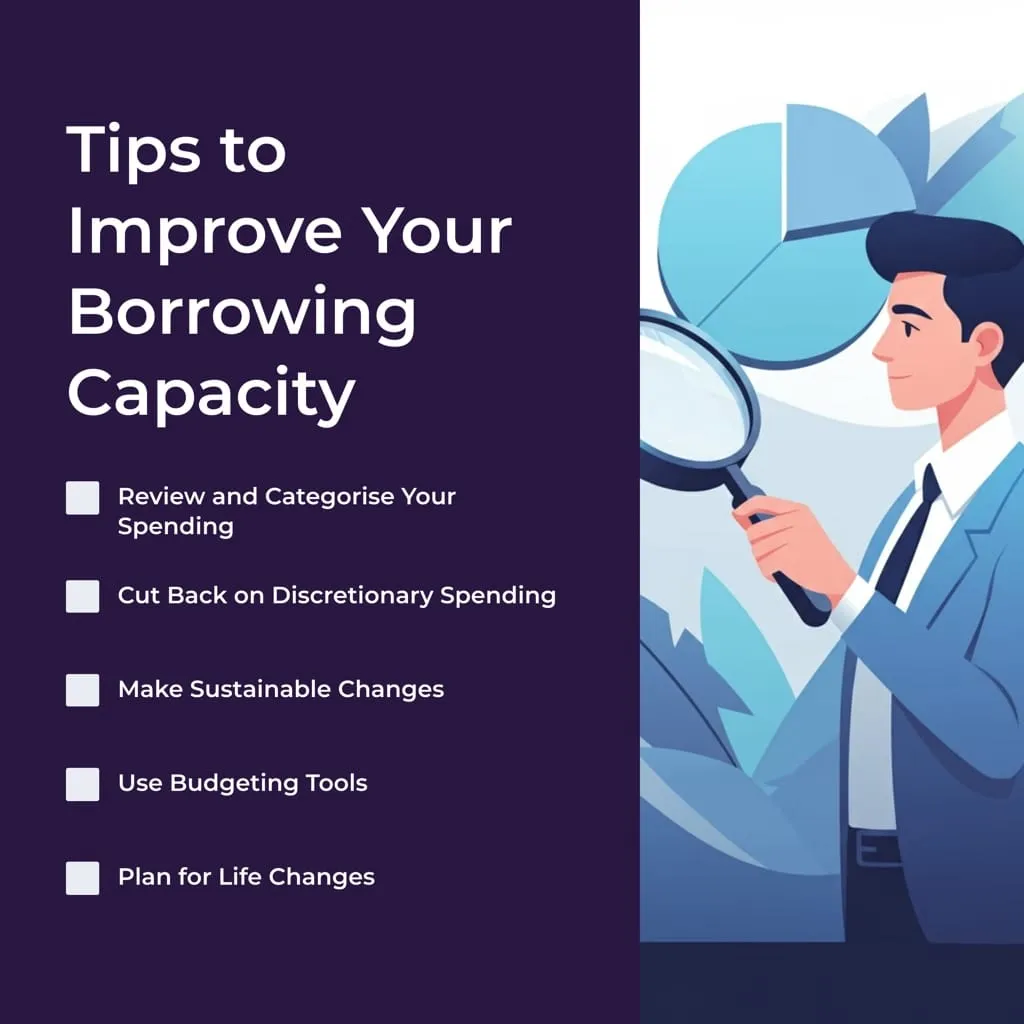
5 Tips To Improve Your Borrowing Capacity

Banks use advanced algorithms to scrub your data. You cannot simply “promise” to spend less once the loan starts. You must prove your financial discipline through your actions months before you sign a contract. Follow these five expert tips to present a “bank-ready” financial profile.

Tips to improve borrowing capacity for household expenditure measure

1. Categorise Your Spending (The Barefoot Method)

Lenders love “clean” bank statements. We recommend using a bucketing system, similar to the Barefoot Investor method, to organise your cash flow.

  • Daily Expenses: Use one account for essentials like groceries and bills.
  • Splurge: Set a strict limit for fun, like dining out and hobbies.
  • Fire Extinguisher: Keep your savings separate to show “genuine savings” history.

When a bank sees clear, organised spending, they gain confidence in your ability to manage a mortgage.

2. The 3-Month Cleanse

Australian banks typically audit the last 90 to 180 days of your transaction history. They look for “sticky” discretionary costs that might hinder your repayments.

  • Cut the Fluff: Cancel unused gym memberships and redundant streaming apps.
  • Reduce Takeaway: Lowering your UberEats frequency for 3 months can significantly boost your “surplus” income.
  • Stop BNPL: Avoid using Afterpay or Zip in the months leading up to your application.

3. Slay the "Credit Card Limit" Dragon

This is the most common mistake we see. Banks do not care if your credit card balance is $0. Instead, they assess you based on your total credit limit.

For example, a $10,000 credit limit is treated as a $10,000 debt by the lender’s calculator. This single limit can slash your borrowing power by $30,000 to $50,000.

  • Action: Reduce your limits to the absolute minimum or close the accounts entirely.

4. Consolidate Your High-Interest Debts

Personal loans and car loans carry much higher interest rates than mortgages. These “short-term” debts eat up a massive portion of your monthly income.

  • The Strategy: If you have equity elsewhere, consider rolling these debts into one lower-interest payment.
  • The Benefit: This lowers your total monthly commitment, which directly increases the “surplus” cash the bank uses to calculate your home loan.

5. Use Modern Budgeting Tools

Don’t guess your expenses; track them. Authoritative tools like Pocketbook or bank-integrated apps help you identify “leakage” in your budget.

  • Audit Your Stated Expenses: Compare your app data against the HEM benchmark.
  • Stay Ahead: If you know your spending is higher than average, you can fix it before the bank’s credit assessor flags it as a risk.

Ready to Maximise Your Capacity?

Small tweaks to your habits today can mean an extra $50,000 in your budget tomorrow. We help you scrub your statements and package your application for the best possible result.

Common Myths About HEM

Myth vs Fact - HEM

Many homebuyers often misunderstand the Household Expenditure Measure. Misinformation can lead to a “loan declined” letter from your bank. Let’s debunk the biggest myths to ensure your application stays on track.

Myth 1: HEM is the only thing banks care about.

Reality: Banks use HEM as a baseline “floor.” However, it is not the only data point they consider. Lenders perform a deep audit of your bank statements and self-reported costs. If your real spending is higher than the HEM, the bank will use your actual figures.

Myth 2: Cutting costs a week before applying will help.

Reality: Last-minute changes rarely work. Banks look at three to six months of transaction history. They want to see sustainable financial habits, not a sudden spending freeze.

  • The 90-Day Rule: Start your “spending cleanse” at least three months before applying.
  • Consistency is Key: Lenders look for regular, predictable spending patterns.

Myth 3: The HEM benchmark is the same for everyone.

Reality: HEM is a dynamic tool. It changes based on your household size, your income, and where you live.

  • Income Bands: Higher earners have higher HEM floors due to “lifestyle creep.”
  • Location: Living in Sydney or Melbourne triggers higher benchmarks than regional areas.
  • Dependents: Each child adds a specific dollar amount to your minimum expense floor.

Myth 4: You can "beat" the system by under-reporting.

Reality: Banks apply the “Higher Of” rule. They compare your stated expenses against the HEM benchmark. Even if you lie about your spending, the bank will automatically use the higher HEM figure. This prevents borrowers from artificially inflating their borrowing capacity.

Myth 5: HEM covers all of your financial commitments.

Reality: HEM only covers general living costs. It ignores fixed liabilities like private school fees, child support, and life insurance. Banks add these costs on top of the HEM benchmark. Failing to disclose these “hidden” expenses is a major red flag for credit assessors.

Why Knowing the Truth Matters

Understanding these myths helps you prepare a stronger application. We help you align your real-world spending with bank expectations. This proactive approach ensures you walk into your meeting with confidence.

Want to know your specific HEM benchmark? Get in touch with our team for a personalised assessment today.

Frequently Asked Questions About Household Expenditure Measure

Does HEM include my HECS or HELP debt?

No. HECS is treated as a separate “committed” debt that reduces your net income, whereas HEM only covers general living costs like groceries and transport.

Generally, no. HEM is a “floor.” Even if you are extremely frugal, banks will usually use the HEM benchmark if your actual spending is lower.

Yes. The Melbourne Institute adjusts HEM based on geographic location to account for the higher cost of services and transport in major capital cities.

The benchmarks are typically updated quarterly or bi-annually to reflect changes in the Consumer Price Index (CPI) and national spending habits.

No. Banks view Buy Now Pay Later services as separate credit liabilities. Frequent use can lower your borrowing capacity beyond the standard HEM calculation.

Yes. Lenders use HEM to ensure you have enough “surplus” income to cover all your properties and your personal lifestyle.

Each dependent increases your HEM “floor.” Banks assume higher costs for food, healthcare, and transport for larger families.

It was a legal ruling that confirmed banks can assume borrowers will “tighten their belts” and cut back on luxury spending once they have a mortgage.

Lenders compare your self-reported expenses against the HEM benchmark, which is a statistical “floor” based on your income and family size. They also audit your last 3–6 months of bank statements to find “red flags” or hidden costs. Under the “Higher Of” rule, the bank will always use whichever figure is higher: your stated expenses or the HEM floor.

You can estimate your HEM by looking at your household type and income bracket (e.g., a couple on $120k typically has a ~$3,200/mo floor). To find your “true” figure, add your average monthly essentials (groceries, bills, transport) plus any “add-ons” that sit outside HEM, like private school fees, child support, and 3% of your total credit card limits.

How a Mortgage Broker Navigates HEM

Navigating the Household Expenditure Measure (HEM) on your own is difficult. Banks often keep their specific benchmarks hidden from the public. This is where an expert mortgage broker becomes your biggest advantage.

We act as the bridge between your real-world spending and the bank’s rigid algorithms. Our goal is to ensure the lender sees a reliable, low-risk borrower.

The Policy Gap: Finding "Friendly" Lenders

Not every Australian bank uses the same version of HEM. Some lenders apply older, more generous benchmarks. Others use updated 2026 figures that are much stricter.

  • Policy Variation: Some banks “shade” your income but use a lower HEM floor.
  • The Sweet Spot: We identify lenders whose internal calculators favour your specific household size.
  • Niche Expertise: We know which banks ignore certain discretionary costs if you explain them correctly.

By choosing the right lender, we can often find thousands in extra borrowing power. This happens without you changing a single spending habit.

The Presentation: Packaging Your Application

How you label your expenses matters just as much as the amount. We help you “package” your spending to meet strict responsible lending standards.

  • Defining Discretionary: We separate “one-off” luxury spends from your permanent living costs.
  • Sustainable Habits: We show the lender that you can easily cut “Wagyu and Shiraz” costs.
  • Audit Readiness: We review your bank statements before the credit assessor ever sees them.

This proactive approach prevents “red flags” from stopping your application in its tracks. We ensure your reported expenses are both realistic and optimized for approval.

Why Accuracy is Your Best Strategy

Banks value accuracy because it builds trust. If a lender catches a hidden expense, they may decline the loan for “non-disclosure.”

  • Guidance: We provide a roadmap to boost your capacity through smarter spending.
  • Verification: Our team checks that your listed costs align with your actual lifestyle.
  • Speed: A clean, accurate application moves through the system much faster.

Don’t leave your borrowing power to chance. Let us navigate the complex world of HEM to find the best deal for your future.

Next Steps And Getting Your Home Loan Approved

At Hunter Galloway, we help clients improve their finances and support them when applying for a home loan. If you are getting ready to apply for a loan, reach out to us for a free consultation. We will help you understand your borrowing capacity. With the right plan, you will be on track to reach your property goals.

Unlike other mortgage brokers who are just one person operations, we have an entire team of experts dedicated to help make your home loan journey as simple as possible.

If you want to get started, please give us a call on 1300 088 065 or  book a free assessment online to see how we can help.

hunter galloway - mortgage broker brisbane team
Our team of home loan experts is here to help you buy a home in Australia

More Resources For Home Buyers

Table of Contents

Why Choose Hunter Galloway As Your Mortgage Broker?

Mortgage Broker of the Year
in 2017, 2018 and 2019
The highest rated and most reviewed
Mortgage Broker in Brisbane on Google
One of the lowest rejection rates

across Mortgage Brokers in Australia

Approximately 40% of home loan applications were rejected in December 2018 based on a survey of 52,000 households completed by 'DigitalFinance Analytics DFA'. In 2017 to 2018 Hunter Galloway submitted 342 home loan applications and had 8 applications rejected, giving a 2.33% rejection rate.
We have direct access to 30+ banks
and lenders across Australia

Important Notice: The information on this website is general in nature and does not take into account your personal objectives, financial situation or needs. You should consider whether the information is appropriate for you before acting on it. Any calculations provided are estimates only and are not a guarantee of any particular outcome. You should obtain independent financial, legal and taxation advice before making any decision regarding any product or service referred to on this website. Hunter Galloway is a trading name. Credit Representative 476903 is authorised under Australian Credit Licence 389328. | Credit Guide | Privacy Policy | Terms & Conditions