


A loan can still be declined even after pre-approval if your financial position, lender policies, or the property itself no longer meet current lending criteria. Many buyers don’t realise banks reassess everything again before granting unconditional approval.
This guide covers 29 reasons a loan can be declined after pre-approval, the evidence worth checking and what to do next.
A mortgage broker in Brisbane can help identify whether the issue is your income, the property, the lender’s policy or missing information. Another approval is never automatic.
Let’s dive in…
If you have already signed a contract, start here
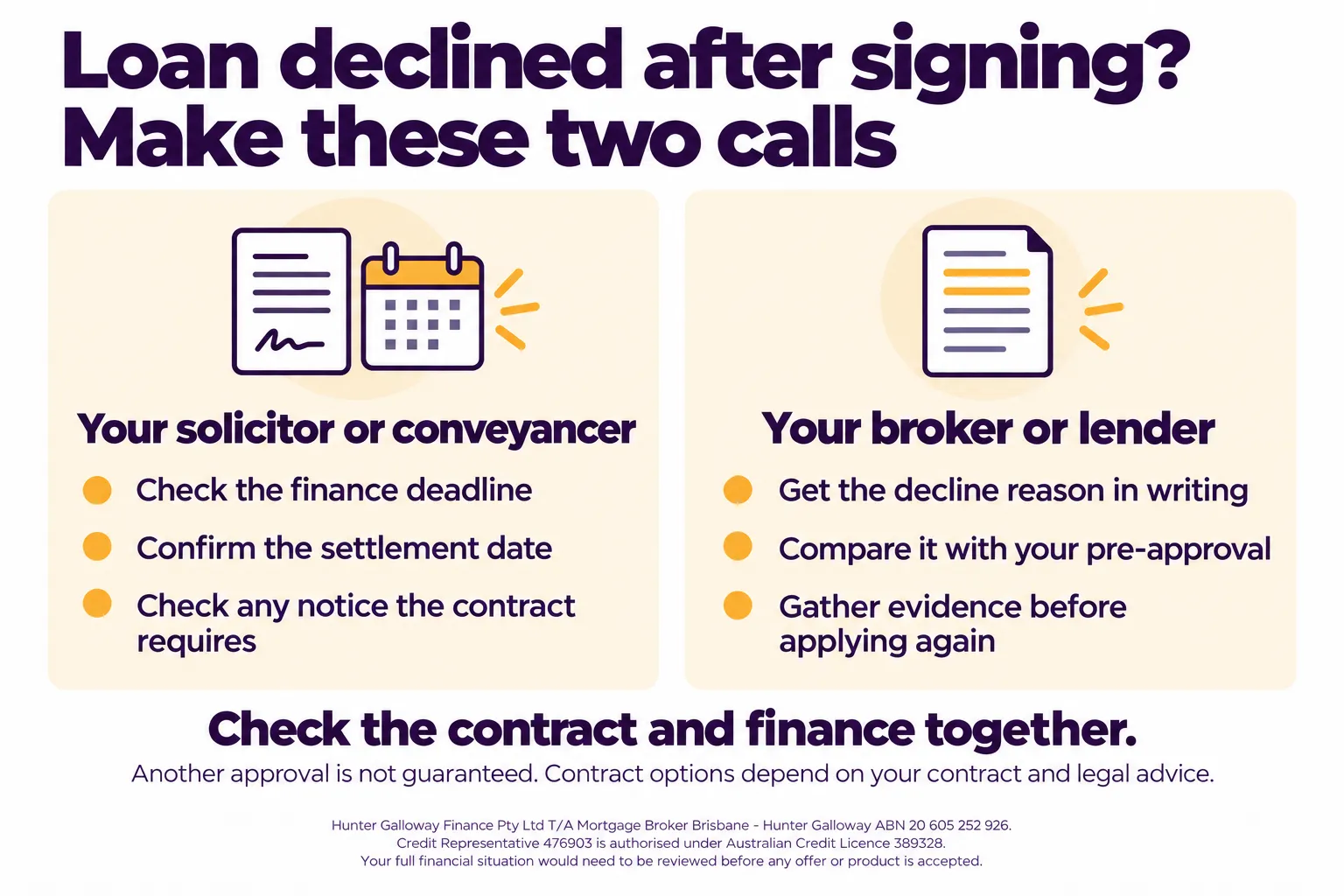
- Call your solicitor or conveyancer. Confirm the finance deadline, settlement date and any notice needed under your contract.
- Ask the lender for the reason in writing. Put the decline beside the pre-approval letter and check what changed.
- Gather the evidence before applying again. The right next step depends on whether the issue is the property, valuation, income, debts, deposit or an incomplete first assessment.
Your broker can work on finance while your solicitor handles the contract. Another lender may reach a different result, but check the repayment and cash left after settlement as well as approval.
1. Switching Jobs After Pre-approval: What You Need to Know
Changing jobs can sometimes catch borrowers off guard. Even if your income goes up, lenders may reassess your application and decline your loan. Banks focus on stability, employment type, and how long you’ve been in your new role. Knowing how this works can help protect your home purchase.

Why Your Loan May Be Declined After Switching Jobs
Even with a pay rise, some banks might say no if you’ve recently changed employers. Here’s why:
- Employment type matters: Full-time versus casual can affect approval chances.
- Time in role: Minimum employment history varies by lender and employment type. Some can consider a new role using your contract, payslips and earlier industry experience.
- Industry experience counts: Banks often look at your broader work history, not just the latest job.
These are the main reasons why a loan is sometimes declined after pre-approval in Australia.
Case Study: When Pre-approval Was Reversed
Take Laura’s story. She had a pre-approved loan while working full-time at Electronic Boutique for two years. Then she moved to JB Hi-Fi on a casual basis, earning more with extra shifts.
Her bank withdrew pre-approval because she hadn’t been in her new casual role for 12 months.
Our Hunter Galloway brokers stepped in and secured unconditional home loan approval with another lender that considered her full industry experience.
This shows that what happens if your loan is declined often comes down to lender policies, not just your pay.
How to Protect Your Loan Approval
If you’ve recently switched jobs, here’s what to do:
- Tell your lender early: Being upfront helps avoid surprises at the final assessment.
- Document your experience: Provide pay slips and employment history to show stability.
- Work with a mortgage broker: They know which lenders are flexible with job changes.
- Check contract deadlines: Ask your solicitor or conveyancer how the job change and delayed finance affect your finance clause.
Key Takeaway
Switching jobs doesn’t have to derail your home purchase. Chat with our Hunter Galloway brokers to:
- Get personalised lender advice
- Maximise your approval chances
- Coordinate the finance assessment while your solicitor advises on your deposit and contract rights
Contact Hunter Galloway today for a free home loan assessment and expert guidance.
Another example: Rhys changed FIFO jobs during pre-approval
Rhys was a FIFO mining supervisor. While his pre-approval was active, he moved to a similar role with a new employer and his pay increased from $145k to $168k.
The first lender did not treat the higher pay as an improvement. The employer and mine site had changed, so it wanted him to wait several months and build a longer history in the new job.
We used his new contract, first payslip, final payslip from the old employer and continuous FIFO work history. Another lender could use that evidence without making him wait several months. His $720k loan was unconditionally approved.
This is why we check the reason for the decline before sending another application. The same job change can be assessed differently by another lender; it does not guarantee the same result for every borrower.
2. A Contractor For Less Than 12 Months: What It Means For Your Loan

Being paid as a contractor doesn’t mean your home loan is off the table. However, less than 12 months in a contract role can make some lenders nervous. Banks look closely at stability, contract length, and how your income is structured.
The Two Types of Contractors Lenders Assess
Most contractors fall into one of these categories, and each is treated differently by lenders:
- PAYG contractors: Work under an employment contract with tax withheld by the employer. Paid leave depends on whether the arrangement is permanent, fixed term or casual.
- Self-employed contractors: Invoice through an ABN and cover their own tax, super, and expenses.
A short contract history can be a problem for some lenders. Others may consider continuity in the same industry, contract renewals and the evidence of ongoing work.
Why Banks Hesitate With Short Contract History
Even a strong income isn’t always enough if your role looks unstable. Banks often decline loan after pre-approval in these circumstances:
- Short remaining contract terms
- Gaps between contracts
- Irregular income patterns
- Limited history in contracting
Case Study: Contractor With Less Than 6 Months Remaining
Kate and Thomas applied for a home loan together. Thomas worked with the same employer for three years. Four months ago, he moved into a contractor role for higher pay.
His initial contract ran for 6 months and had only 2 months left. He also invoiced monthly, making him a self-employed contractor.
His existing bank declined the loan after preapproval due to contract length and income structure.
Our Hunter Galloway home loan experts stepped in and secured unconditional home loan approval with a major lender. We used his new income rate, which was 35% higher than before. This helped them borrow more than if they had relied on his old salary.
| What the lender checks | PAYG contract worker | Self-employed contractor |
|---|---|---|
| How you are paid | Usually through payroll, with payslips and tax withheld. | Usually invoices through a sole-trader business or company. |
| Who you work for | May be employed directly or through a labour-hire agency. | May have one client or several clients. |
| Contract terms | Check the end date, renewal history, hours and employment type. | Check service agreements, remaining work and the history of contracts or clients. |
| Paid leave | Depends on the employment arrangement. Casual employees generally do not receive paid annual or sick leave. | Generally does not receive employee leave entitlements. |
| Evidence of income | Contract, payslips, income statement and salary credits, as required by the lender. | Tax returns, financials, invoices, BAS and bank statements, depending on the lender. |
| Time in role and industry | Minimum history varies. A new role may be considered with evidence of continuity. | Minimum trading and contracting history varies. There is no universal 12-month rule. |
PAYG contract work and self-employed contracting
How you are paid
- PAYG contract worker
- Usually through payroll, with payslips and tax withheld.
- Self-employed contractor
- Usually invoices through a sole-trader business or company.
Who you work for
- PAYG contract worker
- May be employed directly or through a labour-hire agency.
- Self-employed contractor
- May have one client or several clients.
Contract terms
- PAYG contract worker
- Check the end date, renewal history, hours and employment type.
- Self-employed contractor
- Check service agreements, remaining work and the history of contracts or clients.
Paid leave
- PAYG contract worker
- Depends on the employment arrangement. Casual employees generally do not receive paid annual or sick leave.
- Self-employed contractor
- Generally does not receive employee leave entitlements.
Evidence of income
- PAYG contract worker
- Contract, payslips, income statement and salary credits, as required by the lender.
- Self-employed contractor
- Tax returns, financials, invoices, BAS and bank statements, depending on the lender.
Time in role and industry
- PAYG contract worker
- Minimum history varies. A new role may be considered with evidence of continuity.
- Self-employed contractor
- Minimum trading and contracting history varies. There is no universal 12-month rule.
These are common lending categories, not a legal test of employment status. An ABN, invoice or job title alone does not decide whether someone is an employee or an independent contractor. Ask the lender what evidence it needs for your actual arrangement.
How to Strengthen Your Application as a Contractor
If you earn contract income, here’s how to improve your chances:
- Provide your full contract and extension history
- Show consistent work in the same industry
- Demonstrate stable income across multiple months
- Use a broker who understands contractor policies
Key Takeaway
Contract work does not stop you from buying a home. It just means lender selection becomes critical.
Read more: How to get a home loan on contractor income
3. Mortgage Insurance: When LMI Causes A Loan Decline

With a deposit below 20%, you will often need Lenders Mortgage Insurance (LMI), unless a waiver, government guarantee or another exception applies. Where the loan needs mortgage-insurer acceptance, its criteria must be met as well as the lender’s. That can stop an application after pre-approval.
Why Mortgage Insurance Can Stop Your Approval
Mortgage-insurer criteria can differ from the lender’s own rules. The assessment may include:
- Size of your deposit
- Property type and location
- Employment stability
- Credit profile and history
- Overall loan-to-value ratio
So, even when the bank is comfortable, the insurer may still say no.
Case Study: Loan Declined After Pre approval Due To Mortgage Insurance
Shelley called us in early October after her home loan application was declined. Six weeks earlier, her bank had issued pre-approval. She quickly found a property and signed the contract.
The bank completed its valuation and assessment without any issues. However, Shelley only had an 8% deposit. This meant the lender’s mortgage insurer had to approve the deal before unconditional home loan approval was issued.
Although she met the bank’s criteria, the insurer declined the application.
Fortunately, Shelley’s story didn’t end there. Our expert mortgage brokers in Brisbane stepped in and secured approval with another lender using a more suitable insurer policy.
How to Avoid an LMI-Related Loan Decline
If your deposit is under 20%, take these steps to reduce risk:
- Confirm which insurer your lender uses
- Understand their approval criteria early
- Work with a broker who knows lender-insurer combinations
- Explore low-deposit government schemes
- Strengthen your application before submission
Doing this will reduce your chances of getting denied after pre-approval.
Key Takeaway
Mortgage insurance can block approval even when the bank supports your application. However, the right lender and strategy can change the outcome.
4. Declined After an Assessment Rate Change

Many buyers get shocked when a bank declines a loan after pre-approval without any personal changes. Often, the issue is the lender’s assessment rate, not your finances. This is a hidden reason why your pre-approved loan may be declined.
Banks do not use today’s actual interest rate when calculating borrowing power. Instead, they apply a higher assessment rate to stress test your ability to repay. This buffer protects lenders if rates rise in the future.
What Is an Assessment Rate?
For a standard new home-loan assessment, APRA-regulated banks generally test repayments at least 3% above the actual rate. A lender may also apply a minimum assessment rate. Limited exceptions exist; they are not an automatic entitlement. This is a stress test, not the rate you pay.
Ask which assessment rate the lender used and whether it will reassess the application before formal approval. The rate used can change while you are looking for a property.
How Assessment Rate Changes Kill Borrowing Power
A higher assessment rate means the lender tests a larger repayment against the same income. That can reduce the loan it will approve. Ask for a fresh calculation using your actual income, debts, expenses and proposed loan term, rather than relying on the amount in an earlier pre-approval.
Why This Causes Your Loan To Be Declined After Preapproval
You may receive pre-approval at one assessment rate. Then the bank raises it before final approval. Suddenly, the loan no longer fits serviceability rules.
This can derail your purchase and delay unconditional home loan approval. In some cases, buyers must renegotiate or withdraw from the contract.
How to Protect Yourself
If you’re worried about a rate change affecting your final approval, take these steps:
- Ask if your lender will reassess serviceability at final approval
- Confirm whether assessment rates are locked at pre-approval
- Use a broker to monitor lender rate changes
- Avoid borrowing at your absolute maximum
Key Takeaway
Assessment rate changes can quietly reduce your borrowing power. Even strong applicants can lose approval overnight.
5. Being Self-Employed: Why Approval Feels Harder (But Isn’t Impossible)

Getting a home loan while self-employed often feels tougher than it should. Some banks apply stricter rules to business owners. However, many lenders actively support self-employed borrowers.
At Hunter Galloway, we compare how lenders assess your business income and choose the supporting documents for that policy.
Why Self-Employed Loans Get Declined After Pre approval
In Australia, a loan can be declined after pre-approval for business owners usually due to policy, not performance. The most common triggers include:
- Profit changes over 20% between financial years
- Active tax payment plans with the ATO
- Missing or outdated financials for the current year
Banks assess both income stability and financial management habits. Payment plans signal risk, even when income looks strong.
Different Banks, Different Rules
Not all lenders treat self-employed income the same. Their cut-offs and calculations vary widely.
Illustrative comparison of how lender policies can differ. The anonymous bank columns are examples, not a current product recommendation. Confirm the policy, evidence and conditions for your application.
| Lender | Tax Returns Required | Income Calculation Method |
|---|---|---|
| Bank 1 | FY25 + FY26 financials | Average of both years |
| Bank 2 | FY25 only | Most recent year’s profit |
| Bank 3 | FY25 + FY26 + management accounts | Lower of both years |
5. Being Self-Employed: Why Approval Feels Harder (But Isn’t Impossible) comparison
Bank 1
- Tax Returns Required
- FY25 + FY26 financials
- Income Calculation Method
- Average of both years
Bank 2
- Tax Returns Required
- FY25 only
- Income Calculation Method
- Most recent year’s profit
Bank 3
- Tax Returns Required
- FY25 + FY26 + management accounts
- Income Calculation Method
- Lower of both years
This variation can change borrowing power and whether finance is ready before your contract deadline.
Case Study: Strong Profits, Declined by the Bank

Sally and Erica ran a successful wedding photography business for over 18 months. Their profits grew by 142% year-on-year. They applied for an investment loan to expand.
Their bank declined the application due to less than two years of trading history. They also refused to assess the most recent year’s higher profit.
Using bank policy flexibility, our brokers secured unconditional home loan approval with a major lender. We relied on their latest financials to reflect true income strength.
This case highlights that when your loan is declined after pre-approval, it’s not the end of the world.
How to Strengthen Your Self-Employed Application
If you run a business, take these steps before applying:
- Keep tax returns and financials up to date
- Disclose any ATO payment plan and provide its terms, balance and repayment record. Ask your accountant about tax obligations; do not miss tax payments to improve a loan application.
- Maintain consistent business income records
- Work with a broker experienced in self-employed lending
These actions reduce the risk of rejection and improve approval certainty.
Key Takeaway
Being your own boss doesn’t block your path to property ownership. It simply requires smarter lender selection and expert structuring.
Speak with us today for a free assessment tailored to self-employed business owners.
6. Type Of Occupation: How Your Job Can Affect Your Home Loan Approval

Not all jobs are viewed the same by banks. Your occupation plays a bigger role than most buyers realise, especially if you’re relying on pre-approval.
We often see scenarios where a buyer assumes everything is fine, only for the bank to withdraw pre-approval just days before settlement!
This usually happens when your role is seen as unstable or unpredictable.
Why banks treat some occupations as higher risk
Banks care about one thing first: consistent income. If your income fluctuates or depends on seasonal demand, lenders become cautious.
Occupations commonly flagged as higher risk include:
- Underground miners
- FIFO workers
- Seasonal workers
- Farmers
- Sex workers
- Contractors
- Gig economy roles
Even if your income is strong, inconsistency can delay or stop your unconditional home loan approval.
Lenders assess your current income and work arrangements. Any extra checks should relate to the evidence in your application, rather than a blanket assumption about an occupation.
How this leads to declined loans after pre-approval
A pre-approval is only a conditional green light. It does not guarantee your loan will be funded.
After you choose a property, the lender completes the checks needed for formal approval. Pre-settlement checks may also apply; formal approval and settlement are separate stages.
If you work in a higher-risk occupation, lenders may:
- Reassess your income under stricter criteria
- Request additional payslips or contracts
- Reduce the amount they are willing to lend
- Recalculate your borrowing power
- Apply tighter policy rules at the last minute
Even small changes can trigger alarm bells. A shift in hours. A new contract. A drop in overtime. A change of employer.
Banks also re-verify employer stability and ongoing work prospects. If they perceive uncertainty, they may reverse their earlier decision, even days before settlement.
What happens if your loan is declined because of your job?
When this happens, the consequences can be serious.
You could:
- Lose the property
- Risk your deposit
- Miss settlement deadlines
- Have your contract fall through
How Hunter Galloway helps you avoid this trap
Here’s the good news. Different banks view occupations very differently.
Some lenders actively work with borrowers in non-traditional roles. Others avoid them completely. Our job is to place your application with a lender that understands your employment structure.
We look at:
- Your income consistency
- Industry stability
- Contract terms
- Employer profile
Key Takeaway
Your occupation and income structure can affect which lenders are suitable. A lender may need more evidence or reduce the income it can use. Get the policy and evidence checked early, and ask your solicitor about any approaching finance deadline.
7. Going On Holidays Can Trigger A Loan Decline

Taking time off can unexpectedly impact your approval, especially if you’re a casual or contract worker. When income pauses, banks may assume your earnings have dropped, even if it’s only temporary.
Why Your Loan Can Be Declined After Preapproval
Permanent employees generally receive paid leave. Casual employees and self-employed contractors generally do not, while a PAYG contractor’s leave depends on their employment arrangement. A temporary income gap may need explaining during final checks.
Here’s where it can go wrong:
- Banks request your most recent payslip before unconditional home loan approval.
- If that payslip shows low or nil income, the lender may ask for more evidence or use a lower income figure.
- A reduced income can lower your borrowing capacity.
- That change may cause the bank to withdraw pre-approval.
Short-term income gaps often play a bigger role than expected in getting your home loan declined after preapproval
Illustrative example: a casual worker on leave
A relief teacher earning strong income throughout the year applies during the Christmas break. Because no shifts were worked, the latest payslip shows no income.
If the lender uses only that short period, the income figure may be too low for the requested loan. A longer earnings history can help explain the gap; the lender still decides what it will accept.
Key Takeaway
Temporary income pauses can cause a loan to be declined after pre-approval, even when your overall earnings remain strong. Choosing a lender that assesses total yearly income can protect your approval and avoid last-minute stress.
8. Overtime, Shift Loading, Bonuses, and Salary Sacrifice

For many employees, extra pay like overtime, shift loading, and bonuses make up a significant portion of income. Banks often handle this differently, which can affect your loan approval after pre-approval.
Not all lenders recognise that this pay is essential, especially in industries like nursing or shift work.
Why Lenders Adjust Overtime and Bonus Income
Some banks only consider 50 to 80% of your overtime or bonus income and may ignore salary sacrifice contributions like extra superannuation.
This approach can dramatically reduce the amount you can borrow, even if your total earnings remain high.
Real-World Example: Nurses
Nurses often rely on overtime and shift loading as a core part of their pay.
- Working different shifts month-to-month can show variable income.
- Banks that don’t account for this may decline the loan at final assessment.
At Hunter Galloway, we work with lenders who understand shift work income. They can consider 100% of overtime, shift loading, and bonuses where appropriate.
What You’ll Need to Qualify
To maximise your borrowing capacity using overtime or bonus income, we usually require:
- Your two most recent payslips
- Your latest income statement or PAYG payment summary
- In some cases, a letter from your employer confirming regular overtime for 1 to 2 years
Illustrative comparison of how lender policies can differ. The anonymous bank columns are examples, not a current product recommendation. Confirm the policy, evidence and conditions for your application.
| Type of Income | Bank A | Bank B | Bank C |
|---|---|---|---|
| Overtime | 100% can be used | Unacceptable | 80% can be used |
| Bonuses | 100% if >12 months history | Under 2 years unacceptable | 80% can be used |
| Salary Sacrifice | Can be added back if discretionary | Unacceptable | Can be added back if discretionary |
8. Overtime, Shift Loading, Bonuses, and Salary Sacrifice comparison
Overtime
- Bank A
- 100% can be used
- Bank B
- Unacceptable
- Bank C
- 80% can be used
Bonuses
- Bank A
- 100% if >12 months history
- Bank B
- Under 2 years unacceptable
- Bank C
- 80% can be used
Salary Sacrifice
- Bank A
- Can be added back if discretionary
- Bank B
- Unacceptable
- Bank C
- Can be added back if discretionary
Key Takeaway
Banks often undervalue overtime, bonuses, and salary sacrifice, reducing borrowing power. With the right lender and documentation, you can maximise income recognition and protect your approval.
If your income relies on overtime or shift penalties, speak with Hunter Galloway today.
9. Uber Income Or Second Job Not Being Accepted

Extra income from rideshare work or a second job can support borrowing power. However, lenders differ in whether they accept it, how much they use and the history required. If that income was not fully checked at pre-approval, the final calculation can change.
Why Banks Restrict Side Income
Lenders want to see consistency and reliability. Income from gig work or casual second jobs is considered less stable than traditional employment. Without proper documentation, your bank might withdraw pre-approval if you are relying on your second income.
How to Get Your Side Income Accepted
Some lenders ask for 12 months or more of income history; others assess a PAYG second job differently from self-employed gig work. Confirm the policy and evidence for your employment type.
Illustrative comparison of how lender policies can differ. The anonymous bank columns are examples, not a current product recommendation. Confirm the policy, evidence and conditions for your application.
| Type of Income | Bank A | Bank B | Bank C |
|---|---|---|---|
| Uber or Second Job | Most recent year’s tax return | Lowest figure from last 2 years’ tax returns | Average figure from last 2 years’ tax returns |
9. Uber Income Or Second Job Not Being Accepted comparison
Uber or Second Job
- Bank A
- Most recent year’s tax return
- Bank B
- Lowest figure from last 2 years’ tax returns
- Bank C
- Average figure from last 2 years’ tax returns
Documentation You’ll Need
To have your side income considered, prepare:
- Your most recent year’s tax return
- Your most recent ATO Notice of Assessment
- Business Activity Statements (BAS) if applicable
- 6 to 12 months of business account statements
Key Takeaway
Not all banks accept Uber or second job income, but with proper documentation and lender selection, you can boost your borrowing capacity and protect your home purchase.
10. Taking On An Extra Credit Card

When you receive pre-approval, the bank works out how much you can borrow based on your income and your current financial commitments at that exact point in time.
In simple terms, they run your numbers through their calculator to check what you can comfortably manage.
The problem starts when something changes after that . like taking out a new credit card, increasing an existing limit, or financing a car. Even small changes can have a bigger impact than most people realise.
Here’s the catch: banks assess credit cards based on the full limit, not how much you actually owe. So even if you never touch the card, a new $10,000 limit can significantly reduce your borrowing capacity.
If you’re already close to your maximum, that one decision can be enough to tip your application from approved to declined.
(Those QANTAS points suddenly feel a little less rewarding…)
Why this can lead to a declined loan after pre approval
Before settlement, your lender will re-check your financial position. This includes your credit file, liabilities, and any changes since your pre-approval was issued.
If your new commitments push you outside their serviceability rules, they may:
- Reduce the amount they’re willing to lend
- Ask for more funds upfront
- Or decline the loan altogether
It’s one of the more common and avoidable reasons buyers lose their pre-approval.
Simple ways to protect your borrowing power
- Avoid applying for new credit before settlement
- Lower unused credit card limits
- Close Afterpay and similar accounts
- Pay down existing loans where possible
- Check with your broker before making any changes
Read More: How do I increase my borrowing capacity?
11. Too Many Credit Enquiries

As if age, property type, and job security weren’t enough, banks can also decline your home loan simply because you’ve had too many credit enquiries.
Several credit applications in a short period can raise questions, but there is no universal “two or three applications” decline rule. The lender considers the type, timing and reason for the enquiries as well as the rest of your application.
What surprises most people is where these enquiries come from.
It’s not just credit cards.
Every time you:
- Sign up for a phone plan
- Switch electricity providers
- Apply for Afterpay or Zip
- Take out interest-free finance
A credit check is often recorded on your file.
So without realising it, you could be stacking up enquiries that make you look risky in the bank’s eyes.
Why this causes problems with your loan
From a lender’s perspective, multiple enquiries can suggest financial stress or over-reliance on credit . even when that’s not the reality.
When they see too many recent checks, they may:
- Lower your credit score
- Flag your file as high risk
- Decline your application outright
And frustratingly, this can happen even if you’ve never missed a single repayment.
The good news: not all lenders treat this the same
Some banks take a more practical view. If there are genuine reasons for your enquiries . like moving house, changing utilities, or upgrading phones . they may still approve your loan.
There are also lenders who don’t rely heavily on automated credit scoring and instead assess your situation more holistically.
How to stay in control of your credit file
- Request a free credit report from the credit reporting bodies and check it for errors. We can help you understand the entries.
- Set up Credit File Alerts through Equifax
- Space out any credit applications
- Avoid unnecessary finance or “buy now, pay later” services
- Work with lenders who use manual assessments rather than strict credit scoring
Our team regularly works with these more flexible lenders and can help you understand your options with a free, no-obligation assessment.
12. Missing A Phone Bill

Most people think a bad credit history only comes from big issues like bankruptcies or court judgments. But what many buyers don’t realise is that even something as small as a missed phone bill can derail their home loan.
A reportable consumer-credit default generally needs to be at least $150 and 60 days overdue, with required notices given. A single late bill is not automatically a listed default, but the lender may still ask about unpaid debts or account conduct.
We recently helped a first home buyer who had a small phone bill sent to an old address. They’d moved, never received the notice, and had no idea the account was overdue. The telco placed a default on their credit file, and the buyer only discovered it when their bank refused to proceed with formal approval.
In their case, the fact that the bank withdrew pre-approval put the purchase at risk.
Fortunately, they came to us before it was too late. We matched them with a lender who took a more practical view of the situation, and they were still able to secure unconditional home loan approval and move into their dream home.
How lenders look at phone bills
When a telco debt appears on your credit report, check the facts before choosing a lender:
| What to check | Why it matters |
|---|---|
| Amount, overdue period and notices | A reportable consumer default generally requires at least $150 overdue for 60 days and the required notices. |
| Paid or unpaid | Paying a default updates its status; it does not automatically remove a correctly listed default. |
| Accuracy and explanation | Dispute an incorrect entry. For a correct entry, supply payment evidence and the circumstances for the lender to assess. |
| Lender policy | Acceptance depends on the complete credit history and application. Payment alone does not guarantee approval. |
12. Missing A Phone Bill comparison
Amount, overdue period and notices
- Why it matters
- A reportable consumer default generally requires at least $150 overdue for 60 days and the required notices.
Paid or unpaid
- Why it matters
- Paying a default updates its status; it does not automatically remove a correctly listed default.
Accuracy and explanation
- Why it matters
- Dispute an incorrect entry. For a correct entry, supply payment evidence and the circumstances for the lender to assess.
Lender policy
- Why it matters
- Acceptance depends on the complete credit history and application. Payment alone does not guarantee approval.
As you can see, the lender you choose makes a huge difference. The wrong bank can lead to rejection even when the issue is minor and has already been paid.
Ways to navigate a bad credit file
A black mark on your credit file doesn’t always mean your loan will be declined . but it does mean your choice of lender becomes critical.
Here’s what you can do:
- Request a free credit report from the credit reporting bodies and check it for errors. We can help you understand the entries.
- Sign up for Credit File Alerts through Equifax
- Dispute incorrect defaults where appropriate
- Work with lenders who don’t rely solely on rigid credit scoring
- Get expert guidance before submitting your application
Your situation might feel stressful, but it’s often far from hopeless. The right strategy can mean the difference between rejection and approval.
Speak with our Bad Credit Experts on 1300 088 065 to find out how we can help you avoid a declined application and secure the right outcome.
Read More: What happens if I have a bad credit history?
13. Late On A Rent Payment
Most people would assume that being late on rent has nothing to do with getting a home loan. Unfortunately, some lenders see it very differently.
A lender may ask for a tenancy ledger, particularly when rent helps support a small-deposit application. The period required varies by lender; 12 months is not a universal rule.
A missed or late rent payment may need explaining. Its significance depends on the lender, the overall rental record and why the payment was late; a single late payment is not an automatic decline.
Case study: One late payment, one real scare
Sally and Tom had been renting their Brisbane unit for three years with a perfect payment record. In January, they went on holiday and had their funds sitting in their savings account, not their everyday transaction account where the rent was deducted.
Their rent tried to come out as usual, but there wasn’t enough money in that account. The payment failed, their rent showed as late, and an overdrawn fee was charged.
As a result, the bank was about to withdraw their preapproval due to what they labelled as “poor rental conduct” . putting the couple at risk of losing their home
Fortunately, they came to Hunter Galloway. We provided evidence that they had sufficient funds and explained it was purely a timing issue while they were travelling. The lender reversed their decision, and Sally and Tom successfully secured their loan
How late rent can derail your approval
From a bank’s point of view, late rent can suggest:
- Poor money management
- Cash flow issues
- Higher risk of missed mortgage repayments
What to do if your loan is declined after pre approval for late rent
A late payment doesn’t automatically mean your home loan will fail . especially if there’s a reasonable explanation. What matters is how it’s presented.
Here’s what can help:
- Show it was a timing issue or transfer delay
- Provide proof of funds in another account
- Explain admin errors or direct debit failures
- Demonstrate otherwise perfect rental history
Missing one rent payment is frustrating, but it doesn’t have to end your home buying plans. With the right lender and a clear explanation, this situation can often be resolved.
14. Spending Habits

When you apply for a home loan, most banks will ask to see your last 3 months of everyday transaction statements . and some will even request four. They go through these line by line to understand how you actually spend your money, not just what you earn.
And yes, it can be surprisingly detailed.
If you regularly spend large amounts at fashion retailers, bottle shops, betting platforms, or subscription-based entertainment sites, this can raise concerns. From a lender’s perspective, patterns that look like gambling or uncontrolled discretionary spending can directly affect whether or not you receive unconditional home loan approval.
Why your spending can trigger a declined loan
Banks analyse your recent transactions and “annualise” them to calculate your likely yearly living costs. If your expenses look high . even for a short period . they may conclude you don’t have enough surplus income to service a mortgage.
Case study: A holiday that almost cost a home
Tara had just returned from a Sydney holiday and applied for pre-approval through her bank, Suncorp. They reviewed four months of statements and calculated she was spending $2,000 per month on entertainment, plus $1,532 on general living costs.
On paper, this left just $468 per month to cover a mortgage . not nearly enough under their assessment rules.
As a result, her loan was declined, purely due to an unusually expensive month.
Our team stepped in and demonstrated that these expenses were out of character and holiday-related. By identifying once-off costs like flights, airport transfers and accommodation, we were able to reposition her application and secure approval through a more suitable lender.
How to explain high living expenses
High spending doesn’t automatically mean rejection . what matters is how it’s explained and who assesses it.
Helpful steps include:
- Identifying recent holidays or temporary lifestyle changes
- Highlighting once-off purchases or travel costs
- Ensuring your declared expenses match your bank statements
- Working with a lender that considers context, not just raw numbers
Your spending history can absolutely be managed with the right strategy. One expensive month shouldn’t cost you your dream home.
If you’re worried your statements could affect your application, speak with our Home Loan Experts on 1300 088 065. We’ll help you navigate the process and avoid unnecessary setbacks.
15. Decreases In Income

At the time your pre-approval was issued, your bank assessed your income based on what you were earning then. But if your hours have since dropped, a bonus has stopped, or your workload has temporarily reduced, your income on paper may now look lower . and that can be enough for the bank to withdraw pre-approval.
This situation is especially common for casual and shift workers, where hours naturally fluctuate.
Why income drops cause problems
When banks reassess your application before issuing unconditional home loan approval, they verify your most recent payslips. If these show reduced earnings, lenders may conclude you no longer meet their serviceability criteria.
That means:
- Your borrowing capacity may shrink
- Your approval may be downgraded
- Your loan can get declined because of that
How different banks assess casual income
Not all lenders treat variable income the same way. Here’s how the same weekly income can be interpreted very differently:
Illustrative comparison of how lender policies can differ. The anonymous bank columns are examples, not a current product recommendation. Confirm the policy, evidence and conditions for your application.
| Type of Income | Bank A | Bank B | Bank C |
|---|---|---|---|
| Casual Income | Weekly pay × 46 weeks | Weekly pay × 52 weeks | Year-to-date payslip annualised |
15. Decreases In Income comparison
Casual Income
- Bank A
- Weekly pay × 46 weeks
- Bank B
- Weekly pay × 52 weeks
- Bank C
- Year-to-date payslip annualised
Real example: Matthew the barista
Matthew works as a casual barista. During December, his hours dipped due to public holidays and slower shifts. He supplied this quieter-month payslip to his bank, and suddenly his income appeared lower than usual.
Here’s how three banks assessed him:
- Bank A: $500 × 46 = $23,000 per year
- Bank B: $500 × 52 = $26,000 per year
- Bank C: Year-to-date method = $30,000 per year (more accurate reflection)
The wrong lender made Matthew look riskier than he was. The right lender understood the pattern . and that made all the difference.
What helps support fluctuating income
To avoid unnecessary rejection, lenders may accept previous higher income if it’s supported correctly. Typically, they’ll ask for:
- Your two most recent payslips
- Your latest income statement or PAYG payment summary
- Your most recent tax return (if available)
- A clear explanation for the temporary drop
The takeaway
A short-term dip in income doesn’t mean your home loan is doomed. What matters is context, documentation, and choosing a lender that understands how your industry really works.
If you’re worried that recent changes could affect your approval, speak with our Mortgage Broker Brisbane Home Loan Experts on 1300 088 065. We’ll guide you through the safest path to securing approval and protecting your purchase.
Read More: Loans for people with unique employment
16. Working For Family
Working for a family member can have its perks, but when it comes to home loans, it can quickly become a headache. In fact, it’s one of the more common reasons a loan can be declined after pre-approval in Australia.
From a bank’s perspective, family employment can be a red flag. They may worry that your income isn’t truly independent or that your role could change easily if circumstances shift. And when we say “family”, the definition is broad . parents, spouse, de-facto partner, siblings, grandparents, children, in-laws, or even a legally appointed guardian all fall into this category.

Because of this, lenders often apply extra scrutiny. They may want to confirm:
- That your income is genuine and ongoing
- That your role isn’t created just to help secure a loan
- That you’re paid at market rates and under normal conditions
This can mean providing additional documents such as:
- An employment contract outlining your role and pay
- Payslips and bank statements showing consistent income
- Evidence the business is financially viable (like BAS or financial statements)
- A letter from the employer confirming your position and hours
The good news? Working for family doesn’t automatically mean your loan will be declined. It just means the application needs to be structured carefully and placed with a lender that understands your situation.
17. The Type Of Rental You Receive

Lenders commonly use only part of the rent to allow for vacancies and property costs. The percentage depends on the lender, the property and the evidence. Short-term letting, boarder income and a standard residential lease can be assessed differently.
How Airbnb income can be assessed
If you rent out a spare room or use platforms like Airbnb or Stayz, some banks may only take 50 to 60% of your gross rental income into account. This is because short-term rentals are seen as less predictable than a standard long-term lease.
That said, not all lenders take such a conservative approach. Some will accept the rental income shown on the property valuation, and others (including several we work closely with) may allow up to 80% of short-term rental income . as long as you can support it with your latest tax return showing rental income and expenses.
Here’s a snapshot of how differently banks can assess rental income:
Illustrative comparison of how lender policies can differ. The anonymous bank columns are examples, not a current product recommendation. Confirm the policy, evidence and conditions for your application.
| Type of Rental Income | Bank A | Bank B | Bank C |
|---|---|---|---|
| Standard Rental | 80% of gross rent | 80% of gross rent | 75% of gross rent |
| Student Accommodation | 60% | 60% | 60% |
| DHA Lease | Not accepted | 100% of net rent | 75% of gross rent |
| Serviced Apartment | Not accepted | 60% | 60% |
| Holiday Rental | Not accepted | 80% | 60% |
| Short-Term Rental (Airbnb, Stayz, Guest Housing) | Not accepted | 80% | 50% |
| Commercial Rental | 70% | 70% | 70% |
17. The Type Of Rental You Receive comparison
Standard Rental
- Bank A
- 80% of gross rent
- Bank B
- 80% of gross rent
- Bank C
- 75% of gross rent
Student Accommodation
- Bank A
- 60%
- Bank B
- 60%
- Bank C
- 60%
DHA Lease
- Bank A
- Not accepted
- Bank B
- 100% of net rent
- Bank C
- 75% of gross rent
Serviced Apartment
- Bank A
- Not accepted
- Bank B
- 60%
- Bank C
- 60%
Holiday Rental
- Bank A
- Not accepted
- Bank B
- 80%
- Bank C
- 60%
Short-Term Rental (Airbnb, Stayz, Guest Housing)
- Bank A
- Not accepted
- Bank B
- 80%
- Bank C
- 50%
Commercial Rental
- Bank A
- 70%
- Bank B
- 70%
- Bank C
- 70%
Depending on the lender and rental arrangement, the supporting documents may include:
- Your most recent Airbnb or rental platform statement showing income within the last 120 days
- Your two most recent income statement or PAYG payment summaries
- Your two most recent tax returns and ATO Notices of Assessment
If your loan was declined due to the type of rental income you receive, it doesn’t mean you’re out of options. The key is getting an expert mortgage broker to help you apply with the right lender who understands your rental structure.
18. Using Your Deposit Can Get Your Loan Declined After Pre approval

Some pre-approvals last 3 months and others up to 6 months. Check your approval letter. Your deposit may change while you are looking, so update the funds-to-complete calculation before making an offer.
If the deposit has fallen, the lender needs to reassess both the loan and the cash available for purchase costs. A lower deposit may mean a smaller budget, extra LMI, another source of funds or waiting.
Here are some practical ways to navigate it:
- Check whether a smaller-deposit loan or guarantor arrangement is suitable. Some eligible buyers can borrow up to 95% LVR, and a guarantor can sometimes support a higher amount. Lender criteria, purchase costs and the guarantor’s obligations still apply.
- Consider a gifted deposit from parents or family to cover the shortfall.
- For an eligible new home in Queensland valued below $750,000 including land, check whether you qualify for the $30,000 Queensland First Home Owner Grant. Confirm its payment timing before counting it towards funds due under your contract.
- Adjust your purchase price to reduce the deposit needed and improve your approval chances.
We regularly help clients who thought their situation would lead to a loan declined after pre-approval in Australia, only to secure approval by choosing the right lender and structure.
If funds are short, confirm the complete purchase budget and available options before making any further commitment.
Read more: How much is the First Homeowners Grant?
19. Buying In A High-Density Area
Buying in a large apartment complex can require extra checks. Definitions of high density vary by lender and can depend on the number of units, storeys, postcode and the bank’s existing exposure in that building. A Brisbane CBD address is not an automatic decline.
Even when banks are open to apartment purchases, they often decline loans after pre approval for concerns such as:
- Restrictions based on suburb or postcode
- Limits when the building exceeds four storeys
- Minimum apartment size requirements (especially under 40sqm)
- Exposure limits if the bank already has too many loans in the same building
How banks view high-density properties

Illustrative comparison of how lender policies can differ. The anonymous bank columns are examples, not a current product recommendation. Confirm the policy, evidence and conditions for your application.
| Type of Property / Criteria | Bank A | Bank B | Bank C |
|---|---|---|---|
| High Density (Maximum LVR) | 65% | 90% | 95% |
| Minimum apartment size | 1 bedroom 50sqm2 bedrooms 60sqm | Maximum LVR depends on factors like borrower type, loan amount, property location and valuation report | Has to be an owner-occupied purchase (i.e. you will live there) |
19. Buying In A High-Density Area comparison
High Density (Maximum LVR)
- Bank A
- 65%
- Bank B
- 90%
- Bank C
- 95%
Minimum apartment size
- Bank A
- 1 bedroom 50sqm2 bedrooms 60sqm
- Bank B
- Maximum LVR depends on factors like borrower type, loan amount, property location and valuation report
- Bank C
- Has to be an owner-occupied purchase (i.e. you will live there)
How to reduce the risk of having your loan declined after pre approval
If you’re buying in a high-density area, here’s what you should do to avoid problems later:
- Ask your mortgage broker to confirm the bank will accept the specific building
- Arrange a valuation early to identify any red flags
- Double-check the internal floor size of the apartment
- Ensure the lender hasn’t exceeded its exposure limit in that complex
Some lenders will still allow borrowing up to 95% LVR for high-density apartments . but choosing the wrong one can quickly lead to having your home loan declined even after preapproval.
Read more: How to find the best home loan in Brisbane
20. Saving History
When borrowing with a smaller deposit, banks will want to understand your savings history . often referred to as genuine savings. This is simply money that you’ve personally saved and held in your account over time.
Where genuine savings are required, a lender may ask for 5% of the purchase price held for at least 3 months. The amount, holding period and acceptable alternatives vary by lender, insurer and application.

What counts as genuine savings?
While it depends on the lender, some situations allow you to borrow with less than a 10% deposit without showing genuine savings. Banks may accept alternative evidence of financial stability, such as:
- Equity held in other properties
- Rental history over at least 6 months
- Term deposits
- Shares held
Each lender has its own rules for genuine savings, usually based on your deposit size and the property type. Not having traditional savings doesn’t automatically mean your home loan will be declined, but it can influence your approval if not managed correctly.
How banks assess genuine savings
Illustrative comparison of how lender policies can differ. The anonymous bank columns are examples, not a current product recommendation. Confirm the policy, evidence and conditions for your application.
| Type of Savings | Bank A | Bank B | Bank C |
|---|---|---|---|
| Genuine Savings | Over 85% LVR | Over 90% LVR | Over 80% LVR |
20. Saving History comparison
Genuine Savings
- Bank A
- Over 85% LVR
- Bank B
- Over 90% LVR
- Bank C
- Over 80% LVR
Using Rental History as Genuine Savings To Get Your Loan Approved
If you want to demonstrate savings through your rental history, banks usually require a letter from your real estate agent confirming:
- Full names of tenants
- Property address you rented
- Start date of tenancy
- Rent paid per week, fortnight, or month
- Confirmation that no payments were missed
This can be a great way to show financial discipline without a large deposit sitting in your account.
21. Purchasing A Property In A Flood Zone
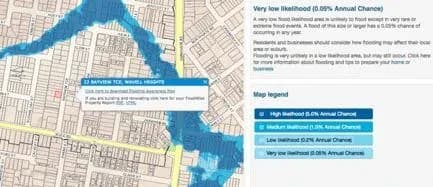
This screenshot shows an example of flood mapping and is not a current report for a property you are considering. Use the council’s latest Flood Awareness Map and a property-specific FloodWise report to check the address, flood levels and current information.
Flood risk can affect the lender’s valuation, insurance requirements and willingness to lend. A 1% Annual Exceedance Probability (AEP), sometimes called a Q100 event, means a 1% chance of a flood of that size in any year. It does not mean a property floods only once every 100 years. Check the specific address and floor levels.
How to check if your property is in a flood zone
You can find out if a property is in a flood zone by:
- Checking the Flood Awareness Map on the Brisbane City Council website
- Downloading a property-specific FloodWise report and checking insurance availability and cost before you commit
Examples of Brisbane suburbs affected in 2011; check the specific address
Albion- Auchenflower
- Balmoral
- Bellbowrie
- Brisbane City
- Bulimba
- Chapel Hill
- Chelmer
- East Brisbane
- Greenslopes
- Hamilton
- Hawthorne
- Indooroopilly
- Kelvin Grove
- Kenmore
- Milton
- New Farm
- Newstead
- Norman Park
- Oxley
- Paddington
- South Brisbane
- Toowong
- West End
- Windsor
- Woolloongabba
- Yeerongpilly
- Yeronga
Flood exposure varies within a suburb and from property to property. This historical list is not a current flood-risk assessment. Check the FloodWise Property Report for the address.
Can you still buy in a flood zone?
Yes . it’s not impossible! Some lenders will consider your application if you can provide:
- Comprehensive flood cover insurance
- A satisfactory property valuation or survey report
- Additional context such as loan amount, property type, location, and loan structure
Buying in a flood zone doesn’t automatically mean your home loan will be declined. With the right lender and documentation, you can still secure a home loan even in higher-risk areas.
If you’re considering a flood-prone property, our home loan team can check lender requirements alongside the valuation and available insurance. Call us on 1300 088 065. Approval still depends on the property and your application.
22. Purchasing A Property With Renovation Issues
That “worst house on the best street” or “renovator’s delight” might look like a dream investment… until the bank declines your loan after pre-approval!

Banks are generally cautious about properties that are incomplete or in poor condition. Missing kitchens, bathrooms with holes, or structural issues are often enough for a lender to say no . especially if your deposit is less than 20%.
What banks look for
Whether a property with renovation issues can be financed depends on the severity and type of problems. Key questions include:
- How bad is the house? Is it structurally sound?
- Are the issues cosmetic or major?
- What will the repairs cost, and how will they be funded? There is no universal $50,000 acceptance threshold.
- Can you provide quotes or a building contract for the renovations?
- Will you be able to live in the house while renovating?
Even with renovation issues, your home loan doesn’t have to be declined. The right lender and proper documentation can make all the difference in securing unconditional home loan approval.
Read More: Renovation loans . the complete guide
23. Changes In Credit Criteria
Lenders can change credit policies while your pre-approval is active. Ask whether your application will be reassessed under the new rules before you commit to a property.
I'd first check whether the new rule applies to your existing application. CommBank gives a useful example: new applications submitted from 25 September 2026 can't combine the 5% Deposit Scheme with its lower assessment buffer for HELP expected to clear in more than 1 year and within 5 years.
But CommBank says applications already in progress, including HomeSeekers, will be honoured if they meet its acceptable-changes rules. We need to check your application and any proposed changes before deciding whether the new rule affects your borrowing amount.
The announcement doesn't remove the separate option for HELP expected to clear within 12 months. See our HECS and home loans guide for the difference.
How to navigate changes in credit criteria
Working with an experienced mortgage broker can make all the difference. Ask plenty of questions before you commit, such as:
- How many years of experience do you have as a mortgage broker in Brisbane?
- What did you do before becoming a mortgage broker?
- Do you own property yourself, and how many?
- What types of home loan customers do you usually assist?
- How many home loans do you arrange each week, and what is the average loan size?
The right broker will guide you through any shifts in credit criteria and ensure your application is structured correctly to maximise your chances of unconditional home loan approval.
24. Failing The Bank's Credit Score
Many banks now rely on credit scores to evaluate applicants instead of manually reviewing past transactions. Your credit score takes into account several factors, including:
- Number of credit enquiries in the past 3 to 6 months
- Types of finance you’ve applied for in the past 12 months
- Overdue or defaulted debts in the past 5 years
- Bankruptcy information, which generally remains on a consumer credit report for the later of 5 years from bankruptcy or 2 years after it ends.
- Late payments on utilities like electricity, gas, or mobile phones
- Interest-free or Buy Now, Pay Later loans like AfterPay
- Court writs or judgments
| Information | Reporting period |
|---|---|
| Credit enquiry | 5 years |
| Default | 5 years |
| Court judgment | 5 years |
| Repayment history | 2 years |
| Financial hardship information | 1 year |
| Bankruptcy | Until the later of 5 years after bankruptcy began or 2 years after it ended. |
| Serious credit infringement | 7 years |
How long information stays on a consumer credit report
Credit enquiry
- Reporting period
- 5 years
Default
- Reporting period
- 5 years
Court judgment
- Reporting period
- 5 years
Repayment history
- Reporting period
- 2 years
Financial hardship information
- Reporting period
- 1 year
Bankruptcy
- Reporting period
- Until the later of 5 years after bankruptcy began or 2 years after it ended.
Serious credit infringement
- Reporting period
- 7 years
A late phone or utility bill is not automatically a listed default. A reportable consumer-credit default generally requires at least $150 to be overdue for 60 days and the required notices. Paying a correctly listed default updates its status but does not automatically remove it. A lender may also hold its own account history, separate from your credit report.
Case Study 1: Tyrone to Loan declined due to recent credit activity
Tyrone applied for a home loan, but in the previous four months he had applied for a personal loan, two credit cards, and an interest-free purchase. He also had one late electricity payment while travelling for work. His bank declined his loan after pre-approval because of a low credit score.
Hunter Galloway stepped in and found a lender that didn’t credit-score home loan applicants. By explaining Tyrone’s travel situation and clarifying his other financial activity, we were able to get his loan approved.
Case Study 2: Nick to Loan declined after pre approval over a 13-year-old missed payment
Nick had a high credit score (over 900), stable employment, no debt and a 20% deposit. The bank declined his application because of an unpaid debt from 13 years earlier in its own records. A lender’s internal account history is separate from a default listing on a consumer credit report.
Failing a bank’s credit score does not automatically mean your home loan will be declined. With the right lender and guidance, you can still secure approval.
25. An Unreliable Pre-approval
This is one of the biggest reasons why people get their loan declined after pre approval to they got the wrong pre approval to begin with…
Not all banks handle pre-approvals the same way. You may hear them called a conditional approval, indicative approval, approval in principle, or home seeker . it depends on the lender.
In most cases, a pre-approval is just an indication that the bank is open to considering your loan. Some banks may only complete a basic credit check and not fully verify your documents until you lodge a full mortgage application.
A full mortgage application is completed once you find a property. At that stage, the lender will thoroughly assess your loan by verifying:
- Payslips and income information
- Bank statements and savings
- Existing liabilities
Getting a pre-approval does not guarantee that the bank can lend you the money . so it’s important to understand the limits of that approval.
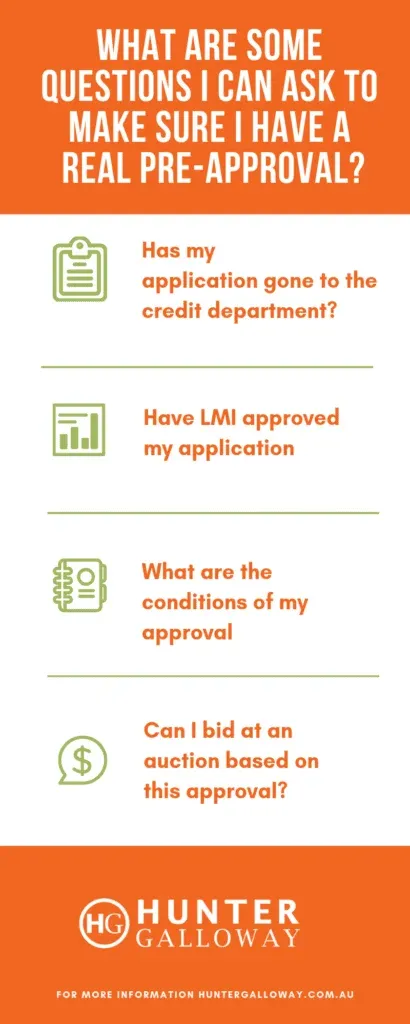
The mortgage-insurer question applies only if your loan needs LMI. Confirm which checks the lender and insurer have completed and which conditions remain. Pre-approval does not guarantee the property will be accepted or the loan will settle. Before bidding at auction, have your solicitor review the contract and ask your broker what lending conditions are still outstanding.
26. The Pre-approval Expired
Many pre-approvals last around 3 months, while some last longer. Use the expiry date and review conditions on your own approval letter.
If you find a property after your approval expires, ask what is needed to renew it before relying on the old amount. The lender may request updated payslips, bank statements, identity documents or a new assessment.
Different banks handle expired pre-approvals differently:
- Some may simply confirm that your financial position hasn’t changed over the past 90 to 180 days.
- Others may require all new supporting documents, including payslips, bank statements, and identification.
The downside is that if your financial situation has changed, the bank could potentially decline your loan even after it was previously pre-approved. That is why it is important to work with an experienced mortgage broker.
27. Forgetting A Few Details Can Get Your Loan Declined After Pre approval

Applying for a home loan involves a lot of documents and information. You need to provide details of every credit card, transaction account, and other financial commitments. Forgetting even a small detail can cause major headaches with banks.
Banks usually request 3 to 4 months of day-to-day transaction statements. If you forget to mention a credit card that has direct debits coming from your main account, the bank may view this as an undisclosed debt or liability.
A common example is an interest-free credit card you may have received from a store like Harvey Norman a few years ago . perhaps you haven’t used it in years and completely forgot about it. With some banks, undisclosed liabilities can lead to an instant loan decline after pre-approval.
How to avoid missing details
- Check your credit report: Ask for a copy and review enquiries and open accounts. Credit enquiries generally stay on a consumer credit report for 5 years, so also review your own records for older accounts.
- Review day-to-day statements: Your broker can go through your accounts with you to ensure no credit cards, AfterPay accounts, or other liabilities have been overlooked.
28. Banks Misunderstanding Your Expenses
Sometimes, banks misinterpret your spending. For example, if you regularly shop at Baby Bunting, they might assume you have a dependent child, even if it’s just a one-off situation like helping a friend or family member.
Case Study: Loan declined over IVF
One of our clients, Jane, was preparing to buy her first home with a significant deposit. When the bank reviewed her application, they noticed payments to an IVF clinic and assumed she had a dependent child. They declined her application outright for non-disclosure and a perceived servicing shortfall.
After explaining the situation . that she was freezing her eggs and did not have a dependent . the bank overturned their decision.
29. Being Too Young… Or Too Old
Age alone does not decide whether a home loan is suitable. If the term extends into your expected retirement, a lender may ask how you will meet the repayments or repay the balance. There is no universal age-45 cut-off. Your income, assets, loan term and proposed exit strategy need to be assessed.

These age-related requirements can limit your mortgage options, depending on the lender. Some common exit strategies banks may ask for include:
- Downsizing to a smaller home once you reach retirement age
- Selling investment properties or shares to free up funds
- Using recurring income from your superannuation to make repayments
- Accessing funds from your superannuation to pay down the loan
If the lender has concerns about repayments in retirement, ask which part of the plan it cannot accept. Our home loan team can review the evidence and options on 1300 088 065. Another approval is not guaranteed.
What if nothing changed after pre-approval?
The lender may only complete its first detailed review at formal approval. Salary packaging, a novated lease, parental leave or a deposit-scheme condition may not have been fully assessed earlier. Check what documents the first decision actually covered.
For a property issue, ask whether the lender rejected the address, reduced the maximum loan or accepted a lower value. Gather the contract, plans, property details and comparable settled sales before you challenge a bank valuation. The apartment mortgage guide covers extra checks for units.
If the lender gives only a broad internal credit or commercial reason, do not guess that fraud or bad credit caused it. Ask for its explanation and complaints process, and check your credit reports. For a decline that did not follow pre-approval, see the home loan decline guide.
What To Do If Your Home Loan Is Declined After Pre-approval?

If your loan is declined after pre-approval, don’t panic. Here’s what to do right away . with clarity and purpose.
- Ask for a Clear Reason to Request specific feedback from your lender. Ask: “Which criteria triggered the decline?” Knowing the exact reason helps you fix it.
- Review & Correct Your Documents to Double-check your payslips, bank statements, tax returns, and credit report. Look for errors or missing liabilities. Even small undeclared debts (like BNPL or a phone bill) can hurt. Disclose any recent changes truthfully . such as a job switch or higher living costs.
- Check the contract immediately: If you have signed, call your solicitor or conveyancer to confirm the finance deadline, settlement date and any right to seek an extension or terminate. A loan decline does not automatically let you cancel. Your broker can work on finance at the same time.
- Keep the application accurate: Avoid unnecessary new credit, continue paying bills and disclose any changes. Work on the actual reason for decline before another application; do not hide spending or commitments.
How a Mortgage Broker Can Recover Your Application
A skilled mortgage broker can be your strongest ally when a pre-approval falls through. Here’s how they help you bounce back.
Strategic Lender Matching
- Brokers know which lenders are more forgiving on valuation shortfalls, credit issues, or income structure.
- They can pivot your application to a more suitable lender quickly, leveraging their lender panel.
- Their network can make or break your second chance . they may already have relationships that smooth the process.
Re-Structuring Your Application
A broker can help rework your application to strengthen it:
- Document your income accurately, including how overtime, bonuses or salary packaging are paid.
- Help you improve your deposit picture (gifts, savings, genuine savings documentation).
- Identify and reduce liabilities or undisclosed debts that concern lenders.
Provide a clear, professional explanation letter for any red flags (job changes, credit hits, large expenses).
Timing Your Re-Application
- Brokers advise when your credit profile has stabilised to minimise the risk of another decline.
- They track the best moment when lender policies are more favourable.
- They help you minimise credit enquiries, reducing hard-pull hits that could hurt your score.
What matters next
Pre-approval is a strong start, but it’s not the finish line. Lenders re-assess in depth at the formal application stage. If things go wrong, act quickly: ask for clarity, correct your documents, and lean on your broker. With the right strategy, you can often recover and still secure that home loan.
What Happens If Your Loan Is Declined After You’ve Signed The Contract?

When a home loan is declined after signing a contract, many buyers feel blindsided and uncertain. Understanding your rights, legal exposure, and the correct steps can protect your deposit and keep your purchase on track.
Key Risks Buyers Must Understand
- Losing your entire deposit to You can forfeit it if finance conditions aren’t met or contract deadlines are missed.
- Breaching contract conditions to Failure to complete settlement as agreed can trigger legal penalties.
- Facing legal action from the seller to Sellers may pursue compensation for financial losses caused by withdrawal.
- Paying damages beyond the deposit to Extra costs may apply if the property resells for less.
- Missing settlement deadlines to Delays expose you to penalties, default notices, and potential contract termination.
Risks During Cooling-Off and Finance Clause Periods
- Cooling-off may be available: In Queensland, many private residential purchases have a 5 business day cooling-off period. Auction purchases and some other contracts are excluded; the period can also be waived or shortened.
- You may still lose a small penalty fee to It compensates the seller for disruption and lost time.
- A cooling-off penalty may apply: For an eligible Queensland contract, the seller may deduct up to 0.25% of the purchase price when you properly terminate during cooling-off. Other states have different rules.
- A finance condition may provide a right to terminate: This depends on the wording, your compliance with it and notice being given correctly. Ask your solicitor before the deadline.
- Deadlines matter: Missing a date can change your rights. Have your solicitor check the exact contract rather than assuming protection ends or continues automatically.
Buyer Rights vs Legal Exposure
- A finance clause may protect you: Its wording sets the conditions and process. It does not automatically pause the contract whenever a lender declines.
- Without an available contract right to exit, your deposit may be at risk: A loan decline alone does not excuse a failure to settle. Your solicitor must assess the seller’s rights and your potential liability.
- Sellers can pursue additional damages in some cases to Especially if the property resells at a lower price.
How Timing Affects Deposit Recovery
- Tell your solicitor and broker immediately: Your solicitor can identify who must receive any formal notice and by when. Simply telling the agent or lender may not satisfy the contract.
- Keep written evidence of the decline: Ask your solicitor what evidence and notice your particular finance condition requires.
- Follow the contract’s exact process to Deviating from the stated procedure weakens your claim to deposit recovery.
When To Engage Your Conveyancer Or Broker
Contact Your Conveyancer Immediately To:
- Assess legal standing to A conveyancer checks if your contract protections are still valid.
- Issue termination notices if required to Proper legal wording and timelines are critical for protection.
- Advise on deposit recovery strategy to Expert guidance maximizes your chances of getting your money back.
Contact Your Mortgage Broker At The Same Time To:
- Explore alternative lenders to Brokers can identify other lenders who may approve your loan.
- Assess emergency approval pathways to Specialist or non-bank lenders might offer fast solutions.
- Review the application evidence and loan structure to Accurately document income, available deposit and liabilities, then check what the lender can accept.
Bonus: What Happens After Your Home Loan Is Approved?

So, you’ve got your approval letter from the bank, your loan is unconditionally approved, and your property purchase is just around the corner. What’s next? Here’s the step-by-step process after your home loan approval.
1. Sign your loan documents
This usually includes mortgage documents, the loan contract, interest-rate terms and direct-debit instructions. If the purchase is subject to finance, your solicitor must confirm what satisfies that condition and give any required notice. Do not assume a broker’s approval letter alone makes the contract unconditional.
2. Talk with your solicitor or conveyancer
Your solicitor will have important documents for you to sign. Make sure to:
- Confirm you’ve signed your loan contracts
- Check for any stamp duty concessions or First Homeowner Grant applications
- Ensure there are no pending searches or adjustments at settlement
3. Arrange mail, power, and internet
Connect your utilities a few days before moving in. You don’t want to arrive at your new home without electricity or internet. Plan early. some services take weeks to activate.
4. Organise a pre-settlement inspection
Arrange the pre-settlement inspection with the agent and your solicitor. Check that the property is in the condition required by your contract. If something is missing or damaged, tell your solicitor before settlement so they can advise on the available options. Settling does not necessarily erase every legal right.
5. Celebrate (after picking up the keys!)
On settlement day, wait for your solicitor or conveyancer to confirm settlement has completed before collecting the keys. The time varies. Congratulations, you’re officially a homeowner!
Loan Declined After Pre-approval FAQs
Next Steps And Settling Your New Home
Our team here at Hunter Galloway is here to help you buy a home in Brisbane.
Unlike other mortgage brokers who are just one-person operators, we have an entire team of experts to help make your home loan journey as simple as possible.
If you want to get started, please get in touch here, and we can book a time that suits you to either a phone call information session or a face-to-face meeting (which doesn’t cost you anything).

Our team of home loan experts is here to help you buy a home in Australia
More Resources For Home Buyers…
Note: Information is subject to change without any further notification. Any home loan application is subject to credit approval and verification of all supporting documentation. Consider this article as general in its nature and not to be taken as advice.
Get a free assessment
Find out why the loan decision changed
Send me the pre-approval letter, final decline reason, contract deadline and the documents the lender reviewed. I will help you separate the lender issue from the property or evidence issue before we discuss another application.
or call 1300 088 065
Hunter Galloway. Australian Credit Licence 389328. Credit Representative 476903. General information only. This is not legal advice, a valuation, a credit assessment or a promise of approval. Client examples are based on real situations. Names and identifying details have been changed.
Experience and sources
How this guide was checked
We reviewed this guide on 18 September 2026 against the existing article and the sources below. The guide explains the evidence and conditions to check; each lender assesses the application and property individually.

Nathan Vecchio is a director & mortgage broker at Hunter Galloway. Hunter Galloway Finance Pty Ltd is Credit Representative 476903, authorised under Australian Credit Licence 389328.
Sources
- CommBank Home Seeker loans: conditional approval and reassessment
- ASIC Moneysmart: buying a house and loan approval
- OAIC: information on your credit report
- OAIC: what stays on a credit report
- Queensland Government: cooling-off periods
- Brisbane City Council: FloodWise property reports
- Fair Work Ombudsman: independent contractors and employees
- Fair Work Ombudsman: casual employees
- ASIC Moneysmart: buying a house
- Queensland Government: cooling-off period and auction exceptions
- CommBank broker announcement: HELP Method 2 and the Government 5% Deposit Scheme, effective 25 September 2026; applications in progress subject to acceptable-changes rules.
General information only, not legal advice, a valuation, a credit assessment or a promise of approval. Lender policies can change. Client examples are based on real situations; names and identifying details have been changed.