


Why ING can stand out
- 01 / Everyday banking
A full offset is available
Orange Advantage can link 1 Orange Everyday account as a 100% offset to each eligible loan account.
- 02 / Family help
An eligible relative can use some property equity to reduce the deposit you need.
- 03 / Returning to work
Parental leave does not always stop the loan
Future return-to-work income may be considered when the dates, role and cash buffer make sense.
ING Orange Advantage vs Mortgage Simplifier
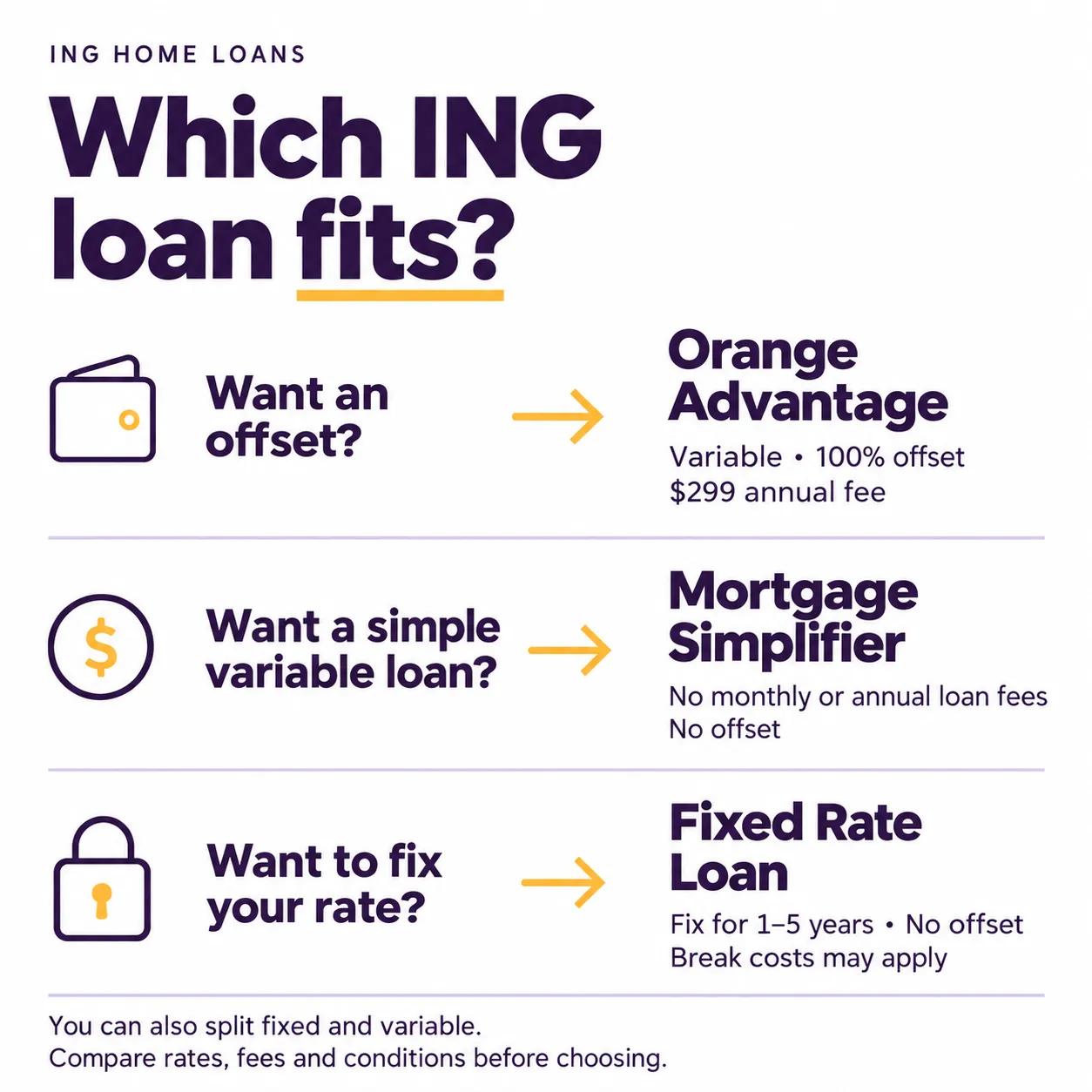
Orange Advantage: an offset account for $299 a year
You can link 1 Orange Everyday account as a 100% offset to each eligible loan account. Money sitting in the offset cuts the balance ING charges interest on, and you can still spend it whenever you need to.
The catch: it’s 1 offset per loan account, and the loan costs $299 a year.
Want separate offsets for bills, holidays and an emergency fund? ING can’t do that on the one loan. Our multiple offset accounts guide compares the lenders that can.
Mortgage Simplifier: no ongoing fees, no offset
There is no monthly or annual loan fee, but there is also no offset account. This can suit someone who will not keep enough savings in an offset to justify paying for it.
The catch: the minimum total borrowing is $150k.
Fixed rates
ING offers fixed terms from 1 to 5 years. Keep extra repayments below $10k in total in each fixed-rate year to avoid its extra-repayment break-cost rule. Paying $10k or more, selling or refinancing during the fixed term can trigger break costs.
ING’s detailed warning uses $10k or more, even though its headline says up to $10k. Check with ING before making a large extra payment. Extra repayments cannot be redrawn during the fixed term, and the fixed loan has no offset.
Renovations and energy upgrades
Planning a renovation? ING may release up to $150k in one payment for non-structural work when the total loan stays at 90% of the property value or less. Structural renovations, a new granny flat, business use and money for living expenses need another lender or loan structure.
ING also has a separate Green Upgrade Loan for eligible existing customers funding approved energy improvements. Check the project, loan balance, property value and current offer before relying on it.
Buying with a guarantor
How ING's guarantor loan works
The loan cannot be used to release extra cash or combine other debts into the home loan. ING also limits who can help and what the guarantor can offer as security.
- 80%
Main loan against the home you buy
Can cover up to 80% of the home you buy.
- Principal + interest
Your repayments
Reduce the loan balance, not just cover the interest.
- 100%
Total purchase borrowing with a guarantor
May cover the full purchase price with enough guarantor support.
You must be able to afford the repayments using your own income. The guarantor is responsible for an agreed part of the loan, not the whole amount.
Our guarantor home loan guide explains how a guarantee works, the risks for your family and how it may be removed.
Why ING can suit a retired guarantor
ING does not automatically rule out a guarantor because they are retired. It looks at their age, assets and how they could repay the guaranteed amount if ING ever asked them to. This may help when a retired parent owns their home but receives the age pension.
The CBA and Bankwest policies reviewed for this guide were stricter when government benefits were the guarantor's only income.
Which family members can help?
ING limits its guarantor loan to a spouse or de facto partner, parent, grandparent, sibling or child. You cannot use cash or a term deposit instead of property, and the loan is not available for construction.
NAB and Macquarie do not offer this type of parent-backed guarantor loan through the broker channel.
Before anyone agrees to guarantee the loan: the guarantor should get independent legal advice and understand the maximum amount they could be responsible for, plus how the guarantee may later be removed.
Applying during parental leave
ING may count the income you will earn after returning to work. You need to show the return date, role, hours and pay. ING will also check whether your savings and other income can cover the period before your normal pay starts again.
Our parental leave home loan guide explains the return-to-work evidence and savings to prepare.
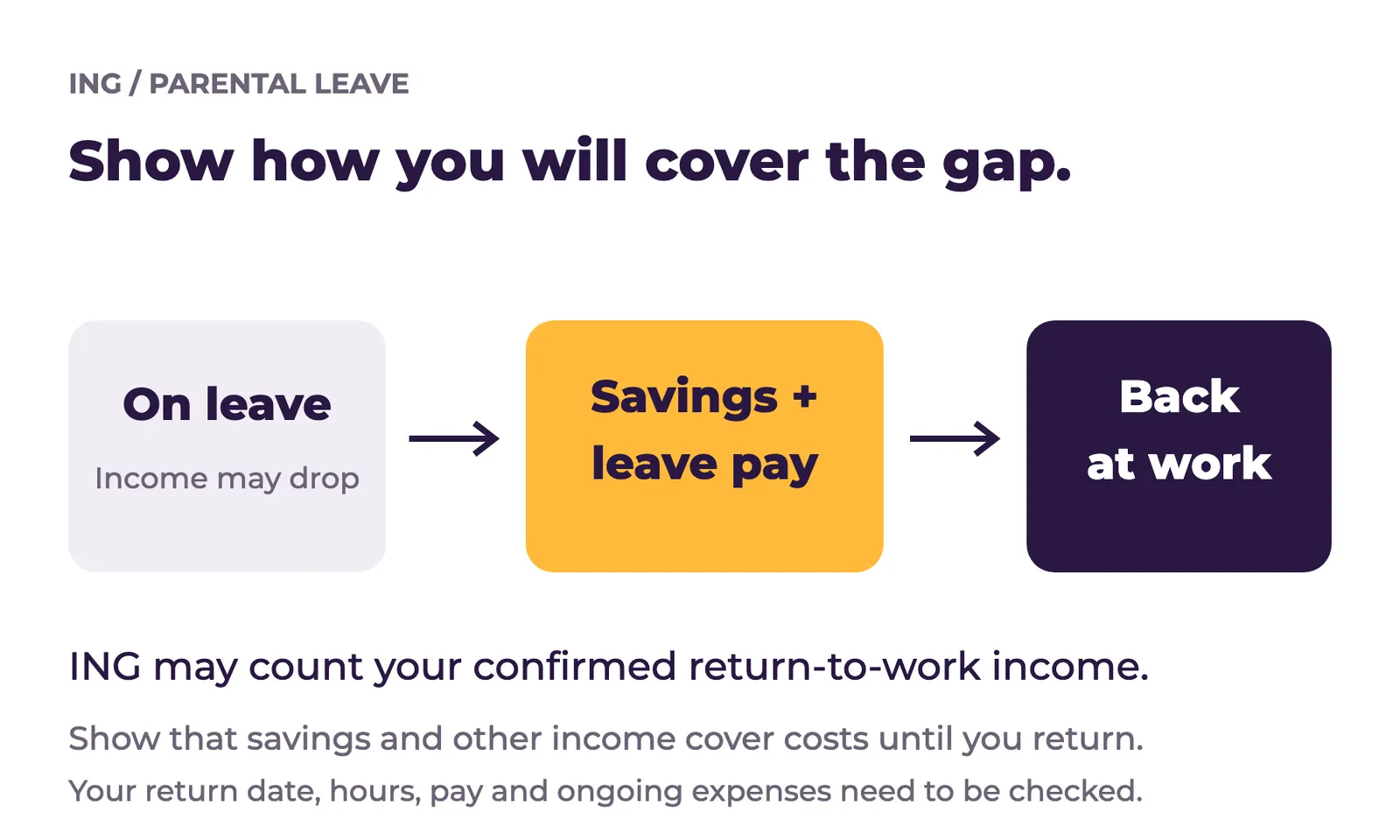
- Have your employer confirm the return date and ongoing pay.
- Show the leave payments or other income you will receive before returning.
- Allow for childcare and other expenses once work resumes.
Income and borrowing power
ING checks how much of your income it can count, your debts and living costs, and whether you could manage repayments if rates rise.
How ING treats income and debt
Scroll to see more columns
| Income or debt | How ING may treat it | What to prepare |
|---|---|---|
| Employee (PAYG) income | Regular base income can be used when employment is ongoing and documents match | Recent payslips and employment details |
| Casual income | ING may use 100% after 6 months in the job, or with 2 years in a similar role or industry | Payslips and employment history |
| Second job | ING may use 100% after 6 months with the second employer, provided combined work stays within 60 hours a week | Payslips and start dates for both jobs |
| Self-employed income | The 1-year method still needs full financial documents. ING may use 90% of the latest year's accepted income when the business has traded for at least 2 years and you borrow 80% or less | Lodged returns and business financials. The 1-year option cannot be used with personal debt consolidation |
| Rental income | Up to 95% may be used, or 85% for a property in a higher-risk postcode | Lease, rental statement or valuation evidence |
| Credit cards | ING may count 3.8% of the card limit as a monthly commitment | Consider reducing unused limits before applying |
| Shared debt with someone not applying | ING may use 50% when the other person can prove they cover their half. Otherwise ING uses the full commitment | Loan statements and evidence of who makes each repayment |
| HELP or HECS debt | May leave the repayment out if your balance is $15k or less and you meet the savings requirement | Current ATO balance and verified savings left after covering the transaction, enough to repay the whole HELP debt |
- How ING may treat it
- Regular base income can be used when employment is ongoing and documents match
- What to prepare
- Recent payslips and employment details
- How ING may treat it
- ING may use 100% after 6 months in the job, or with 2 years in a similar role or industry
- What to prepare
- Payslips and employment history
- How ING may treat it
- ING may use 100% after 6 months with the second employer, provided combined work stays within 60 hours a week
- What to prepare
- Payslips and start dates for both jobs
- How ING may treat it
- The 1-year method still needs full financial documents. ING may use 90% of the latest year's accepted income when the business has traded for at least 2 years and you borrow 80% or less
- What to prepare
- Lodged returns and business financials. The 1-year option cannot be used with personal debt consolidation
- How ING may treat it
- Up to 95% may be used, or 85% for a property in a higher-risk postcode
- What to prepare
- Lease, rental statement or valuation evidence
- How ING may treat it
- ING may count 3.8% of the card limit as a monthly commitment
- What to prepare
- Consider reducing unused limits before applying
- How ING may treat it
- ING may use 50% when the other person can prove they cover their half. Otherwise ING uses the full commitment
- What to prepare
- Loan statements and evidence of who makes each repayment
- How ING may treat it
- May leave the repayment out if your balance is $15k or less and you meet the savings requirement
- What to prepare
- Current ATO balance and verified savings left after covering the transaction, enough to repay the whole HELP debt
Have $15k or less left on HECS?
ING may leave your HELP repayment out when working out how much you can borrow. You'll need a current ATO record showing a balance of $15k or less, plus enough savings left after your deposit and buying costs to cover that balance in full. ING needs to verify those savings.
If you owe $12k, for example, you'd need at least $12k left once the money needed to complete your purchase is accounted for.
Before paying extra towards HECS, I'd compare your borrowing power and the savings you'd have left under each option. Your compulsory HELP repayments still continue even if ING leaves them out of its home loan calculation. Our HECS and home loan guide explains the options.
How much of the property value can ING lend?
- 95%
Owner-occupied purchase
For a home you will live in, with principal and interest repayments. Roughly a 5% deposit before costs.
- 90%
Investment
For an investment purchase or refinance. Roughly 10% deposit or equity before costs.
- 80%
Owner-occupied
For interest-only borrowing on your own home. Roughly 20% deposit or equity before costs.
How much you can borrow depends on your income, credit history, postcode, property and any LMI requirements. Some higher-risk postcodes may be capped at 90% for an owner-occupied purchase.
The debt-to-income check
ING also compares your total debt with your gross annual income. This is called debt-to-income, or DTI. For example, $600k of total debt against $100k of gross annual income is a DTI of 6.
Borrowing 80% or less?
ING generally wants total debt to stay below 8 times gross annual income.
Borrowing more than 80%?
The limit tightens. ING generally wants total debt to stay below 6 times gross annual income.
For credit cards, ING uses the card limit, not what you currently owe. A large existing mortgage, investment debt or unused card limit can reduce the amount ING will lend, even on a strong salary.
ING also assesses repayments using the higher of 5.50% or 3% above the actual rate. This is a safety test, not the rate you will pay.
Investors can hit an income ceiling
ING can use up to 95% of standard rent, or 85% in a postcode it sees as higher risk. The catch is that rent cannot make up more than half of the total income ING uses in the application. It also ignores Airbnb, Stayz and other short-term or holiday rental income.
ING may look generous when you check one property's rent, then become restrictive once rent dominates the household income it can use. Investors with several properties should compare borrowing capacity before choosing it.
Deposit, gifted equity and genuine savings
When you borrow more than 90% of the property value, ING generally wants at least 5% of the purchase price to come from genuine savings.
What may count
- Savings or a term deposit held for at least 3 months
- A gift or inheritance held for at least 3 months
- Equity in another property
- A satisfactory 3-month rental payment record
An acceptable rental history can help show a regular saving habit. It does not give you the cash for a deposit: you still need funds for the purchase and its costs.
What usually does not count
- Future savings you have not built yet
- A personal loan or other borrowed deposit
- A builder incentive or purchase cashback
- Business funds that are not clearly available personally
Buying a family property below market value
Ordinary purchase vs. favourable family purchase
Ordinary purchase: ING uses the lower figure
- The loan is measured against the lower of the purchase price or the valuation. A higher valuation does not normally create an instant deposit.
Favourable family purchase: gifted equity may do more of the work
- ING may use the valuation when the family member selling the property signs ING's Gift Statutory Declaration. The declaration confirms the discount is a genuine gift and will never be repaid.
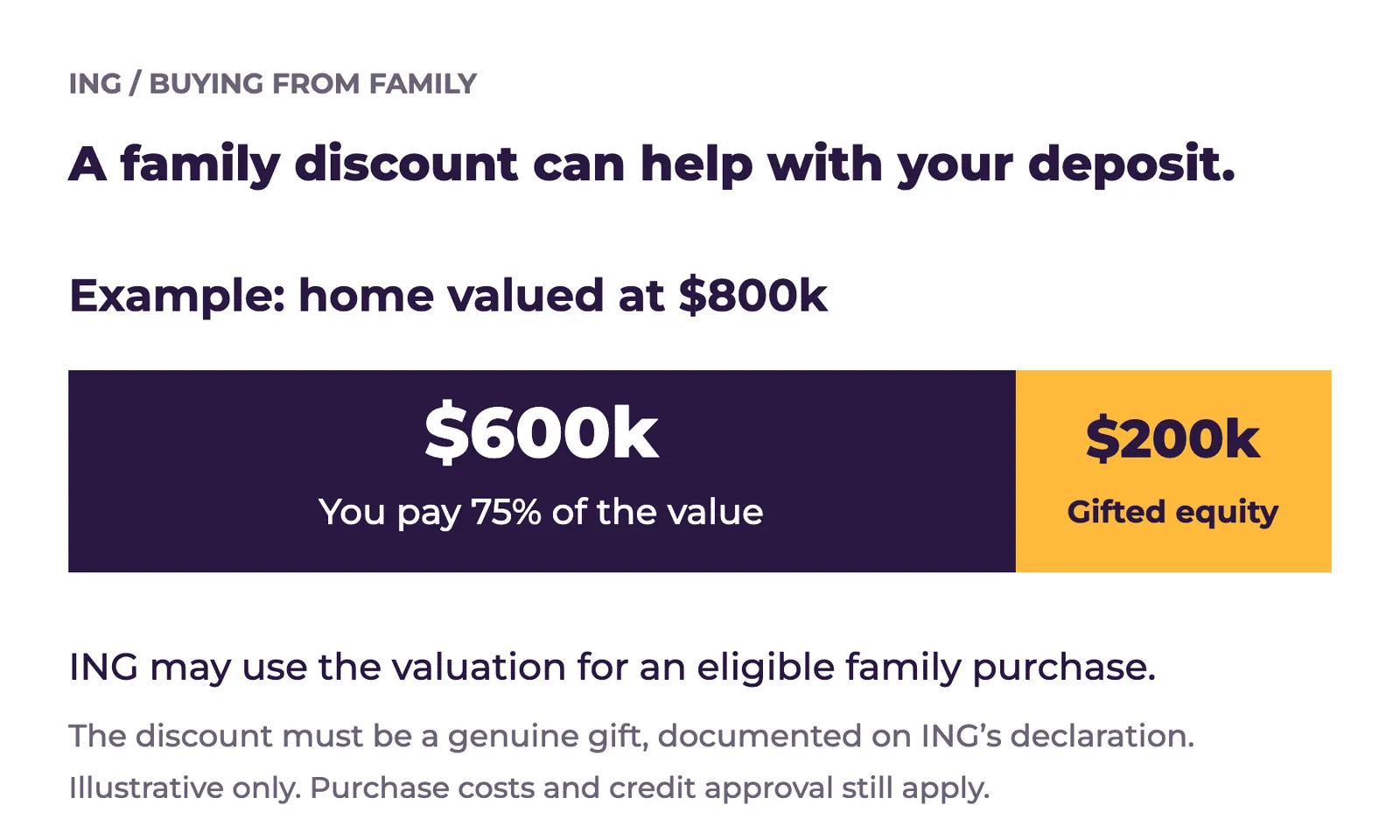
Our gifted equity guide compares how the discount, valuation and buying costs fit together.
Buying off the plan
Signed an off-the-plan contract more than 12 months ago? If the property has increased in value, ING may use the current valuation and lend up to the agreed purchase price while staying inside its usual limits on the share of the property value you can borrow. That growth may do part of the deposit work.
Government scheme and LMI waivers
Using the Australian Government 5% Deposit Scheme? ING is not currently listed as a participating lender. If the scheme is part of your plan, compare the current participating lenders before choosing a bank.
Work in medicine or another high-income profession? ING has no professional LMI waiver for any profession. Compare the deposit, LMI cost and full loan result rather than assuming your profession receives special treatment.
A 5% deposit does not always mean you have enough to buy. You also need money for purchase costs and any shortfall if the valuation comes in below the price.
The property can change the answer
Send us the address and contract early, plus any strata or letting agreement. We’ll check whether ING accepts the property, especially for apartments, acreage or anything with a management agreement.
ING's property rules
Scroll to see more columns
| Property | ING's broad position | What needs a closer look |
|---|---|---|
| Standard apartment | May be considered from 40m² | Building concentration, zoning, location and self-contained use |
| Large development | ING limits how many units it will fund in one project | Generally no more than 25% of units, or 10% in a new staged release |
| Acreage | May work up to 10 hectares | The property should be residential and not rely on farming income |
| Warehouse conversion | May be considered | Residential approval, marketability, access and valuation |
| Serviced or managed apartment | Usually not suitable | Letting pools, short-stay restrictions, hotel or resort use |
| Construction or vacant land | Not part of ING's standard residential offer covered here | Compare a lender that supports your build structure |
- ING's broad position
- May be considered from 40m²
- What needs a closer look
- Building concentration, zoning, location and self-contained use
- ING's broad position
- ING limits how many units it will fund in one project
- What needs a closer look
- Generally no more than 25% of units, or 10% in a new staged release
- ING's broad position
- May work up to 10 hectares
- What needs a closer look
- The property should be residential and not rely on farming income
- ING's broad position
- May be considered
- What needs a closer look
- Residential approval, marketability, access and valuation
- ING's broad position
- Usually not suitable
- What needs a closer look
- Letting pools, short-stay restrictions, hotel or resort use
- ING's broad position
- Not part of ING's standard residential offer covered here
- What needs a closer look
- Compare a lender that supports your build structure
See our guide to rural property home loans.
Check the strata letting rules. An apartment can look standard but still fall outside ING's rules if the by-laws or management agreement restrict owner use or require holiday letting.
Our apartment loan guide explains how size, building type and use can affect lending.
Fees, assessment times and Broker Express
- $299/year
Orange Advantage
The annual fee pays for the offset-enabled loan setup.
- $0
Mortgage Simplifier ongoing fee
No monthly or annual loan fee, but no offset account.
Ask about application, settlement and discharge costs as well as the ongoing fee. A fixed loan can also have break costs if you repay early or change the loan.
ING’s public broker website showed the following assessment times on 11 September 2026. These apply to complete applications and exclude valuation wait times.
Selling, refinancing or paying off your ING loan? Our ING discharge guide explains how to start, what to have ready and how long to allow.
- 2 business days
Purchase assessment
- 2 business days
Refinance assessment
- 2 business days
Non-assessed pre-approval
We’ll check the current ING broker service levels against your finance deadline and allow time for the valuation, missing documents and any follow-up questions.
ING Broker Express: ING's public option vs. Hunter Galloway's access
ING's public option: non-assessed pre-approval
- This is a useful early check, but ING has not worked through the full application or checked every document. It gives you less certainty before bidding or signing a contract.
For eligible HG clients: fully assessed through Broker Express
- Hunter Galloway is one of a limited number of brokers with access to ING Broker Express. ING can review your income, debts, documents and credit history before you choose a property.
In our experience, eligible Broker Express files can move faster than the standard ING broker path. We’ll check whether your application is eligible, particularly if an auction is close or your contract has a short finance deadline.
We’ll explain whether your ING pre-approval has been fully assessed and what conditions remain. A fully assessed result gives you more confidence that your finances fit, but ING still needs to accept the property and valuation. We’ll work through the outstanding loan conditions with you before you commit to an unconditional purchase.
ING compared with alternatives
ING compared with alternatives
Scroll to see more columns
| Your situation | Why ING may work | When another lender may be better |
|---|---|---|
| Buyer using a guarantor loan | ING accepts a spouse or de facto partner, parent, grandparent, sibling or child, and may suit some retired-parent guarantors | Compare alternatives for other relationships, construction, or term-deposit or cash security. NAB and Macquarie do not offer this type of guarantor loan through brokers |
| Buying below market value from family | ING may use the valuation when the discount is documented as gifted equity that will not be repaid | Compare the cash needed, LMI result and legal structure if the gift or sale does not fit ING's declaration requirements |
| Returning from parental leave | Confirmed return-to-work income may count if you can cover costs until you return | Another lender may fit better if the return date or future hours are uncertain |
| Self-employed borrower | A 1-year method may work when you borrow 80% of the property value or less | Compare NAB or a specialist lender if the latest year, company structure or documents do not fit |
| Small-apartment buyer | Standard self-contained apartments from 40m² may be acceptable | Tell us if the building has short-stay rentals or letting restrictions. ING may also limit lending if it already has many loans in the building. |
| First-home buyer using the government scheme | ING may still work outside the scheme if your deposit and costs are enough | ING is not currently on the scheme's participating-lender list, so compare a participating lender |
| Company or trust borrower | ING does not offer these residential loans to companies or trusts | Compare a lender that accepts the borrowing entity and purpose |
| Buying before selling | ING is not an option for bridging finance | Compare a lender that can use your existing and new properties in a bridging structure. See our bridging-loan guide |
| Tight refinance borrowing power | ING tests repayments at 3% above the actual rate, or 5.50%, whichever is higher | ING has no reduced-buffer or fast title-insurance refinance option. Compare lenders with a suitable refinance path |
- Why ING may work
- ING accepts a spouse or de facto partner, parent, grandparent, sibling or child, and may suit some retired-parent guarantors
- When another lender may be better
- Compare alternatives for other relationships, construction, or term-deposit or cash security. NAB and Macquarie do not offer this type of guarantor loan through brokers
- Why ING may work
- ING may use the valuation when the discount is documented as gifted equity that will not be repaid
- When another lender may be better
- Compare the cash needed, LMI result and legal structure if the gift or sale does not fit ING's declaration requirements
- Why ING may work
- Confirmed return-to-work income may count if you can cover costs until you return
- When another lender may be better
- Another lender may fit better if the return date or future hours are uncertain
- Why ING may work
- A 1-year method may work when you borrow 80% of the property value or less
- When another lender may be better
- Compare NAB or a specialist lender if the latest year, company structure or documents do not fit
- Why ING may work
- Standard self-contained apartments from 40m² may be acceptable
- When another lender may be better
- Tell us if the building has short-stay rentals or letting restrictions. ING may also limit lending if it already has many loans in the building.
- Why ING may work
- ING may still work outside the scheme if your deposit and costs are enough
- When another lender may be better
- ING is not currently on the scheme's participating-lender list, so compare a participating lender
- Why ING may work
- ING does not offer these residential loans to companies or trusts
- When another lender may be better
- Compare a lender that accepts the borrowing entity and purpose
- Why ING may work
- ING is not an option for bridging finance
- When another lender may be better
- Compare a lender that can use your existing and new properties in a bridging structure. See our bridging-loan guide
- Why ING may work
- ING tests repayments at 3% above the actual rate, or 5.50%, whichever is higher
- When another lender may be better
- ING has no reduced-buffer or fast title-insurance refinance option. Compare lenders with a suitable refinance path
Hunter Galloway lender rating
ING broker score
ING scores well for digital service, Broker Express access, guarantor loans and favourable purchases. The overall result is pulled back by narrower borrower, construction and property rules.
7.4/10
Good for a straightforward application
Our rating across 6 categories
Score breakdown
Each category is scored out of 10
- Credit policy fitUseful niches, but strict credit history and several hard exclusions7.5/10
- Borrowing capacityCompetitive in some cases, but debt limits tighten above 80% of the property value7.0/10
- Property acceptanceGood for standard homes and some small apartments, limited for complex use6.5/10
- Product and offset featuresA strong 100% offset, but only 1 account per loan7.5/10
- Application speed and certaintyBroker Express lets us arrange a fuller review before you choose a property; allow time for the remaining checks8.0/10
- Ongoing pricing and serviceSimple digital banking and strong recent customer-satisfaction results8.0/10
What the customer survey tells us
What customers said in 2026: ING recorded 92.1% home-loan customer satisfaction in Roy Morgan's May 2026 results, the highest of the banks Roy Morgan measured. See ING's announcement and survey details

Experience and sources
How this guide was checked
Reviewed 18 September 2026 by Nathan Vecchio.
The sources below cover ING's products, lending requirements, service times and government scheme participation. The HELP debt changes apply from 18 September 2026. We check the current rules for your application before recommending a loan.

Joshua has worked in mortgage broking since 2011. See Joshua's experience and qualifications
Sources and check dates
- Detailed ING lending policy: checked 1 September 2026; not fully rechecked in this public-source update.
- ING Orange Advantage: checked 11 September 2026
- ING Mortgage Simplifier: checked 11 September 2026
- ING Fixed Rate Home Loan: checked 11 September 2026
- ING broker service levels: checked 11 September 2026
- ING home-loan customer satisfaction announcement: checked 11 September 2026
- Australian Government 5% Deposit Scheme participating lenders: checked 11 September 2026
- MoneySmart home loan guidance: checked 11 September 2026
- How Hunter Galloway reviews lenders
- ING HELP Debt Assessment Update: effective 18 September 2026.
- ING: Orange Advantage linking form IM214 (09/25), checked 15 October 2026
How are we paid?
The lender pays us commission, which we disclose before you proceed. Hunter Galloway is independently owned.
We compare more than 30 lenders and must act in your best interests. Our Brisbane team can compare ING with other lenders and explain which options fit your situation. Read more about how we review lenders
What home buyers say about us
 Google
“Clear, incredibly responsive and accurate.”
- Google
“Preapprovals done quickly and efficiently.”
- Google
“Reassuring every step of the way.”
More help with your home loan
NAB Home Loan Review
See where NAB may suit self-employed and professional borrowers.
Read guideWestpac Home Loan Review
Compare professional, guarantor loan and credit policy options.
Read guideFamily guarantor home loans
Understand the structure, risks and path to releasing a guarantee.
Read guideBuying your first home
Plan your deposit, costs, pre-approval and lender choice.
Read guideSelf-employed home loans
See how lenders assess tax returns and business income.
Read guideHow offset accounts work
Work out whether an offset will save more than it costs.
Read guide
ING home loan FAQs
These are the ING questions clients ask us most often.
Want to know whether ING fits your situation?
We can check your income, deposit and property against ING and other suitable lenders before you apply.
or call 1300 088 065
Hunter Galloway Finance Pty Ltd, Credit Representative 476903, is authorised under Australian Credit Licence 389328. General information only; policies, rates and fees can change and your full financial situation would need to be reviewed before any offer or product is accepted.