


When can you remove a guarantor?
You can ask the lender to remove your guarantor once your home and financial position can support the remaining loan. A loan at or below 80% of the lender's property valuation is a common starting point. Release still needs the bank's approval.
I would check your loan balance, arrange the appropriate valuation and compare a release with your current lender against refinancing. You may have an option before the whole loan is repaid.
What needs to change before release?
The guarantee has no standard 2, 3 or 5 year expiry. It stays in place until the lender releases it under the agreement. Keeping up with repayments and building equity can help you qualify, but neither automatically ends the guarantee.
Start a review when the loan has reduced, your property may be worth more or the family needs its security released. We also need to check your current finances, repayment history and any other debts linked to the properties.
How the 80% review point works
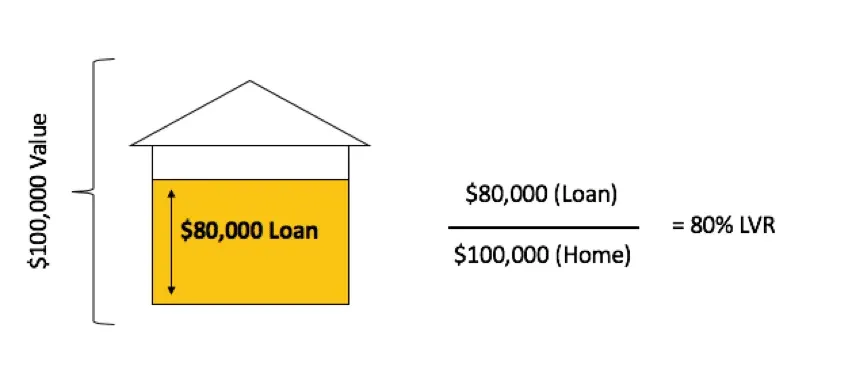
To calculate LVR, divide the loan balance by the property value accepted by the lender, then multiply by 100. Use your home's standalone value for this review, without adding your parents' property.
For a home valued at $450,000, 80% is $360,000. If you owe $405,000, your LVR is 90%. You would need to reduce the loan by $45,000 to reach 80% at that valuation.
| Loan balance | LVR | What I would check |
|---|---|---|
| $360,000 | 80% | Whether the existing lender can release the guarantee without lenders mortgage insurance (LMI). |
| $405,000 | 90% | Whether release or refinance is available, and whether LMI or another cost applies. |
The same $450,000 home at 80% and 90% LVR
$360,000
- LVR
- 80%
- What I would check
- Whether the existing lender can release the guarantee without lenders mortgage insurance (LMI).
$405,000
- LVR
- 90%
- What I would check
- Whether release or refinance is available, and whether LMI or another cost applies.
How Thomas reached 80% LVR
Thomas bought with his parents as guarantors. He paid down his loan while his home’s value rose. Together, those changes put him in a position to ask the bank to release his parents.
- 100% LVR
At purchase in 2022
Loan balance: $700,000
Property value: $700,000
- 80% LVR
At the review in 2025
Loan balance: $656,000
Bank valuation: $820,000
Removing a guarantor at 80% or 90% LVR
At or below 80%, many standard loans can avoid LMI, which makes this a useful time to ask for a release. The lender decides whether it can process a partial release, vary the loan or needs an internal refinance or new application.
Above 80%, I would still check the options if your parents need to be released. Some lenders may consider a release with LMI, a suitable refinance or another accepted arrangement. It is not an automatic right at 90%.
Keep your current lender
Ask what its release process requires, whether a new assessment is needed and which fees apply. You may be able to keep the existing loan.
Refinance to another lender
Compare valuation, approval requirements, LMI, fees and the total cost. Check the remaining term so a lower repayment does not simply spread the debt over longer.
Westpac's published release criteria give one example: it considers repayment conduct and whether LMI is no longer needed, or the borrower is willing to pay a premium. We still need its approval for the particular loan.
When will you have to pay LMI?
LMI may apply when the remaining loan is above the lender's usual limit without a guarantee. It is not compulsory on every loan above 80%: some products or eligible borrowers qualify for an exception.
Ask for a current quote. LMI premiums can differ between lenders for the same borrowing, so I compare the actual cost before recommending a refinance. Our LMI waiver guide explains some of the exceptions.
Steps to remove a guarantor from your mortgage
The order I would follow
- Find out when the family needs the releaseRecord any sale, refinance, renovation or retirement deadline before choosing the application route.
- Check the loan and guarantee documentsConfirm the balance, repayments, guarantee limit, all secured loans and both property owners.
- Arrange the lender's valuationUse a valuation that the proposed lender accepts. An online estimate is useful for planning but does not approve a release.
- Confirm the release requirementsAsk whether a partial release, loan variation, internal refinance or refinance to another bank is needed.
- Compare the costs and lodgeProvide the requested financial evidence, valuation and release forms. Include all fees and any LMI before choosing a route.
- Get written confirmationConfirm that the guarantee and relevant mortgage security have been released. The guarantor's solicitor can check the title position where needed.
What to have ready
| Information | Why it matters |
|---|---|
| Current loan statement and repayment history | Shows what is owing and how the account has been managed. |
| Property details and recent improvements | Helps arrange the appropriate bank valuation. |
| Income, debts and living costs | Needed if the lender reassesses affordability or you refinance. |
| Guarantee and security documents | Identifies the agreed obligation and other linked debts. |
| The guarantor's plans and deadline | Helps coordinate the release before a sale or new application. |
Guarantor removal checklist
Current loan statement and repayment history
- Why it matters
- Shows what is owing and how the account has been managed.
Property details and recent improvements
- Why it matters
- Helps arrange the appropriate bank valuation.
Income, debts and living costs
- Why it matters
- Needed if the lender reassesses affordability or you refinance.
Guarantee and security documents
- Why it matters
- Identifies the agreed obligation and other linked debts.
The guarantor's plans and deadline
- Why it matters
- Helps coordinate the release before a sale or new application.
Ask which period of repayment history the lender requires rather than assuming every bank uses the same 6 or 12 month rule. If there have been missed payments or hardship, tell us early so we can check the appropriate next step.
What does removing a guarantor cost, and how long does it take?
There is no single release fee or guaranteed turnaround. A straightforward release and a full refinance involve different work. We need the lender's current fees and processing estimate before giving you a budget or date.
| Possible cost | When to check it |
|---|---|
| Valuation | Before ordering; some lenders cover the valuation and others charge. |
| Release or loan variation fee | When asking the current lender to change its security. |
| Discharge and registration charges | When a mortgage is removed or replaced. |
| Refinance and fixed-rate break costs | Before paying out an existing loan or changing lender. |
| LMI or a low deposit charge | If the remaining loan is above the new lender's threshold. |
| Legal advice | For the guarantor or a change involving ownership, sale or separation. |
Costs to ask about
Valuation
- When to check it
- Before ordering; some lenders cover the valuation and others charge.
Release or loan variation fee
- When to check it
- When asking the current lender to change its security.
Discharge and registration charges
- When to check it
- When a mortgage is removed or replaced.
Refinance and fixed-rate break costs
- When to check it
- Before paying out an existing loan or changing lender.
LMI or a low deposit charge
- When to check it
- If the remaining loan is above the new lender's threshold.
Legal advice
- When to check it
- For the guarantor or a change involving ownership, sale or separation.
Timing can depend on the valuation, approval, signed forms, the guarantor's existing lender and registration work. If your parents are selling, have the release agreed and coordinated with settlement. Do not promise they can complete a sale based only on an estimated processing time.
I would compare costs over the remaining loan term too. Resetting a loan with 22 years remaining to a new 30 year term may reduce the monthly payment while adding interest overall.
What if the bank will not remove the guarantor yet?
Ask what is preventing the release. A valuation shortfall needs a different response from an income problem or a security document issue. Once we know the reason, we can choose a useful next step.
Options to compare before waiting
- Reduce the guaranteeAsk whether the lender will reduce the family's exposure even if a full release is not available yet.
- Reduce the loan balanceExtra repayments or a lump sum may close an equity gap. Check break costs and keep enough cash for emergencies.
- Check the valuationIf an estimate misses completed improvements, ask whether a fuller valuation is appropriate. Renovations do not guarantee a matching increase in value.
- Compare another lenderA different valuation or policy may help, but the refinance must still be approved and worth the cost.
If affordability is the issue, a higher valuation alone will not fix it. We may need to review debts, accepted income or the purchase and loan structure before another application.
Our guides to paying off your home loan faster and building home equity explain options to discuss before committing spare cash or spending on renovations.
If your guarantor needs to sell, refinance or retire
Tell us before the family commits to a contract or new borrowing. The bank may still rely on their property even when your repayments are up to date.
Can my guarantor sell their home?
A sale can proceed once the lender accepts the discharge arrangements. That may mean releasing the guarantee, paying down debt, replacing the security or holding an agreed amount of cash as security. The bank must approve the arrangement.
Do not assume all the sale proceeds will be available for the next home. If money is held as security, your parents need to understand how much, for how long and the conditions for getting it back.
Can I sell my house if I have a guarantor loan?
Ask for the payout and security-release requirements before you sell. Sale proceeds need to cover the relevant debt and costs. If there is a shortfall, the guarantee may still be enforceable; selling does not itself clear the obligation.
What happens if we separate?
A separation agreement does not remove a borrower or guarantor from the bank's contracts. The person keeping the property may need approval to take over the loan, refinance or provide replacement security.
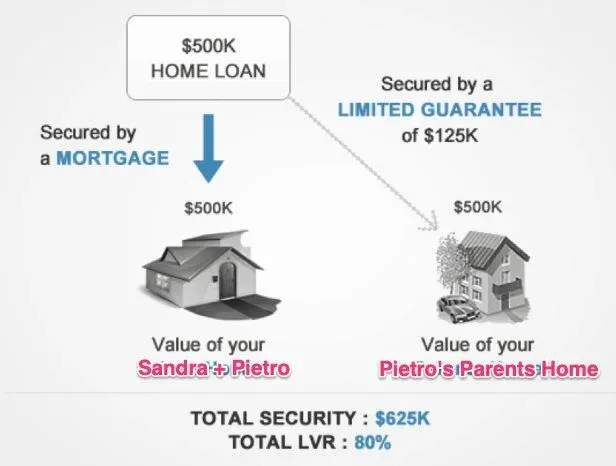
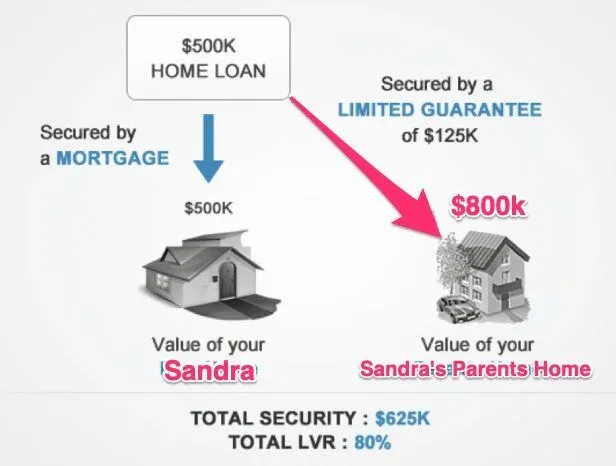
In Sandra and Pietro's example, Sandra kept the home after they separated. His parents' guarantee was replaced with support from her parents through a refinance. That option depends on the new borrower, guarantors and security being accepted. Have your solicitor and broker coordinate the ownership and loan changes.
Our divorce and separation home loan guide explains how the refinance, payout and legal documents fit together.
Before: Pietro's parents provided the guarantee
After: Sandra's parents replaced them
What if a guarantor dies or can no longer make decisions?
Contact the lender and the family's solicitor. The guarantee does not simply disappear, and the documents, estate and authority to act need reviewing. Avoid assuming either that an immediate release is mandatory or that a replacement guarantor can be added without approval.
Check all the loans attached to the property
Ask the bank for a full list of the loans and guarantees secured against the property, including any agreed priority amount. A title search alone may not tell you how much equity is already committed.
On one of our files, the guarantors thought their property only supported an $800,000 loan. The bank later confirmed a $1,000,000 priority amount under its security arrangements. More of the property's equity was already committed than the family expected, leaving too little for the proposed guarantee. The deal could not proceed as planned.
I want that checked before the family commits. Paying down one loan account does not necessarily release the property if it still supports other debts.
Frequently asked questions
Related guides
- Home loan guide
Guarantor home loans
How the original guarantee and loan fit together.
Read guide - Home loan guide
Risks of going guarantor
The responsibilities of the family member providing support.
Read guide - Home loan guide
Who can be a guarantor?
Check eligibility if considering a replacement.
Read guide - Home loan guide
Buying with your parents
Separate ownership arrangements from guarantees.
Read guide - Home loan guide
LMI waivers
Check whether an exception could affect refinance costs.
Read guide - Home loan guide
Westpac home loan review
Compare loan features if you are considering refinancing.
Read guide
Experience and sources
How this guide was checked
I checked the lender and government sources below on 29 September 2026. We confirm the requirements for your loan and property before recommending an application.

Thomas's example compares his 2022 purchase with his 2025 review. Past outcomes do not establish eligibility for another release.
Let us check whether your guarantor can be released
Send us the current balance, property address and your lender's name. Tell us if your parents have a sale or refinance deadline so we can check the right route and timing.
or call 1300 088 065
General information only. Your circumstances and current lending criteria need to be assessed. Guarantors should obtain independent legal advice before signing; family property transfers also need legal and tax advice.