


Client story
They were earning decent money and still felt like they were living pay to pay.
Georgia had just returned to work after maternity leave, and she and Luke had recently had their second child. Even with 2 incomes coming in again, the mortgage, car loan, personal loan and 2 credit cards took such a large bite from each pay that it never felt like they were getting ahead.
They had a $480k mortgage and $70k across the other debts. Their existing lender still declined the top up because it assessed the current repayments and the full $25k in card limits before those debts were paid out.
I was able to get the new $550k loan approved. We found a lender that let us pay out the credit cards, car loan and personal loan at settlement, and both cards were closed.
But the lower minimum was not the whole solution. Georgia and Luke kept putting another $500 a month into the offset so those short debts did not quietly become a 30 year problem.
- Monthly repayments before$4,854
- New minimum repayment~$3,280
Monthly repayment difference: About $1,575 less. The new minimum uses a $550k balance, 5.95% rate and 30 year term. This was the rate used in their example; check the rate you would be offered today. It excludes fees and is not a promise about another refinance.
If you are already missing repayments, contact your creditors' hardship teams early. Here's how a hardship arrangement can show on your credit file. You can also speak to a free financial counsellor through the National Debt Helpline on 1800 007 007. Moneysmart's debt consolidation guide explains the costs and risks to compare. A refinance review can happen beside that support. It should not delay it.
Why would my bank say no if the new repayment is lower?
A lower repayment is only part of the assessment. The lender also checks your income, living costs, credit history and which debts will be paid out. As Georgia and Luke found, credit card limits and the way a lender assesses existing debts can make a difference. Equity alone does not settle those questions.
If your bank has said no, start with the reason before making another application. Our guide to a declined home loan explains what to check.
How much could the monthly repayments drop?
One repayment can be easier to manage than several due dates. I compare 4 ways of handling the same debts, so you can see which one lowers the monthly pressure and which one clears the debt sooner.
1. Keep everything as it is
How long the current debts take to repay and how much interest is left.
2. Combine the debts and pay the new minimum
The lowest monthly repayment, and the cost over the full home loan term.
3. Combine the debts and clear them over the same period
The repayment needed to finish when the slowest current debt would have.
4. Combine the debts and keep paying the same amount
How much sooner the combined debt is gone.
What happens if the debt runs for longer?
This example combines $75k of debt: a $20k card at 19.99% with $600 monthly payments, a $25k personal loan at 12% with $658.35 payments, and a $30k car loan at 9% with $622.76 payments. Rates stay constant, there are no new card purchases, and current payments continue.
| Scenario | Monthly repayment | Estimated interest |
|---|---|---|
| Current debts | About $1,881 | About $23,394 |
| $75k at 6.00% over 25 years | $483 | $69,968 |
| $75k at 6.00% over 5 years | $1,450 | $11,998 |
| $75k at 6.00%, keep paying $1,881 | $1,881 | About $8,860 |
Keep paying the same $1,881 and the combined debt clears in about 45 months, with about $8,860 in estimated interest. The 5 year row is option 3.
The 25 year option releases about $1,398 a month. It also produces about $46,574 more estimated interest than keeping the current debts if only the minimum is paid.
The 5 year option still cuts the required payment by about $431 a month and costs less interest than keeping the current debts. The lower rate helps, but the term decides the result.
Compare an unsecured loan with borrowing against your home
An unsecured personal loan does not use your home as security. A home-equity loan may offer a lower interest rate, but it puts the home behind the debt. Compare the actual offers and total repayment cost rather than assuming the lowest rate is the best result.
Our home equity loan guide explains how much equity a lender may let you use.
Here is an example comparing $30,000 loans. These rates are assumptions, not current offers. Repayments include principal and interest, with a constant rate and no fees or offset balance.
| Feature | Personal loan (unsecured) | Home equity (secured) |
|---|---|---|
| Interest rate (assumed) | 14.50% p.a. | 6.20% p.a. |
| Loan term | 5 years | 30 years |
| Monthly repayment | $706 | $184 |
| Monthly difference | Higher required repayment | About $522 less per month |
| Total interest | $12,351 | $36,147 |
$30k personal loan and home equity loan compared
Interest rate (assumed)
- Personal loan (unsecured)
- 14.50% p.a.
- Home equity (secured)
- 6.20% p.a.
Loan term
- Personal loan (unsecured)
- 5 years
- Home equity (secured)
- 30 years
Monthly repayment
- Personal loan (unsecured)
- $706
- Home equity (secured)
- $184
Monthly difference
- Personal loan (unsecured)
- Higher required repayment
- Home equity (secured)
- About $522 less per month
Total interest
- Personal loan (unsecured)
- $12,351
- Home equity (secured)
- $36,147
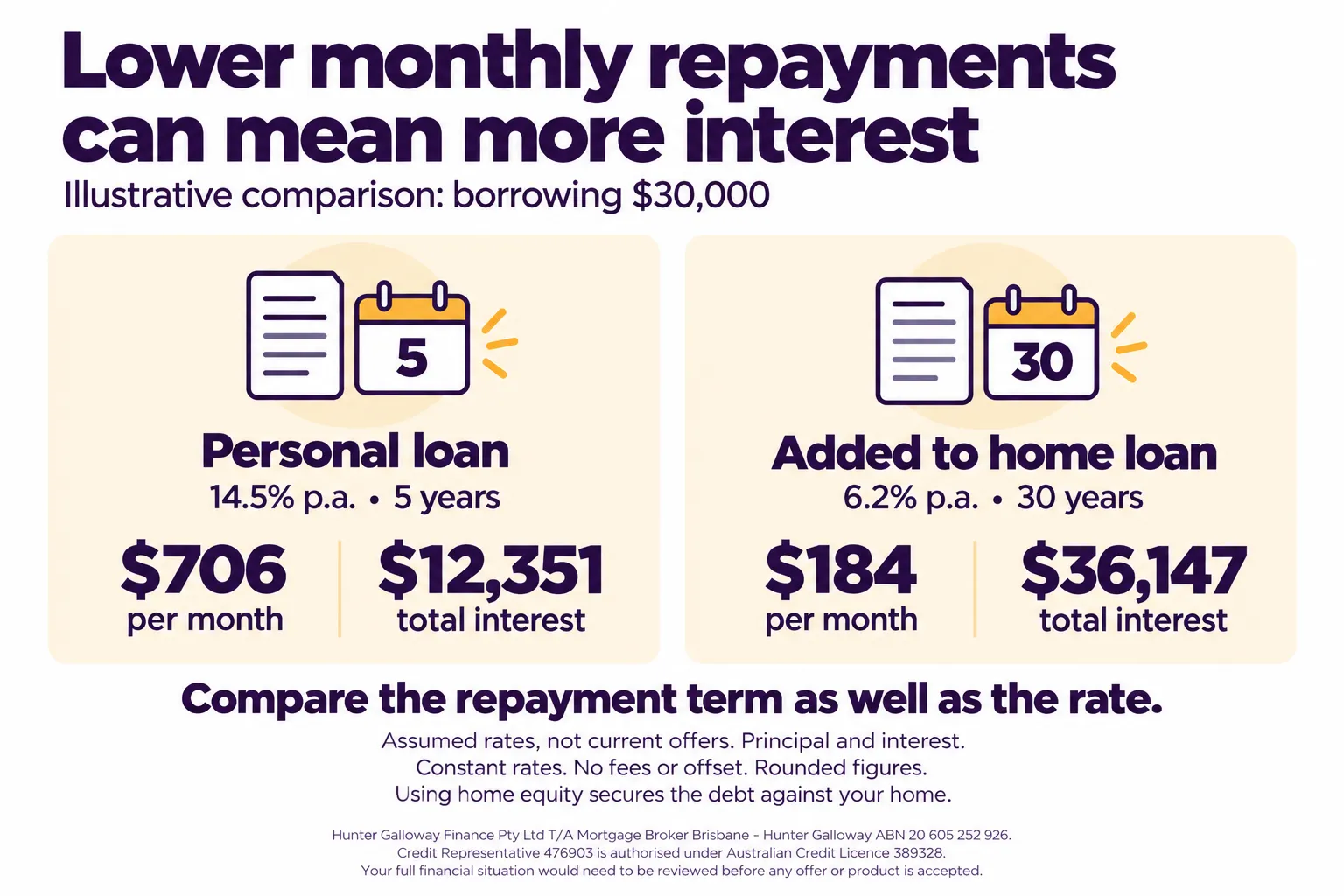
In that $30k example, about $583 a month would clear the 6.20% secured loan in 5 years, or $441 in 7 years, assuming a constant rate and no fees. Compare the same repayment period before choosing a lower mortgage minimum.
Which debts should go into the home loan?
I check each debt before deciding whether to move it. This is the order I use.
- Start with the debt causing the pressureA revolving card at a high rate and near its limit may be the immediate problem. Confirm the actual balance, limit, rate and payment before doing anything else.
- Set aside debts that are nearly finishedIf a car loan has 18 months left, I compare its remaining interest and payout fee with an 18 month consolidation target. A 25 year minimum is not the right comparison.
- Add payout costs before calling it a savingInclude early termination, discharge, application and risk costs. Check which will be added to the loan and which you will pay upfront.
- Decide which accounts to closePaying off a card does not close it. Before applying, I check which cards must be closed or have their limits reduced.
- Set the repayment for the consolidated splitFirst, work out the repayment needed to clear the debt within its original timeframe. If you cannot afford that, compare the lower repayment with the extra interest a longer term would cost.
This sequence can leave out a nearly finished car loan while dealing with an expensive credit card. It also shows whether the main goal is a lower monthly repayment, because rolling a debt into the home loan does not automatically make it cheaper overall.
Will the bank approve the refinance?
Start with the property value and available equity
The lender compares the proposed total home lending with the value it accepts for the property.
Loan to value ratio, or LVR, equals total lending divided by the accepted property value.
At or below 80% LVR, debt consolidation may be simpler. Above 80%, lender choice can narrow and lenders mortgage insurance or another risk cost may apply. That cost must go into the total cost comparison.
Use the equity calculator for a first estimate. The figure that matters for the application is the lender's accepted valuation, which may differ from an online or agent estimate.
One client’s home, bought for $700k, received bank valuations of $800k, $720k and $740k. Same home, 3 different answers. Another valuation won't necessarily come in higher, but an agent's estimate and comparable sales can support a review. The lender still decides which value it accepts.
Then check the lender's debt consolidation rules
Adding consumer debts can rule out a refinance option that would work for the mortgage alone.
| Where lenders land | What that can mean for you | What I check |
|---|---|---|
| Options for ordinary consumer debts Macquarie , Commonwealth Bank , Brighten, Pepper Money and Resimac | Credit cards and personal loans may fit, but tax debt, business debt, the property value or the number of accounts can change the result. | The order I work in: check equity, list every payout and separate consumer, tax and business debt. |
Where lenders land on debt consolidation
Options for ordinary consumer debts Macquarie , Commonwealth Bank , Brighten, Pepper Money and Resimac
- What that can mean for you
- Credit cards and personal loans may fit, but tax debt, business debt, the property value or the number of accounts can change the result.
- What I check
- The order I work in: check equity, list every payout and separate consumer, tax and business debt.
Lender rules checked 8 October 2026. This is a general starting point for the 5 lenders named, not a ranking or a recommendation. Policies change, and each lender assesses your full application.
For the lenders discussed here, see our reviews of Macquarie, Commonwealth Bank, Brighten, Pepper Money and Resimac. Check the selected lender’s current consolidation conditions before applying.
Before choosing a lender, I check your recent repayments alongside the debts and equity above.
Why a reduced refinance assessment may disappear
Some refinance loans use a lower repayment assessment buffer. They generally need to closely replace the existing home loan, with tight limits on extra borrowing and what it can fund.
This is why a borrower may pass an eligible mortgage-only refinance but fail when cards and personal loans are added. Use the refinance home loan guide to compare the wider application, costs and remaining term.
What can complicate the refinance?
Paying a card out is not the same as closing it
In Georgia and Luke's case, the balances were paid directly and both cards were closed at settlement.
Confirm how each creditor will be paid and which accounts must be closed or have their limits reduced. Lender and insurer conditions differ. Even a paid-off card can reduce borrowing capacity if its limit stays open, and it can be used again.
ATO debt needs its own check
ATO debt is not treated like an ordinary credit card by every lender.
I first check the type of tax debt, its balance, any payment plan and your recent repayment record. Then I check whether the loan allows that tax debt to be paid out and whether the lender must pay the ATO directly at settlement.
Compare a proposed tax-debt refinance with discussing a payment arrangement with the ATO. Get tax advice where business debts or mixed purposes are involved.
If there are missed payments or a credit problem
Do not use repeated applications to discover which lender may proceed. Start with the credit reports, account conduct and the reason the payments were missed.
If hardship support is needed now, contact the creditors first. A refinance is not emergency debt relief and approval is not certain.
The guide to refinancing with bad credit explains how your credit history can affect the options.
Specialist lending can cost more. Compare it with hardship arrangements and financial counselling, and do not rely on a guaranteed move back to a mainstream lender in 12 or 24 months. A Part 9 debt agreement needs financial counselling or legal advice before treating a refinance as the solution.
What documents will the lender need?
Start with identification, income evidence, bank statements and your assets and liabilities. Add current statements and payout figures for every debt, including limits and any early repayment fees. PAYG and self-employed applicants may need different income documents; confirm the selected lender’s requirements.
Include discharge and government charges, application and valuation fees, ongoing loan costs and any fixed-rate break cost in the comparison. Ask for written figures based on the expected payout date.
What will you pay after settlement?
First, we agree how soon you want to repay the consolidated debt. That lets us set a repayment to aim for, rather than automatically dropping to the new loan's minimum.
A target that leaves no room for a car repair, school cost or rate change is unlikely to last. I will show you the monthly repayment and the longer term cost before the application goes in, so you know what the lower repayment would cost over time.

Already have a proposed refinance? Send the current balances, payouts, proposed rate, term and costs. I can put the 4 repayment options beside each other before the application is lodged.
Review your options
The refinancing process guide explains the application, discharge and settlement stages.
When is debt consolidation the wrong first step?
I would pause when:
- urgent hardship support is needed now
- the proposed total cost is materially higher and the longer term is not a deliberate trade-off
- fees, LMI or another risk cost consume the expected saving
- the accepted property value does not support the required lending
- short unsecured debts would be secured against the home without a workable repayment plan
- you are likely to borrow again on the accounts you have just paid off
- an insolvency, debt agreement, legal or financial counselling issue needs specialist help first
The next useful step may be smaller than a refinance. It could be getting a payout figure, closing an unused card, asking for hardship support, testing the valuation or setting a repayment that clears one debt without moving it.
Frequently asked questions
Experience and sources
How this guide was checked
Check the loan costs, repayment term and total interest before consolidating debts. Each lender assesses your application and property individually.

Joshua Vecchio is a director & mortgage broker at Hunter Galloway. Hunter Galloway Finance Pty Ltd is Credit Representative 476903, authorised under Australian Credit Licence 389328.
Sources
General information and repayment estimates only. This is not a credit assessment, financial advice or promise of approval. Policies can change and each lender assesses the full application.
Related guides
- Start here
Refinance your home loan
Compare the rate, fees, loan term and features before you move.
Read guide - Related guide
Bank discharge forms
Find the current form and steps for leaving your lender.
Read guide - Related guide
Challenge a bank valuation
What to do when one valuation leaves you short.
Read guide - Calculator
Mortgage repayment calculator
Compare repayments using your loan amount, rate and preferred term.
Open calculator - Calculator
Extra repayment calculator
See what regular extra repayments may change over the remaining loan term.
Open calculator

Let me compare what consolidation would change for you
Start with roughly what you owe, your monthly repayments and what you think your home is worth. Tell me if a lender has said no or a payment is overdue. I can help you work out which options are worth checking. Before an application, we will need statements and payout figures to compare the monthly repayments, total cost, lender conditions and how you will pay off the combined debt.
or call 1300 088 065
General information only. Subject to assessment, lender criteria and your circumstances. Client examples are based on real situations. Names and identifying details have been changed.