


The deposit you need depends on the loan or scheme you use. I'd also check what you'll have left after buying costs and whether the repayments fit your budget.
You may be able to buy with no deposit of your own using a guarantor home loan. Other options can start from 2% or 5%, while a 20% deposit usually avoids lenders mortgage insurance (LMI).
A guarantor uses their property as extra security; they do not hand you the deposit as cash. We still need to check your repayments, the guarantor’s security and how the buying costs will be paid.
What does a home loan deposit actually cover?
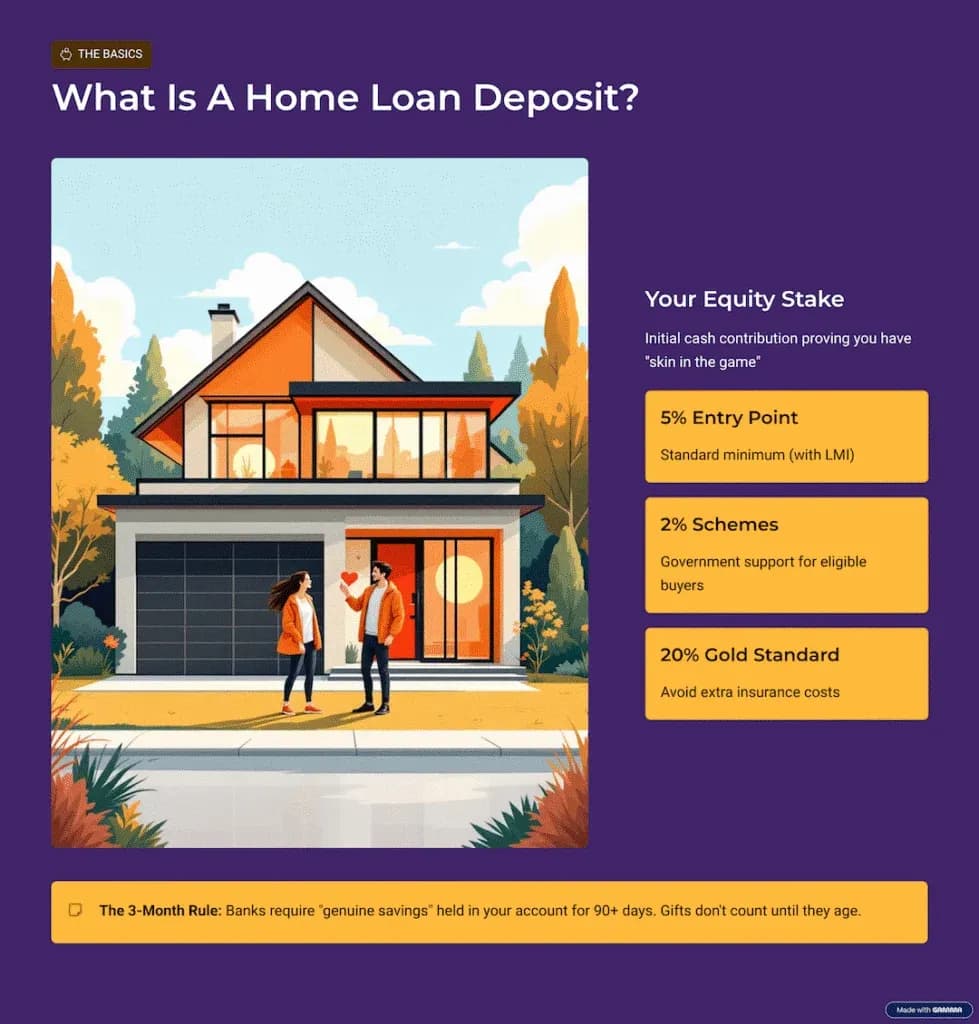
Your deposit is the part of the purchase price you contribute. If an $800k home is bought with an $80k deposit, the base loan is $720k before any LMI or fees are added.
Lenders compare the loan with the lower of the purchase price and their accepted valuation. This is called the loan-to-value ratio, or LVR. A 10% deposit produces a 90% LVR when the purchase price and valuation match.
| Deposit | Cash deposit | Base loan before LMI and costs |
|---|---|---|
| 0% with a suitable guarantor | $0 of your own deposit | $800k, before any separately funded buying costs |
| 2% | $16k | $784k, or less where shared equity reduces the loan |
| 5% | $40k | $760k |
| 10% | $80k | $720k |
| 20% | $160k | $640k |
Base deposit and loan on an $800k purchase
- Cash deposit
- $0 of your own deposit
- Base loan before LMI and costs
- $800k, before any separately funded buying costs
2%
- Cash deposit
- $16k
- Base loan before LMI and costs
- $784k, or less where shared equity reduces the loan
5%
- Cash deposit
- $40k
- Base loan before LMI and costs
- $760k
10%
- Cash deposit
- $80k
- Base loan before LMI and costs
- $720k
20%
- Cash deposit
- $160k
- Base loan before LMI and costs
- $640k
With a 5% deposit, how much can I borrow?
On the $800k home above, a $40k deposit leaves a $760k loan before any financed costs. The bank still needs to check whether your income can cover that loan, after allowing for your expenses and other debts.
I'd check both figures before you start looking at homes: the deposit you have available after buying costs, and the loan you can comfortably repay. If either falls short, we need to adjust the price range or look at your options.
Use our borrowing calculator for an estimate, then work through how much home you can afford to include repayments, buying costs and the savings you want left over.
If you plan to use the Australian Government 5% Deposit Scheme, check its eligibility rules and the price cap for your location too. A scheme place does not replace the lender's loan assessment.
The deposit you agree to pay the seller is separate from the lender’s deposit requirement. Even with a guarantor loan, your contract may require a payment before settlement. Agree how that payment will be funded and when it is due before signing. Our Queensland house deposit guide explains the timing.
Your minimum deposit is not your total cash needed
A low-deposit approval can still fail at settlement if every dollar has been allocated to the deposit. Keep the deposit separate from the other costs and the money you want left after buying.
| Cost | What to confirm |
|---|---|
| Transfer duty | Your state, buyer status, property type, value and contract date |
| Solicitor or conveyancer | Contract review, searches, settlement work and disbursements |
| Building and pest or strata review | The property type and the reports you need before going unconditional |
| Lender and government charges | Application, valuation, registration and settlement costs where applicable |
| Moving and immediate work | Removalists, insurance, utilities and urgent repairs |
| Cash left after settlement | A buffer for rate changes, repairs and unexpected bills |
Costs to check before setting the property budget
Transfer duty
- What to confirm
- Your state, buyer status, property type, value and contract date
Solicitor or conveyancer
- What to confirm
- Contract review, searches, settlement work and disbursements
Building and pest or strata review
- What to confirm
- The property type and the reports you need before going unconditional
Lender and government charges
- What to confirm
- Application, valuation, registration and settlement costs where applicable
Moving and immediate work
- What to confirm
- Removalists, insurance, utilities and urgent repairs
Cash left after settlement
- What to confirm
- A buffer for rate changes, repairs and unexpected bills
In Queensland, eligible first home buyers can receive a full transfer duty concession on a new home or residential vacant land for contracts from 1 May 2025, with no property value cap. For an established first home, the full concession applies up to $700k and reduces between $700k and $800k. Check the contract date and property use with your solicitor.
Our Queensland house deposit guide and stamp duty guide explain how the deposit and buying costs fit together.
Does the whole deposit need to be genuine savings?
Not always. On a higher LVR application, lenders commonly want at least 5% of the purchase price to be shown as genuine savings or an accepted equivalent. Money held or built up over at least 3 months is a common test, but the exact rule and exceptions differ.
A non-repayable gift, inheritance, sale proceeds, grant or tax refund can still help with the purchase. The question is whether the chosen lender accepts it and whether part of the application must still demonstrate a savings history. Read our genuine savings guide before assuming gifted funds need to sit untouched for 3 months.
- Saved funds
Usually the simplest evidence
Account balances and regular transfers over time can demonstrate the savings history.
- Family gift
Useful when it is genuinely non-repayable
The lender may ask for a signed gift declaration and evidence of where the money came from.
- Grant or scheme
Helpful but not interchangeable
Each program has its own eligibility, property and participating-lender rules.
How a smaller deposit changes LMI and the interest rate

With less than a 20% deposit, you may need to pay lenders mortgage insurance or a lender low-deposit fee. LMI protects the lender if the property is sold and the debt is not fully repaid. It does not make your repayments if you lose your job.
The premium is not the same everywhere. It depends on the loan amount, LVR, lender and insurer. Many lenders let you add it to the loan, subject to a maximum total LVR. That reduces the cash needed now but increases the debt and the interest paid.
The interest rate can also be higher at a higher LVR tier. Compare the rate, comparison rate, LMI or lender fee and repayments for the same property and loan amount, not the advertised rate alone.

| Path | Potential benefit | What to check |
|---|---|---|
| 0% deposit with a guarantor | May let you buy without your own cash deposit and avoid LMI | Suitable guarantor security, repayment capacity, buying costs, legal advice and a plan to release the guarantee |
| 20% deposit | Smaller loan and usually no LMI | Time required to save and the cash left after purchase |
| 10% deposit | A smaller loan than with a 5% deposit; LMI may also be lower if both loans require it | LMI waiver eligibility, LVR pricing and genuine savings |
| 5% deposit with LMI | Buy sooner without waiting for 20% | Premium, rate, total loan, repayments and refinance risk |
| 5% Deposit Scheme | Minimum 5% for eligible first home buyers with no LMI | Eligibility, owner-occupier rules, price cap and participating lender |
| 2% pathway | Available through specific schemes | Whether it is a guarantee, shared equity or state loan and its ongoing rules |
How the common deposit levels compare
- Potential benefit
- May let you buy without your own cash deposit and avoid LMI
- What to check
- Suitable guarantor security, repayment capacity, buying costs, legal advice and a plan to release the guarantee
20% deposit
- Potential benefit
- Smaller loan and usually no LMI
- What to check
- Time required to save and the cash left after purchase
10% deposit
- Potential benefit
- A smaller loan than with a 5% deposit; LMI may also be lower if both loans require it
- What to check
- LMI waiver eligibility, LVR pricing and genuine savings
5% deposit with LMI
- Potential benefit
- Buy sooner without waiting for 20%
- What to check
- Premium, rate, total loan, repayments and refinance risk
5% Deposit Scheme
- Potential benefit
- Minimum 5% for eligible first home buyers with no LMI
- What to check
- Eligibility, owner-occupier rules, price cap and participating lender
2% pathway
- Potential benefit
- Available through specific schemes
- What to check
- Whether it is a guarantee, shared equity or state loan and its ongoing rules
Work out which deposit option fits your budget
Start with your savings, rough income, other debts and the area where you'd like to buy. We can help you compare the cash needed and repayments under suitable deposit options, then explain what needs checking before you apply.
or call 1300 088 065
The initial conversation does not create a credit enquiry.
Government options that can reduce the deposit

Australian Government 5% Deposit Scheme
Eligible first home buyers can purchase with a minimum 5% deposit. Eligible single parents or legal guardians can use a minimum 2% deposit. The current scheme has no income caps, unlimited places and no LMI, but the property must sit within the location price cap and the loan must come from a participating lender.
In Queensland, the current property cap is $1m for Brisbane, the Gold Coast and Sunshine Coast, and $700k elsewhere. Read our full 5% Deposit Scheme guide for the eligibility and owner-occupier rules.
Help to Buy
Help to Buy is shared equity, not a grant. You need a minimum 2% deposit and an eligible loan. The Australian Government may contribute up to 30% of an existing home or 40% of a new home, reducing the mortgage required.
For an $800k existing home, the maximum 30% contribution is $240k. With a 2% deposit of $16k, the base mortgage would be $544k before buying costs.
For the 2026-27 financial year, taxable income must be no more than $103k for an individual, or $165k for joint applicants and single parents. The Queensland property cap is $1m in Brisbane, the Gold Coast and Sunshine Coast, and $700k elsewhere. Ongoing shared-equity rules also apply. Our Help to Buy guide explains what happens after purchase.
Queensland First Home Owner Grant
Queensland's First Home Owner Grant is $30k for eligible contracts signed on or after 20 November 2023, and the government has continued it beyond 30 June 2026. It applies to eligible new homes valued below $750k, including land. It is not available for an established home and does not replace the need to qualify for the loan.
Check the full conditions in our Queensland First Home Owner Grant guide.
Can your profession reduce the deposit needed to avoid LMI?
Selected lenders waive LMI for eligible professions, but the job title alone is not enough. Registration, qualifications, income, loan purpose, property and maximum loan limits can all apply.
Doctors and dentists have several lender options. Lawyers and accountants can also have no-LMI pathways with a smaller deposit. Eligible nurses and midwives may have a 10% deposit option with lenders including Westpac and St George. See our doctor home loan guide, lawyer LMI waiver guide, accountant home loan guide and nurse home loan guide.
Our Westpac home loan review and St George home loan review explain the lender differences. Engineers should not assume they receive the same broad waiver. Their no-LMI options are much narrower.
Ways to build the deposit without weakening the application
Start with a target that includes buying costs and the amount you want left after settlement. Keep the money in an account where the savings history is easy to show, and avoid moving it through several accounts without a reason.
The First Home Super Saver Scheme lets eligible first home buyers count up to $15k of voluntary contributions from a financial year and up to $50k across all years, plus associated earnings under the release rules. Get tax advice and request the required determination before ownership transfers. Read our First Home Super Saver guide.
HECS does not change the deposit percentage, but it can reduce borrowing power. Some lenders may exclude HECS when the balance is expected to be cleared within 12 months, while other policies use different tests. Compare the loan result before paying off a large balance from your deposit. Our HECS and home loans guide explains the trade-off.
What can go wrong with a very small deposit?
The main risks to plan for
- A larger loan and possibly a higher interest rate can make repayments tighter
- A small fall in the property value can leave little equity or make refinancing difficult
- A new LMI premium on refinance can wipe out the saving from a lower rate
- Using every dollar at settlement leaves no buffer for repairs or income changes
- A low valuation can create a cash shortfall after you have signed the contract
If the savings gap is the main issue, compare our no-deposit home loan guide, guarantor home loan guide and home loans for lower incomes.
How to choose the right deposit target
We can compare the smallest deposit that works for you, the next deposit level that could reduce LMI or the rate, and a 20% deposit. A suitable guarantor may let you start without your own deposit.
For each option, compare how much you could borrow, the cash needed, repayments, rate, fees and useful features such as an offset. Then decide whether buying sooner is worth the extra cost. Use the deposit calculator as a starting point, and confirm the lender’s figures and buying costs before making an offer.

Experience and sources
How this guide was checked
We checked the government schemes, Queensland duty concessions and lender deposit requirements against the sources below. We also considered the buying costs and loan comparisons we work through with clients.

Jayden is a mortgage broker and co-owner of Hunter Galloway. He works with buyers whose income, employment or deposit does not fit a simple bank checklist. See Jayden's experience.
Sources
- Australian Government: 5% Deposit Scheme FAQs
- Australian Government: 5% Deposit Scheme property price caps
- Australian Government: Help to Buy
- Queensland Government: First Home Owner Grant
- Queensland Revenue Office: first home transfer duty concessions
- Australian Taxation Office: First Home Super Saver Scheme
- Hunter Galloway: Lenders Mortgage Insurance guide
- Bankwest: guarantor loans and borrowing without a deposit
Lender policy, government programs and document requirements can change. Confirm the current position before changing jobs, signing a contract or relying on a particular deposit strategy. This is general credit information, not personal financial, tax or legal advice.
Useful guides for your next step
Lenders mortgage insurance
Compare the cost of buying sooner with LMI.
Read guideGenuine savings
See which funds and savings histories may count.
Read guide5% Deposit Scheme
Check buyer, property and participating-lender rules.
Read guideHelp to Buy
Understand the 2% deposit and shared-equity trade-offs.
Read guideHome Loans for Low Income Earners
Compare deposit support with the amount your income can service.
Read guideHome loan job requirements
Check how your work history and income will be assessed.
Read guide
Straight answers
Minimum home loan deposit FAQs
What home buyers say about us
 Google
“Clear, incredibly responsive and accurate.”
- Google
“Preapprovals done quickly and efficiently.”
- Google
“Reassuring every step of the way.”
Work out which deposit option fits your budget
Start with your savings, rough income, other debts and the area where you'd like to buy. We can help you compare the cash needed and repayments under suitable deposit options, then explain what needs checking before you apply.
or call 1300 088 065
The initial conversation does not create a credit enquiry.