


Looking at a loan through your super fund? New residential SMSF borrowing was restricted from 10 August 2026. See the SMSF rules and AMP's refinance option below.
How much deposit will you need?
AMP uses the loan amount and the property value it accepts to calculate your loan-to-value ratio, or LVR. The postcode, property type, repayment option and product can all reduce the maximum. Lenders Mortgage Insurance protects the lender, even though you pay for it.
AMP deposit and genuine savings checks
Scroll to see more columns
| Your position | What AMP checks |
|---|---|
| Base LVR above 85% | You need evidence of a genuine contribution of at least 5% of the purchase price. Base LVR is calculated before adding the LMI premium. |
| Base LVR of 85% or less | AMP does not require savings records for this rule, but you still need to tell it about your assets, deposit and the money needed to finish the purchase. |
| Professional borrower | AMP has no occupation-based LMI waiver. The Professional Package name does not mean your profession removes LMI. |
| Family help | AMP no longer offers new family-guarantee loans. |
- What AMP checks
- You need evidence of a genuine contribution of at least 5% of the purchase price. Base LVR is calculated before adding the LMI premium.
- What AMP checks
- AMP does not require savings records for this rule, but you still need to tell it about your assets, deposit and the money needed to finish the purchase.
- What AMP checks
- AMP has no occupation-based LMI waiver. The Professional Package name does not mean your profession removes LMI.
- What AMP checks
- AMP no longer offers new family-guarantee loans.
For example, if your base loan is 88% of the property value, you are above the 85% savings threshold even though you are below 90%. We'll check the source of your contribution and the purchase costs before you make an offer. Our genuine savings guide explains the evidence lenders may ask for.
AMP is not on the current Australian Government 5% Deposit Scheme lender panel, checked on 9 September 2026. You need a participating lender to use the Scheme. Our 5% Deposit Scheme guide, professional LMI waiver guide and guarantor home loan guide explain the other deposit options.
Self-employed? 1 year of tax returns may be enough
AMP may suit you if you can provide full financial records. You generally need at least 2 years in business, your most recent year's personal and business tax returns, and the latest Notice of Assessment. AMP may ask for additional documents. After 31 March, the latest financial year's figures are required. New low-doc and alt-doc applications are not available.
If your income has changed, we need to explain why and check which figure AMP will use. Forecasts and income from a business you are still buying cannot replace established income. If you have traded for less than 2 years, our self-employed home loan guide covers other options.
An ATO debt does not automatically rule you out
How AMP assesses an outstanding ATO debt
Scroll to see more columns
| Your tax debt | How AMP may assess it |
|---|---|
| Agreed ATO repayment arrangement | AMP counts the agreed tax repayment alongside your other repayments. |
| No repayment arrangement | AMP uses its own repayment calculation over no more than 12 months. The assessed repayment can reduce how much you can borrow. |
| Debt paid | AMP needs confirmation that it has been cleared. |
- How AMP may assess it
- AMP counts the agreed tax repayment alongside your other repayments.
- How AMP may assess it
- AMP uses its own repayment calculation over no more than 12 months. The assessed repayment can reduce how much you can borrow.
- How AMP may assess it
- AMP needs confirmation that it has been cleared.
How AMP works out what you can borrow
Your borrowing amount depends on the income AMP accepts, household expenses, debts and the property. AMP checks repayments at 3% above the actual rate, with a minimum assessment rate of 6.5%, or uses the actual declared repayment if that is higher.
Income and employment worth checking early
- New permanent job: AMP generally looks for 6 months with the employer. A shorter period may work if you have at least 12 months of continuous work in the same occupation or industry.
- Casual or PAYG contract work: at least 6 months with the current employer is needed, with additional checks on employment continuity and consistent earnings.
- Investment income: AMP may count up to 80% of eligible investment income, including dividends, with at least 1 year evidenced through tax returns. Capital gains from selling assets do not count as income.
- New-to-bank applicants: you must live and work in Australia and meet AMP's citizenship or permanent-residency requirements. Existing AMP expat customers have separate rules. Hunter Galloway cannot assist borrowers who are based or working overseas.
A shared investment loan may not count entirely against you
If you own an investment property with someone who is not applying with you, such as a sibling, AMP's common debt reducer may let it use your share of the rent and repayments. It uses the higher of your ownership share or an equal share based on the number of borrowers. The other borrower must show they can cover their share.
This does not apply in the same way to debt shared with your spouse or partner. A partner joining as a co-borrower takes on a different commitment and needs a separate assessment. We'll check the ownership, existing loan and supporting declaration before relying on a higher borrowing amount. Start with our mortgage borrowing calculator, then have your actual figures compared.
Your postcode can change the deposit and loan limit
AMP groups properties into 5 location zones. Check the actual address early: a large deposit does not remove every postcode restriction. The standard thresholds below can also be reduced by the product, apartment rules or loan purpose.
AMP standard postcode thresholds
Scroll to see more columns
| Location | Standard loan threshold | What to check |
|---|---|---|
| Zones 1 to 2 | $2m | Generally up to 95% with principal and interest or 90% with interest-only, including LMI. |
| Zone 3 | $1m | Higher amounts need further credit review; check the applicable LVR. |
| Zone 4 | $750k | Higher amounts need further credit review; check the applicable LVR. |
| Zone 5 | $400k | Case-by-case, with LMI at every LVR. Maximum 90% principal and interest or 80% interest-only. Higher amounts need specialist credit approval. |
- Standard loan threshold
- $2m
- What to check
- Generally up to 95% with principal and interest or 90% with interest-only, including LMI.
- Standard loan threshold
- $1m
- What to check
- Higher amounts need further credit review; check the applicable LVR.
- Standard loan threshold
- $750k
- What to check
- Higher amounts need further credit review; check the applicable LVR.
- Standard loan threshold
- $400k
- What to check
- Case-by-case, with LMI at every LVR. Maximum 90% principal and interest or 80% interest-only. Higher amounts need specialist credit approval.
Loans above these thresholds need additional credit approval. The property and product rules still apply. Check the address in AMP's Security Property Location Guide before you make an offer.
Want interest-only repayments? Check the term as well as the deposit
AMP interest-only limits
Scroll to see more columns
| Loan and interest-only period | Maximum LVR to check | Main condition |
|---|---|---|
| Standard home or investment loan: 1 to 5 years | Up to 90% including LMI | Postcode, product and security limits may be lower. SuperEdge has its own 80% limit. |
| Investment Professional Package: 6 to 10 years | Up to 90% | Your property and finances must still meet AMP's requirements. |
| Investment Equity Flex: 6 to 10 years | Up to 80% | This product has separate term and eligibility rules. |
| Predominantly owner-occupied lending: 6 to 10 years | 70% where the long interest-only portion exceeds half the loan | Do not assume the investment limit applies to your own home. |
- Maximum LVR to check
- Up to 90% including LMI
- Main condition
- Postcode, product and security limits may be lower. SuperEdge has its own 80% limit.
- Maximum LVR to check
- Up to 90%
- Main condition
- Your property and finances must still meet AMP's requirements.
- Maximum LVR to check
- Up to 80%
- Main condition
- This product has separate term and eligibility rules.
- Maximum LVR to check
- 70% where the long interest-only portion exceeds half the loan
- Main condition
- Do not assume the investment limit applies to your own home.
Interest-only repayments leave the principal outstanding. AMP then checks whether you can afford principal and interest repayments over the remaining term. We'll compare that later repayment before choosing a longer interest-only period. Our investment loan guide covers the wider costs of owning a rental property.
Which AMP loan suits the way you will use it?
AMP products and features
Scroll to see more columns
| Product | May suit you if | Main catch |
|---|---|---|
| Professional Package | You want variable or fixed splits, with a 100% offset on eligible variable lending. | A $415 annual package fee applies. Fixed loans do not have an offset; check break costs and extra-repayment limits. |
| Essential | You want a simpler variable loan, redraw and no ongoing package fee. | No offset or fixed-rate option. Product and borrower restrictions apply. |
| Equity Flex | You are an investor considering a longer term and 6 to 10 years of interest-only repayments. | Separate 80% LVR limit and repayment/exit-strategy checks. It is not a general owner-occupier option. |
| Construction or Land Loan | You need staged building payments or standalone vacant-land finance. | The contract, land size, postcode and repayment rules differ from a standard home loan. |
| SuperEdge | Your SMSF needs to refinance an existing residential LRBA that meets the rules. | For eligible existing residential borrowing only. The fund needs a corporate trustee and must meet the fund rules below. |
- May suit you if
- You want variable or fixed splits, with a 100% offset on eligible variable lending.
- May suit you if
- You want a simpler variable loan, redraw and no ongoing package fee.
- Main catch
- No offset or fixed-rate option. Product and borrower restrictions apply.
- May suit you if
- You are an investor considering a longer term and 6 to 10 years of interest-only repayments.
- Main catch
- Separate 80% LVR limit and repayment/exit-strategy checks. It is not a general owner-occupier option.
- May suit you if
- You need staged building payments or standalone vacant-land finance.
- Main catch
- The contract, land size, postcode and repayment rules differ from a standard home loan.
- May suit you if
- Your SMSF needs to refinance an existing residential LRBA that meets the rules.
- Main catch
- For eligible existing residential borrowing only. The fund needs a corporate trustee and must meet the fund rules below.
With the Professional Package, fixed loans allow up to $10k in extra repayments per 12-month period without penalty under the product terms. Variable loans offer more repayment flexibility. If you plan to keep savings against the loan, read how an offset account works before deciding whether the package fee is worthwhile.
On an eligible variable loan, such as the Professional Package, you can link up to 10 offset accounts. Bill money can sit in one, savings in another, and both balances still reduce the interest you’re charged. Essential and fixed loans don’t have an offset at all. If the offsets are the reason you’d choose AMP, count the $415 package fee as part of their cost. Our multiple offset accounts guide lists the lenders that offer several offsets and what each one charges.
Already with AMP? Your older product may have different features and fees. Check your current statement and ask for a pricing review before deciding whether to switch.
AMP home loan fees to include in your comparison
Selected AMP fees checked 8 September 2026
Scroll to see more columns
| Fee | Amount | What to allow for |
|---|---|---|
| Essential settlement fee | $0 | AMP lists no settlement fee for Essential. |
| Essential solicitor fee | $295 | Separate from the $0 settlement fee. |
| Essential ongoing fee | $0 | No monthly account or annual package fee. |
| Standard AMP discharge fee | $490 | Government fees and any other charges may be extra. AMP First has separate terms. |
| Professional Package annual fee | $415 | Compare it with the rate, offset benefit and features you will use. |
| Master Limit application | $399 | You may also pay a loan-change fee if you add Master Limit later. Ask for the total cost first. |
| SuperEdge settlement | $950 | For an eligible SMSF refinance. |
| SuperEdge account management | $10 a month | Valuation, legal and other costs may also apply. |
- Amount
- $0
- What to allow for
- AMP lists no settlement fee for Essential.
- Amount
- $295
- What to allow for
- Separate from the $0 settlement fee.
- Amount
- $0
- What to allow for
- No monthly account or annual package fee.
- Amount
- $490
- What to allow for
- Government fees and any other charges may be extra. AMP First has separate terms.
- Amount
- $415
- What to allow for
- Compare it with the rate, offset benefit and features you will use.
- Amount
- $399
- What to allow for
- You may also pay a loan-change fee if you add Master Limit later. Ask for the total cost first.
- Amount
- $950
- What to allow for
- For an eligible SMSF refinance.
- Amount
- $10 a month
- What to allow for
- Valuation, legal and other costs may also apply.
The amounts above come from AMP's Professional Package page, Master Limit feature guide and SuperEdge product summary. Your quote and contract confirm the fees. We compare the actual rate for your loan amount, deposit and purpose rather than relying on a headline rate.
Essential fees are listed in AMP's product summary. The standard discharge amount comes from AMP's discharge FAQ, checked on 9 September 2026.
How AMP's Master Limit works
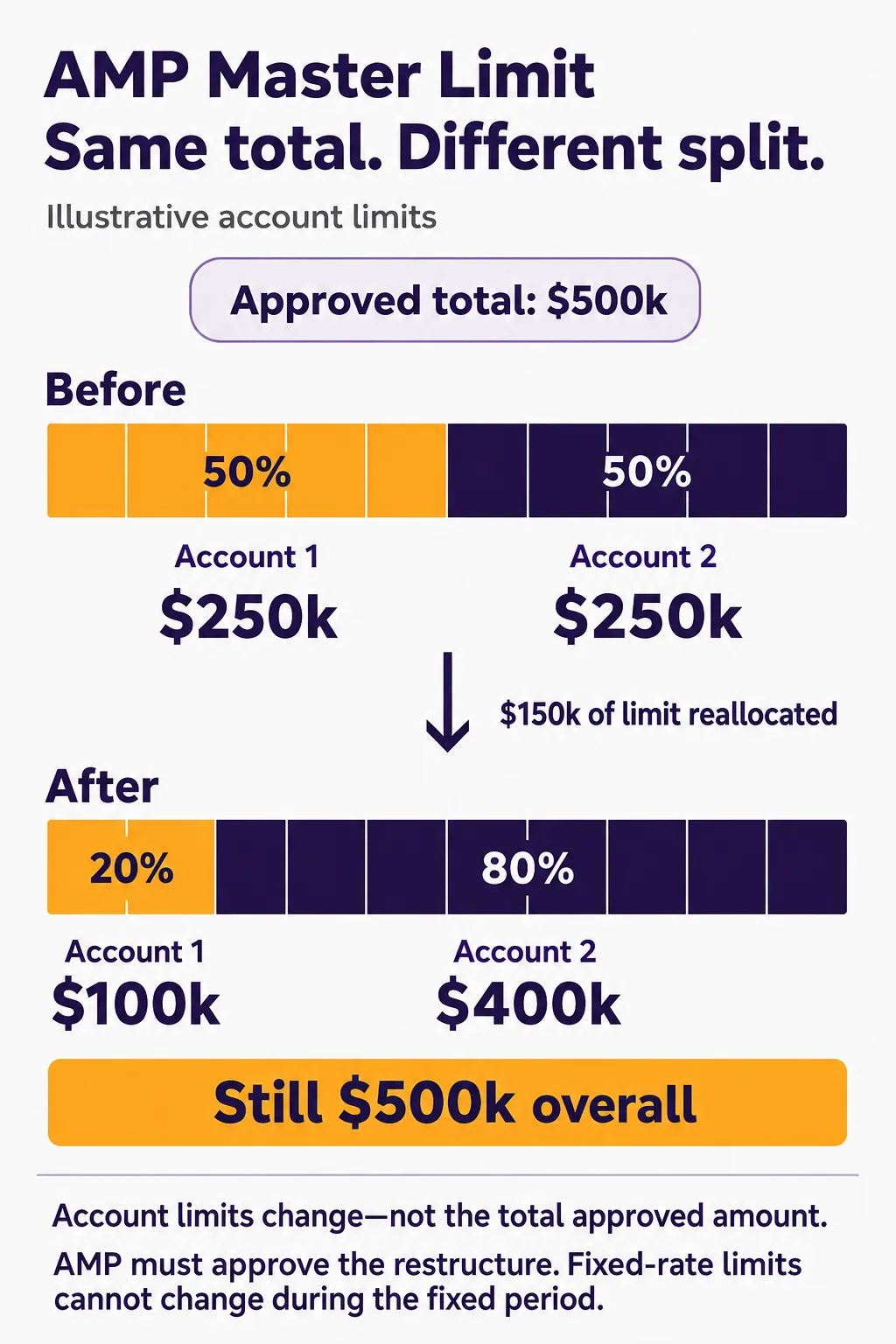
With Master Limit, you may be able to change the limits on individual loan accounts without AMP assessing your finances again, as long as you stay within the approved total. You can have up to 10 accounts, with a line of credit as the main account. The arrangement can last up to 10 years and is usually limited to 80% of the property value.
For example, you could start with a $500k total limit split into 2 accounts of $250k each. You could then ask AMP to change those limits to $100k and $400k, keeping the same $500k total. You still need to request the change. If you sell or replace a property used to secure the loan, or change the total limit, AMP must assess the loan again and fees may apply.
Master Limit is not available on SuperEdge, Essential or Land Loans, or with the excluded construction and Equity Flex products. Moving money between splits does not decide whether interest is tax deductible. Have your accountant check how the funds are used and recorded.
Check the property before you commit
Apartments and high-density buildings
AMP generally requires at least 45 square metres of internal living area, excluding balconies and car spaces. It may consider 40 square metres for a good-quality property in a desirable, high-demand capital-city location. Studios and bedsitters are not accepted, regardless of size.
In a high-density location, developments with more than 10 units have extra restrictions: generally no more than 2 apartments per borrower, with an overall lending concentration limit of 25% of the development and no more than 10 units. Established apartments over 6 months old may reach 95% on principal and interest or 90% interest-only, including LMI. Other high-density apartments are generally capped at 90%. Other product limits still apply.
Read our guide to high-density apartment rules.
Building or renovating
AMP can finance up to 2 dwellings at a time, but it excludes strata-titled construction, owner-builders, labour-only contracts, modular or relocatable homes and Zone 5 construction. You need an acceptable fixed-price contract and the build must finish within 12 months of loan approval.
The land for a construction loan cannot be larger than 2.02 hectares. Do not confuse that with AMP's separate allowance for some established, non-income-producing rural residential properties up to 40 hectares. The advertised construction LVR can reach 90%, but whether LMI is added or included depends on the purpose and repayment terms. We'll check the contract, postcode and required contribution before you rely on that figure.
Construction valuation and inspection requirements
Scroll to see more columns
| Contract amount | Checks to allow for |
|---|---|
| Up to $1.5m | An on-completion valuation before funding and a final inspection/valuation. |
| Above $1.5m to $2m | Also an inspection at enclosed or lock-up stage. |
| Above $2m | Quantity surveyor involvement and inspections at each stage, at your cost, plus the required valuations. |
- Checks to allow for
- An on-completion valuation before funding and a final inspection/valuation.
- Checks to allow for
- Also an inspection at enclosed or lock-up stage.
- Checks to allow for
- Quantity surveyor involvement and inspections at each stage, at your cost, plus the required valuations.
Our construction finance guide explains progress payments and the documents to prepare. AMP can require extra checks for a non-standard contract, so these are not the only possible inspection costs.
Vacant land and acreage
Vacant residential land must be no larger than 2.02 hectares, have all-weather road access and connected electricity, and stand alone as security. It cannot be cross-secured with another property. Maximum LVR is 90% principal and interest or 80% interest-only. The standard land-loan limits are $600k in Zones 1 to 2, $400k in Zone 3 and $200k in Zone 4.
Acreage with an existing home has different rules. Some residential or rural-residential properties up to 40 hectares may qualify, but income-producing rural properties are not accepted under that residential policy.
See our guide to rural property home loans.
Buying before selling
AMP's bridging option is for existing customers whose mortgage has been with AMP for more than 6 months and has been kept up to date. If your current home is not unconditionally sold, AMP generally needs you to afford the temporary peak debt. Where the sale is unconditional, it may assess the debt left afterwards, subject to the deposit and settlement requirements. Zone 5 properties are excluded. Compare bridging loan options before committing to the next purchase.
Borrowing extra: cash out and business purposes
AMP cash-out requirements
Scroll to see more columns
| Extra cash requested | What AMP needs |
|---|---|
| Up to $500k | A declared purpose may be enough at up to 90% LVR if negative gearing is not needed for the assessment. |
| Above $500k to $1m | A statutory declaration and supporting purpose documents, where available. |
| Above $1m | AMP needs to consider an exception before it can approve this amount. |
| Any amount where base LVR exceeds 85% | The extra cash is limited to 20% of the property value AMP accepts. You still need the required supporting documents. |
- What AMP needs
- A declared purpose may be enough at up to 90% LVR if negative gearing is not needed for the assessment.
- What AMP needs
- A statutory declaration and supporting purpose documents, where available.
- What AMP needs
- AMP needs to consider an exception before it can approve this amount.
- What AMP needs
- The extra cash is limited to 20% of the property value AMP accepts. You still need the required supporting documents.
The 90% cash-out limit excludes LMI on principal and interest terms but includes LMI on interest-only terms. The property, product and purpose may impose a lower limit. Borrowing extra increases your debt and the repayments you need to cover.
Business-purpose borrowing under this home-loan policy is limited to 10% of your total borrowing with AMP, up to $100k. It can cover an established business purchase without relying on that business's future income, or an eligible business-loan refinance where you have owned the business for at least 2 financial years. This is separate from AMP's specialist business-finance range.
Business-purpose borrowing under this policy is on principal and interest terms, with a maximum base LVR of 90% and applicable LMI limits.
SMSF residential borrowing changed on 10 August 2026
If you were planning to borrow through your SMSF to buy a residential property, the rules have changed. From 10 August 2026, new limited recourse borrowing arrangements generally cannot be used to acquire residential real estate. A limited recourse borrowing arrangement, or LRBA, is the borrowing structure used for these SMSF property loans.
What the SMSF borrowing change means
Scroll to see more columns
| Your situation | What the change means |
|---|---|
| New residential purchase with a new LRBA | Generally no longer permitted from 10 August 2026. |
| Existing residential LRBA | The law preserves existing borrowing arrangements and qualifying refinancing. |
| Binding acquisition arrangement entered into before 10 August 2026 | A transitional exception may apply even if settlement happens later. Have your adviser check the actual contract and arrangement. |
| Residential purchase using existing fund cash | The borrowing change does not prohibit an outright purchase. Other SMSF investment rules still apply. |
| Borrowing for business real property | This remains possible under the law if the LRBA and other super rules are met. It does not mean AMP offers commercial SMSF loans. |
- What the change means
- Generally no longer permitted from 10 August 2026.
- What the change means
- The law preserves existing borrowing arrangements and qualifying refinancing.
- What the change means
- A transitional exception may apply even if settlement happens later. Have your adviser check the actual contract and arrangement.
- What the change means
- The borrowing change does not prohibit an outright purchase. Other SMSF investment rules still apply.
- What the change means
- This remains possible under the law if the LRBA and other super rules are met. It does not mean AMP offers commercial SMSF loans.
These rules come from Schedule 5 of the Treasury Laws Amendment (Tax Reform No. 1) Act 2026. The ATO's SMSF guidance is another reference for trustees. Your SMSF adviser and solicitor should confirm whether an existing arrangement or contract qualifies.
Already have an SMSF residential loan?
AMP's current policy describes SuperEdge for dollar-for-dollar refinancing of an existing complying residential LRBA. First confirm that the existing arrangement qualifies under the law, then check the lender's requirements. AMP does not offer commercial or rural SMSF security under this product.
SuperEdge requirements for an eligible refinance
Scroll to see more columns
| Requirement | What to check |
|---|---|
| Trustee and fund | Corporate SMSF trustee, with at least $250k in net fund assets at assessment. |
| Deposit or equity | Maximum 80% LVR. |
| Loan amount | $200k minimum; up to $2.5m in Zones 1 to 2 or $2m for high-density properties. |
| Location | Zones 1 to 2, including accepted high-density properties. Selected Zone 3 Perth metropolitan postcodes require additional credit approval. Other Zones 3 to 5 are excluded. |
| Property | Completed residential investment property; no owner-occupied, commercial, rural or rural-residential security. |
| Rate and term | Variable only. Principal and interest terms start at 10 years; a 1 to 5 year interest-only period needs at least 10 years of principal and interest afterwards. Maximum overall term is 30 years. |
| Offset and cash reserve | Offset available; the fund must retain eligible liquid assets of at least 5% of the loan amount after settlement. |
- What to check
- Corporate SMSF trustee, with at least $250k in net fund assets at assessment.
- What to check
- Maximum 80% LVR.
- What to check
- $200k minimum; up to $2.5m in Zones 1 to 2 or $2m for high-density properties.
- What to check
- Zones 1 to 2, including accepted high-density properties. Selected Zone 3 Perth metropolitan postcodes require additional credit approval. Other Zones 3 to 5 are excluded.
- What to check
- Completed residential investment property; no owner-occupied, commercial, rural or rural-residential security.
- What to check
- Variable only. Principal and interest terms start at 10 years; a 1 to 5 year interest-only period needs at least 10 years of principal and interest afterwards. Maximum overall term is 30 years.
- What to check
- Offset available; the fund must retain eligible liquid assets of at least 5% of the loan amount after settlement.
What you cannot do with SuperEdge
- No redraw, line of credit, Master Limit or loan increases.
- No cash out, debt consolidation, top-ups or substitution of security.
- No vacant land, construction, property under construction or off-the-plan strata purchase.
- No owner-occupied purpose, related-party occupation or use as your own home.
- No extension of the loan term or product switch under the published product rules.
The fund needs enough income to cover the repayments and running costs. Have your SMSF adviser and solicitor check the arrangement, trustee responsibilities and guarantees before changing the loan.
Documents, credit history and approval timing
What to have ready
- Employees: 2 consecutive payslips, with at least 3 months of year-to-date income or the additional income evidence AMP accepts.
- Self-employed: your most recent year's personal and business tax returns, the latest Notice of Assessment, any financial statements AMP requests and any tax-debt arrangement. You generally need at least 2 years in business.
- For an eligible SuperEdge refinance: fund and bare-trust documents, fund financials, contribution evidence, existing loan details and the required adviser/legal documents.
An old credit problem needs an early check
AMP may consider discharged bankruptcy after at least 2 years. For Part IX or Part X agreements, it generally needs at least 2 years since the debt was fully paid. These applications are capped at 80% LVR and must meet the remaining credit rules. Tell us about an issue early so we can check the dates and evidence before you add another credit enquiry.
AMP initial assessment times checked 8 September 2026
Scroll to see more columns
| Application type | Published assessment timeframe | Important limit |
|---|---|---|
| PAYG or self-employed | 2 business days | Where no further information is required. |
| SuperEdge SMSF | 4 business days | Allow extra time for the remaining approval and settlement steps. |
| Company or trust | 10 business days | Additional documents or questions can extend the process. |
| Remaining documents received | 2 business days | For AMP to review the missing documents after you send them in. |
- Published assessment timeframe
- 2 business days
- Important limit
- Where no further information is required.
- Published assessment timeframe
- 4 business days
- Important limit
- Allow extra time for the remaining approval and settlement steps.
- Published assessment timeframe
- 10 business days
- Important limit
- Additional documents or questions can extend the process.
- Published assessment timeframe
- 2 business days
- Important limit
- For AMP to review the missing documents after you send them in.
These are the AMP Broker Hub processing times checked on 8 September 2026. They change with workload. Valuation, legal work, conditions and settlement happen separately. We'll check the current queue against your contract deadline. Our pre-approval guide explains what is still outstanding after an initial decision.
If you are struggling with repayments
Contact AMP's financial hardship team early. Depending on your circumstances, support may include a temporary repayment change, deferral or a longer term. AMP will assess your circumstances and explain what help is available, for how long and what it will cost.
How AMP compares with other lenders
When AMP may fit and when to compare alternatives
Scroll to see more columns
| Your situation | Where AMP may help | What to compare |
|---|---|---|
| Self-employed with ATO debt | AMP may consider your tax debt whether or not you have a repayment arrangement. | We'll work out how the tax repayments affect what you can borrow and how much deposit you can keep. |
| Professional with a small deposit | A standard loan may still work. | NAB, Westpac or CommBank may have a profession-specific LMI waiver. |
| 1 year of tax returns available | AMP generally needs at least 2 years in business, with the most recent year's tax returns and latest Notice of Assessment. | If you have traded for less than 2 years, compare lenders that accept a shorter business history. |
| Managing investment loan splits | Master Limit may allow rebalancing within an approved total. | AMP assesses the full limit. Check the fees and what happens if you change properties. |
| Existing residential SMSF LRBA | SuperEdge may provide a refinance option with offset. | Compare costs and fund eligibility; a new residential LRBA purchase is not an alternative. |
| Small apartment, unusual build or higher-risk postcode | Some properties qualify within AMP's limits. | Compare another lender before you commit if the size, construction or postcode fails. |
| Simple refinance | Essential may provide the features you need without an offset package. | Compare the rate and switching costs with other suitable lenders. |
- Where AMP may help
- AMP may consider your tax debt whether or not you have a repayment arrangement.
- What to compare
- We'll work out how the tax repayments affect what you can borrow and how much deposit you can keep.
- Where AMP may help
- A standard loan may still work.
- What to compare
- NAB, Westpac or CommBank may have a profession-specific LMI waiver.
- Where AMP may help
- AMP generally needs at least 2 years in business, with the most recent year's tax returns and latest Notice of Assessment.
- What to compare
- If you have traded for less than 2 years, compare lenders that accept a shorter business history.
- Where AMP may help
- Master Limit may allow rebalancing within an approved total.
- What to compare
- AMP assesses the full limit. Check the fees and what happens if you change properties.
- Where AMP may help
- SuperEdge may provide a refinance option with offset.
- What to compare
- Compare costs and fund eligibility; a new residential LRBA purchase is not an alternative.
- Where AMP may help
- Some properties qualify within AMP's limits.
- What to compare
- Compare another lender before you commit if the size, construction or postcode fails.
- Where AMP may help
- Essential may provide the features you need without an offset package.
- What to compare
- Compare the rate and switching costs with other suitable lenders.
Read our NAB review, Westpac review and CommBank review for professional LMI waivers and different ways to use your income. Our refinancing guide explains how to compare savings after costs.

Experience and sources
How this guide was checked
We checked AMP's public Broker Hub policy, product and processing-time pages on 8 September 2026. The SMSF commencement date and transitional rules were checked directly in Schedule 5 of the amending Act.
Essential fees, the standard discharge fee and the government Scheme lender panel were checked again on 9 September 2026.

Joshua has worked in mortgage broking since 2011 and holds Diploma and Certificate IV qualifications in finance and mortgage broking. See Joshua's experience, qualifications and published work.
Sources
- AMP Broker Hub credit policy, checked 8 September 2026
- AMP loan products and SuperEdge refinance requirements
- AMP Master Limit and other loan features
- AMP processing times, checked 8 September 2026
- AMP Professional Package fees and features
- AMP financial hardship assistance
- Treasury Laws Amendment (Tax Reform No. 1) Act 2026, Schedule 5
- How Hunter Galloway reviews lenders
- AMP standard discharge fee, checked 9 September 2026
- Current government 5% Deposit Scheme lender panel
AMP's rules, fees and assessment times can change. We confirm the current position before recommending a lender or submitting an application.
AMP home loan FAQs
Answers to the questions that can change your lender shortlist.
Hunter Galloway is independently owned and is not owned by AMP. We compare more than 30 lenders and must put your interests first. The lender pays us commission, which we disclose before you proceed. Read how we review lenders for our approach.
Our Brisbane team can compare AMP with other lenders using your income, deposit and property details.
Want to compare AMP with your other options?
We'll compare how much suitable lenders could lend you, the repayments and the fees before you apply.
or call 1300 088 065
Hunter Galloway Finance Pty Ltd is Credit Representative 476903, authorised under Australian Credit Licence 389328.