


How your job affects your home loan options
Start with the guide that matches how you work and are paid. Keep each income source separate: the overtime in your main job may need different evidence from a second job.
We can assess each of these situations. The lender still checks your work history, income evidence and the rest of your application.
If living costs are holding you back, the expenses and borrowing power section covers school fees, HEM and other borrowing limits.
Which guide matches the way you are paid?
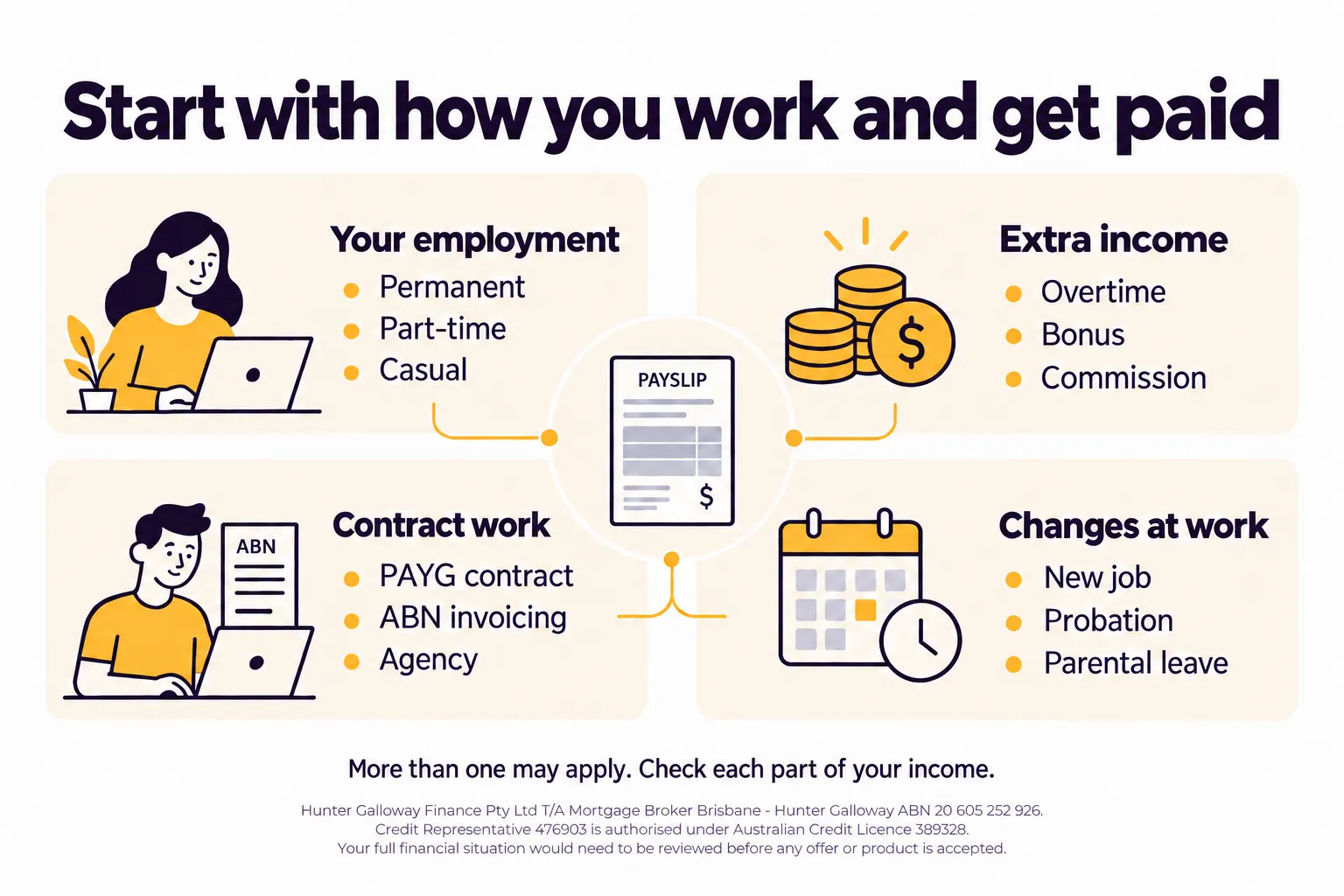
| Your situation | What we check next | Detailed guide |
|---|---|---|
| Casual work | Time in the job, consistency, how year-to-date pay is converted to a yearly figure and prior work history | Casual employment home loans |
| Part-time work | Contracted hours, actual hours and whether another job is needed | Part-time employment home loans |
| Fixed term or PAYG contract | Whether the work is treated as permanent, casual or contract income | Contractor income home loans |
| Temporary or agency work | Who employs you, time with the agency, placement history and gaps between assignments | Temporary and agency worker home loans |
| PhD stipend or scholarship | The award letter, tax treatment, remaining term and any tutoring or partner income | PhD stipend home loans |
| ABN or business income | Trading history, tax returns, financial statements and which business expenses the lender may add back to profit | Self-employed home loans |
| Several income types or an arrangement that is hard to classify | Which income was left out, how the work is classified and what evidence could explain it | Unusual employment home loans |
| Novated lease through work | Payslip deductions, lease repayments and what paying it out would leave for your deposit | Novated leases and home loans |
Your employment arrangement
Casual work
- What we check next
- Time in the job, consistency, how year-to-date pay is converted to a yearly figure and prior work history
- Detailed guide
- Casual employment home loans
Part-time work
- What we check next
- Contracted hours, actual hours and whether another job is needed
- Detailed guide
- Part-time employment home loans
Fixed term or PAYG contract
- What we check next
- Whether the work is treated as permanent, casual or contract income
- Detailed guide
- Contractor income home loans
Temporary or agency work
- What we check next
- Who employs you, time with the agency, placement history and gaps between assignments
- Detailed guide
- Temporary and agency worker home loans
PhD stipend or scholarship
- What we check next
- The award letter, tax treatment, remaining term and any tutoring or partner income
- Detailed guide
- PhD stipend home loans
ABN or business income
- What we check next
- Trading history, tax returns, financial statements and which business expenses the lender may add back to profit
- Detailed guide
- Self-employed home loans
Several income types or an arrangement that is hard to classify
- What we check next
- Which income was left out, how the work is classified and what evidence could explain it
- Detailed guide
- Unusual employment home loans
Novated lease through work
- What we check next
- Payslip deductions, lease repayments and what paying it out would leave for your deposit
- Detailed guide
- Novated leases and home loans
| Your situation | What we check next | Detailed guide |
|---|---|---|
| Overtime or penalty rates | How each payslip line is classified, the percentage used, the history the lender needs and any occupation exception | Overtime income home loans |
| Shift work and shift loadings | Which amounts are ordinary earnings, shift loadings, penalties or overtime, and how consistent they have been | Shift worker home loans |
| Extra shifts from the same employer | Whether payroll records them as ordinary hours, casual hours, overtime or shift loadings | Extra shifts and home loans |
| A second job | Time in each job, combined hours, earlier experience and whether both rosters are sustainable | Second job home loans |
| Bonus income | How it is earned, how often it is paid and how the current result compares with earlier years | Bonus income home loans |
| Commission income | Base salary, current commission, payment frequency and earlier sales history | Commission income home loans |
| FIFO income | Base pay, roster, overtime, site and shift allowances, reimbursements and work history | FIFO income home loans |
Extra income and rosters
Overtime or penalty rates
- What we check next
- How each payslip line is classified, the percentage used, the history the lender needs and any occupation exception
- Detailed guide
- Overtime income home loans
Shift work and shift loadings
- What we check next
- Which amounts are ordinary earnings, shift loadings, penalties or overtime, and how consistent they have been
- Detailed guide
- Shift worker home loans
Extra shifts from the same employer
- What we check next
- Whether payroll records them as ordinary hours, casual hours, overtime or shift loadings
- Detailed guide
- Extra shifts and home loans
A second job
- What we check next
- Time in each job, combined hours, earlier experience and whether both rosters are sustainable
- Detailed guide
- Second job home loans
Bonus income
- What we check next
- How it is earned, how often it is paid and how the current result compares with earlier years
- Detailed guide
- Bonus income home loans
Commission income
- What we check next
- Base salary, current commission, payment frequency and earlier sales history
- Detailed guide
- Commission income home loans
FIFO income
- What we check next
- Base pay, roster, overtime, site and shift allowances, reimbursements and work history
- Detailed guide
- FIFO income home loans
| Your situation | What we check next | Detailed guide |
|---|---|---|
| New job | Start date, first payslip, earlier work and any gap between roles | Home loans after starting a new job |
| Probation | Whether probation affects eligibility, your earlier work in the same field and any extra checks for a smaller deposit | Home loans while on probation |
| Parental leave | Return date, employer confirmation and expected income | Parental leave home loans |
| Employment history and job requirements | How the current role, earlier work and gaps affect the application | Home loan job requirements |
Changes and employment history
New job
- What we check next
- Start date, first payslip, earlier work and any gap between roles
- Detailed guide
- Home loans after starting a new job
Probation
- What we check next
- Whether probation affects eligibility, your earlier work in the same field and any extra checks for a smaller deposit
- Detailed guide
- Home loans while on probation
Parental leave
- What we check next
- Return date, employer confirmation and expected income
- Detailed guide
- Parental leave home loans
Employment history and job requirements
- What we check next
- How the current role, earlier work and gaps affect the application
- Detailed guide
- Home loan job requirements
Expenses and borrowing power
Your salary is only one part of the borrowing calculation. School fees and other household costs can change the result even when your income stays the same. These guides explain what to check before deciding you need to earn more.
| What is affecting your budget? | What we check | Read the guide |
|---|---|---|
| Private school fees | Remaining fees, savings, lender treatment and the repayments your family can afford | School fees and borrowing capacity |
| The bank uses higher living costs than your budget | Your declared spending, the lender’s benchmark and expenses counted separately | How HEM affects your home loan |
| Your borrowing estimate is lower than expected | Income, debts, expenses and changes worth comparing before you apply | Ways to improve borrowing power |
Expenses that can affect borrowing power
Private school fees
- What we check
- Remaining fees, savings, lender treatment and the repayments your family can afford
- Read the guide
- School fees and borrowing capacity
The bank uses higher living costs than your budget
- What we check
- Your declared spending, the lender’s benchmark and expenses counted separately
- Read the guide
- How HEM affects your home loan
Your borrowing estimate is lower than expected
- What we check
- Income, debts, expenses and changes worth comparing before you apply
- Read the guide
- Ways to improve borrowing power
How lenders assess your income
Lenders check which income they can count, your work history and the documents supporting your pay. A long employment history helps explain your work, but you may still need to show what an extra payment on your payslip is for.
First, establish what each payment is. Base salary, overtime, commission and reimbursements can be treated differently. The total gross figure on a payslip may therefore be higher than the income used in the loan assessment.
Package a car through work? See how a novated lease affects your home loan before relying on your gross salary to set a buying budget. If you work in a public hospital, ambulance service or charity and package other pay through a provider such as RemServ, lenders add that back in different ways. Our home loans for nurses guide and home loans for doctors guide set it out lender by lender.
Next, check the history the lender needs for that particular income. Time with your current employer, earlier work in the same field and gaps between jobs can all matter. A new permanent job is assessed differently from a new second job or a recent move into casual work.
Finally, match the figures to the evidence. Current payslips show what you are earning now; an earlier income statement or final payslip can help explain whether variable income has continued. If the numbers differ, find the reason before estimating what you can borrow.
What lenders need for each employment type
For permanent full-time and part-time PAYG work, start with the contracted hours and base pay. If the payslip also includes extra shifts or overtime, separate those amounts so they can be checked under the relevant income rules.
With casual or agency work, a recent high pay period may not represent your usual income. Your history, hours and any gaps help explain the pattern. Agency placements can change while the employer stays the same, so confirm who employs you before treating every placement as a new job.
Contract work needs a closer look at the arrangement. Being paid through PAYG can lead to a different assessment from invoicing through your own ABN. The contract, paid leave and tax arrangements help establish how the lender will categorise it.
If you run a business, use the self-employed home loans guide for trading history and financial evidence. Our tradie home loans guide covers work under your own ABN. We don't arrange low-doc or alt-doc loans. Our low doc loans guide explains the difference and the records you may need for a full-document loan. If your income comes through your own company or a family trust, our company director home loan guide and trust income home loan guide explain how lenders follow that income.
Tell us how you are paid and whether your work has changed recently. We can check the records a lender needs before you rely on an online borrowing estimate.
Does your income fit the way the bank assesses it?
Overtime, bonuses, commission and allowances
A lender may use only part of your overtime, bonus or commission income, or require more history before including it. Regular shift loadings and penalty rates also need to be identified correctly.
If your recent pay is lower than usual, explain what changed and supply the evidence. A temporary drop in hours and a lasting change to your roster are different situations. The lender needs enough information to decide which income it can rely on.
The YTD calculator turns year-to-date pay into an estimated annual figure. A lender may accept a lower figure. Check the period covered and separate any income that needs its own assessment before using the result in a purchase budget.
New jobs, probation, parental leave and HECS
Starting a new role or being on probation does not automatically rule out a home loan. Check the current role alongside your previous work before deciding you need to wait. The new job and probation guides above explain what can help support an application.
For parental leave, the questions include income during leave, the expected return date and pay, and how the household will meet its commitments in the meantime. Our parental leave guide covers the evidence a lender may need.
A HECS-HELP debt can also affect the amount available for repayments. The ATO lists the minimum repayment income as $69,528 for the 2026-27 year. Above that threshold, repayments start at 15 cents for each dollar over it. Lender treatment can differ, so read the HECS and home loans guide before assuming your salary alone determines borrowing power.
Payslips, bank statements and living expenses
I would start with the part of your income that needs explaining, then ask for the documents that answer that question. The lender may ask for more than this table lists.
| What I am trying to work out | What we usually check |
|---|---|
| How the lender will categorise the job | Your employment contract or letter of offer, whether you receive paid leave, and whether any income is invoiced through an ABN |
| Whether overtime, penalties or allowances are consistent | Two recent payslips, your latest Tax Ready income statement, the final payslip from the previous financial year, and a clear breakdown of each extra-income line |
| Whether a short time in the job can be supported | A simple timeline of the current and previous roles, the work performed, the industry and any gaps |
| What income returns after parental leave | The return-to-work letter, expected hours, return date and any recent income evidence the lender asks for |
Bring the document that answers the question
How the lender will categorise the job
- What we usually check
- Your employment contract or letter of offer, whether you receive paid leave, and whether any income is invoiced through an ABN
Whether overtime, penalties or allowances are consistent
- What we usually check
- Two recent payslips, your latest Tax Ready income statement, the final payslip from the previous financial year, and a clear breakdown of each extra-income line
Whether a short time in the job can be supported
- What we usually check
- A simple timeline of the current and previous roles, the work performed, the industry and any gaps
What income returns after parental leave
- What we usually check
- The return-to-work letter, expected hours, return date and any recent income evidence the lender asks for
Bank statements can help a lender check income and spending. Our guide to how many months of bank statements you need explains what may be requested.
A lender also considers living expenses and may compare them with the Household Expenditure Measure. If declared spending is well below the benchmark, the lender may ask for an explanation.
Choose a budget you can live with
The income a lender accepts and the income you want to rely on are separate decisions. Before choosing a purchase budget, ask what repayments would leave for everyday costs and savings. If overtime, commission or a second job is part of the plan, compare the household budget with less of that income.
Decide how much cash you want to keep after buying, as well as how much you can put into the deposit. A higher borrowing limit is useful only if the repayments still suit your household.
If you already own a home, our next-home buying and selling guide covers repayments, sale and purchase timing, and the cash you want to keep. If the assessment leaves less room than expected, read our strategies to improve borrowing power before making changes.
Once your income sources, work history and documents are clear, we can compare lender requirements. Talk through your income and employment with a broker before applying, so you know which part of the assessment needs attention and whether more evidence would help.
Income and employment home loan questions
What does your current income work out to?
Run your year-to-date figures through the calculator before you talk to a lender about what you can borrow.
Open the YTD calculatoror call 1300 088 065
Hunter Galloway Finance Pty Ltd is Credit Representative 476903, authorised under Australian Credit Licence 389328.
Sources and review
How this guide was checked
Reviewed 17 September 2026 by Jayden Vecchio.
Lenders assess employment history and income differently. Confirm the current rules against your payslips, employment documents and full application before relying on a borrowing estimate.
The specialist school-fees guide covers the client examples, lender conditions and supporting sources.

References
Lender requirements can change. Confirm the rules and documents for your application before relying on an income or borrowing estimate.