


Client story
Gavin's company was 8 months old. His carpentry career was not.
Gavin had worked as a carpenter for 5 years. He started as a sole trader, then moved the same work into a company 8 months before looking at a home loan.
His first bank focused on the company registration date. On that view, his business looked too new.
I went back through the history instead. The old ABN, new company figures, ownership, customers and an accountant's letter all showed that Gavin had not started a new career. He had changed how the same carpentry work was set up.
- 8 months
New company history
- 5 years
Continuous carpentry history
The lender used Gavin's 5 years of carpentry history. His home loan was unconditionally approved.
Can tradies get a home loan?
Yes. Tradies can use PAYG wages, regular overtime and allowances, contract income or business income. The lender still needs enough history and evidence for the way you are paid.
The biggest differences usually come from 4 things: whether you are PAYG or invoicing, how long that setup has been running, what profit the business shows and how much you owe on vehicles or equipment.
Are you PAYG, contract or self-employed?
Start with your ordinary wage, then separate overtime, allowances and reimbursements. The history of each part can change how much a lender uses.
First confirm whether you are paid through payroll or invoices. A PAYG contract and an ABN contractor can be assessed very differently.
Start with the business age, latest completed figures, debts and the profit after normal costs. Turnover by itself is not the income a lender uses.
Check the wage, dividends or profit you rely on, your shareholding, the company history and its debts. A salary from your own company does not always get treated like ordinary PAYG income.
If you are a PAYG tradie
If your payslip shows an ordinary salary or hourly wage, this is usually the simplest starting point. The parts that need a closer look are overtime, site allowances, travel payments, living-away-from-home payments and a recent move to a new employer.
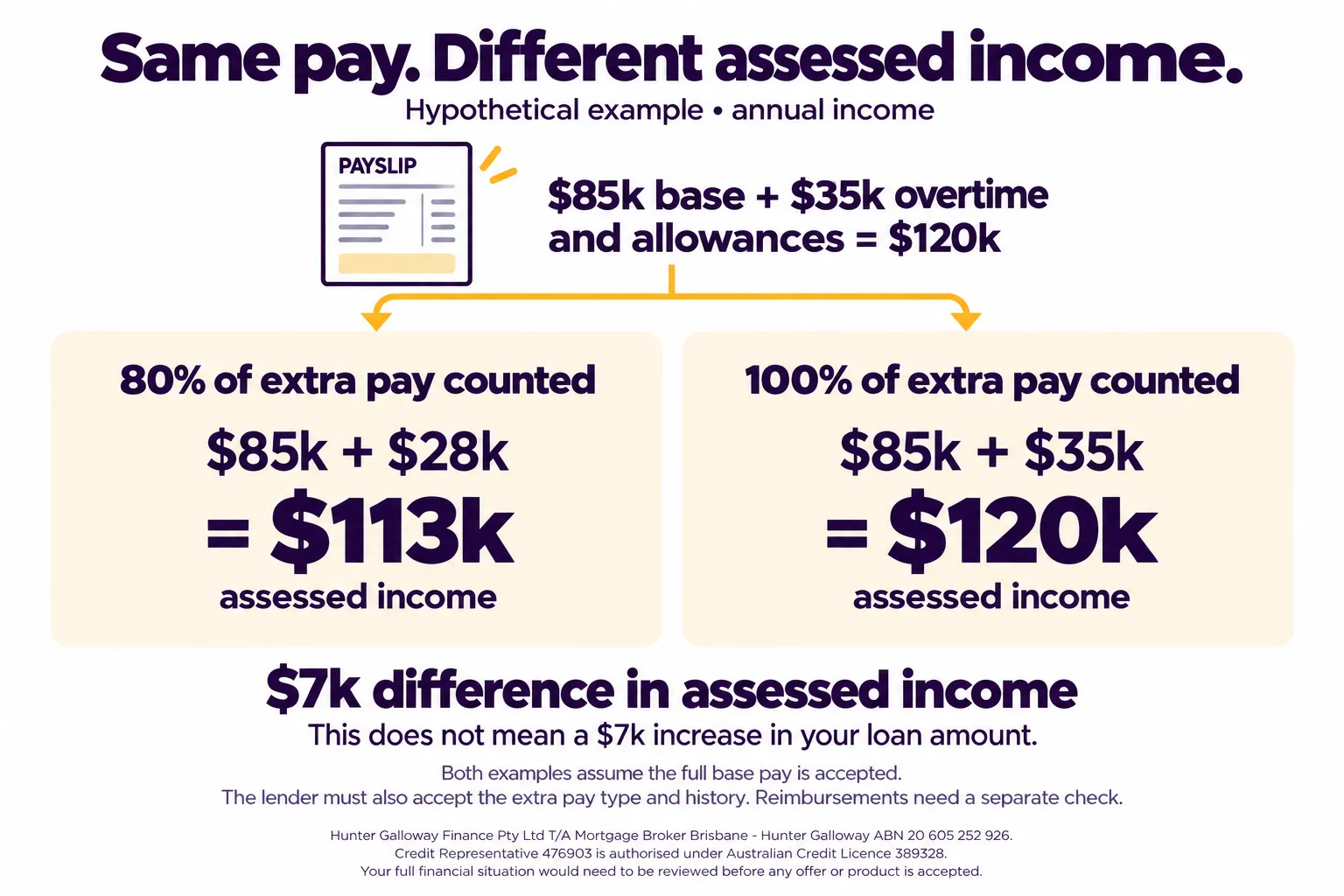
I separate the payslip into ordinary income and everything on top. Then I check whether the extra income is regular, how long it has been paid and whether the lender treats it as continuing income or a reimbursement.
| Example calculation | Base pay | Extra pay counted | Assessed income |
|---|---|---|---|
| 80% of $35k extra pay accepted | $85k | $28k | $113k |
| 100% of $35k extra pay accepted | $85k | $35k | $120k |
If you work on a major project as a crane or plant operator, bring payslips that itemise overtime and each allowance, plus your enterprise agreement (EBA) classification where it applies. Site, travel and living-away-from-home payments need to be checked separately.

If a large part of your pay comes from overtime, shift work, allowances or a separate job, the unusual employment home loan guide is a starting point for the income evidence to discuss with your broker.
If you are paid on contract or a day rate
The word contractor can describe 2 very different people. You may be paid through payroll as a PAYG contractor, or you may send invoices through an ABN or company.
A PAYG contractor can sometimes be assessed much like an employee, with the contract term, gaps between contracts and earlier work in the same trade helping explain the income. If you invoice, the lender is more likely to treat you as self-employed and ask for business evidence.
The contractor income home loan guide explains how lenders assess PAYG, day-rate and ABN setups differently.
If you are a sole trader or run a company
The number that matters is not the turnover printed across the top of the accounts. It is the income left after the business costs, adjusted only where the lender's rules allow it.
I usually start with:
- how long the business and ABN have been active
- the latest completed personal and business returns
- profit and loss statements and balance sheets
- wages, dividends or distributions paid to you
- business debts, leases and credit cards
- whether the latest year is stronger or weaker than the year before
Some lenders may use the latest completed year. Others average 2 years, cap a large increase or need a longer time in business. That is why using the taxable income from one return in an online calculator can give you an inaccurate result.
Other adjustments can include voluntary super above the compulsory amount or interest on a business debt being cleared. They depend on the lender and the accounts. I check whether each cost continues, and whether any replacement repayment still needs to be included.
If you pay yourself a wage from your trade business, read the self-employed home loan guide for more on how lenders assess business income.
Why can 2 banks use different income figures?
The table below covers 10 lenders. They use 3 broad ways to assess the latest completed year. That year may help, but only when the business history and current trading support it.
Suncorp Bank will not accept new home loan applications from 7 October 2026, so it is not included below. Existing borrowers can read our Suncorp home loan review.
| Lender approach | What that can mean for you | What I check |
|---|---|---|
| A recent completed year may be usable ANZ , Bankwest , NAB , Commonwealth Bank , ING and Macquarie | The latest completed year may be usable, even when the lender still needs 2 years of evidence. | I confirm business age, compare both years and check whether current trading supports the newer result. |
| A simpler full-verification option may exist Westpac and St George | Fewer business documents does not mean low doc. The income is still fully checked. | I check the required evidence before asking you for more documents. |
| Two years or a more conservative figure may be needed Firstmac and People First Bank | A short business history or large income increase may mean averaging or using the lower figure. | I calculate the conservative result first so we know whether waiting changes the answer. |
Why can 2 banks use different income figures?
A recent completed year may be usable ANZ , Bankwest , NAB , Commonwealth Bank , ING and Macquarie
- What that can mean for you
- The latest completed year may be usable, even when the lender still needs 2 years of evidence.
- What I check
- I confirm business age, compare both years and check whether current trading supports the newer result.
A simpler full-verification option may exist Westpac and St George
- What that can mean for you
- Fewer business documents does not mean low doc. The income is still fully checked.
- What I check
- I check the required evidence before asking you for more documents.
Two years or a more conservative figure may be needed Firstmac and People First Bank
- What that can mean for you
- A short business history or large income increase may mean averaging or using the lower figure.
- What I check
- I calculate the conservative result first so we know whether waiting changes the answer.
Westpac’s self-employed guidance and Macquarie’s credit guidelines (broker reference) explain why the income year used and the documents required are separate checks.
Related lender and guide links: ANZ · Bankwest · NAB · Commonwealth Bank · ING · Macquarie · Westpac · St George · Firstmac · People First Bank
How do utes, tools and equipment affect borrowing power?
A ute can appear as a business expense and as an ongoing loan. Those are not the same thing.
Depreciation is a paper expense and may be added back within a lender's rules. Loan repayments and ordinary running costs are real commitments. I do not add back every motor vehicle expense and pretend the ute costs nothing.
| What appears in the figures | What I check | Why it matters |
|---|---|---|
| Depreciation | The depreciation schedule and lender's permitted adjustment | It may reduce taxable profit without being the same as cash leaving the business that year. |
| Vehicle or equipment loan | The actual repayments, balance and whether the debt continues | The repayment can still reduce borrowing power even where part of the accounting expense is adjusted. |
| Fuel, repairs and registration | Whether they are normal ongoing costs | Running costs do not disappear just because the vehicle helps produce income. |
| One-off tool purchase | Invoice, accounting treatment and whether finance was used | A genuine one-off cost may be treated differently from a cost that repeats every year. |
How do utes, tools and equipment affect borrowing power?
Depreciation
- What I check
- The depreciation schedule and lender's permitted adjustment
- Why it matters
- It may reduce taxable profit without being the same as cash leaving the business that year.
Vehicle or equipment loan
- What I check
- The actual repayments, balance and whether the debt continues
- Why it matters
- The repayment can still reduce borrowing power even where part of the accounting expense is adjusted.
Fuel, repairs and registration
- What I check
- Whether they are normal ongoing costs
- Why it matters
- Running costs do not disappear just because the vehicle helps produce income.
One-off tool purchase
- What I check
- Invoice, accounting treatment and whether finance was used
- Why it matters
- A genuine one-off cost may be treated differently from a cost that repeats every year.
What if you recently changed ABN, company or employment type?
A changed setup does not always mean the work itself is new. Gavin's example is one version of this. A PAYG plumber moving into the same work as a sole trader may have useful industry history, even though the ABN is recent.
I would look for evidence connecting the old and new setup, such as earlier payslips, the former ABN, company registration, invoices, contracts, customers, bank statements and an accountant's explanation. Whether a lender accepts that continuity is still a policy and credit decision.
If the business is new, we need to assess it on that basis. We can check whether a lender has an option now, whether a smaller loan changes the answer or whether waiting for the next set of figures is the sensible choice.
Do tradies get special deposit options?
Being a tradie does not create a general LMI waiver by itself. Your deposit options may still include a standard loan, a family guarantee or the Australian Government 5% Deposit Scheme if you meet its current eligibility rules and property price cap.
The deposit is only one part of the application. A 5% option does not make unfinished tax returns or an unsupported income figure disappear. Check the income and deposit route together.
Allow for purchase costs as well as the deposit. Check your state’s current grant and transfer-duty rules. In Queensland, the first home owner grant and home transfer-duty concessions have separate eligibility conditions. Your property type, contract date and personal circumstances can change the help available.
Our low-deposit home loan guide explains the deposit options. If this is your first purchase, the first home buyer guide covers the wider buying process.
Buying during your apprenticeship
Compare buying on your current income with waiting until the qualified pay rate is documented. Keep evidence of regular overtime and allowances. A gift or guarantor may help with the deposit, but you still need to show that you can afford the repayments. A lower purchase budget is another option to assess.
If you have HELP or an Australian Apprenticeship Support Loan, bring the current balance and repayment details. I check the loan type before assessing its effect. See how HECS debt can affect a home loan for the HELP side of that check.
Working in Australia on a visa?
Tell me your visa and residency status, who you are buying with, and whether you want an existing home, a new home or land. Loan eligibility and permission to buy the property are separate checks. Foreign buyers face restrictions on existing homes, with limited exceptions. Check the Australian Government’s residential-property guidance and any state foreign-buyer duty before committing to a purchase. A citizen or permanent-resident partner does not settle every question about your share of the property.
If you plan to build, our construction loan guide explains how the loan and progress payments work. Property-purchase permission still needs its own check.
What should I prepare?
PAYG tradie
- recent payslips
- latest Tax Ready income statement
- employment contract or letter if the role is new
- prior-year payslip or income statement where overtime and allowances matter
Sole trader or company
- latest lodged personal and business returns
- notices of assessment
- financial statements, including profit and loss and balance sheet
- current business debts and equipment finance
- recent BAS or business statements where a lender needs them
- documents linking an old and new business setup where continuity matters
Do not collect every document on that list before speaking with me. I would first identify what is missing and ask for the evidence that could affect the assessment.
Before you apply
- Make the accounts easy to followKeep business and personal spending separate where possible, and explain personal transactions in business accounts.
- Check what is up to dateConfirm which returns and BAS have been lodged. Bring the current figures if the completed year no longer reflects the work coming in.
- Check finance changes firstSpeak with me before taking new ute or equipment finance, closing facilities or using savings to clear a debt. We can compare the effect on repayments and the cash left for your purchase.
Home loan guides for different trades
An electrician, plumber, builder, carpenter and concreter can face the same income questions. The occupation becomes more useful when it changes the pay pattern, licensing evidence, business costs or work history.
Questions tradies ask
Experience and sources
How this guide was checked
Reviewed 18 September 2026 by Joshua Vecchio.
Lender comparisons checked 30 July 2026 and reviewed quarterly. They are a general starting-point view of the lenders named above, not a ranking, a recommendation or credit advice.
The sources below cover PAYG and business-income evidence, deposit schemes, HELP repayments and Queensland grants and duty concessions. We confirm current lender requirements against your documents and circumstances before recommending a loan.
Suncorp Bank's application cutoff was checked on 6 October 2026.

Sources
- ANZ: Home loans for business owners
- Westpac: Home loans for self-employed and business owners
- Macquarie: Residential Home Loans Credit Guidelines (broker reference)
- Westpac: Minimum required documents checklist
- Australian Government 5% Deposit Scheme
- APRA: HELP debt treatment
- Australian Government: Residential land and foreign investment
- Queensland Revenue Office: First home owner grant eligibility
- Queensland Revenue Office: Home concession rates
- Suncorp Bank: New home lending applications close from 7 October 2026
General information only. Lender policies can change, and the lender must assess the full application. Technical broker references explain individual lender rules; they are not an approval or a rule shared by every lender.
Useful calculators
Use the mortgage repayment calculator to test repayments alongside your other commitments. Our borrowing power guide explains the factors behind a lender’s estimate.
Estimate your borrowing power
Use your current income and deposit for a starting estimate.
This is a guide, not a loan approval. Overtime, allowances, business add-backs and existing debts can change what a lender will assess.

Check how a lender may read my trade income
Tell me your trade, how you are paid, how long you have worked that way and what your latest income evidence looks like. I will identify the number that needs testing and whether the current setup gives us a sensible lender option.
or call 1300 088 065
Your full financial situation and current lender policy need to be assessed before any loan recommendation.
This is general information, not a loan approval. Lender policy, pricing and evidence requirements can change, and the lender must assess the full application.
Client examples are based on real situations. Names and identifying details have been changed.