


You might pay only part of a shared mortgage, yet a bank could count the whole repayment against you. We check whether a lender’s rules and your evidence allow it to count your share, then work out the difference to your borrowing budget.
Can I buy on my own if I already have a joint mortgage?
Yes, having a joint mortgage does not automatically stop you buying another property in your own name. You still need to show the bank you can afford the new loan alongside your existing commitments.
Banks call this affordability check serviceability. They start with your income, then allow for everyday costs and debt repayments. Counting only an accepted share of your joint repayment may leave more room for the new loan.
Our borrowing power guide explains what else affects the amount you can borrow.
A common debt reducer isn't a separate loan you take out. It's a different way some lenders work out what you can afford. It won't pay down any debt, and it isn't debt consolidation (rolling debts into one loan) or debt recycling (an investment and tax strategy).
Am I still responsible for the whole joint loan?
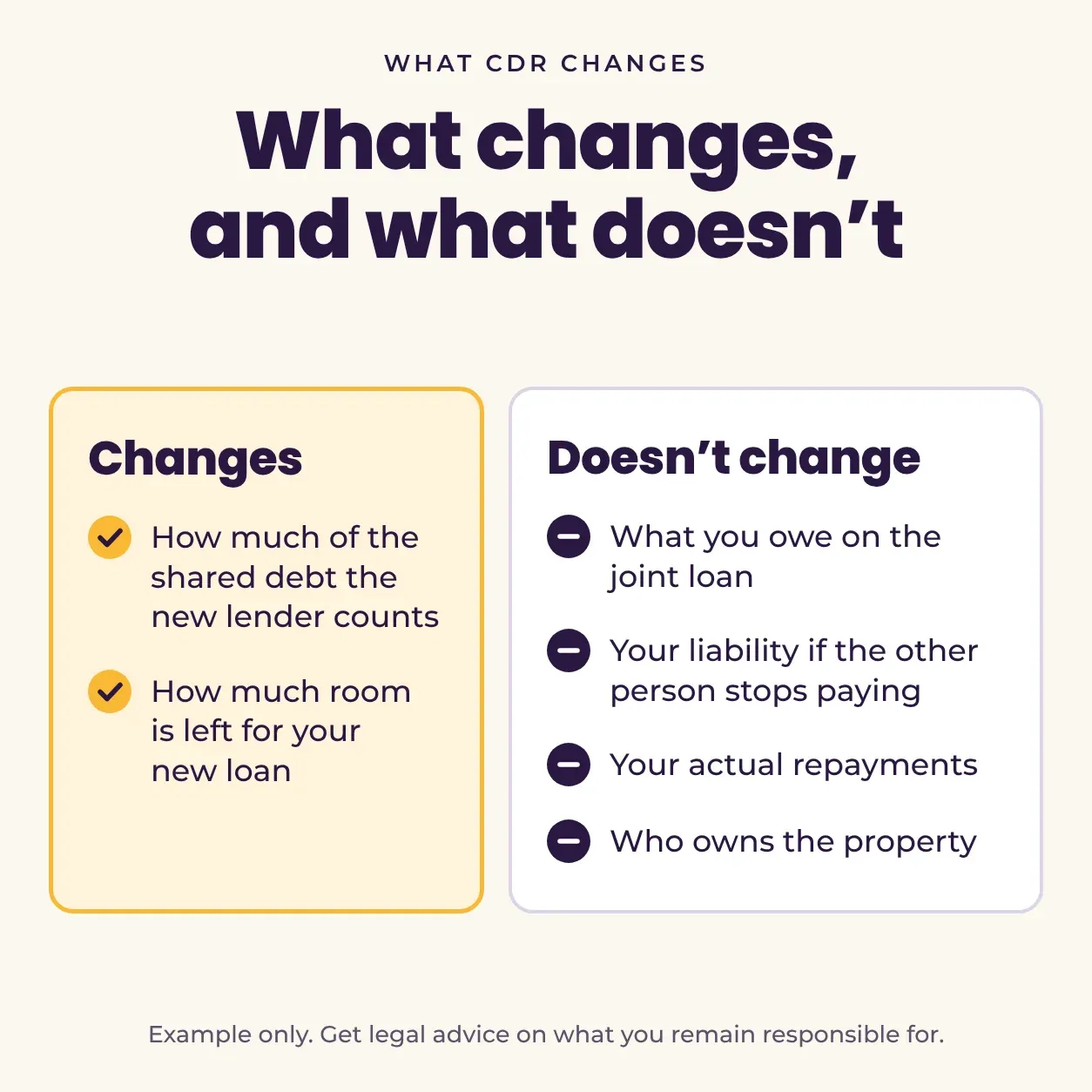
Yes. If the other borrower stops paying, the lender may still require you to repay the whole joint debt. Owning half the property or agreeing to pay half the mortgage between yourselves does not limit the lender to collecting half from you.
The smaller figure used for your new application does not change the old loan contract. Ask your solicitor what you remain responsible for. Moneysmart’s guide to relationships and money explains the risks of shared loans.
How much difference could a common debt reducer make?
Here's a simple example of how the calculation works. It isn't an estimate of what you'd be approved for.
Say a bank counts $4k a month for your existing joint mortgage when it works out what you can borrow. If you qualify under a policy that accepts a 50% share, it would count $2k for you instead. That could make room for a new loan that didn't fit when the bank counted the full $4k.
| Assessment approach | Monthly repayment counted |
|---|---|
| Whole joint repayment | $4k |
| Accepted 50% share | $2k |
This doesn't put an extra $2k in your pocket. Your actual mortgage repayment stays the same. The bank's calculation may use a higher repayment than you currently pay, to allow for rates going up. Once we run the full numbers, we can tell you what the change means for your borrowing budget.
If the shared property earns rent, we also check how much of that income the bank will accept. You cannot assume it will count all the rent while counting only part of the repayment.

Can a lender split living costs with a partner who isn't applying?
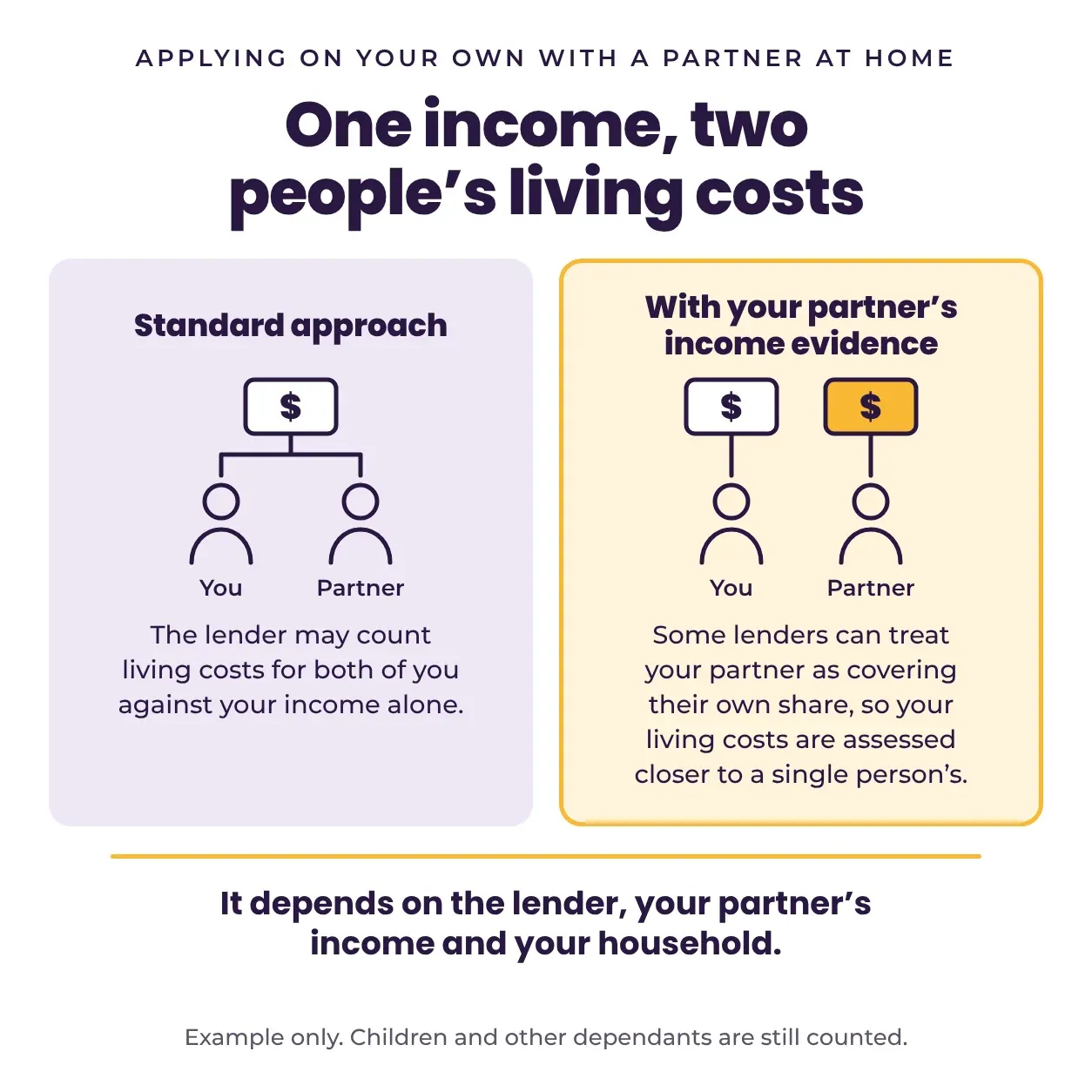
Living costs work in a similar way. If you apply on your own but live with a partner, the lender doesn't just look at you. It may count living costs for your whole household, two adults, against your one income. That alone can take a big chunk out of what you can borrow.
Some lenders take a similar approach to the common debt reducer here. If your partner earns their own income and you can show it with their payslips, the lender may accept that they cover their own share of the household costs. Your living costs are then assessed closer to a single person's.
Other lenders assess the whole household, and each sets its own rules for when it will split the costs. Children and anyone else you support are still counted.
Riley's file shows how much the household side can move the number. He earned about $180k. As a single applicant his borrowing power was about $840k. Once his partner and child were included in the application, it dropped to about $650k, a difference of roughly $190k on the same income.
Can a common debt reducer help after separation?
It is worth checking if you want to buy on your own but still have a mortgage with your ex. An agreement about who will pay a debt does not, by itself, take your name off it. We need to see which accounts are still open and whether any agreed payout or refinance has gone through.
Some lenders only allow a repayment split for spouses who still live together, so their rules may no longer fit after separation. Other options for shared debts have their own rules, so we check each one separately. We start with where things stand now and the proof of who pays what, then work out what's possible.
If you are deciding whether to keep the home or sell after separation, compare the new loan and monthly budget with the cash left after a sale. Our divorce and separation home loan guide covers the wider process, while our guide to joint debts after separation explains what to check on the accounts.
Which lenders offer common debt reducer policies?
Who you share the loan with matters. A lender that helps someone whose spouse pays part of the mortgage may have different rules for a brother, sister or ex-partner. These are the main differences we check before calculating your borrowing budget.
| Lender | What the lender may count | Conditions to check |
|---|---|---|
| CommBank | CommBank calls its approach Alternate Servicing. It can count your proven share of an existing joint home loan. | You need a signed statutory declaration and evidence that the repayments are being made, not an assumed 50/50 split. We confirm CommBank's current rules on who you can share the loan with before relying on it. |
| Westpac | For spouses living together, Westpac can split the repayment based on each partner's verified share of household income. | Your spouse can't be on the new loan. Westpac still counts the whole joint debt when it compares your total debt with your income. For a joint debt with someone who isn't your spouse, we confirm Westpac's current rules before relying on any split. |
| St George | For spouses living together, St George can split the repayment based on each partner's verified share of household income. | Your spouse can't be on the new loan. St George still counts the whole joint debt when it compares your total debt with your income. For a joint debt with someone who isn't your spouse, we confirm St George's current rules before relying on any split. |
| Macquarie | Macquarie can count a share of joint repayments for married or de facto couples. | It checks your spouse can afford the rest, so half isn't automatic. Your spouse also confirms their finances and employment in a signed statement, provides income evidence and acknowledges the new loan. Debts shared with anyone other than a spouse count in full. |
| ING | ING may count half a joint repayment if counting the whole amount means you don't pass its affordability check. | At least half still counts against you, and the other borrower must be able to afford their half or ING counts the full amount. We check the proof it needs and whether your relationship fits before relying on it. |
| Pepper Money | Pepper may count 50% of joint repayments when one spouse applies alone. | You need to pass Pepper's affordability checks both on your own and as a household, so it needs the other person's permission and details of their income, assets, debts and living costs. We'd check separately whether this fits after separation. |
| AMP | AMP can split an eligible investment property loan shared with a relative who isn't your spouse, such as a sibling. | AMP bases the split on ownership, with a statutory declaration from the other person. Different rules apply to a shared home you live in. For debt shared with your spouse, AMP counts the whole joint debt unless your spouse joins as a servicing guarantor. That means their income supports the application and they guarantee the loan, taking on responsibility if you can't pay. |
| ME Bank | ME counts the whole joint debt when you apply on your own. | It doesn't offer a repayment split. Paying half between yourselves won't change that. |
Common debt reducer lender comparison
- What the lender may count
- CommBank calls its approach Alternate Servicing. It can count your proven share of an existing joint home loan.
- Conditions to check
- You need a signed statutory declaration and evidence that the repayments are being made, not an assumed 50/50 split. We confirm CommBank's current rules on who you can share the loan with before relying on it.
- What the lender may count
- For spouses living together, Westpac can split the repayment based on each partner's verified share of household income.
- Conditions to check
- Your spouse can't be on the new loan. Westpac still counts the whole joint debt when it compares your total debt with your income. For a joint debt with someone who isn't your spouse, we confirm Westpac's current rules before relying on any split.
- What the lender may count
- For spouses living together, St George can split the repayment based on each partner's verified share of household income.
- Conditions to check
- Your spouse can't be on the new loan. St George still counts the whole joint debt when it compares your total debt with your income. For a joint debt with someone who isn't your spouse, we confirm St George's current rules before relying on any split.
- What the lender may count
- Macquarie can count a share of joint repayments for married or de facto couples.
- Conditions to check
- It checks your spouse can afford the rest, so half isn't automatic. Your spouse also confirms their finances and employment in a signed statement, provides income evidence and acknowledges the new loan. Debts shared with anyone other than a spouse count in full.
- What the lender may count
- ING may count half a joint repayment if counting the whole amount means you don't pass its affordability check.
- Conditions to check
- At least half still counts against you, and the other borrower must be able to afford their half or ING counts the full amount. We check the proof it needs and whether your relationship fits before relying on it.
- What the lender may count
- Pepper may count 50% of joint repayments when one spouse applies alone.
- Conditions to check
- You need to pass Pepper's affordability checks both on your own and as a household, so it needs the other person's permission and details of their income, assets, debts and living costs. We'd check separately whether this fits after separation.
- What the lender may count
- AMP can split an eligible investment property loan shared with a relative who isn't your spouse, such as a sibling.
- Conditions to check
- AMP bases the split on ownership, with a statutory declaration from the other person. Different rules apply to a shared home you live in. For debt shared with your spouse, AMP counts the whole joint debt unless your spouse joins as a servicing guarantor. That means their income supports the application and they guarantee the loan, taking on responsibility if you can't pay.
- What the lender may count
- ME counts the whole joint debt when you apply on your own.
- Conditions to check
- It doesn't offer a repayment split. Paying half between yourselves won't change that.
The other lenders we compare, including NAB, ANZ, Bankwest, ubank, Firstmac, Teachers Mutual, Resimac, People First and Brighten, don't include a repayment split in the policies we hold. With them, we plan on the whole joint repayment counting unless the lender confirms otherwise.
Our lender reviews cover costs and other loan features to compare as well.
Could the bank still say I have too much debt?
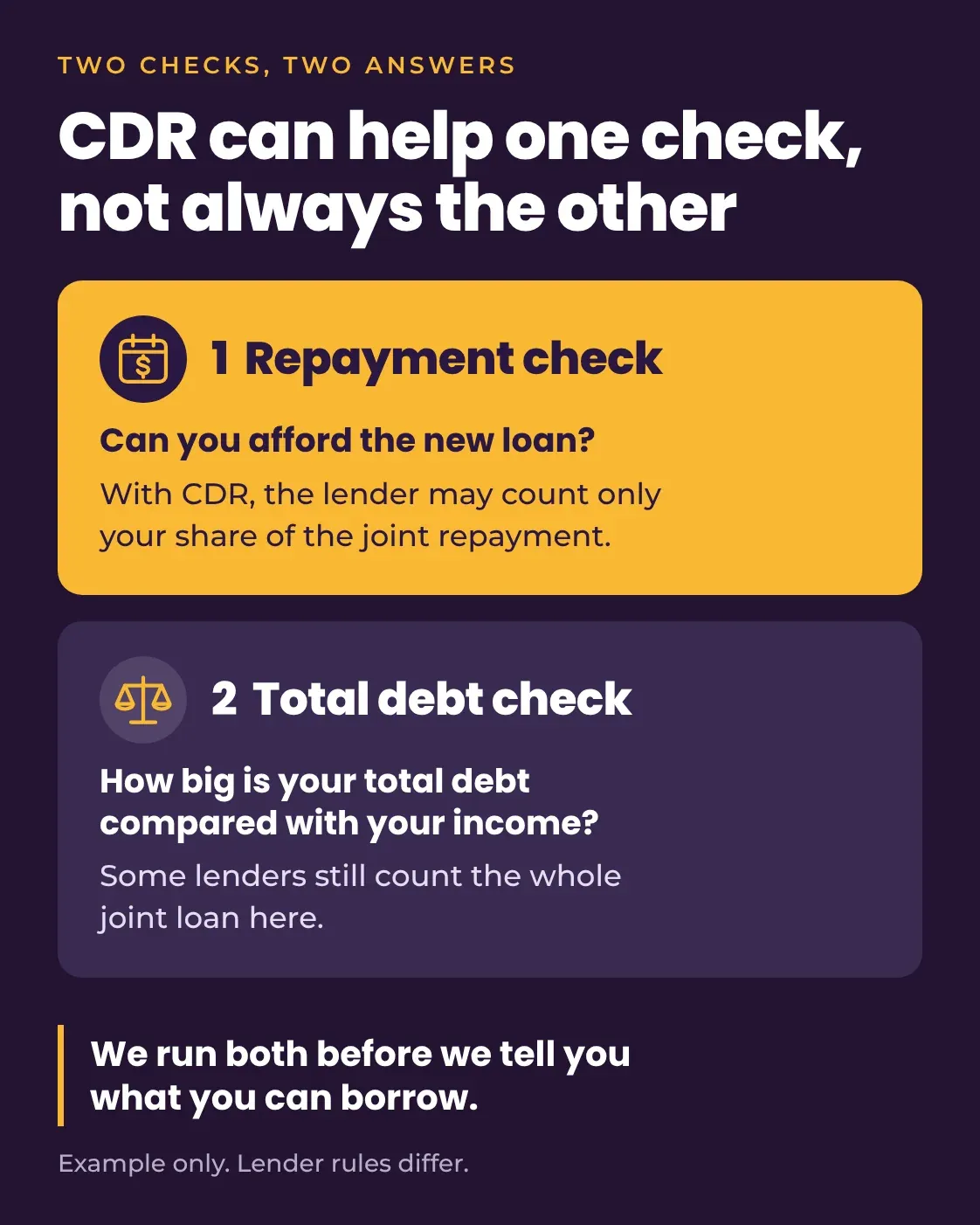
A lender can accept a smaller share of your monthly repayment and still count the whole joint loan balance when it checks your total debt. We look at both before telling you what you can borrow.
- Repayment check: can you afford the new loan after the repayments the lender counts?
- Total debt check: how does the debt the lender counts compare with your yearly income?
Since 1 February 2026, APRA (the banking regulator) has limited how much of their new lending banks and other deposit-taking lenders can give to borrowers whose total debt is 6 times their annual income or more. The limit is 20% of new lending for homes people live in, and a separate 20% for investment lending. Some exemptions and specific counting rules apply.
This limits the lender’s overall lending. It isn't a ban on anyone borrowing 6 times their income or more. A lender can set tighter rules of its own, and a common debt reducer does not guarantee you will pass either check. See APRA’s DTI announcement.
What documents do we need to check your options?
Start with your current loan statements and what you want to buy or refinance. We can then explain which lender options are worth checking and what else you need to provide:
- Current statements for shared loans, including their limits, balances, repayments and repayment history.
- Who is named on each loan, how the borrowers are related and who will apply for the new loan.
- Proof of your income and other debts, plus the other borrower’s details if the lender needs them.
- Your everyday household costs, children or others you support, property ownership details and any rent received.
- Any relevant signed separation agreement, payout figures and evidence that an agreed debt closure or refinance has completed.
- Your deposit or equity (the value in your property above what you owe), the amount you want to borrow and any contract or settlement deadline.
Do not send someone else’s financial information without their permission. We can explain what the lender needs and how the other person can provide it securely.
What if CDR still does not get the loan across the line?
We look at what is holding the application back. A smaller share of the joint repayment will not solve every problem: the bank still needs to accept your income, credit history and the property, and you need enough deposit. We also check that the new repayments leave you enough for everyday life. Depending on what's in the way, the fix might be a smaller loan, more deposit, or sorting out the joint loan first through a payout or refinance.
If you are already struggling with repayments, speak with the existing lender about support before taking on another mortgage.
What should I ask my broker?
- Can this lender count my share of the repayment for the kind of loan and relationship I have?
- How much would it count, and what proof do I need?
- How much rent will it accept, and whose living costs and other debts will it count?
- Does the other person need to provide documents or take a role in the new application?
- Will the bank still count the whole loan when comparing my total debt with my income?
- How do the rates and fees compare with the other loans I qualify for?
Common debt reducer FAQs
Check what your joint mortgage means for your next loan
Tell us what you're planning next and how you and the other borrower split the mortgage repayments now. Send through your current loan statements and income details, and our Brisbane mortgage brokers can check which lenders will accept that split and what it means for your budget before you commit to anything.
Get a free assessmentor call 1300 088 065
General information only. This article does not consider your objectives, financial situation or needs and is not legal or tax advice. Lender policies can change. Applications remain subject to the lender’s assessment and approval.
Sources
Macquarie: Understanding common debt reducer policy. Public guidance checked 28 October 2026.
AMP: Public Broker Hub policies, Common debt reducer section. Checked 28 October 2026.
Pepper Money: Investor policy overview. Public confirmation that CDR is offered, checked 28 October 2026.
APRA: Activation of debt-to-income limits as a macroprudential policy tool. Checked 28 October 2026.
Moneysmart: Relationships and money. Shared-loan guidance checked 28 October 2026.
Moneysmart: Debt consolidation and refinancing. Explanation checked 27 October 2026.
Client examples are based on real situations. Names and identifying details have been changed.