


Why ME Bank can stand out
- 01 / OFFSET
Up to 10 accounts can reduce the same variable balance
CompleteME lets you link up to 10 SpendME accounts to the variable part of the loan.
- 02 / SELF-EMPLOYED
3 ways to assess business income
Depending on your business, ME may use your company-paid wage or 1 or 2 years of financial records.
- 03 / SMALLER DEPOSIT
Eligible purchases may reach 95%
ME may lend up to 95% of the accepted property value, but LMI normally applies above 80%.
- Eligible paid parental-leave income may be used in full when the return-to-work plan and documents are acceptable.
- Regular overtime, penalties and allowances may be used in full for eligible essential-services workers.
Products, offset accounts and fixed rates
The product decision comes down to whether you will keep enough money in offset to justify CompleteME's annual fee.
ME Bank product comparison
Scroll to see more columns
| Product | Useful feature | Fees and limits |
|---|---|---|
| CompleteME | Up to 10 SpendME offsets on the variable loan. No offset on a fixed portion. | $395 annual fee. No top-up or product-switch fee. |
| EconoME | Redraw while variable, with no annual fee. | No offset. $150 for an approved top-up and $300 for certain switches or loan changes. |
CompleteME
- Useful feature
- Up to 10 SpendME offsets on the variable loan. No offset on a fixed portion.
- Fees and limits
- $395 annual fee. No top-up or product-switch fee.
EconoME
- Useful feature
- Redraw while variable, with no annual fee.
- Fees and limits
- No offset. $150 for an approved top-up and $300 for certain switches or loan changes.
Is the offset worth $395?
The offset is most useful when you regularly keep money in it. We'd estimate the annual interest saving by multiplying your average offset balance by the home-loan rate, then compare that with the $395 fee. If you usually have little left in savings, EconoME may cost less. The rate offered on each loan matters too.
Both products allow unlimited extra repayments while variable. During a fixed period, you can pay up to $10k extra each year before an early repayment charge may apply. Redraw is not available during the fixed period.
Use our offset guide to estimate the saving, then compare Macquarie, ING and Bankwest for different account limits and fees.
With CompleteME you can link up to 10 SpendME accounts to the variable loan, so bill money and savings don’t have to share one balance. Splitting the same savings across more accounts doesn’t save extra interest, though, so the $395 annual fee still has to be covered by what you keep in offset. EconoME has no offset. You can check ME’s limit and fee against other banks in our multiple offset accounts guide.
Deposit, LMI and the 5% Deposit Scheme
Eligible purchases and standard home-loan refinances may reach 95% of the accepted property value. Lenders Mortgage Insurance, or LMI, normally applies when the base loan is above 80%.
Loan-to-value ratio (LVR) is the loan as a percentage of the property value. A 90% LVR means borrowing $90 for every $100 of property value. You still need money for any buying costs.
ME does not publish a professional LMI waiver for doctors or other professions. If you qualify for a waiver elsewhere, we'd compare the borrowing amount, rate, repayments and cash needed across the options.
Deposit sources ME may accept
- Savings or term deposits
- Shares or equity in another home
- A non-repayable gift from immediate family
- Inheritance or available mortgage redraw
Extra cash you may still need
- Transfer duty where it applies
- Conveyancing and inspections
- Any gap between the price and valuation
- LMI that cannot be added to the loan
Our 5% Deposit Scheme guide explains eligibility and participating lenders.
ME Bank and self-employed borrowers
ME can be useful once the business and Australian Business Number (ABN) have been active for at least 18 months. A company director generally needs at least 12 months as a director and must be a current shareholder.
Ways ME can use your business income
Scroll to see more columns
| Option | How ME assesses the income | Main limit |
|---|---|---|
| Wages only | May use the regular salary or wages your company pays you | Up to 80% and $3m; not available to sole traders |
| 1 year of financial records | Uses your latest year of business income and may add back some business expenses | Up to 80% and $3m |
| 2 years of financial records | Uses 2 years of income records, with business expenses and debts taken into account | Normal product, LMI and property limits apply |
- How ME assesses the income
- May use the regular salary or wages your company pays you
- Main limit
- Up to 80% and $3m; not available to sole traders
- How ME assesses the income
- Uses your latest year of business income and may add back some business expenses
- Main limit
- Up to 80% and $3m
- How ME assesses the income
- Uses 2 years of income records, with business expenses and debts taken into account
- Main limit
- Normal product, LMI and property limits apply
The wages-only option can suit a company director who pays themselves a regular wage and does not need business profit to qualify. ME still needs financial statements showing the company traded profitably.
If your company wage is not enough to qualify, ME may use 1 year of business income. It can add back some expenses when calculating that income, but it also needs to account for the business debts.
Our self-employed loan guide explains the documents. Compare NAB and ANZ if your business history or latest results need a different approach.
Income and borrowing power
How much you can borrow depends on what ME counts as income, your living costs, existing debts and the new repayments.
ME Bank: Income and borrowing power
Scroll to see more columns
| Income or debt | What ME may count | What to check |
|---|---|---|
| Paid parental leave | Up to 100% when the return-to-work and repayment checks are met | Employer letter and cash available during any unpaid period |
| Essential-services income | Eligible regular overtime, penalties and allowances may be used in full | Occupation, history and payslips |
| Other variable income | Regular overtime, bonuses and commission are generally reduced to 80% | History and likelihood it will continue |
| Rent and investments | Some short-stay, serviced-apartment and commercial rent may be used at 70%; interest and dividends at 60% | Evidence of the income and an acceptable property |
| Overseas employment income | Eligible income may be used at 80% for principal and interest loans up to 70% | Currency, visa, Australian address and documents |
| Joint debt | ME generally counts the whole debt repayment if the other borrower is not applying with you | This can reduce a sole applicant's borrowing power |
| HECS or HELP | Repayments normally count towards your existing commitments | Compare another lender before making a voluntary repayment |
- What ME may count
- Up to 100% when the return-to-work and repayment checks are met
- What to check
- Employer letter and cash available during any unpaid period
- What ME may count
- Eligible regular overtime, penalties and allowances may be used in full
- What to check
- Occupation, history and payslips
- What ME may count
- Regular overtime, bonuses and commission are generally reduced to 80%
- What to check
- History and likelihood it will continue
- What ME may count
- Some short-stay, serviced-apartment and commercial rent may be used at 70%; interest and dividends at 60%
- What to check
- Evidence of the income and an acceptable property
- What ME may count
- Eligible income may be used at 80% for principal and interest loans up to 70%
- What to check
- Currency, visa, Australian address and documents
- What ME may count
- ME generally counts the whole debt repayment if the other borrower is not applying with you
- What to check
- This can reduce a sole applicant's borrowing power
- What ME may count
- Repayments normally count towards your existing commitments
- What to check
- Compare another lender before making a voluntary repayment

ME normally counts your HECS or HELP repayment when working out how much you can borrow. We wouldn't leave it out just because you are close to paying it off unless ME confirms it can do so.
For a lender comparison, see the HELP discussion in our CBA review.
We can run the numbers before you start looking at properties. That is especially useful if you work for yourself, earn overseas income or have pay that varies, because ME may not count all of it.
Apartments, acreage and construction
ME can lend on standard houses, townhouses and apartments if the property and valuation qualify. If you're buying a small unit, a regional property or a home with an unusual title, we'll check whether ME will consider it before you make an unconditional offer.
ME Bank: Apartments, acreage and construction
Scroll to see more columns
| Property | ME's broad position | What needs a closer look |
|---|---|---|
| Apartment below 40m² | Not accepted | Internal floor area excludes balconies, garages and outdoor space |
| Apartment from 40m² to under 50m² | May work in a suitable metropolitan location | Not accepted in regional and other non-metropolitan areas |
| More than 2.2 to 10 hectares | Up to 95% may be available | LMI, zoning, use and location |
| More than 10 to 20 hectares | Up to 70% | Acceptable fringe-city or town location |
| More than 20 to 40 hectares | Up to 60% | More than 40 hectares is not accepted |
| Serviced apartment | Not accepted as security | Rental income may still be considered from a property held elsewhere |
- ME's broad position
- Not accepted
- What needs a closer look
- Internal floor area excludes balconies, garages and outdoor space
- ME's broad position
- May work in a suitable metropolitan location
- What needs a closer look
- Not accepted in regional and other non-metropolitan areas
- ME's broad position
- Up to 95% may be available
- What needs a closer look
- LMI, zoning, use and location
- ME's broad position
- Up to 70%
- What needs a closer look
- Acceptable fringe-city or town location
- ME's broad position
- Up to 60%
- What needs a closer look
- More than 40 hectares is not accepted
- ME's broad position
- Not accepted as security
- What needs a closer look
- Rental income may still be considered from a property held elsewhere
See our guide to rural property home loans.
Construction, vacant land and guarantor loans
ME's current digital products do not provide a standard construction loan, vacant-land purchase or guarantor loan.
Already own the land?
If you already own acceptable land, ME may allow an equity release against the land value at up to 80% to fund one home or an eligible renovation. This is not a normal progress-payment construction loan.
Properties ME generally excludes
Boarding houses, shared accommodation, relocatable homes, partially built homes funded elsewhere, development security, landlocked property and several unusual title or zoning types.
Read our apartment mortgage guide or construction finance guide before signing if the property is outside a standard established home.
Refinancing, debt consolidation and extra cash
A home-loan refinance with no extra borrowing may reach 95% with LMI. The limit falls when you add unsecured debts or take extra cash.
ME Bank: Refinancing, debt consolidation and extra cash
Scroll to see more columns
| Final loan position | Extra cash you may be able to borrow | What to remember |
|---|---|---|
| Up to 80% | No stated dollar cap on the extra cash | The purpose and full application still need approval |
| Above 80% to 90% | Extra cash capped at 20% of the property's value | LMI and higher-deposit rules may apply |
| Above 90% | Extra cash is not available | You may still be able to refinance without borrowing extra |
- Extra cash you may be able to borrow
- No stated dollar cap on the extra cash
- What to remember
- The purpose and full application still need approval
- Extra cash you may be able to borrow
- Extra cash capped at 20% of the property's value
- What to remember
- LMI and higher-deposit rules may apply
- Extra cash you may be able to borrow
- Extra cash is not available
- What to remember
- You may still be able to refinance without borrowing extra
ME may allow extra cash for accepted personal purposes such as renovations. It does not allow extra cash for business purposes or cryptocurrency, and the cash cannot be counted as income when ME works out what you can afford.
Adding other debts to a 30-year home loan may lower the monthly repayment, but you can end up paying more interest if you take longer to clear them. We'd compare the total cost and what happens if you pay that part of the loan off sooner.
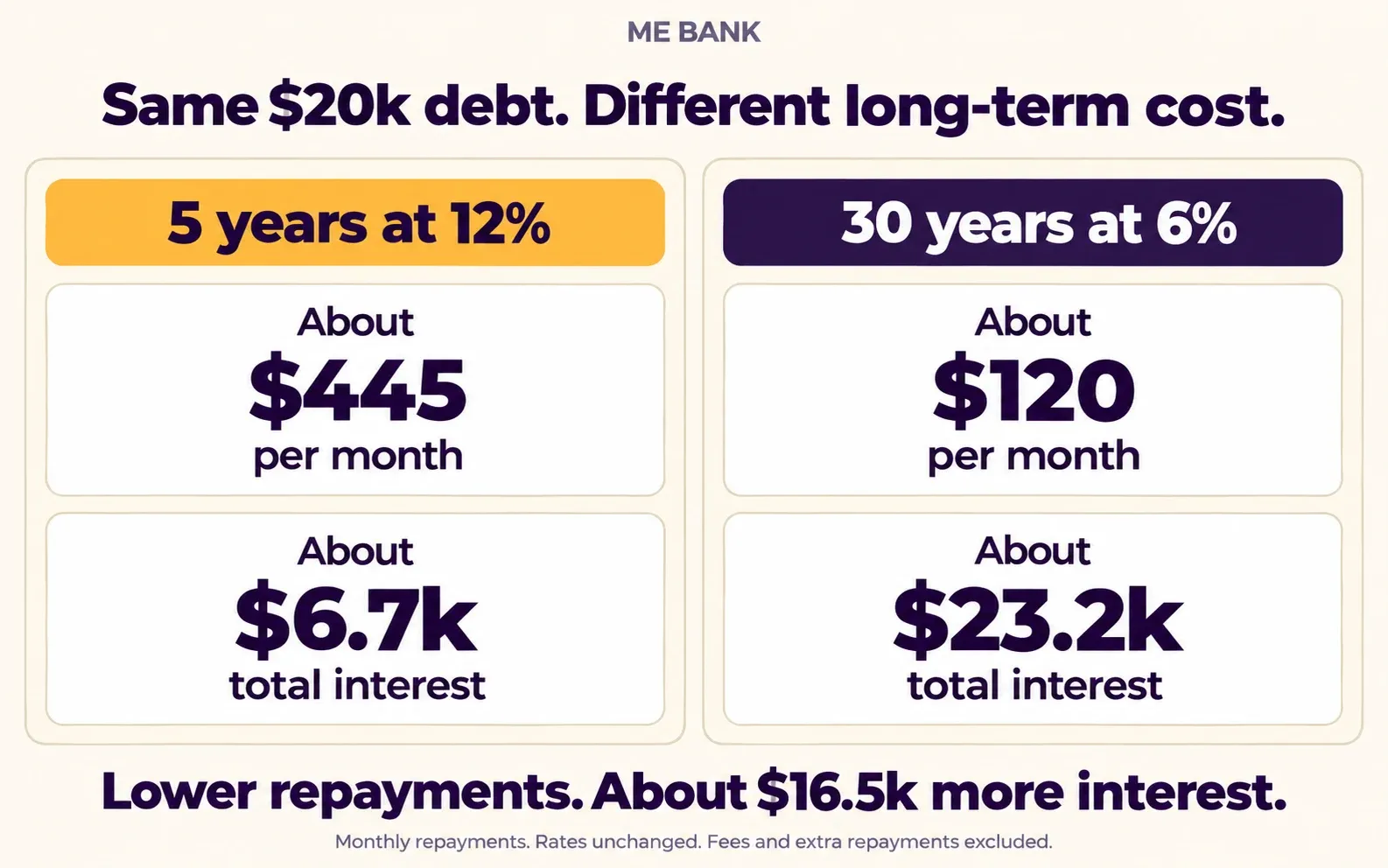
For example, repaying $20k over 5 years at 12% costs about $445 a month and $6,700 in interest. Spreading it over 30 years at 6% lowers the repayment to about $120 a month, but the interest rises to about $23.2k, about $16.5k more.
Those figures use unchanged rates and monthly repayments, with no fees or extra repayments. Your ME rate may differ. Paying the added debt off over a shorter term can reduce that interest bill.
ME Bank's borrower rules
ME's current digital home loans allow up to 2 people to borrow in their own names. You can still use eligible business income if you're a company director, sole trader, business partner or trust beneficiary.
Australian citizens and permanent residents can apply with an Australian residential address. Some temporary residents may also qualify, depending on their visa and income. Every borrower needs an Australian residential address, so the options are limited if you live overseas.
If you need the new loan in a company or trust name, have more than 2 applicants or live overseas without an Australian address, compare another lender first.
Fees and approval timing
- $395/year
CompleteME annual fee
Paid at settlement or product switch, then each year.
- $150
Settlement fee
Applies to CompleteME and EconoME.
- $750
Optional rate lock
Used to hold an eligible fixed rate for up to 90 days.
Valuation costs above ME's included allowance may also be payable. Fixed-rate early repayment charges can apply if you exceed the permitted extra repayments or break the fixed contract.
How long does ME Bank take?
- Same day
Pre-check and submission when lodged before 2pm
- +3 days
Verification and initial assessment
- +3 days
Credit review once all documents are received
ME's published service estimates, checked on 11 September 2026, suggest allowing about 6 business days after submission for the application to reach credit assessment, plus time for valuation, LMI or follow-up questions. ME says it picks up replies to its information requests within 2 business days. We'll check the current turnaround against your finance or auction deadline.
Our pre-approval guide explains why an early approval still has conditions.
ME Bank compared with alternatives
ME may suit you if it can use your business income or you'll make good use of the offsets. The annual fee, deposit and property requirements can change that decision. We'd compare the amount you can borrow and the total cost with other lenders.
Compare ME with other lenders
Scroll to see more columns
| Your situation | Why ME Bank may work | When another lender may be better |
|---|---|---|
| Keeping savings in separate accounts | Up to 10 offsets on a variable CompleteME loan | Compare the $395 annual fee with the saving you will actually make |
| Self-employed borrower | 3 ways to assess income, with full records and at least 18 months in business | Use another lender if you need low-doc lending or have a newer business |
| First-home buyer with a small deposit | An ordinary purchase may reach 95% with LMI | ME is not on the 5% Deposit Scheme panel and does not offer a guarantor loan |
| Paid parental leave or regular overtime | ME may use more of the eligible income when the evidence fits | Compare if the return-to-work plan or income history is incomplete |
| Construction or vacant land | You may be able to borrow against land you already own | ME does not offer a standard loan to buy land and pay a builder in stages |
| Small apartment or acreage | We can check the size and location limits before you make an offer | Compare another lender when the size, location, zoning or title is outside its usual limits |
- Why ME Bank may work
- Up to 10 offsets on a variable CompleteME loan
- When another lender may be better
- Compare the $395 annual fee with the saving you will actually make
- Why ME Bank may work
- 3 ways to assess income, with full records and at least 18 months in business
- When another lender may be better
- Use another lender if you need low-doc lending or have a newer business
- Why ME Bank may work
- An ordinary purchase may reach 95% with LMI
- When another lender may be better
- ME is not on the 5% Deposit Scheme panel and does not offer a guarantor loan
- Why ME Bank may work
- ME may use more of the eligible income when the evidence fits
- When another lender may be better
- Compare if the return-to-work plan or income history is incomplete
- Why ME Bank may work
- You may be able to borrow against land you already own
- When another lender may be better
- ME does not offer a standard loan to buy land and pay a builder in stages
- Why ME Bank may work
- We can check the size and location limits before you make an offer
- When another lender may be better
- Compare another lender when the size, location, zoning or title is outside its usual limits
Hunter Galloway lender rating
ME Bank broker score
The 6 categories below explain our rating.
7.2/10
Useful offsets and business-income options
Our rating across 6 categories
Score breakdown
Each category is scored out of 10
- Lending flexibilitySeveral income options, with limits on who can borrow and what the loan can fund7.0/10
- Borrowing capacityCan accept some business income, parental-leave pay and regular overtime7.5/10
- Property acceptanceWorks for standard homes but excludes several small or unusual properties6.5/10
- Product and offset featuresUp to 10 offsets, or a basic loan with no annual fee if you do not need an offset8.0/10
- Application speed and certaintyAllow around 6 business days to reach credit assessment, plus time for valuation or further questions6.5/10
- Ongoing pricing and serviceSimple app banking, but no branches and the offset costs $395 a year7.5/10

Experience and sources
How this guide was checked
Reviewed 11 September 2026 by Nathan Vecchio.
The sources below cover ME's home loans, fees, assessment times and government scheme participation. We confirm the current income and property requirements for your application before recommending a loan.

Joshua has worked in mortgage broking since 2011 and holds Diploma and Certificate IV qualifications in finance and mortgage broking.
Sources and check dates
- Detailed ME lending policy: checked 4 September 2026; not fully rechecked in this public-source update.
- ME Bank home loans: checked 11 September 2026
- CompleteME product and fees: checked 11 September 2026
- EconoME product and fees: checked 11 September 2026
- ME Bank broker service estimates: checked 11 September 2026
- Australian Government 5% Deposit Scheme participating lenders: checked 11 September 2026
- ME Bank: offset accounts, checked 15 October 2026
Rates, fees, offers and lending requirements can change.
How are we paid?
The lender pays us commission, which we disclose before you proceed. We compare more than 30 lenders and must put your interests first. Our Brisbane team can compare ME with other lenders and explain what the differences mean for your loan.
More help with your home loan
LMI waivers
Compare professions, deposits and lender rules.
Read guideSelf-employed home loans
Compare income records and lender options.
Read guideGuarantor home loans
Understand the family arrangement and risks.
Read guideOffset accounts
Work out how an offset could help.
Read guide5% Deposit Scheme
Check eligibility and participating lenders.
Read guideBridging loans
Plan buying before selling.
Read guide
ME Bank home loan FAQs
Want to know whether ME Bank fits your situation?
Tell us about your income and the property you're considering. We can work out what ME may lend and compare the repayments, fees and other options.
or call 1300 088 065
Hunter Galloway Finance Pty Ltd, Credit Representative 476903, is authorised under Australian Credit Licence 389328. General information only; policies, rates and fees can change and your full financial situation would need to be reviewed before any offer or product is accepted.