


Client story
Harriet wanted to keep her children in their school zone
Harriet was a school counsellor and the main carer for her children. She wanted to keep the family home so the kids could stay at the same school.
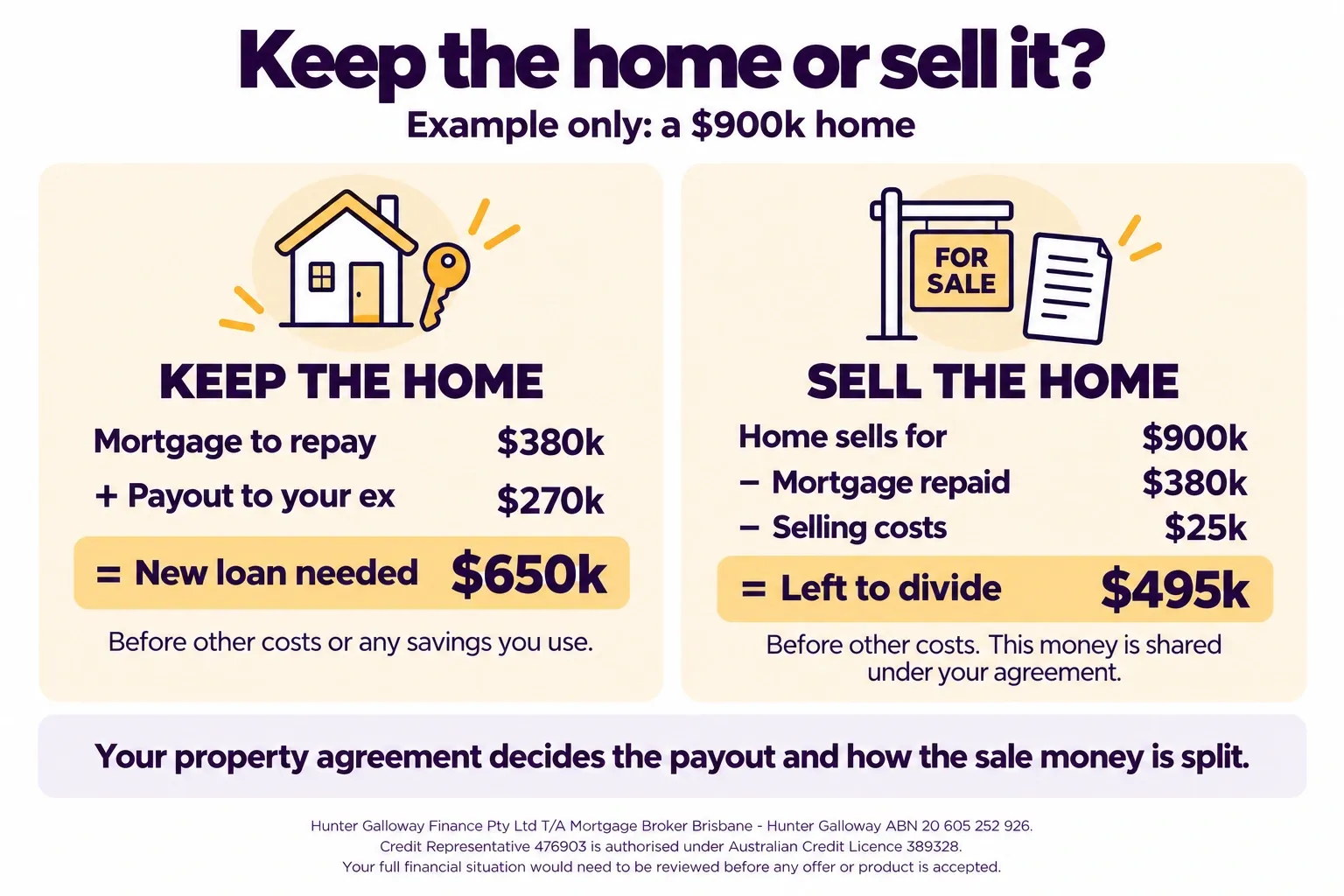
Once we added the old mortgage and the amount going to her ex-partner, Harriet needed a new loan of about $650k in her name.
Her bank said the loan did not work on its first assessment. I checked the signed agreement, what Harriet would earn after separation, the debts she would keep and her normal living costs. Then I tested the loan with a lender that could use that information properly.
The $650k refinance was approved and settled with the agreed payout. Harriet kept the family home, so her children could stay in their school zone.
The short answer
For the keep option, calculate the new loan and monthly repayment. For the sell option, calculate what may be left after the mortgage and selling costs, then allow for rent or the next purchase. Use the income and expenses you expect after separation for both.
What numbers should you use for both options?
Compare both options using the same property estimate and the income and expenses you expect after separation. Keep the sale proceeds separate from the amount you personally receive under the property agreement.
| Question | Keep | Sell |
|---|---|---|
| Home loan | Current mortgage plus agreed payout and known finance costs | The mortgage is paid out from the sale |
| Housing cost | New repayment plus rates, insurance and upkeep | Rent or the repayment on the next purchase |
| Cash outcome | Your share stays tied up in the home | Cash left after the mortgage, selling costs and agreed split |
| Timing | The new loan, payout and ownership change need to happen in the right order | The sale, move and next purchase may overlap |
What numbers should you use for both options?
Home loan
- Keep
- Current mortgage plus agreed payout and known finance costs
- Sell
- The mortgage is paid out from the sale
Housing cost
- Keep
- New repayment plus rates, insurance and upkeep
- Sell
- Rent or the repayment on the next purchase
Cash outcome
- Keep
- Your share stays tied up in the home
- Sell
- Cash left after the mortgage, selling costs and agreed split
Timing
- Keep
- The new loan, payout and ownership change need to happen in the right order
- Sell
- The sale, move and next purchase may overlap
Use our property buyout guide and calculator for your own figures, then compare repayments with the mortgage repayment calculator.
Can you afford the home on your own?
The new loan can be much larger than the old mortgage once the amount going to your ex-partner is added. The lender will check the whole loan using the income, debts and living costs you will have after separation.
Include child support paid, any income the lender may use, dependants, childcare, school costs, card limits and every joint debt that is still open.
If the budget is too tight, you may need to discuss a different payout, what happens to the property or a longer timeframe. Those are legal and personal decisions. Checking the budget first helps you see the pressure before committing to an agreement.
What would selling leave you with?
Start with the expected sale price and subtract the mortgage payout and selling costs. The remaining amount still has to be divided under the property agreement. The agreement may also deal with other assets and debts.
Allow for the cost of your next home too. Renting may need bond, advance rent and moving costs. Buying again needs a deposit, purchase costs, an acceptable property and another loan application.
Timing can change the answer as much as the sale price. If the next purchase has to settle before the former home sells, the cash may not be available yet. If the sale happens first, temporary rent and moving twice may need to be included.
I compare the cash left after selling with what you need for your next home. That shows whether you can cover the move and next housing costs when they fall due.
For a single-parent purchase, our home loan guide for single mothers explains the deposit, income, child support and government-scheme questions.
If you are also considering moving out and renting the former home to tenants, our sell or keep it as a rental guide covers vacancies, repairs and the cost of holding both properties. Get legal and tax advice about the separation before relying on that option.
If you can't agree on selling, or on who pays the mortgage in the meantime, ask your family lawyer. Our separation guide explains what the lender expects from both borrowers until the loan changes.
If the home was your main residence, a transfer under a court order or binding financial agreement usually rolls over for capital gains tax, and the main residence exemption may still apply. If you rent it out first, that can change. Your accountant should confirm.
Try more than one property value
A higher bank valuation can make the new loan easier, because the loan is smaller compared with the home's value. But if your property agreement also uses a higher value, the agreed payout may increase, which can mean a larger loan.
A lower value can reduce the payout but make the new loan harder. That is why I test a reasonable range before the agreement becomes hard to change. The value used for the separation and the value accepted by the lender may not be the same.
I would also test a slightly higher repayment and one unexpected home cost to see whether you could still afford the home if the first estimate is a little off.
What should you have ready?
- current mortgage balance and all joint limits
- agreed or proposed payout
- property-value range and who obtained each figure
- post-separation income, support and household costs
- monthly rates, insurance, maintenance and body corporate if relevant
- likely selling, moving and next housing costs
- where the legal documents are up to and the date a decision is needed
Frequently asked questions
Experience and sources
How this guide was checked
The public sources below explain separation, tax and transfer-duty questions to discuss with your advisers. The comparison does not determine your legal settlement or guarantee a loan.

Jayden Vecchio is a mortgage broker at Hunter Galloway. Hunter Galloway Finance Pty Ltd is Credit Representative 476903, authorised under Australian Credit Licence 389328.
Sources
General information only. Loan approval, legal documents, transfer duty and tax treatment depend on your circumstances. State revenue guidance applies to the jurisdiction named. Obtain legal and tax advice before agreeing to a property transfer.
Related guides
- Start here
Divorce and separation home loans
Compare keeping the home, selling and buying elsewhere.
Read guide - Start here
Calculate a property buyout
Work out the loan and cash needed to keep the home.
Read guide - Related guide
Home loans for single mothers
Low deposit and income options for a single parent household.
Read guide - Related guide
Using child support for a home loan
Check the payment history and documents a lender may need.
Read guide - Related guide
Consent orders and your home loan
Coordinate the legal documents, loan approval and settlement date.
Read guide - Related guide
Joint debts and your credit file
Check joint accounts, missed repayments and errors before applying.
Read guide - Related guide
Home loans during parental leave
How a return to work date and employer letter may help.
Read guide - Related guide
Changing a borrower or owner
What happens when someone needs to come off the loan or title.
Read guide - Related guide
Bad credit home loans
Start with what is on the credit file and the evidence behind it.
Read guide - Useful calculator
Home equity calculator
Estimate the difference between the property value and the loan still owing.
Open calculator - Useful calculator
Mortgage repayment calculator
Compare repayments using your loan amount, rate and preferred term.
Open calculator - Related guide
Sell or rent out your home
Read guide
Compare keeping and selling with your own numbers
We can check the proposed loan, monthly housing costs and sale position before you commit to a property outcome with your lawyer.
or call 1300 088 065
Your full financial situation would need to be reviewed before any offer or product is accepted.
About this information: General information only. It is not legal, tax, financial or credit advice. The property agreement, costs, valuation and loan assessment depend on the complete circumstances.
Client examples are based on real situations. Names and identifying details have been changed.