


Why Pepper can stand out
- 01 / Self-employed
There are several ways to show your income
Pepper has full-doc and alt-doc options. Some borrowers can use 1 year of financials, while eligible Specialist applications can start with a 6-month ABN.
- 02 / Credit history
The details of your credit history matter
A small paid default is different from a recent missed mortgage repayment. Pepper’s 5 tiers let us check the actual issue and the price of dealing with it.
- 03 / Deposit options
Your deposit can come from more than savings
Genuine savings are not required across the home-loan tiers. A family gift or another accepted source may help, but the money still needs to be documented.
Is Pepper Money a bank?
Pepper Money is a non-bank lender that can be worth a look if your income or credit history makes getting a home loan difficult. You manage your loan online or over the phone, so you’ll need to be comfortable without a branch to visit.
Its home-loan range has 5 tiers: Prime, Near Prime Clear, Near Prime, Specialist and Specialist PLUS. Each has different income, credit and borrowing limits. We’ll check which one fits your situation and compare it with other lenders.
Pepper Money also backs Connective Solutions. If that name appears on your quote, our Connective Home Loans review explains how it fits into the wider range. Check the particular rate, fees and features rather than assuming it is the same as a Pepper-branded loan.
Which Pepper tier could fit your credit history?
The tier affects both the price and the deposit you need. We look at the credit report, dates and amounts, then check how you have managed repayments since the problem occurred.
Which credit tier could fit?
Scroll to see more columns
| Tier | Credit issues it can consider | What matters |
|---|---|---|
| Prime | Paid defaults up to $500 | The cleanest-credit option in Pepper’s range |
| Near Prime Clear | Paid or unpaid defaults up to $1k | Tighter credit limits than Near Prime; discharged bankruptcy is not listed for Clear |
| Near Prime | Defaults, judgements and writs up to $3k; larger listings more than 24 months old | Discharged bankruptcy can be considered from 1 day after discharge, subject to the remaining rules |
| Specialist | More recent adverse credit and missed repayments | Larger listings generally need more than 12 months’ history; the mortgage repayment record needs its own check |
| Specialist PLUS | More serious recent credit events and mortgage arrears | Lower loan and LVR limits, with lending restricted to Category 1 and 2 locations |
- Credit issues it can consider
- Paid defaults up to $500
- What matters
- The cleanest-credit option in Pepper’s range
- Credit issues it can consider
- Paid or unpaid defaults up to $1k
- What matters
- Tighter credit limits than Near Prime; discharged bankruptcy is not listed for Clear
- Credit issues it can consider
- Defaults, judgements and writs up to $3k; larger listings more than 24 months old
- What matters
- Discharged bankruptcy can be considered from 1 day after discharge, subject to the remaining rules
- Credit issues it can consider
- More recent adverse credit and missed repayments
- What matters
- Larger listings generally need more than 12 months’ history; the mortgage repayment record needs its own check
- Credit issues it can consider
- More serious recent credit events and mortgage arrears
- What matters
- Lower loan and LVR limits, with lending restricted to Category 1 and 2 locations
Specialist PLUS can consider multiple listings arising from a single credit event within the last 12 months. We’ll need to explain what happened, show how you’re managing repayments now and check whether the new loan is affordable.
Our bad credit home loans guide covers the wider options. The guides to paid and unpaid defaults and discharged bankruptcy explain why the details can change the lender shortlist.
Self-employed? You may have more ways to show your income
We’ll check whether you qualify for a full-doc loan before looking at alt-doc. Prime normally asks for 2 years of financials. Near Prime Clear has a 1-year option, and Near Prime can also use 1 year where the credit history is clear. If you provide earlier financials, Pepper will look at those too.
For an alt-doc loan, you declare your financial position and provide documents to back it up. That can be 6 months of business bank statements, 6 months of BAS or Pepper’s accountant letter, depending on the tier and business history.
How long must your business have been trading?
Scroll to see more columns
| Alt-doc tier | ABN history | GST history, where required |
|---|---|---|
| Prime / Near Prime Clear | 24 months | 12 months |
| Near Prime with clear credit | 12 months | 6 months |
| Near Prime without clear credit | 24 months | 12 months |
| Specialist | 6 months | 6 months |
| Specialist PLUS | 12 months | 12 months |
An accountant’s letter is not accepted if the ABN is less than 12 months old, or for Specialist PLUS. You’ll need the accepted BAS or business bank statements instead. The amount you want to borrow also affects whether Pepper will accept an accountant’s letter, so we’ll check that before asking you to arrange one.
For full-doc business income, we start with the profit and check eligible adjustments, such as directors’ wages, depreciation, interest on debts being refinanced and super contributions above 12%. We’ll need evidence for each adjustment and will check that the same income hasn’t been counted twice.
Our low-doc loans guide and self-employed home loans guide explain how to prepare the evidence. If your ABN is new, we’ll check the business history and documents Pepper needs before you apply.
Overtime, a second job and other income
How your income is assessed
Scroll to see more columns
| Income type | What Pepper checks |
|---|---|
| Casual or second job | Prime and Specialist PLUS require 12 months with the current employer. Near Prime Clear, Near Prime and Specialist use 6 months with the current employer and 18 months in the industry |
| Bonus or commission | Prime generally uses 2 years; other tiers look for 12 months. We’ll check how much of that income Pepper will count |
| Overtime | 100% where it is a condition of employment; otherwise 50% where regular for 6 months with the same employer |
| Allowances | Eligible allowances can be included at 100%, with evidence that you receive them |
| Interest and dividends | 100% may be used with 2 years of consistent income; capital gains are excluded |
| Foreign PAYG income | Available on eligible non-conforming loans for Australian residents, with income paid into an Australian bank account by the employer |
- What Pepper checks
- Prime and Specialist PLUS require 12 months with the current employer. Near Prime Clear, Near Prime and Specialist use 6 months with the current employer and 18 months in the industry
- What Pepper checks
- Prime generally uses 2 years; other tiers look for 12 months. We’ll check how much of that income Pepper will count
- What Pepper checks
- 100% where it is a condition of employment; otherwise 50% where regular for 6 months with the same employer
- What Pepper checks
- Eligible allowances can be included at 100%, with evidence that you receive them
- What Pepper checks
- 100% may be used with 2 years of consistent income; capital gains are excluded
- What Pepper checks
- Available on eligible non-conforming loans for Australian residents, with income paid into an Australian bank account by the employer
Pepper does not lend to expats or accept foreign self-employed income. If your income changes from month to month, we’ll check how long you’ve been earning it and how much Pepper will count.
A different assessment buffer may help
Pepper’s standard home-loan assessment uses the higher of 5.50% or 2% above the actual rate. Some eligible Prime and Near Prime Clear applications at up to 80% LVR may qualify for a 1% buffer under specific purchase, refinance or fixed-rate conditions. We’ll run your figures through Pepper’s calculator to see which buffer applies.
For example, at an actual rate of 7%, the standard 2% buffer means testing repayments at 9%. That can produce a different result from a lender using 3% above the actual rate, but your income, expenses and debts still need to cover the assessment. Loans above 90% LVR also face a stronger surplus-income test.
Applying on your own with joint debts?
If you’re applying on your own, Pepper may count 50% of eligible debts you share with your spouse. Your spouse still needs to provide details of their income, assets, debts and living expenses, and your household needs to pass Pepper’s affordability checks. Both of you remain legally responsible for any joint debts.
Our mortgage calculator provides an initial borrowing estimate. We can then check how much Pepper would lend you.
How much deposit or equity will you need?
The deposit you need depends on your loan tier, income documents and property. LVR is the percentage of the property’s assessed value you borrow. The table shows the maximum for each option; we’ll check the limit for your application.
How much deposit or equity will you need?
Scroll to see more columns
| Tier | Full-doc purchase / refinance | Alt-doc purchase / refinance |
|---|---|---|
| Prime | 95% purchase, with LPF potentially added up to 98%; refinance up to 95% including fees | 95% / 95% |
| Near Prime Clear | 95% purchase, with LPF potentially added up to 98%; refinance up to 95% including fees | 90% / 90% |
| Near Prime | 95% / 90% | 85% / 80% |
| Specialist | 95% / 85% | 85% / 80% |
| Specialist PLUS | 80% / 80% | 75% / 75% |
- Full-doc purchase / refinance
- 95% purchase, with LPF potentially added up to 98%; refinance up to 95% including fees
- Alt-doc purchase / refinance
- 95% / 95%
- Full-doc purchase / refinance
- 95% purchase, with LPF potentially added up to 98%; refinance up to 95% including fees
- Alt-doc purchase / refinance
- 90% / 90%
- Full-doc purchase / refinance
- 95% / 90%
- Alt-doc purchase / refinance
- 85% / 80%
- Full-doc purchase / refinance
- 95% / 85%
- Alt-doc purchase / refinance
- 85% / 80%
- Full-doc purchase / refinance
- 80% / 80%
- Alt-doc purchase / refinance
- 75% / 75%
For eligible loans, Pepper may lend 95% towards the purchase and add the Lender Protection Fee, bringing the total loan to 98%. You’ll still need your deposit and buying costs. Larger loans and credit issues can mean you need more deposit.
Your deposit doesn’t have to come from money you’ve saved over time. Pepper can consider a gift, sale proceeds or other accepted funds, with documents showing where the money came from. If you’ve borrowed part of the deposit, Pepper will count those repayments too. Use our deposit calculator to allow for the costs as well as the deposit.
Your postcode can affect the loan limit and fees
Pepper groups postcodes into 5 categories. Categories 1 to 4 can qualify within the loan’s limits; Category 5 is excluded. If your property is in Category 3 or 4, we’ll check the actual borrowing limit rather than applying a blanket 80% or 70% cap.
For Prime and Near Prime Clear, Category 3 and 4 locations require a custom Lender Protection Fee calculation. Specialist PLUS is limited to Category 1 and 2. The exact address and property type can still reduce the maximum, so check them before committing to a contract.
Lender Protection Fees and the current promotion
Pepper uses a Lender Protection Fee, or LPF, rather than standard lenders mortgage insurance. It protects the lender, not you. A loan without LMI can still have a sizeable upfront risk charge, so ask for the LPF in dollars.
Prime Alt Doc also has a standard 0% LPF when you borrow 80% or less of the property value. Some postcodes, larger loans and units need a separate fee calculation, so we’ll check the amount for your property.
What fees will you pay?
Scroll to see more columns
| Standard home-loan fee | Prime | Near Prime Clear / Near Prime | Specialist / Specialist PLUS |
|---|---|---|---|
| Establishment, including 1 standard valuation | $599 | $995 | $995 |
| Monthly administration | $10 per split | $15 per split | $15 per split |
| Title protection | $0 | $0 | $400 per loan |
| Discharge | $500 per loan | $500 per loan | $500 per loan |
Legal fees start at $330 including GST, plus separate costs paid to third parties. Construction and vacant-land loans have different charges: their listed establishment fees are $999 for Prime and $1.2k for Near Prime. Ask for a complete quote for the product you are actually using.
Monthly fees are charged per split. For example, 2 Near Prime splits at $15 each cost $30 a month, or $360 a year. We’ll include that cost when comparing loans.
Offset, fixed rates and loan terms
Eligible variable loans have a 100% offset sub-account. Fixed-rate loans do not. Pepper allows up to 4 splits, including the offset sub-account split, so check the structure and account charges before deciding how to divide the loan.
For a construction loan, offset becomes available after the build rather than during progress payments. On a fixed home loan, Pepper says extra repayments can be accessed through redraw after the fixed period ends.
Fixed home loans without break costs
Pepper advertises fixed terms of 2, 3, 5, 7 or 10 years with no break costs or early repayment fees on its fixed home loans. That can be useful if you want repayment certainty but might need to sell or change the loan. You may still pay discharge and other loan fees.
After formal approval, you can request a 90-day rate lock. It costs $750 where the fixed balance is up to $500k, or 0.15% of the fixed loan balance at settlement for larger loans. Check the non-refundable fee and timing before paying. SMSF loans have a separate early-repayment fee, explained below.
A longer term lowers repayments, but adds interest
Home-loan terms range from 10 to 40 years across the tiers. A 40-year term can reduce the required monthly repayment while increasing the total interest paid. It also needs to fit your age and repayment plan.
Interest-only is limited to 5 years, followed by principal and interest, with a maximum overall term of 30 years. Fixed interest-only options use 2, 3 or 5-year periods that match the fixed term. Check the repayment after interest-only finishes, not just the initial amount.
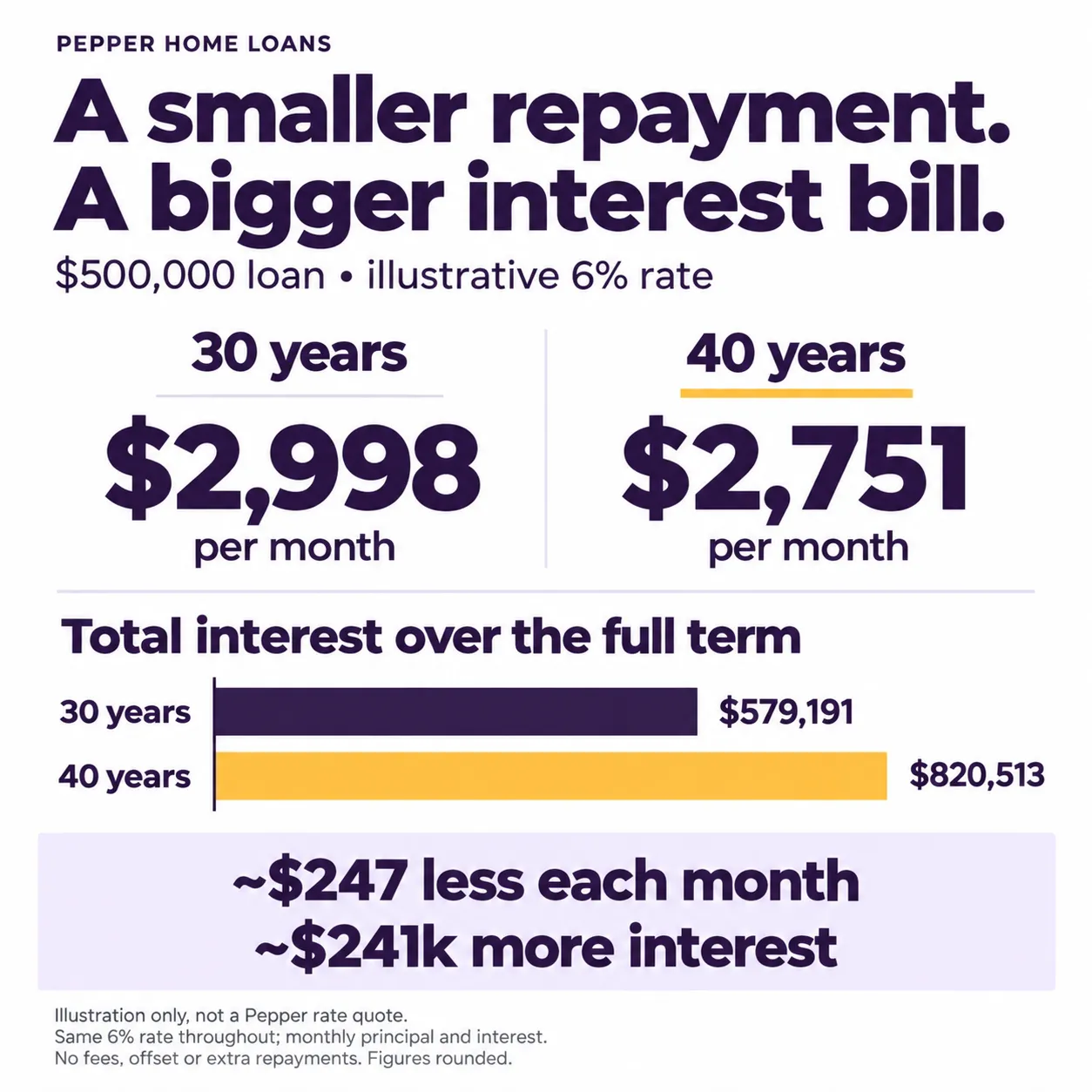
Illustration only, not a Pepper rate quote. This $500,000 example assumes monthly principal-and-interest repayments, the same 6% rate throughout, and no fees, offset or extra repayments. Figures are rounded. Lending criteria apply.
Refinancing debts, including an ATO balance
Which debts can you refinance?
Scroll to see more columns
| Tier | Debt and cash-out differences |
|---|---|
| Prime | Consumer debt consolidation can be considered, but tax and business debts are excluded. Cash out is not available for business use |
| Near Prime Clear | ATO debt can be considered where it is not overdue or is on a payment plan; business-use cash out may be available |
| Near Prime | Broader debt consolidation and business-use cash out; an ATO balance left in place needs an acceptable plan |
| Specialist / Specialist PLUS | Broader ATO payout options, with the full credit and affordability assessment still required |
- Debt and cash-out differences
- Consumer debt consolidation can be considered, but tax and business debts are excluded. Cash out is not available for business use
- Debt and cash-out differences
- ATO debt can be considered where it is not overdue or is on a payment plan; business-use cash out may be available
- Debt and cash-out differences
- Broader debt consolidation and business-use cash out; an ATO balance left in place needs an acceptable plan
- Debt and cash-out differences
- Broader ATO payout options, with the full credit and affordability assessment still required
Pepper can consider refinancing private and solicitor loans too. We’ll look at your current loan, repayment history and what you need the money for, then check whether you can afford the combined repayments.
Consolidating debt can reduce the number of repayments and sometimes the monthly amount, but spreading short-term debt over a mortgage can increase total interest. It also secures the debt against your home. Where possible, compare keeping a shorter repayment schedule for the amount being consolidated.
Our guides to ATO tax debt loans and refinancing with bad credit explain what to prepare.
Can Pepper help you build?
Pepper has full-doc and alt-doc construction loans. The rates, fees and borrowing limits differ from its standard home loans, so we’ll compare the options for your build.
What can you build?
Scroll to see more columns
| Point to check | Construction limit |
|---|---|
| Full-doc / alt-doc LVR | Up to 95% full-doc or 85% alt-doc |
| Loan amount | Up to $2m, reducing at higher LVRs; alt-doc above 80% is capped at $1m |
| Near Prime alt-doc construction | Maximum $1m |
| Location and land size | Category 1 or 2, with no more than 5 acres |
| Cash out or debt consolidation | Not available as part of the construction loan |
- Construction limit
- Up to 95% full-doc or 85% alt-doc
- Construction limit
- Up to $2m, reducing at higher LVRs; alt-doc above 80% is capped at $1m
- Construction limit
- Maximum $1m
- Construction limit
- Category 1 or 2, with no more than 5 acres
- Construction limit
- Not available as part of the construction loan
Vacant residential land is a separate option: Category 1 or 2, up to 5 acres and a maximum 85% LVR. The loan cap is $1.5m up to 75% LVR, or $1m above 75% and up to 85%. Separate rates and fees apply.
Building your own home and financing a development need different loans. Pepper’s commercial loans don’t cover commercial construction. It has separate, restrictive rules for borrowing against completed, unsold properties, so we’ll check those separately if that’s what you need.
Check the property before relying on a loan limit
Pepper’s standard residential policy excludes heritage-listed buildings, relocatable or mobile homes, studio and serviced apartments, resort complexes, retirement villages and bedsits. If you’re looking at acreage, we’ll check the zoning and how the land is used. A residential lifestyle block and a working farm have different requirements.
Commercial property needs the separate commercial product. You can’t use a standard home loan for a hotel, motel, club, caravan park, vineyard or farm. We’ll check the property as well as your income before recommending a loan.
SMSF lending after 10 August 2026
Pepper’s current residential SMSF product is refinance-only, for properties the fund acquired before 10 August 2026. It is not available for a new residential purchase. Borrowing for eligible business real property remains a separate option.
There are legal exceptions for existing borrowing and certain earlier arrangements. Your accountant and solicitor should check how those apply to your fund. We’ll then check whether Pepper offers the loan you need.
SMSF loan features and costs
Scroll to see more columns
| Point to check | Current SMSF product |
|---|---|
| Trustee and fund | Corporate trustee only, with at least $150k in fund assets |
| Residential refinancing | Up to 90% full-doc or 80% alt-doc, with loan-size limits reducing as the loan percentage rises |
| Commercial SMSF | Up to 80% LVR; Prime has a $5m product ceiling, but that amount is not available at every LVR |
| Term | 10 to 30 years; up to 5 years interest-only before principal and interest |
| Cash out or debt consolidation | Not available |
| Early repayment fee | 2% of the initial loan amount if repaid within the first 3 years |
- Current SMSF product
- Corporate trustee only, with at least $150k in fund assets
- Current SMSF product
- Up to 90% full-doc or 80% alt-doc, with loan-size limits reducing as the loan percentage rises
- Current SMSF product
- Up to 80% LVR; Prime has a $5m product ceiling, but that amount is not available at every LVR
- Current SMSF product
- 10 to 30 years; up to 5 years interest-only before principal and interest
- Current SMSF product
- Not available
- Current SMSF product
- 2% of the initial loan amount if repaid within the first 3 years
On a $500k SMSF loan, a 2% early-repayment fee would be $10k. That is a different product from Pepper’s fixed home loans without break costs, and it can change whether a refinance makes sense.
Pepper also has an eligible like-for-like SMSF refinance option using 6 months of satisfactory repayments, a lower repayment or rate, and up to 80% LVR. The loan amount is limited to the existing debt plus set-up fees. A current Prime residential application-fee promotion runs until 12 November 2026, subject to its conditions.
Commercial loans have their own limits
Pepper offers full-doc and alt-doc commercial property loans up to $5m, depending on the property and loan tier. If you need to borrow 80% of the property value, the published metro limit is $2.5m. Other locations or tiers can have lower limits.
Commercial and SMSF loans have separate valuation, legal, fee and security requirements. We’ll get a separate quote for these loans because the standard home-loan fees don’t carry over.
How long does a Pepper application take?
Pepper advertises approval within 2 to 3 business days for eligible home-loan applications. Income checks and valuations can add time. We’ll check the current turnaround before you agree to a finance date and allow time for the loan documents and settlement.
How basic is Pepper’s online banking?
Online banking is a weak point for Pepper. It has a loan portal, but I’d describe the experience as basic compared with a bank. There’s no branch network or full everyday banking service. If you use your offset regularly, we’ll check how you’ll move money between Pepper and your everyday bank before you commit.
I’d choose Pepper because it can help with a borrowing problem, not for its online banking. If you already qualify with a bank, its fees and day-to-day account access need a close comparison.
How does Pepper compare with other lenders?
Compare your lender options
Scroll to see more columns
| Your situation | Why Pepper might fit | What we compare |
|---|---|---|
| Short business history or alternative income evidence | Several full-doc and alt-doc options | The accepted income, deposit, fees and rate at other lenders |
| Defaults, arrears or discharged bankruptcy | A choice of specialist credit tiers | The actual tier and loan limit, rather than a generic “bad credit” quote |
| Tax debt or business-use equity | Available on eligible non-Prime options | The long-term cost and whether the proposed debt treatment fits |
| Straightforward borrower | Prime and eligible LPF promotions may be worth comparing | Whether a bank offers a lower total cost or better everyday features |
| Fixing the rate | No break costs on the fixed home-loan product | The rate loading and loss of offset during the fixed period |
- Why Pepper might fit
- Several full-doc and alt-doc options
- What we compare
- The accepted income, deposit, fees and rate at other lenders
- Why Pepper might fit
- A choice of specialist credit tiers
- What we compare
- The actual tier and loan limit, rather than a generic “bad credit” quote
- Why Pepper might fit
- Available on eligible non-Prime options
- What we compare
- The long-term cost and whether the proposed debt treatment fits
- Why Pepper might fit
- Prime and eligible LPF promotions may be worth comparing
- What we compare
- Whether a bank offers a lower total cost or better everyday features
- Why Pepper might fit
- No break costs on the fixed home-loan product
- What we compare
- The rate loading and loss of offset during the fixed period
For a standard bank comparison, read NAB, Westpac, St George, Macquarie, UBank and ME Bank. Our lender review hub includes other non-bank options too.
We’ll explain which Pepper tier fits your situation and what it costs. If you’re hoping to refinance later, we’ll discuss what would need to change for you to qualify. The loan still needs to be affordable now.
Hunter Galloway lender rating
Pepper broker score
We rate Pepper more highly for helping with difficult income and credit situations than for everyday service. Basic online banking, specialist loan costs and property restrictions bring our overall score down.
6.9/10
Useful for the right application
Our rating across 6 categories
Score breakdown
Each category is scored out of 10
- Credit policy fitA broad range of credit tiers for defaults, arrears and discharged bankruptcy.8.5/10
- Borrowing capacityDifferent ways of showing your income may help you borrow more.8.0/10
- Property optionsConstruction and separate commercial lending add options, but residential exclusions and location rules matter.6.0/10
- Product and offset featuresVariable offset and fixed home loans without break costs; no offset on fixed portions.7.5/10
- Application speed and certaintyStraightforward applications may move quickly; complicated income or a valuation can take longer.6.5/10
- Ongoing pricing and serviceBasic online banking and no branch network. Specialist pricing, risk fees and monthly charges for each split also add to the cost.5.0/10

Experience and sources
How this guide was checked
We checked this guide against Pepper Money’s product guide effective 21 August 2026 and its rates and fees guide effective 17 September 2026, along with its broker lending guidelines and public loan information. The review covers fees, income documents and online account access.

I’ve worked in mortgage broking since 2011 and hold Diploma and Certificate IV qualifications in finance and mortgage broking.
Sources
- Pepper home-loan product and policy documents
- Pepper SMSF product documents
- Fixed home-loan features, rate lock and fees
- Government 5% Deposit Scheme participating lenders
- SMSF borrowing changes: Schedule 5 of the 2026 Act
- Pepper’s product guide (21 August 2026) and rates and fees guide (17 September 2026).
- Pepper online loan-account access
Confirm the current tier, pricing, fees and promotion conditions before applying. Construction, commercial and SMSF products have separate terms.
What home buyers say about us
 Google
“Clear, incredibly responsive and accurate.”
- Google
“Preapprovals done quickly and efficiently.”
- Google
“Reassuring every step of the way.”
More help with your home loan
Bad credit home loans
Understand the issues lenders assess.
Read guideLow-doc loans
Compare the alternatives to full tax returns.
Read guideSelf-employed home loans
Prepare the income evidence for your business.
Read guideATO tax debt
Understand the options for an outstanding tax balance.
Read guideDeposit calculator
Allow for fees and buying costs.
Open calculatorLender reviews
Compare lenders against your situation.
Read guide
Pepper Money home loan FAQs
The practical questions to check before choosing a tier.
Our Brisbane mortgage brokers can compare Pepper with other lenders based on your income, deposit and plans.
Want to know whether Pepper fits?
Tell us about your income, credit history and property. We can check the options and compare the loans available through our panel.
or call 1300 088 065
Hunter Galloway Finance Pty Ltd is Credit Representative 476903, authorised under Australian Credit Licence 389328.