


Client story
Abby's court timetable did not fit her finance clause
Abby had signed a purchase contract while funds from her separation remained in solicitor trust and her consent orders were still moving through the court process.
She had 14 days to meet the finance clause. The court process was likely to take longer, so I checked the bank's document requirements and what proof it needed for the money held in trust before the deadline expired.
We got Abby's $488k loan approved on day 11. Her sealed orders arrived later, before settlement.
That was the result for Abby's application. It does not mean signed draft orders are generally enough. The bank's conditions, legal documents and dates still need to be checked before accepting a short finance deadline.
The short answer
You can start checking the finance before consent orders are final. The loan, legal documents and settlement date still need to work together. I would test the borrowing first, then confirm exactly what the chosen lender needs before approval and settlement.
What needs to be agreed before the loan can settle?
Property agreement
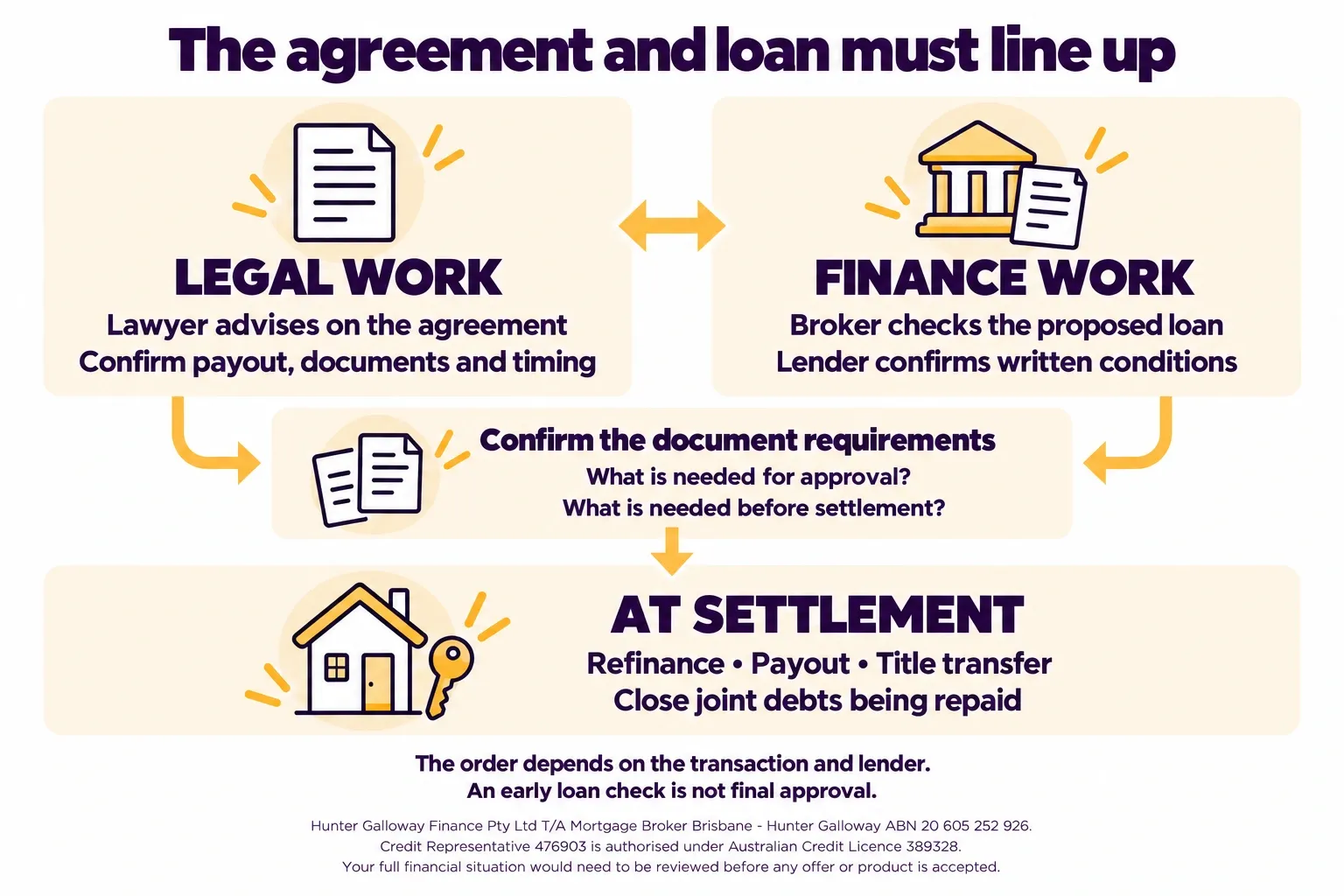
Your family lawyer advises on who keeps or sells the property, the agreed payout and the timing.
Loan decision
The lender checks the proposed loan, borrower, income, liabilities and property against its requirements.
Completing the settlement
Your lender and conveyancer coordinate the discharge, new loan, payout, title change and required documents.
Duty and tax position
Whether any relief or rollover applies to the actual transfer. Obtain legal and tax advice.
Which should come first: the finance or the consent orders?
- Check the likely loanWork out the new loan, valuation range and income and debts after separation.
- Have the legal terms drafted with adviceTell your lawyer which parts of the proposed agreement depend on finance. Your lawyer advises on the legal document.
- Confirm the lender's written conditionAsk which document is required for approval, which is required for settlement, and whether the lender will control how the money is paid out.
- Protect contract deadlinesAsk your solicitor about a finance clause and settlement period that allow for the court, lender and release of trust funds.
- Coordinate settlementCoordinate the payout, refinance, title transfer and closure of any joint debts being repaid.
Which legal document will your lender need?
A lender may ask for consent orders, a binding financial agreement, a court order, evidence of funds in trust, a solicitor undertaking or another condition. The documents can differ with the transaction and selected lender.
Consent orders and a binding financial agreement are different legal paths. A family lawyer should advise which is appropriate and whether the document properly deals with the property transfer.
Can the loan be checked before the orders are final?
You can test the finance before the final legal step. I can estimate the new loan, check the post-separation income and debts, arrange an early valuation where useful and identify which loan conditions depend on the final document.
I give your lawyer a short list of what the loan depends on. For example, the refinance may only work if the payout stays below the amount we tested, a joint card is closed, the valuation reaches the required figure and the lender receives the signed document it asked for before settlement. Your lawyer can then see which parts of the proposal depend on finance without having to interpret lending policy.
If the numbers do not work, finding out early gives everyone a chance to consider a different payout, sale, property target or timetable. That is safer than signing terms first and hoping the bank finds a way to make them fit.
The legal agreement does not change the loan by itself
An agreement between you and your former partner does not, by itself, release either borrower from the loan. The lender usually needs to agree to the change. Some court orders can bind a lender, so ask your lawyer how any order affects the bank and your liability.
For a buyout, the guide to calculating a co-owner payout and total new loan explains the finance maths and includes the calculator. Your solicitor or conveyancer should confirm the title transfer, duty position and settlement sequence.
Before settlement, I check that the mortgage payout, new loan, agreed payment to your former partner and title instructions all match. Otherwise, the conveyancer may be left waiting for money, or the lender may ask for another document on settlement day.
Transfer duty relief may apply, but the rules depend on where the property is and how the transfer is documented. For a Queensland property, the Queensland Revenue Office's matrimonial exemption guidance sets out the requirements. In Queensland, the exemption generally needs the sealed court order or financial agreement, lodged with the transfer. An informal agreement usually won't qualify. Ask your solicitor or conveyancer to confirm the treatment of your transfer.
If child support is part of your income, check the payment evidence your lender may need before relying on it in your loan estimate.
If joint debts are still open, our guide to separation and your credit file explains what to check before applying again.
What should you have ready?
- what you want to happen to the home and the proposed payout
- property-value range and current mortgage
- post-separation income, expenses and liabilities
- document type and current status, using the lawyer's description
- finance, court and settlement dates
- where settlement funds are held and how they can be released
- the exact lender condition, if already provided
Frequently asked questions
Experience and sources
How this guide was checked
We checked the legal-document and settlement guidance against the court, lender and government sources below on 21 September 2026. We confirm what the selected lender needs at assessment, approval and settlement. Your lawyer advises on the agreement and its legal effect.

Joshua Vecchio is a mortgage broker at Hunter Galloway. Hunter Galloway Finance Pty Ltd is Credit Representative 476903, authorised under Australian Credit Licence 389328.
Sources
- Federal Circuit and Family Court: applying for consent orders
- Federal Circuit and Family Court: financial or property agreement
- NAB: separating finances when relationships end
- Queensland Revenue Office: matrimonial transfer duty exemptions
- ATO: when relationship-breakdown CGT rollover applies
- Legal Aid Queensland: property and financial agreements
General information only. Loan approval, legal documents, transfer duty and tax treatment depend on your circumstances. State revenue guidance applies to the jurisdiction named. Obtain legal and tax advice before agreeing to a property transfer.
Related guides
- Start here
Divorce and separation home loans
Compare keeping the home, selling or buying elsewhere.
Read guide - Start here
Calculate a property buyout
Work out the loan and cash needed to keep the home.
Read guide - Related guide
Home loans for single mothers
Low deposit and income options for a single parent household.
Read guide - Related guide
Keep the house or sell?
Compare the new loan and ongoing costs with selling and moving.
Read guide - Related guide
Home loans during parental leave
How a return to work date and employer letter may help.
Read guide - Related guide
Changing a borrower or owner
What happens when someone needs to come off the loan or title.
Read guide - Related guide
Bad credit home loans
Start with what is on the credit file and the evidence behind it.
Read guide - Related guide
Using child support for a home loan
Check the documents and payment history a lender may need.
Read guide - Related guide
Joint debts and your credit file
Check repayments, account closure and evidence before applying again.
Read guide
Let me line up the finance and legal steps
Send the proposed payout, document status and finance or settlement dates. I will check what the lender needs and what must be coordinated with your lawyer before the deadline.
or call 1300 088 065
Your full financial situation would need to be reviewed before any offer or product is accepted.
About this information: General information only. It is not legal, tax, financial or credit advice. Obtain family-law, conveyancing and tax advice on the actual documents and transfer.
Client examples are based on real situations. Names and identifying details have been changed.