1300 088 065

Home loan guide

Can You Break A Lease When You Buy A House in 2026?

Buying a home does not automatically end your lease. The costs and notice rules depend on your agreement and location.

Buying a home does not, by itself, end a rental agreement. If your fixed term has not finished, you can ask the owner or agent to agree to an earlier end date, but you may still have to pay compensation. The amount and process depend on your state or territory, when the agreement began, and what it says. Check those details before setting a move date.

This guide explains what to check, how to keep costs down, and where the rules differ across Australia. Check your state or territory’s rules or estimate possible costs.

How to break a rental lease early

What Does Breaking The Lease Mean?

A fixed-term rental agreement sets an end date. Leaving before that date without a legal ground or an agreed early end can be a lease break.

You may have to pay compensation, but that does not always mean paying every week remaining on the lease. The rules may set a break fee or cap, or allow claims for particular costs. The agreement date and state or territory matter.

Tell the owner or agent in writing as soon as you can and ask for an itemised estimate under the rules that apply.

When can a tenancy end early?

There is no single national list of situations that end a tenancy immediately. Some laws allow early termination for specific reasons, such as family violence, an unsafe property, a serious breach or hardship. A notice, evidence or tribunal order may be required, and compensation can still be possible. A landlord’s breach, a tenant’s breach, a mortgagee notice or a tenant’s death does not automatically end every agreement without cost.

Before moving out, check the current rules for your state or territory and follow the required notice process. If you and the owner agree to an earlier end, record the date and any payment or bond arrangements in writing.

Buying a home does not remove the cost by itself. Your options are to negotiate an early end, use a legal ground that applies to your situation, or follow the ordinary break-lease rules for your agreement.


What Are The Steps For Breaking My Lease?

Step 1. Check your agreement and write to the owner or agent

Check whether your agreement is fixed-term or periodic, its end date, and any break-lease clause. Tell the owner or agent in writing that you want to leave early. Ask what steps and costs apply in your state or territory, and keep their reply.

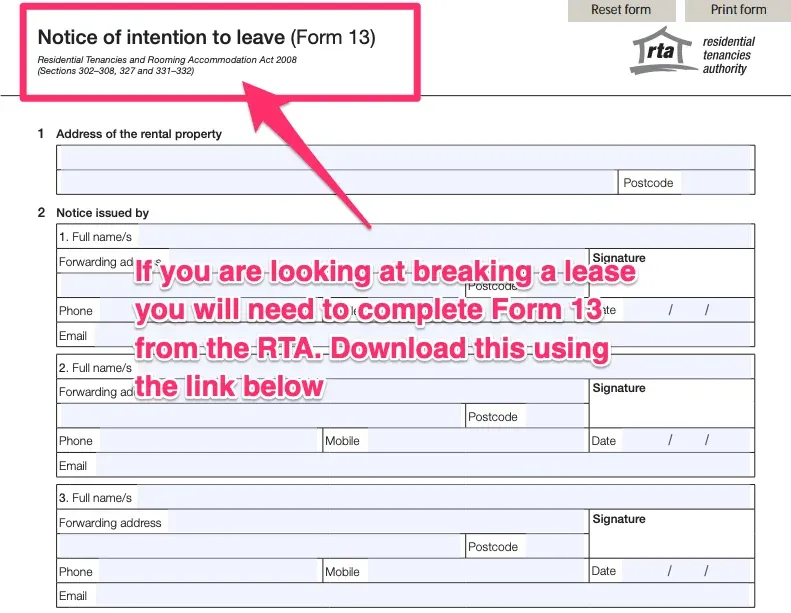
In Queensland, a tenant who is breaking a fixed-term agreement can give a Notice of Intention to Leave (Form 13). Other states and territories use different forms and notice rules.

  • Give as much notice as you can, but do not assume that notice alone ends a fixed-term agreement.
  • Ask whether the owner will agree in writing to an earlier end date or approve a replacement tenant.
  • Keep a copy of the notice and proof that it was sent.
Breaking lease RTA-notice-of-intention-to-leave-form13
Queensland Form 13 only; other states and territories use different notices.

Step 2. Agree on the handover date and document the condition

Follow the date in a valid notice, written agreement or tribunal order. Giving a notice does not always let you stay or leave on the date you choose, so check that it is the right notice for your circumstances.

Before handing back the keys:

  • Compare the property with your entry condition report and check your state or territory’s cleaning standard. A professional cleaner is not automatically required everywhere.
  • Arrange pest treatment only if required by your agreement or the law that applies.
  • Leave the garden and outdoor areas in the condition required by your agreement and local law.
  • Take dated photos and keep copies of receipts and communications.

Clear condition records help if there is a disagreement about damage, cleaning or the bond. They do not remove any compensation that may be payable for ending a fixed term early.

when breaking a lease take lots of photos of the property
If you clean the backyard, take a photo. You never know; there could be a storm overnight, and you could get blamed for something you didn’t do.

Queensland only: complete the exit condition report

  • For a Queensland general tenancy, use Form 14a to record the property’s condition at the end. Compare it with the entry report and keep photos. See the RTA’s exit condition report guidance.
  • Give the completed report to the property manager or owner when returning the keys. Other jurisdictions use different procedures.

Queensland only: request your bond refund

  • After the tenancy has ended, a tenant or managing party can request a refund from the RTA online or using Form 4. See the RTA’s current Form 4 guidance. If everyone agrees to the split, all parties on the paper form sign it. If there is a dispute, a party can lodge a request and the disputed amount may be held while the process runs.

Tip: Read the Queensland RTA guide to ending a tenancy for Queensland procedures.

When Is My Tenancy Agreement Terminated?

Moving out and ending the agreement are not always the same thing. Your agreement ends under the applicable notice, written agreement, tribunal order or other legal ground. In Queensland, handing over vacant possession also affects when reletting costs are calculated. Check the rules that apply before assuming rent or compensation has stopped.

Queensland hardship applications through QCAT

If either party believes continuing the tenancy would cause excessive hardship, they can make an urgent application to QCAT. The person applying needs evidence. QCAT decides whether to end the agreement and can also order compensation, such as some lost rent or reletting costs. A hardship application does not guarantee a cost-free end.

What Costs Do I Need To Pay When Breaking My Lease?

There is no single break-lease fee for Australia. A claim may depend on your state or territory, agreement date, lease length and the terms in your agreement. It can include rent loss, advertising or reletting amounts, but the rules may cap these costs or limit which costs can be claimed. Do not rely on a quote until you know the rule that applies to your agreement.

For example, in Queensland, fixed-term agreements under three years that started or renewed on or after 30 September 2024 use a reletting-cost formula based on how much of the term has expired. The tenant pays the lower of that formula amount and the rent up to when a replacement tenant moves in. No additional reletting costs can be added under this rule. Earlier agreements may be treated differently.

Queensland example: how the cap can work

Suppose weekly rent is $500 and a fixed term of less than three years is 40% complete when the tenant hands back vacant possession. The formula amount is three weeks’ rent, or $1,500. If a replacement tenant moves in after 10 days, rent for those 10 days is about $714. The lower amount is used, so the reletting cost would be about $714 under this example. This is an example of the Queensland rule, not a national estimate; unpaid rent, services or damage are separate.

Before you agree to pay

Ask for an itemised calculation, the agreement clause or rule relied on, the relevant dates, and evidence for claimed advertising or other expenses. Whether the owner must take a particular step, and how a delay affects your liability, depends on the applicable law and facts.

Ways to keep the process moving

  • Write to the owner or agent as early as you can and keep a copy.
  • Ask whether they will agree to an end date or approve a replacement tenant, and get any agreement in writing.
  • Ask for a current itemised cost estimate and how the owner will meet any duty to limit their loss.
  • Keep the entry and exit reports, photos, notices, emails and receipts together.
  • If you cannot agree on the amount, contact the relevant tenancy authority or tribunal for the correct process in your jurisdiction.

Read the Queensland RTA guide to ending a tenancy for Queensland procedures. For another state or territory, use the official source in the comparison table.

How Landlords Must Minimise Your Costs

A rental property with a For Rent sign

Many tenancy laws require an owner to take reasonable steps to limit losses after a tenant leaves early. The exact duty and the costs affected vary by jurisdiction and agreement date. For example, Queensland’s RTA says owners must mitigate loss; South Australia says a landlord should try to re-let as soon as possible; and Victoria requires the rental provider to make reasonable efforts to re-let.

Ask for an itemised breakdown and the relevant dates. Keep the advert, emails and any written agreement. A delay may matter, but it does not automatically remove one week of liability in every state.

What to ask the owner or agent

  • When did you begin seeking a replacement tenant?
  • What rent was advertised, and when were applications or inspections arranged?
  • Which costs are being claimed, and what invoices or other evidence support them?
  • Which rule or clause applies to my agreement and its start date?

Check to see if you are eligible for a home loan

State-by-State Rules For Breaking A Lease In Australia

A guide to checking the lease-break rules in your state or territory

These are starting points for ordinary residential tenancies, not a substitute for checking your agreement and current official guidance. The agreement’s date can change which rules apply. Periodic tenancies also have different notice rules from fixed terms.

On smaller screens, swipe sideways to read each column.

State or territoryWhat to check if you leave a fixed term earlyOfficial guidance
NSWFor agreements of three years or less signed after 23 March 2020, a set break fee may apply based on how much of the term has expired: four, three, two or one week’s rent. Longer and older agreements can follow different rules. Hardship applications go to NCAT; compensation may still be ordered.NSW Fair Trading
VictoriaA rental provider may claim specified costs, including lost rent while vacant, reasonable advertising and a proportionate reletting fee where an agent is used. VCAT resolves disputes.Consumer Affairs Victoria
QueenslandFor fixed terms under three years started or renewed on or after 30 September 2024, reletting costs are the lower of the week-based formula and rent until a new tenant starts. Earlier agreements may have a compliant term for reasonable reletting costs. QCAT can consider hardship, but may still order compensation.Queensland RTA · QCAT hardship information
South AustraliaA fixed-term break can involve loss of rent, advertising and reletting costs, subject to statutory limits and formulas. SACAT can end a tenancy where continuing it would cause undue hardship. Periodic notice is a separate rule.SA.GOV.AU
Western AustraliaContact the lessor to agree an early end. Costs can include reasonable advertising and rent until a new tenant moves in or the agreement ends. The lessor must take reasonable steps to limit losses; specific early-termination grounds and procedures also apply.WA Consumer Protection
TasmaniaA tenant who leaves before the end date without a valid termination reason or notice may remain liable for rent until a new tenancy starts or the fixed term ends, plus advertising costs. The owner must make reasonable efforts to find a replacement. Check current Consumer Affairs Tasmania guidance for notices and disputes.Consumer Affairs Tasmania
ACTFor fixed terms of three years or less started on or after 10 December 2024, the standard break-lease clause caps the fee at six weeks’ rent if less than half the term has passed, or four weeks if half or more has passed. The amount can reduce if a replacement tenant moves in within a set period. Older agreements may differ, so check the clause and start date. ACAT and statutory early-exit grounds may also apply.ACT Government · Renting Book (January 2026) · Residential Tenancies Act
Northern TerritoryFor agreements entered into on or after 2 January 2024, rental-loss compensation is capped at up to 28 days’ rent if less than half the term has passed, or 14 days if more than half has passed. Actual loss and mitigation matter; older agreements may differ.NT Government · NT Consumer Affairs fact sheet

These rules can change. If the amount matters to your move budget, check the current government page and get advice from the tenancy authority, tribunal or a tenant service before agreeing to a payment.

What Are Some Ways You Can Break The Lease Without Costs?

An early end with no compensation is possible only if your agreement, a written settlement or a legal ground allows it. Buying a home does not automatically remove costs.

1. Check whether a legal ground applies

Some jurisdictions allow early termination for specific grounds, such as a serious landlord breach, family violence, an unsafe property or hardship. The required notice, evidence and decision-maker differ. A repair problem does not automatically let you leave without following the local process. Contact the relevant tenancy authority or tenant service before relying on a ground.

2. Ask about an agreed end date or approved replacement

The owner or agent may agree in writing to end the agreement early or may approve a transfer to a replacement tenant. Ask what costs remain and how the bond will be handled. Approval and fees depend on local law and the agreement, so do not assume a replacement makes the break cost-free.

A replacement tenant being shown through a rental
An approved replacement tenant may affect the cost, depending on local rules.

3. Keep the agreement in writing

Record the agreed end date, any compensation, responsibility for advertising or reletting costs, and the bond split. If you cannot reach agreement, follow the dispute process for your state or territory.

Tips to Minimise Costs Even if You Can’t Avoid Them

  • Write as early as possible and keep a record of the date and response.
  • Ask for a written estimate and the rule or agreement term used to calculate it.
  • Offer to help find a replacement tenant if the owner agrees. You do not have authority to approve a new tenant yourself.
  • Keep condition reports and photos to support any bond discussion.

Read the Queensland RTA guide to ending a tenancy for Queensland tenancy procedures.

Hypothetical example: agreeing on an end date

A renter and owner agreeing an end date

Hypothetical example: A renter buying a home asks the owner in writing to end the rental agreement on a set date and offers to help find a replacement. The parties record any payment and bond arrangements before the renter moves. The result depends on the agreement and local law; no particular saving or outcome can be assumed.

Hypothetical example: leaving without agreed notice

A renter leaving a rental early

Hypothetical example: A renter moves out without giving the correct notice or agreeing on an end date. They may still face a claim for compensation, and the bond is not automatically forfeited. The amount and process depend on the agreement and jurisdiction. Keep records and check any bond claim before accepting it.

Bonus: What Happens If You Buy A Property With Tenants?

You may buy a property that already has tenants. Before signing, ask your conveyancer to review the contract, tenancy agreement, bond and any notices so you understand when the tenant can lawfully leave and what obligations transfer to you. The answer depends on the contract and state or territory law.

1. Confirm the tenancy details

  • Ask for the current signed tenancy agreement, any variations, the rent ledger and bond details.
  • Check the fixed end date, notice already given, rent amount, bond status and any disputes or repair issues.
  • Do not assume a tenant must leave because the property is sold or because compensation is offered. Get advice on the applicable rules before agreeing to a settlement date.

2. Plan for management and insurance

  • If the property will be an investment, decide who will manage the tenancy and read the policy wording before relying on landlord insurance. Cover, exclusions, waiting periods and claim conditions differ by insurer.
  • A property manager can handle day-to-day tenancy tasks, but does not remove the owner’s legal responsibilities.
A tenanted investment property
Check the policy wording and tenancy arrangements before settlement.

Would you like to learn about your situation?

Bonus: Should You Avoid Rent To Buy?

Consumer Affairs Victoria describes rent-to-buy as arrangements that combine a rental component with a purchase component, but the documents determine the rights and costs. Some combine a rental agreement with an option or contract to purchase later. Paying rent does not necessarily build a deposit or give you an ownership interest, and the price, fees, conditions and consequences if a party defaults depend on the documents. Before signing, ask an independent property lawyer to review the arrangement and a lender whether the proposed purchase and finance plan are workable. Be cautious of claims about guaranteed savings or profits.

Avoid rent to buy
Rent-to-buy arrangements differ. Check the contract, costs and ownership terms before signing.

FAQs About Breaking A Lease To Buy A House

Next Steps From Here To Buy Your First Home

Our team at Hunter Galloway is here to help you make your home journey easy.

Unlike other mortgage brokers who are just one-person operations, we have an entire team of experts to help make your home loan journey as simple as possible.

If you want to get started, please give us a call on 1300 088 065 or  book a free assessment online to see how we can help.

Our dedicated Hunter Galloway Team

Related guides