


The short answer
If you want to keep the home after separating, I'd start by separating 2 numbers: what you agree to pay your ex, and the mortgage you'll need to take on yourself. The payout can look manageable until you add the loan that's already there.
Work out the home's agreed value, subtract the mortgage payout and apply the share agreed in your settlement. Then add the existing mortgage, the buyout and any costs you're borrowing for, less the cash you put in. The split isn't automatically 50/50.
Use the home buyout calculator to see the payout and total loan separately, then compare the worked examples below.
How to calculate the payout and the new mortgage
- Find the equityStart with equity = agreed property value minus the current mortgage payout.
- Work out the agreed payoutThen calculate payout = equity multiplied by the other person's agreed share, adjusted for the wider settlement.
- Estimate the full new loanFinally, estimate new loan = existing mortgage payout + buyout payment + financed costs, minus your cash contribution.
Home buyout calculator
The calculator assumes you borrow the full agreed payout. You can pay the estimated costs from savings or add them to the loan, but there's no field for cash you put towards the payout itself. If you're putting in cash, take it off the total loan yourself, as in step 3 above. The repayment shown will still be based on borrowing the full payout. Swap the example rate and costs for your own figures.
An $880,000 home with a $420,000 mortgage
Say your Melbourne home is worth $880,000, the mortgage payout is $420,000 and you've agreed to split the equity equally. Here's how the payout and new loan would add up:
| Calculation | Amount |
|---|---|
| Equity: $880,000 less $420,000 | $460,000 |
| Payout for a 50% equity share | $230,000 |
| Existing loan plus payout, before costs or cash contribution | $650,000 |
The payout and mortgage on an $880,000 home
Equity: $880,000 less $420,000
- Amount
- $460,000
Payout for a 50% equity share
- Amount
- $230,000
Existing loan plus payout, before costs or cash contribution
- Amount
- $650,000
The remaining owner needs approval for the $650,000 loan, which includes the $230,000 payout. With $30,000 cash contributed and no financed costs, the new loan would be $620,000. A Victorian relationship-breakdown duty exemption may apply if its conditions are met; legal and registration costs remain.
A $590,000 unit with a $360,000 mortgage
For a Brisbane unit worth $590,000 with a $360,000 mortgage, the same agreed 50/50 equity split gives you these figures:
| Calculation | Amount |
|---|---|
| Equity: $590,000 less $360,000 | $230,000 |
| Payout for a 50% equity share | $115,000 |
| Existing loan plus payout, before costs or cash contribution | $475,000 |
The payout and mortgage on a $590,000 unit
Equity: $590,000 less $360,000
- Amount
- $230,000
Payout for a 50% equity share
- Amount
- $115,000
Existing loan plus payout, before costs or cash contribution
- Amount
- $475,000
You'd need to afford a $475,000 mortgage, plus any costs you add to it. Your lawyer also needs to check whether the transfer qualifies for Queensland duty relief. Splitting the equity equally doesn't decide that.
Check the figures behind your estimate
Start with the equity

- To get the equity, start with the property's current market value, then subtract what's still owed on the mortgage.
- A $500k home with a $300k mortgage has $200k in equity.
Agree on a value you can both use
You need a realistic value you can both work from. An independent valuer considers recent sales, location, size, age and condition. Our property valuation guide explains the difference between a valuation and an appraisal.
A higher value can mean more equity and a larger payout. What you owe and the wider settlement still affect the final amount.
What you still owe
An $800,000 home with a $300,000 mortgage has $500,000 in equity. If you've agreed to divide that equity equally, the payout is $250,000.
If the mortgage is $500,000 instead, there's $300,000 in equity and the same agreed half share is $150,000. In either case, you still need to fund the mortgage that's already there as well as the payout.
Renovations and improvements
Give the valuer records of major renovations. They may affect the value, but a $50,000 kitchen won't always add $50,000. Your lawyer can separately explain how contributions to renovations fit into the settlement.
A changing property market
Use recent sales and a current valuation. The figure you had in mind when you separated may be out of date by the time you're ready to transfer the home.
Keep the home, sell it or stay joint owners?
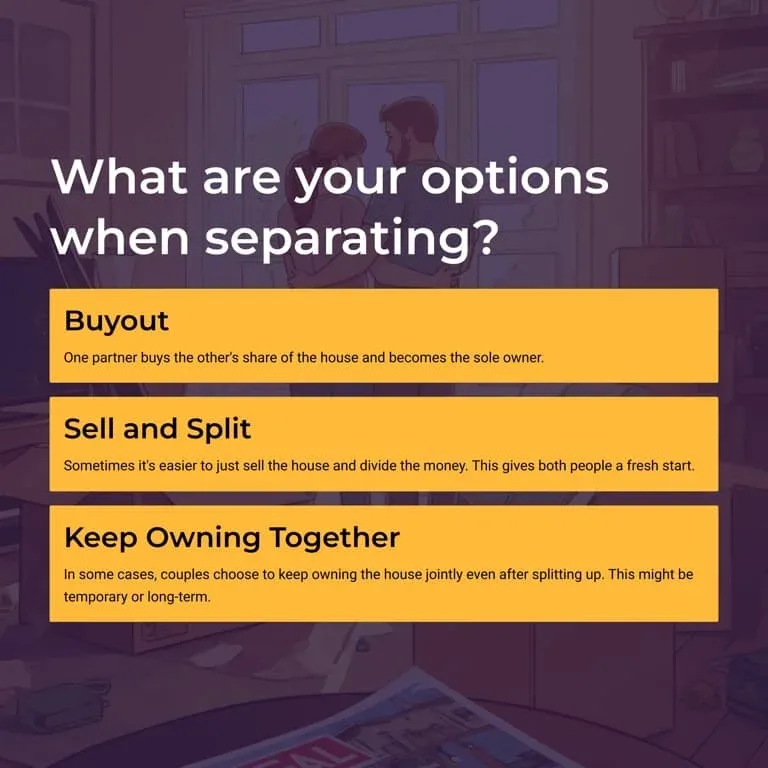
You can buy out your partner, sell the home or keep owning it together for a time. I'd put the repayments and living costs beside each option before deciding.
If you are also changing the ownership record, see our guide to adding a partner to the property title.
Buyout
Staying can keep you and the children near school, friends and familiar routines. Check what the full new mortgage would leave you to live on, then compare the buyout costs with selling and moving. Keeping the home needs to work beyond settlement day.
Sell and split
Selling can release equity and end joint ownership once settlement and the mortgage discharge are complete. The money must still be divided according to your agreement or court order. Allow for selling costs and work out where you'll live next before relying on the proceeds.
Keep owning together
Keeping the home jointly for a while can give you time, but you're still financially connected. Agree with your lawyer who pays the mortgage, rates and repairs, who lives there, and what happens if one person wants to sell or stops paying.
I'd want an end date or a clear trigger for reviewing the arrangement. Waiting doesn't guarantee a better sale price.
If you're still deciding whether to keep the home, start with our keep or sell after separation guide. Our separation and home loans guide brings the loan, joint debts and next steps together.
How does the law affect the split?

A property settlement can include the home, other assets, superannuation and debts. Your share of the overall settlement isn't necessarily the same percentage as your share of the house title. Agree the legal settlement before using a calculator result as the payout amount.
The final property split may not be equal, especially if one person contributed more or has greater future needs.
Ask your family lawyer how the law applies to the proposed payout and the wider property settlement.
A fair split can be unequal
The law asks whether a settlement is 'just and equitable' and looks at the wider circumstances. Your lawyer can advise on that whether or not you go to court.
The bank has a different job: deciding whether to approve the loan. Its approval doesn't tell you whether the settlement is fair.
Money each person contributed
Your lawyer will consider financial contributions such as:
- Paying the house deposit
- Making mortgage repayments
- Covering major renovations or upgrades
- Paying rates, utilities, or insurance
Financial contributions are one part of the assessment. Your lawyer also considers unpaid work, caring responsibilities and each person's future needs.
Unpaid work
The Family Law Act also values unpaid efforts, such as:
- Maintaining the home (repairs, gardening, cleaning)
- Supporting your partner’s career or studies
- Acting as the primary homemaker
Even if you didn’t earn an income, your contributions to the household still count.
Caring for children and the household
Time spent caring for children or managing the household also counts as a contribution. The effect of those roles on future earning potential is considered too.
What each person needs next
Your lawyer also looks at what each of you will need after separating, including:
- Your age and health
- Your income and job security
- Whether you’ll be the primary carer of any children
- Any other financial obligations or dependants
Caring for children can affect current and future financial circumstances. Your lawyer assesses this alongside the other factors; it doesn't produce a fixed percentage for the house.
How long you were together
There's no automatic percentage based on the length of a relationship. A lawyer considers the whole financial history, contributions and current and future circumstances. The economic effect of family violence can also be relevant under the current law.
The steps to buying out a partner

Step 1. Work out what you can afford
Start with your income, living costs, other debts and the cash you can contribute. We'll assess the full mortgage you'd need on your own, then compare its rate, term and features. The lender may order its own valuation even if you've already agreed on a value for the settlement.
If you need child support to make the loan work, check what evidence a lender may need. Have details of your joint cards and loans ready too, including any accounts being paid out or closed as part of the settlement.
Step 2. Work through the settlement
Take the valuation, current mortgage payout and borrowing estimate into the settlement discussion. Your lawyer can help you work through the payout, other assets and timing.
If direct contact is safe and appropriate, keep the discussion focused on those figures. If it isn't, ask your lawyer about another way to negotiate. A mediator may help where appropriate; each person can get independent legal advice.
Have your lawyer record the agreed payout, conditions and date the money is needed. Keep copies of the signed documents.
Our consent orders and home loans guide explains how to coordinate the finance checks with your lawyer before relying on a settlement deadline.
Step 3. Complete the transfer and loan
Your conveyancer or property lawyer prepares the title-transfer documents and coordinates settlement with the lender. The payout, ownership change and new loan need to happen together.
The lender must approve the refinance or other change that releases the outgoing borrower. A title transfer or private agreement doesn't remove someone from the mortgage. Confirm the full loan amount, repayments and term before settlement. Afterwards, check that the ownership transfer and the lender's release are both complete.
What about tax and stamp duty?
A relationship-breakdown transfer may qualify for duty relief and CGT rollover, but these are separate checks. Have your solicitor and tax adviser confirm both before setting the settlement amount.
Capital gains tax
If the relationship-breakdown rollover conditions are met, the person transferring their share disregards the capital gain or loss on that eligible transfer. The transfer must be made under a qualifying court order, formal agreement or arbitration award. A private or informal arrangement doesn't qualify. Ask your tax adviser to check the actual documents and transfer.
The person receiving the share generally takes over its relevant cost base. The buyout price doesn't automatically become the new tax cost base.
Stamp duty on the transfer
Relationship-breakdown exemptions or nominal-duty rules can reduce transfer duty, depending on the state and the actual transfer. The people receiving the property, legal documents and connection to the settlement matter. A buyout between friends or siblings doesn't automatically receive relationship-breakdown relief.
If the home has been an investment
If the property has been rented, used for a business or owned by a non-resident, ask for advice before assuming a main-residence exemption applies. Include any agreed tax adjustments in the wider settlement. The home equity figure is only one part of the agreement.
What other costs need to go in the budget?
Before fixing the payout date, get a current mortgage payout and quotes for the work needed to transfer the home. A complicated settlement can cost more than a simple refinance. These are the costs I'd put in the budget:
- Valuation: check whether the lender covers its valuation and whether you need a separate report for the property settlement.
- Legal advice and settlement documents: ask what the quote includes and whether conveyancing, negotiations and consent-order work are separate. Avoid counting the same legal work twice.
- Loan costs: allow for application, settlement, discharge and any fixed-rate break costs. Ask for a payout valid for the intended settlement date.
- Duty and registration: confirm any exemption or nominal duty, plus current title and mortgage registration fees.
- LMI: a new loan above 80% LVR may attract a new premium unless an exception applies. Check LMI waivers if relevant; a previous premium doesn't automatically transfer.
- Cash buffer: keep an allowance for moving, repairs and bills after settlement.
Use our refinancing guide and extra repayment calculator to compare the loan alongside the payout. For lender features and fees, the Commonwealth Bank and NAB reviews are starting points; obtain a current quote for your application.
Is keeping the home worth it?
What you could gain by staying

Keeping the home gives you any future rise in its value, but you also carry the risk of a fall and all the repair bills. A mortgage, court orders or other obligations can still affect what you do with the property, including a later sale.
What you'd take on

Watch the new loan term. Starting again at 30 years can make the monthly repayment look easier while adding to the total interest. Compare the loan over your remaining term first.
There can be pressure to agree quickly just to get the conversation over with. I'd check the figures properly before you commit to a payout date you can't meet or a mortgage that's too tight.
Does the state you're in change the costs?
Duty and registration rules depend on where the property is. Your conveyancer can tell you which exemption or reduced duty might apply and which documents you need. The links below go to each revenue office.
| State or territory | What to confirm |
|---|---|
| NSW: official guidance | Check the relationship-breakdown exemption and supporting agreement or order. |
| VIC: official guidance | Relief can apply to an eligible transfer made solely because of the relationship breakdown. |
| QLD: official guidance | Confirm that the relationship instrument and transfer meet the matrimonial or de facto exemption rules. |
| SA: official guidance | Use the category matching your relationship and legal documents; relief isn't automatic. |
| WA: official guidance | Eligible transfers can attract $20 nominal duty. |
| TAS: official guidance | Check the relationship-breakdown relief and document requirements. |
| ACT: official guidance | Check the personal-relationship transfer exemption and required supporting documents. |
| NT: official guidance | Confirm the settlement-of-property exemption and the applicable form and evidence. |
Duty rules by state and territory
- What to confirm
- Check the relationship-breakdown exemption and supporting agreement or order.
- What to confirm
- Relief can apply to an eligible transfer made solely because of the relationship breakdown.
- What to confirm
- Confirm that the relationship instrument and transfer meet the matrimonial or de facto exemption rules.
- What to confirm
- Use the category matching your relationship and legal documents; relief isn't automatic.
- What to confirm
- Eligible transfers can attract $20 nominal duty.
- What to confirm
- Check the relationship-breakdown relief and document requirements.
- What to confirm
- Check the personal-relationship transfer exemption and required supporting documents.
- What to confirm
- Confirm the settlement-of-property exemption and the applicable form and evidence.
Before you agree to the buyout
Before you promise a payout date, confirm the amount with your lawyer and find out what the lender will approve. Leave money for transfer costs and the bills after settlement. If the loan leaves too little to live on, revisit selling or temporary joint ownership before committing.

Sources and further reading
Payout calculations checked on 30 September 2026. The court, ATO and state revenue sources below cover property settlements, tax and duty.

Jayden Vecchio is a mortgage broker at Hunter Galloway. Hunter Galloway Finance Pty Ltd is Credit Representative 476903, authorised under Australian Credit Licence 389328.
Reference links
- Federal Circuit and Family Court: property and financial matters
- ATO: relationship breakdown and property transfers
- NSW relationship transfer duty guidance
- VIC relationship transfer duty guidance
- Queensland Revenue Office: matrimonial transfer duty exemptions
- SA relationship transfer duty guidance
- WA relationship transfer duty guidance
- TAS relationship transfer duty guidance
- ACT relationship transfer duty guidance
- NT relationship transfer duty guidance
- ATO: when relationship-breakdown CGT rollover applies
- ATO: main residence exemption after relationship breakdown
More help with your property buyout
- Your next step
Home loans after separation
Work through the mortgage, joint debts and next steps.
Read guide - Settlement timing
Consent orders and your home loan
Line up the loan with the payout and dates agreed through your lawyer.
Read guide - Your equity
Working out your equity
Estimate equity before agreeing to a property payout.
Use calculator - Tax and costs
Refinance costs and tax
Understand which costs may need advice from a tax adviser.
Read guide - Choosing a loan
Home loan features
Compare the features you'd use on the new loan.
Read guide - Ownership
Buying with a partner
Understand ownership arrangements before sharing a property.
Read guide
Questions about buying out a partner
Show 4 more questions
Check the finance for your property buyout
Tell us the home's value, what you owe and the payout you're discussing with your solicitor. We'll work out the mortgage you'd need and what the repayments would leave in your monthly budget.
or call 1300 088 065
Hunter Galloway Finance Pty Ltd is Credit Representative 476903, authorised under Australian Credit Licence 389328.
General information only. The Melbourne and Brisbane figures are calculations using assumed values and agreed equity shares, not client outcomes or loan offers. Loan approval, your legal settlement, transfer duty and tax treatment depend on your circumstances and the relevant state or territory. Get legal and tax advice before agreeing to a property transfer.