


Why use Bank of Melbourne?
- 01 / Deposit
Buy with a smaller deposit
Eligible doctors and dentists can borrow up to 95% without LMI. Nurses and other eligible professionals have options too.
- 02 / Income
More ways to show your income
There are options for self-employed borrowers, and eligible employees can have more of their overtime and allowances counted.
- 03 / Features
Useful features beyond the rate
Multiple offsets, building loans and bridging can make it worth a look if a basic online loan won’t do everything you need.
Bank of Melbourne is part of Westpac, alongside St George and BankSA. It’s the Victorian brand in that group, so a lot of the home-loan features and lending rules will look familiar if you’ve read our St George review.
That doesn’t mean the three brands will quote the same rate or run the same offer. I’d compare the actual deal for your loan, then check that the property and income fit. Westpac’s own home loans also need a separate comparison: see our Westpac review.
Where does Bank of Melbourne fall short?
- The package has a costThe Advantage Package costs $395 a year. We’ll compare whether the rate and features save you enough to cover it.
- An LMI waiver depends on your jobWe’ll check your job, professional registration and income to see whether you can avoid LMI.
- Interest-only lending has tighter limitsThe 95% investment option is for principal-and-interest repayments. Interest-only investment lending has a lower limit.
- It isn’t a low-doc lenderYou may be able to use fewer years of tax records, but you’ll still need to show what your business earns.
- The property can change the answerA small apartment or unusual property can need a bigger deposit, even if your income is strong.
Can you avoid LMI with Bank of Melbourne?
Your job could let you buy with a smaller deposit without paying lenders mortgage insurance. The useful part is keeping more cash available for buying costs or a buffer after settlement. Here’s how much deposit you may need for your job.
Professional LMI waiver eligibility
Scroll to see more columns
| Your profession | Possible deposit without LMI | What we need to check |
|---|---|---|
| Doctors, medical specialists and dentists | 5% (up to 95% LVR) | Eligible role and registration. No minimum income threshold for the waiver; you still need to afford the loan. |
| Registered nurses, midwives and eligible allied health professionals | 10% (up to 90% LVR) | $90k combined gross annual income from eligible medical work, plus the occupation and registration rules. |
| Lawyers, solicitors, barristers and judges | 10% (up to 90% LVR) | $120k minimum income and the relevant practising or employment requirements. |
| Eligible accountants, actuaries, auditors, CFOs and finance managers | 10% (up to 90% LVR) | $120k minimum income and the required professional membership or qualification. |
- Possible deposit without LMI
- 5% (up to 95% LVR)
- What we need to check
- Eligible role and registration. No minimum income threshold for the waiver; you still need to afford the loan.
- Possible deposit without LMI
- 10% (up to 90% LVR)
- What we need to check
- $90k combined gross annual income from eligible medical work, plus the occupation and registration rules.
- Possible deposit without LMI
- 10% (up to 90% LVR)
- What we need to check
- $120k minimum income and the relevant practising or employment requirements.
- Possible deposit without LMI
- 10% (up to 90% LVR)
- What we need to check
- $120k minimum income and the required professional membership or qualification.
LVR is the loan as a share of the bank’s property valuation. Buying costs sit on top of the deposit figures above. Our LMI waiver guide explains how the different lender offers compare.
For the rules that apply to your job, see our home loans for nurses, doctor home loans and home loans for accountants guides.
Which healthcare roles count?
The 90% medical list includes audiologists, chiropractors, midwives, occupational therapists, optometrists, osteopaths, pharmacists, physiotherapists, podiatrists, psychologists, radiographers, registered nurses, sonographers, speech pathologists and vets.
For doctors and dentists, the maximum loan under the waiver is $5m, with a $7.5m total lending limit under the concession. The accounting and finance concession has a $4m group lending limit. Already have a loan with Westpac, St George or BankSA? Tell us when we check your waiver, as those loans can count towards the total limit.
I’d check the exact occupation before building your budget around a waiver. For example, an IT professional or engineer doesn’t qualify for these Bank of Melbourne concessions just because their income is high. Another lender may have a better option.
What about the 5% Deposit Scheme?
Bank of Melbourne participates in the Australian Government 5% Deposit Scheme. Eligible first home buyers, including some people who haven’t owned a home in the last 10 years, can buy with a 5% deposit and no LMI. Eligible single parents and single legal guardians may qualify with 2%.
You need to live in the property, meet the scheme rules and buy within the local price cap. Repayments are principal and interest, with an exception during an eligible construction period.
Buying an $800k home as a registered nurse
If you qualify for both options, here’s how the deposit and loan amounts compare:
5% Deposit Scheme versus a registered nurse LMI waiver on an $800k home
Scroll to see more columns
| On an $800k home | 5% Deposit Scheme | Nurse LMI waiver |
|---|---|---|
| Your deposit | $40k (5%) | $80k (10%) |
| Your home loan | $760k | $720k |
| LMI | $0 if you qualify | $0 if you qualify |
| Main requirements | Meet the Scheme’s buyer rules, live in the home and stay within the local property price cap. | Meet the nurse registration and $90k eligible medical-income requirements described above. |
- 5% Deposit Scheme
- $40k (5%)
- Nurse LMI waiver
- $80k (10%)
- 5% Deposit Scheme
- $760k
- Nurse LMI waiver
- $720k
- 5% Deposit Scheme
- $0 if you qualify
- Nurse LMI waiver
- $0 if you qualify
- 5% Deposit Scheme
- Meet the Scheme’s buyer rules, live in the home and stay within the local property price cap.
- Nurse LMI waiver
- Meet the nurse registration and $90k eligible medical-income requirements described above.
Buying costs are extra in both cases. This assumes the bank values the home at $800k and you qualify for the full loan amount. The Scheme lets you buy with $40k less upfront, but you’ll owe $40k more. At the same rate and loan term, that means higher repayments.
Can family help with your deposit?
Yes. Bank of Melbourne calls its family guarantee Family Pledge. An eligible family member uses equity in their property to support part of your loan. That can reduce the deposit you need and help avoid LMI.
Your parent, child or sibling may be able to help. The bank can also consider step-family members and legal guardians, but this option doesn’t include grandparents, aunts or uncles. You don’t have to be a first home buyer; the rules below depend on whether you already own property.
If you’re buying a home to live in, you and anyone applying with you can own no more than 1 other property between you. If you’re buying an investment, neither of you can already own another property.
Buying before you sell?
Bank of Melbourne’s Relocation Loan can help you buy your next home before selling the current one. The bridging period can run for up to 12 months, subject to approval.
I’d start with a realistic sale price and the loan you’ll have left after the sale. Then allow for interest and the possibility that selling takes longer than expected. For an eligible loan, the bank can check affordability using the loan you’ll have left after selling your old home.
Read our bridging loan guide before committing to the next purchase. The numbers need to work if the sale doesn’t go exactly to plan.
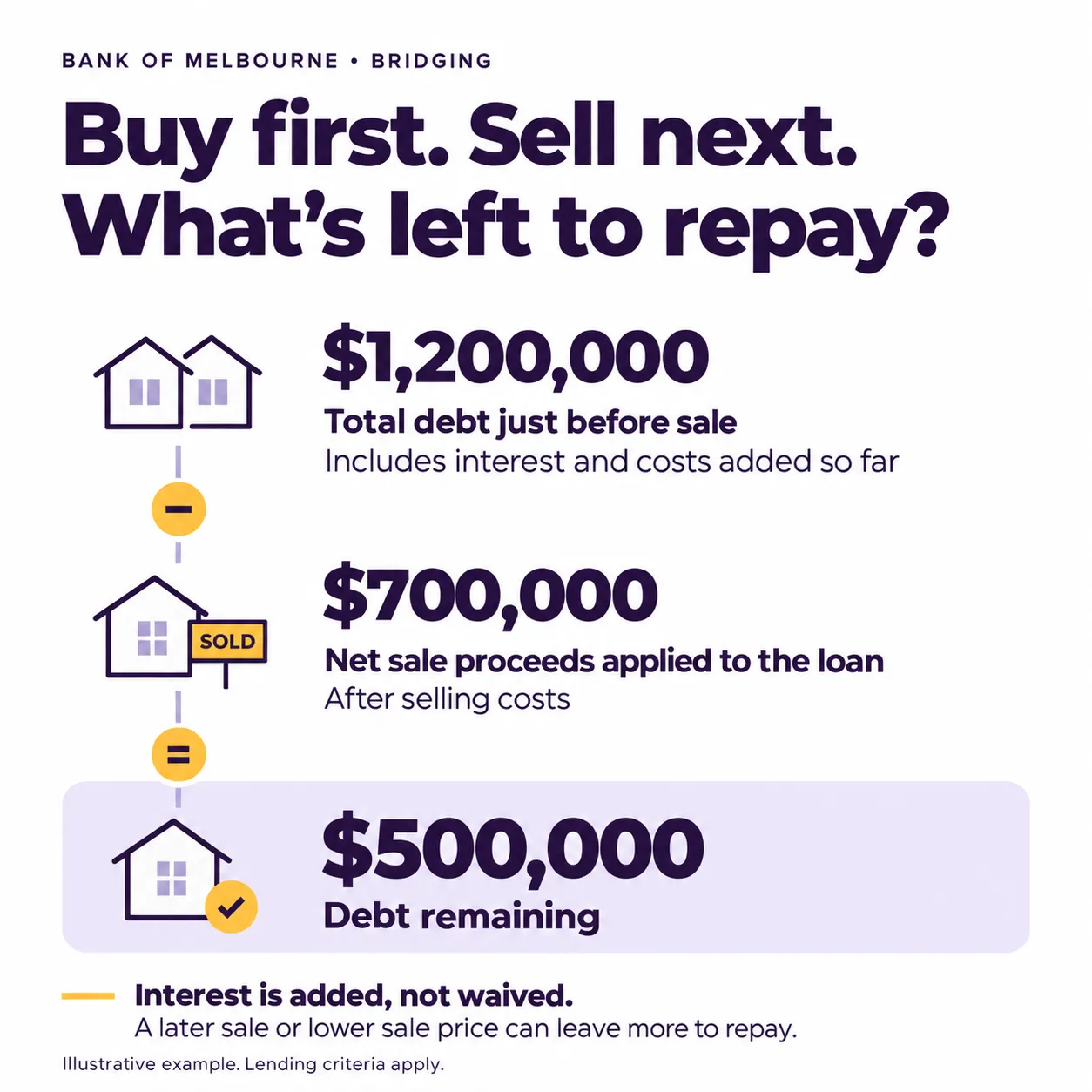
In this illustrative example, the $1.2 million debt includes interest and costs added up to the sale. The $700,000 sale proceeds are after selling costs. A later sale or lower sale price can leave more debt to repay. Lending criteria apply.
Which home loan should you look at?
Home loan options
Scroll to see more columns
| Option | Why you might choose it | What to watch |
|---|---|---|
| Basic variable | A simpler variable loan with redraw | No offset. Compare the actual rate and fees with the package. |
| Standard variable with Advantage Package | Offset accounts and package pricing | The package costs $395 a year. |
| Fixed rate | More certainty about repayments during the fixed period | No offset against the fixed portion. Extra-repayment limits and break costs can apply. |
| Split loan | Fix part and keep part variable | An eligible offset reduces interest on the variable portion only. |
| Building loan | Funds released as your builder completes stages | The build contract, valuation and progress payments need approval. |
| Relocation loan | Buy before selling your current home | Check the sale deadline, interest costs and debt left after the sale. |
- Why you might choose it
- A simpler variable loan with redraw
- What to watch
- No offset. Compare the actual rate and fees with the package.
- Why you might choose it
- Offset accounts and package pricing
- What to watch
- The package costs $395 a year.
- Why you might choose it
- More certainty about repayments during the fixed period
- What to watch
- No offset against the fixed portion. Extra-repayment limits and break costs can apply.
- Why you might choose it
- Fix part and keep part variable
- What to watch
- An eligible offset reduces interest on the variable portion only.
- Why you might choose it
- Funds released as your builder completes stages
- What to watch
- The build contract, valuation and progress payments need approval.
- Why you might choose it
- Buy before selling your current home
- What to watch
- Check the sale deadline, interest costs and debt left after the sale.
How do the offset accounts work?
You can link up to 10 offset accounts to an eligible variable home loan. That’s handy if you like keeping bills, savings and your emergency fund separate. The bank adds the eligible balances together, so money across those accounts can reduce the interest you pay.
The offsets don’t reduce interest on a fixed loan or the fixed part of a split. If you’re building, our construction loan guide explains why the loan works differently while funds are being drawn down.
How do Bank of Melbourne’s rates and fees compare?
The rate you get depends on the loan, deposit, repayment type and whether you’re buying a home or an investment. Check Bank of Melbourne’s current rates, then compare a quote for your own situation.
I wouldn’t choose the loan because of a large advertised discount. What matters is the rate you actually pay, the fees and whether you’ll use the features. The $395 package fee needs to be part of that comparison.
- $0 or $600
Establishment fee
$0 on Basic. Standard Variable and Fixed Rate loans have a $600 fee, waived with the Advantage Package.
- $395 a year
Advantage Package
The annual Advantage Package fee on eligible Standard Variable and Fixed Rate loans.
- $350
Discharge fee
Charged when you pay out your loan or discharge the mortgage. Government charges are extra.
Other Bank of Melbourne loan fees and costs
Scroll to see more columns
| Cost | Amount and when it applies |
|---|---|
| Document processing | $100 when the mortgage or title documents are processed at settlement. The package does not waive this fee. |
| Monthly loan account fee | $0 on Basic. $8 on Standard Variable and Fixed Rate loans, waived with the Advantage Package. |
| LMI | Can apply if you don’t qualify for a waiver, Scheme or guarantee and your deposit is small. |
| Fixed-rate break costs | Calculated for your loan. Can apply if you repay, refinance or change a fixed loan early. |
| Other buying or refinancing costs | Allow for conveyancing, government charges, any property valuation fee and discharge costs from your current lender. |
- Amount and when it applies
- $100 when the mortgage or title documents are processed at settlement. The package does not waive this fee.
- Amount and when it applies
- $0 on Basic. $8 on Standard Variable and Fixed Rate loans, waived with the Advantage Package.
- Amount and when it applies
- Can apply if you don’t qualify for a waiver, Scheme or guarantee and your deposit is small.
- Amount and when it applies
- Calculated for your loan. Can apply if you repay, refinance or change a fixed loan early.
- Amount and when it applies
- Allow for conveyancing, government charges, any property valuation fee and discharge costs from your current lender.
Fees checked on 8 September 2026 against Bank of Melbourne’s current home loan fee schedule (dated 22 April 2025). Check your quote for any extra fees, including an optional fixed-rate lock.
Use our mortgage calculator for an initial borrowing estimate and our deposit calculator to work out the cash you’ll need. If you already have a Bank of Melbourne loan, it’s worth asking us to check your rate against current options.
How will Bank of Melbourne assess your income?
Self-employed borrowers
There are several ways to show business income. Fast Track can use 2 years of personal ATO notices of assessment for eligible borrowers. Other applications may use a 1-year assessment or a standard review of business financials.
Those options have different trading-history and deposit requirements. Providing 1 year of figures doesn’t necessarily mean you can apply after only 1 year in business. Some eligible self-employed medical professionals have a separate concession after 1 full financial year.
We’ll check which option you can use before asking your accountant for documents. If you’re using the shorter business-history option for medical professionals or the 90% allied-health waiver, you can’t simply add Fast Track to it; each has its own document rules. See our self-employed home loan guide for how lenders look at business income.
Overtime, allowances and other income
For eligible healthcare, frontline emergency services and trade employees, Bank of Melbourne can count 100% of qualifying overtime and allowances. Usually it wants evidence with the same employer over at least 6 months; shorter histories need individual consideration.
Your regular overtime could help you borrow more. The bank needs to accept that income, and this option doesn’t cover self-employed contractors or office-based emergency services staff.
We’ll also include your rent, debts, living costs and credit-card limits when comparing how much you could borrow.
What should investors check?
Bank of Melbourne lends for investment purchases, but the repayment choice changes the maximum loan size. Bank of Melbourne may lend up to 95% including LMI for principal-and-interest investment loans, or up to 90% for interest-only loans.
A refinance has its own limits, so don’t assume a 95% purchase option also applies when switching your existing loan.
If you want interest only, I’d compare the repayment during that period and after it ends. The loan still has to be paid off over the remaining term.
How long does approval take?
Before you agree to a finance deadline, we’ll check how long the bank is taking and what it needs from you. Allow extra time if you’re self-employed, using a guarantor or building.
A pre-approval is useful when you’re shopping, but the bank still needs to accept the property and any remaining conditions. Check the expiry date on your letter and ask what needs updating if your search takes longer.
Once you have full approval, the loan documents, any discharge from your old lender and your conveyancer’s settlement work still need to be completed.
What is it like to use day to day?
Bank of Melbourne offers everyday accounts, internet banking and mobile banking alongside the loan. Its Complete Freedom account can work as an offset when linked to an eligible variable loan, with debit-card access and Apple Pay and Google Pay.
That’s useful if you want to keep your banking together. I’d still choose the home loan on its own merits. A bundled credit card or other extra isn’t a saving if you wouldn’t otherwise use it.
Bank of Melbourne or St George?
There’s a lot of overlap because they’re both part of the same banking group. I’d expect the same main conversations about profession waivers, income and loan features. I wouldn’t treat two quotes from these brands as a comparison of the whole market.
Lender comparison
Scroll to see more columns
| What you’re comparing | Bank of Melbourne and St George |
|---|---|
| Profession waivers | Broadly aligned medical, legal and accounting concessions. Check the exact role and income rules. |
| Offsets and loan range | Both offer multiple offsets on eligible variable loans, plus fixed, split, building and bridging options. |
| Family help | Both have family guarantee options with relationship and property-ownership conditions. |
| Rates and offers | Can differ by brand, loan and promotion. Compare written quotes. |
| Existing group loans | Already have a loan with Westpac, St George or BankSA? That could affect how much you can borrow under the waiver. |
- Bank of Melbourne and St George
- Broadly aligned medical, legal and accounting concessions. Check the exact role and income rules.
- Bank of Melbourne and St George
- Both offer multiple offsets on eligible variable loans, plus fixed, split, building and bridging options.
- Bank of Melbourne and St George
- Both have family guarantee options with relationship and property-ownership conditions.
- Bank of Melbourne and St George
- Can differ by brand, loan and promotion. Compare written quotes.
- Bank of Melbourne and St George
- Already have a loan with Westpac, St George or BankSA? That could affect how much you can borrow under the waiver.
Read our St George home loan review for the closest comparison, and our Westpac review for the parent bank’s separate range.
I’d also compare a lender outside the group. Our NAB, Macquarie, ubank and ME Bank reviews cover other options. You can browse all our lender reviews too.
Who would I put Bank of Melbourne on the shortlist for?
- Professionals who can avoid LMIAn LMI waiver could make buying with a smaller deposit more practical.
- Employees with regular overtimeYour regular overtime could help you borrow more.
- Self-employed borrowers with good recordsWe’ll compare how lenders work out your business income and how much each may let you borrow.
- Buyers with more to organiseYou may need a building loan, help from family or finance to buy before you sell.
If you don’t need those features, I’d check whether a simpler loan costs less. If your income or property doesn’t fit, we’ll compare lenders with different requirements.
Our mortgage brokers can work through those options with you. Meet the team or get in touch if you’d like help comparing loans.
Hunter Galloway lender rating
Bank of Melbourne broker score
I like the professional waivers, income options and useful loan features. Package costs, property checks and keeping your rate competitive are the trade-offs.
7.6/10
Good for the right borrower
Our rating across 6 categories
Score breakdown
Each category is scored out of 10
- Credit policy fitUseful profession waivers, income options, guarantees and bridging.8.5/10
- Borrowing capacitySome overtime and self-employed options help; debts and living costs still matter.7.5/10
- Property acceptanceA broad home-loan range, with extra checks for unusual properties.7.0/10
- Product and offset featuresUp to 10 offsets on eligible variable loans, plus fixed, split and building options.8.0/10
- Application speed and certaintySeveral established assessment options; timing still depends on the documents and property.8.0/10
- Ongoing pricing and serviceEveryday banking is available, but the package fee and ongoing rate need checking.6.5/10

Experience and sources
About this review
I’ve focused on when Bank of Melbourne could help and where I’d compare another lender. We checked the bank’s product information and the lending policy on 8 September 2026, including the main differences and similarities with St George.

Joshua has worked in mortgage broking since 2011 and holds Diploma and Certificate IV qualifications in finance and mortgage broking. Hunter Galloway Finance Pty Ltd is Credit Representative 476903, authorised under Australian Credit Licence 389328.
Sources
Rates, fees and lending rules can change. We check the current offer and your circumstances before recommending a loan. How do we get paid? A lender may pay us commission when we arrange your loan. We disclose how we're paid before you proceed. This review is general information, not a recommendation.
Bank of Melbourne home loan FAQs
The questions I’d check before choosing the loan.
Is Bank of Melbourne right for your home loan?
We can check your deposit and income, compare the options and help you work out which lender fits.
or call 1300 088 065
Hunter Galloway Finance Pty Ltd is Credit Representative 476903, authorised under Australian Credit Licence 389328.