


Your mate says he'll pay $250 a week to move in, but the bank might count only $150 of that income or nothing at all.
That gap decides whether renting out a room helps you borrow or just leaves you short. Find out before you lift your price limit.
Short answer: Renting out a room might help you borrow, but only if your lender agrees to count it. A mate saying he'll move in isn't income the bank has accepted.
What kind of room rental are you planning?
Start with who's moving in and how they'll pay you.
A long-term boarder sharing your kitchen is different from a run of holiday guests. A separately leased flat is different again. Lenders can assess each one under different rules, even if the money lands in the same account.
Tell the lender what it really is. A partner contributing to household bills isn't automatically paying rent either.
If you're comparing income sources, our income and employment guides explain other income a lender may consider.
What would a room really leave you?
Here's a hypothetical household budget, not a bank's lending calculation.
| Room income and costs | Amount |
|---|---|
| Rent charged each occupied week | $250 |
| Rent over 46 paid weeks | $11,500 |
| Extra power, cleaning and wear | −$2,000 |
| Left before tax and other costs | $9,500 |
| Rent if all 52 weeks were paid | $13,000 |
For comparison, hypothetical rent of $150 over the same 46 weeks is $6,900. That's household-budget arithmetic, not a lender's annual income calculation or a confirmed CommBank allowance. The bank might count less, or none.
Work out what you could borrow without the rent first, using our mortgage calculator. Then test repayments with Moneysmart's mortgage calculator. Ask yourself how long your savings could cover a vacancy, late payments or a boarder who leaves.
Think about what you'd do if you wanted to stop renting the room, too.
You'll be sharing your home, so make sure it's an arrangement you want rather than a budget that needs someone to pay every week forever.
A separate borrowing estimate with established boarder income
This hypothetical comparison is for an existing homeowner with established boarder income. It isn't a first home buyer or proposed-room-rent example.
The borrower earns $120,000 gross a year from PAYG employment, with no dependants, HELP debt or other debts, and $3,000 monthly living expenses. Their owner-occupied house is worth $1 million, with a $500,000 replacement variable loan at 50% loan-to-value ratio.
Both runs use the same NAB 30-year principal and interest pricing input of 6.48% and an assessment rate of 9.48%.
| Modelled income scenario | Maximum borrowing estimate |
|---|---|
| Without boarder income | $546,703 |
| With $150 a week of established boarder income | $593,519 |
Borrowing Estimate
Without boarder income
- Maximum borrowing estimate
- $546,703
With $150 a week of established boarder income
- Maximum borrowing estimate
- $593,519
The difference is $46,816. This is an estimate, not approval. Lender-accepted established income and evidence are required. It isn't a CommBank result or evidence that a proposed first home buyer room arrangement qualifies. Pricing inputs were held constant. Repricing at the maximum borrowing amount wasn't modelled.
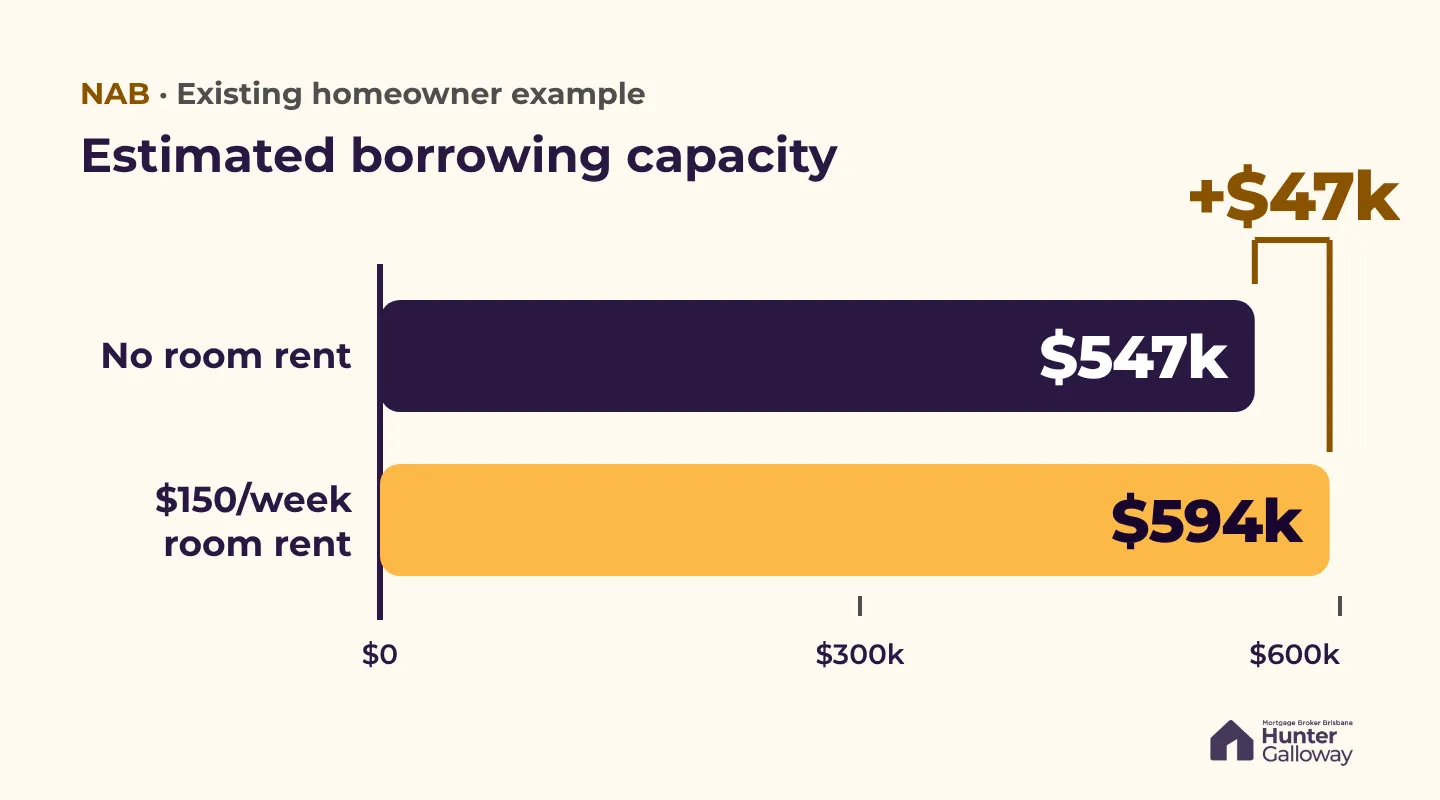
NAB existing-homeowner example with established, documented room rent of $150 a week, using the profile and rates above.
Estimated capacity rises from $546,703 to $593,519, a $46,816 difference. Chart labels are rounded. This is not proposed rent or a first-home-buyer result.
Which lenders can count room rent
Some lenders will consider room rent, but the amount they count and the evidence they need can be very different. Check those two things before comparing loans.
NAB needs established room rent, not a flatmate's promise
For NAB, you'll need tax evidence for the full most recent financial year ending 30 June. It must show the property's address and the room rent you actually received. Bring 2 recent rent credits as well, to show the payments are continuing. NAB uses the lower of your 12-month average and current rent; you can't turn a shorter history into a full year by multiplying it.
This makes NAB a different conversation for an existing homeowner with a documented history than for someone buying their first home and planning to find a boarder. Our NAB home loan review covers its broader lending features.
CommBank may count up to $150 a week for a first home buyer
Buying your first home with a boarder? CommBank may count up to $150 a week from one eligible arrangement if you live in the home. A friend or family member can qualify, but your spouse cannot. The loan must be for personal use, not investment.
Before you build that money into your budget, we still need to confirm whether your arrangement qualifies, which documents you'll need and whether the bank reduces the income it counts.
Our Commonwealth Bank home loan review explains the wider loan options. Proposed room rent, established rent and first-home scheme eligibility still need separate checks.
Wave Money can count part of your room rent
Wave Money can count 80% of boarder or housemate income when you provide the supporting documents. On $250 a week, that is $200 of income for assessment, not $200 of extra borrowing power. The lender still checks the arrangement, expenses, loan and property.
A larger income allowance is only useful if the complete loan suits you. We would compare the rate, fees and repayments as well. We also check whether we can arrange the particular lender before including it in your shortlist.
Firstmac separates boarders from rental properties
Firstmac won't count boarder income, but eligible granny-flat rent can be considered separately. That matters if you're choosing between renting a spare bedroom and a self-contained dwelling. Our Firstmac home loan review covers its wider lending options.
ANZ, ME and ubank exclude room income
ANZ and ME Bank don't count individual-room or boarder income. ubank also excludes shared spaces and individual rooms, so don't apply its whole-property rental allowance to a spare bedroom.
A separately rented investment property is assessed differently. For ING, undeclared cash rent without tax-return evidence is excluded. We still need to check a documented room-rental arrangement separately; we can't assume it is excluded as well.
Broker check: We establish who occupies the property, how the rent is documented and how long it has been paid before running borrowing figures. The NAB chart above assumes established income. It is not evidence that a proposed boarder qualifies.
These are examples, not an exhaustive list or approval. Policies and products can change. A lender accepting one kind of rental income does not establish that it will count your arrangement.
A spare room, a granny flat and a boarding house need different checks
A boarder normally shares part of your home. A self-contained granny flat has its own living facilities. A boarding or rooming house can be a different property type altogether. Calling all 3 'rental income' hides the question the bank needs answered.
For a granny flat, we check the layout, approvals and valuation evidence before treating the rent as income from a separate dwelling. For several rooms let separately, we check whether the lender will accept the property as residential security. A lender saying yes to the rent is not enough if it says no to the building.
Before you increase your buying budget, book a free assessment. Send us the proposed arrangement and any agreement or payment records. We can compare suitable lenders using the income each will accept, rather than assuming your full weekly rent counts.
Five things we check with the lender
- Do you accept boarder income for this loan and property?
- Can you consider a proposed arrangement, or must payments already be happening?
- What evidence do you need, and does my relationship to the boarder matter?
- Is there a dollar cap, or a limit on how much of the loan can depend on it?
- How do you allow for the extra household costs?
We can put these questions to suitable lenders and compare their answers before you apply. A lender counting proposed rent and one requiring a full tax-year history may produce very different buying budgets.
Bring any agreement and payment records. If the arrangement hasn't started, say so. An agent's rent estimate may help you plan, but doesn't establish that a bank accepts the income. Don't create a payment history or relabel transfers to make an application fit.
Before you advertise the room
Rent from letting a room commercially is generally taxable income. A genuine domestic arrangement with family or friends that only shares household costs generally isn't rental income, and you can't claim rental deductions for it.
The relationship or a below-market payment alone doesn't settle the treatment. Ask your accountant which applies before setting the rent.
Rental deductions need to be limited to the part of the home and time used to earn rent. Charging below-market rent can further limit deductions.
Renting a room can also affect the main residence exemption when you sell, so part of a capital gain may be taxable. Check that before deciding what the room would leave you after costs.
Check your insurance, lender conditions and any body corporate requirements before advertising.
Will room rent affect my first-home help?
You can rent out a room and still qualify for Queensland's first home owner grant if you keep using the new home as your main residence and meet the other requirements. You need to move in within 1 year and live there for 6 continuous months. The grant doesn't cover an ordinary established home.
Duty concessions have different rules. Part-home rental arrangements starting on or after 10 September 2024 can qualify after you move in, if you keep living there for 1 year. Other eligibility rules apply. Letting the whole home during that year is different.
For the 5% deposit scheme, you need to live in the home. Ask the participating lender two things before relying on room rent: does your actual arrangement preserve scheme eligibility, and how much of that income will it count?
CommBank's allowance for eligible boarders doesn't mean every room-rental arrangement qualifies with every lender.
Our first home buyer loan guide covers the broader finance questions.
What are your responsibilities to a boarder?
In Queensland, the main renting law generally doesn't cover boarders or lodgers. If you take a bond, the bond rules still apply, including when you live in the home. Contact the RTA if you're unsure whether someone is a boarder or a tenant.
Quick answers
Check the room rent before lifting your budget
Send our Brisbane mortgage broking team the property, your income and the room arrangement. We'll check which suitable lenders could count it and what that means for your buying budget. Call Hunter Galloway on 1300 088 065 or request a free assessment.
Sources
Lender policy checks: 30 October 2026. CommBank's first home buyer FAQ confirms the public $150-a-week cap; full broker-policy conditions, income adjustments, evidence and application eligibility still require confirmation. The separate policy entry was under maintenance, so its older calculation rules have not been treated as current.
Firstmac policy: September 2026. ubank rental-income entry: checked 27 October 2026. Wave Money's public lending overview gives the 80% boarder/housemate allowance, subject to supporting documents.
Quickli hypothetical NAB borrowing estimates checked 30 October 2026. Established-income scenario only, using the profile and unchanged pricing inputs in the example.

Sources
- Wave Money public lending overview
- Firstmac residential lending policy
- CommBank's spare-room guide
- March first home buyer update
- ATO rental income guidance
- ATO rental income and capital gains tax guidance
- QRO first home owner grant eligibility
- QRO concession and grant rules
- scheme guide
- RTA boarders and lodgers guidance
- Moneysmart's mortgage calculator
General information only, not tax or legal advice or a promise of finance.