

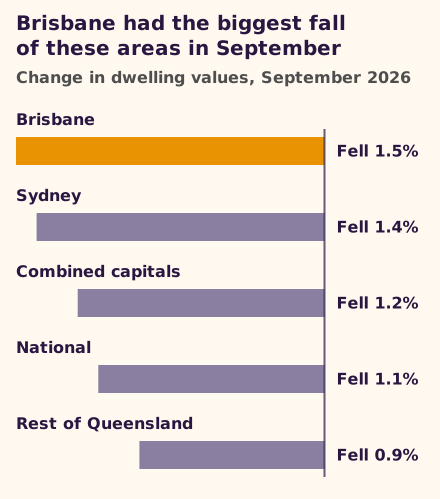
Brisbane dwelling values fell 1.5% in September, the largest monthly fall among the capitals, but remained 5.9% higher than a year earlier. Buyers may have more room to negotiate. Higher rates still make the repayment the first number I'd check.
This guide shows you what the current numbers mean, where different budgets are landing, and the checks I'd make before you commit to a home.
If you want help matching the market to your actual borrowing position, our Brisbane mortgage broker team can check the repayments, upfront costs and lender issues before you make an offer.
Should you buy in Brisbane now?
If you're waiting for someone to call the top or bottom of the Brisbane market, you could be waiting a while.
The useful question is simpler: can you buy a suitable property, keep a cash buffer and hold it comfortably if rates or life change?
If the answer is yes, one monthly price move shouldn't decide the whole plan. If buying would empty your savings or push repayments to the edge, stick to your budget, even if the asking price has dropped.
The main thing is to separate the market from your position. Brisbane can be a strong long-term market and still contain properties you shouldn't buy. It can also soften for a few months while a well-located home remains the right decision for you.
Brisbane market at a glance
Scroll to see more columns
| Measure | Figure | What it means |
|---|---|---|
| Annual change | +5.9% | Higher than a year ago, but falling now |
| Monthly change | -1.5% | Biggest capital-city fall. Check recent sales. |
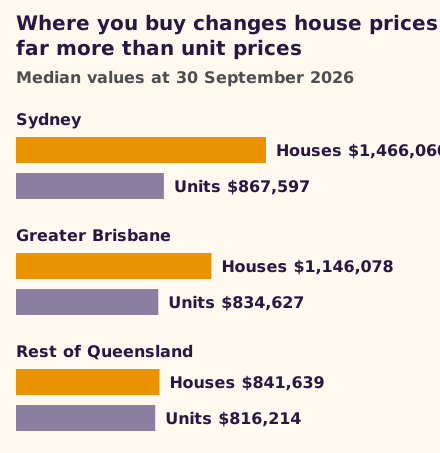
| House vs unit | $1,146,078 vs $834,627 | Units are cheaper to buy into |
| CBA forecast | -1% in 2026; +2% in 2027 | 8% peak-to-trough fall across the cycle |
| Listings, all capitals | Up 23.1% on a year earlier | More choice for buyers |
- Figure
- +5.9%
- What it means
- Higher than a year ago, but falling now
- Figure
- -1.5%
- What it means
- Biggest capital-city fall. Check recent sales.
- Figure
- $1,146,078 vs $834,627
- What it means
- Units are cheaper to buy into
- Figure
- -1% in 2026; +2% in 2027
- What it means
- 8% peak-to-trough fall across the cycle
- Figure
- Up 23.1% on a year earlier
- What it means
- More choice for buyers
Sources: Cotality’s September update and CBA Economic Insights (client research note), 1 October 2026. Greater Brisbane house median $1,146,078 and unit median $834,627 at 30 September 2026. These citywide medians describe the whole market. A specific property needs its own valuation.
House medians across Sydney, Greater Brisbane and the rest of Queensland are $624,421 apart. Unit medians are only $51,383 apart. A median house in the rest of Queensland ($841,639) costs just $7,012 more than a median Greater Brisbane unit ($834,627).
The median unit is $165,373 under the 5% Deposit Scheme's $1 million Brisbane price cap, so an eligible first home buyer may be able to buy it with a 5% deposit of $41,731 and no Lenders Mortgage Insurance (LMI). The median house is $146,078 over the cap. Avoiding LMI on it usually takes a 20% deposit of $229,216.
What the market is doing now
The latest fall is more pronounced than the early slowdown.
Brisbane dwelling values fell 1.5% in September while remaining 5.9% higher over the year. Those two figures describe different periods. Values can be up over the year and still be falling month to month.
Cotality’s September report also shows longer selling times and more advertised stock across the combined capitals. That figure covers all the capitals, so treat it as broader context for Brisbane.
For a buyer, slower speed can be useful. You may see fewer frantic offers, longer conversations with agents and a better chance to make the contract subject to the checks you actually need.
Good entry-level homes can still move quickly. The difference is that you shouldn't assume every open home will turn into a ten-person bidding contest.
What does your budget buy in Brisbane?
Use the citywide median as a temperature check for the whole market.
Cotality’s Greater Brisbane house median was $1,146,078 in September 2026. It sits in the middle of a wide range of prices, so it can't tell you what a specific house is worth. Use it to understand the broad price gap, then compare recent sales for the property type and area you want.
Use these price bands to guide your search; the available properties will vary.
Below about $700,000
Your realistic options are mostly units, townhouses and a smaller number of houses in the Ipswich corridor or on the Greater Brisbane fringe.
Caboolture, Kippa-Ring and Woodridge have had unit stock below the Brisbane-wide unit median. Condition, flood exposure and transport can change the value quickly from one street to the next.
At this price, a building and pest report, flood check and strata review can matter more than chasing another $10,000 off the asking price.
About $700,000 to $900,000
This is where the choice opens up.
You may be comparing an outer-corridor house with land against a better-located unit or townhouse closer to work. Neither is automatically the smarter buy.
The house may give you land and fewer shared-property rules. The unit may save hours of travel and carry lower repayments. Body corporate fees, upcoming works and insurance need to sit beside the purchase price in that comparison.
About $900,000 to $1 million
You have a broader choice of outer-ring houses, middle-ring units and townhouses.
For an eligible first home buyer, this range can still sit under the Australian Government 5% Deposit Scheme's $1 million Brisbane price cap. Staying under the cap doesn't make the loan affordable by itself. The lender still checks income, debts, living costs and the property.
Above $1 million
Choice improves, but so does the cost of being wrong.
At this level, I'd pay close attention to the bank valuation, repayment buffer and what else the purchase stops you doing. An extra bedroom or slightly better postcode can be expensive if it leaves no room for repairs, parental leave or a future rate rise.
Houses versus units: the real trade-off
Brisbane units grew 8.5% over the year to 30 September 2026 and houses grew 5.3%. At 30 September 2026 the Greater Brisbane house median was $1,146,078 and the unit median was $834,627.
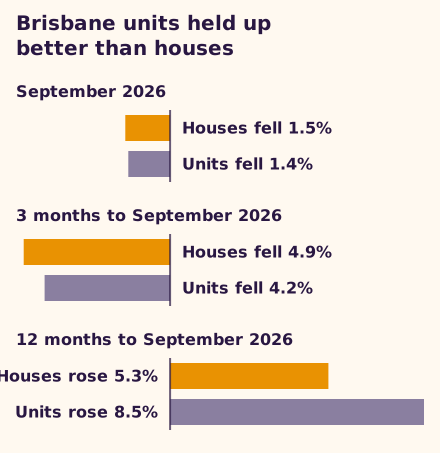
That gap changes more than the purchase price.
Using September's medians as an example, a 10% deposit differs by roughly $31,000 before duty and buying costs. For today’s purchase, run the same comparison using the actual prices of the properties on your shortlist.
Source: Cotality Home Value Index, data to 30 September 2026.
Comparing houses with units and townhouses
Scroll to see more columns
| Compare | House | Unit or townhouse |
|---|---|---|
| Price | Often higher price and repayments | Lower entry price in many established areas |
| Space | More chance of land and room to extend | Usually less space |
| Location | Outer-corridor value may mean a longer commute | Often closer to transport and work; more supply nearby |
| Upkeep | You control more of the maintenance | Body corporate fees add to holding costs |
| Costly surprises | Flood, retaining walls, roofing and termites | Defects, insurance and planned strata works |
- House
- Often higher price and repayments
- Unit or townhouse
- Lower entry price in many established areas
- House
- More chance of land and room to extend
- Unit or townhouse
- Usually less space
- House
- Outer-corridor value may mean a longer commute
- Unit or townhouse
- Often closer to transport and work; more supply nearby
- House
- You control more of the maintenance
- Unit or townhouse
- Body corporate fees add to holding costs
- House
- Flood, retaining walls, roofing and termites
- Unit or townhouse
- Defects, insurance and planned strata works
There's no market-wide winner.
The better fit is the property type you can afford to hold without resenting the compromise. If a cheaper house adds ten hours of travel every week, it may not feel cheaper for long. If a unit has a large special levy coming, add it to the advertised price.
Four areas worth comparing on a first-home budget
Ipswich: lower house entry, property checks matter
Ipswich remains one of the clearest places to look for a house on a first-home budget. It has rail access and established centres. Our Ipswich suburb guide can help you narrow the search.
The trade-off is property variation. Flood exposure, building condition and the exact distance to a station can change the answer within the same suburb.
Judge each street and property on its own checks before you buy.
Logan: compare the location and property type
Logan covers very different property types and locations, so a Greater Brisbane growth figure won't describe every option there.
A Woodridge unit, a Kingston house and a newer property around Loganlea don't have the same buyer pool, transport or maintenance profile. Compare current local sales and listings, then check the individual property.
Moreton Bay: lifestyle and transport, with a widening range
Moreton Bay gives buyers several different routes: rail-connected units, peninsula lifestyle and houses further north.
The trade-offs are just as varied. Coastal exposure can affect insurance and maintenance. Apartment buildings can have very different body corporate positions. A house further north may be cheaper but add a longer commute.
Middle-ring units: location can beat land
A well-run unit or townhouse in the middle ring can be a practical first step for someone who wants to stay close to work and established services.
That option only works if the building is well run.
Read the body corporate records. Check the sinking fund, insurance, defects and planned works. If the bank or insurer dislikes the building, your personal view of the suburb won't fix the finance.
For suburb-level research, use our Best suburbs in Brisbane guide and Brisbane suburb map. This page is the market overview. Those tools are where you narrow the search. Buying to invest instead? Our guide to 5 Queensland property hot spots compares prices, rents and holding costs.
Check to see if you're eligible for a home loan
Three traps that can turn a cheap property into an expensive one
1. The bank's valuation can come in below your price
You can agree to pay $800,000 and have the bank value the property lower.
The lender normally works from the lower figure when calculating the loan. If the valuation comes back at $760,000, you may need more cash, a smaller loan or a different structure.
This is why I wouldn't use every dollar for the deposit before the valuation and contract conditions are clear.
2. Flood and insurance can change the finance
Brisbane buyers need to check flood exposure before they get emotionally committed.
Start with the council FloodWise report, then get an insurance quote for the exact address. A property can look affordable until the insurance premium or excess lands in the real budget.
3. A unit's special levy is part of the purchase price
Low body corporate fees don't tell you whether the building has enough money set aside.
Read the body corporate records and meeting minutes. If major waterproofing, cladding or lift work is coming, a special levy can remove the saving you thought you were getting.
Interest rates have changed what buyers can pay
The RBA announced a rise to 4.60% on 29 September 2026, effective 30 September. That was its fourth increase this year. Your lender’s home loan rate and the timing of any change are separate, so refresh the repayment calculation before making an offer.
The ABS August inflation release, published on 30 September, showed annual headline inflation at 4.0%, up from 3.5% in July. Underlying (trimmed mean) inflation, which strips out the biggest price swings, was unchanged at 3.6%. The release came out after the RBA decision. I wouldn't build a buying budget around a rate cut that hasn't happened. Our interest-rate outlook covers the bank forecasts.
That creates a strange market. Prices can remain high while the amount a bank will lend you falls.
Don't carry last year's pre-approval into this year's offer. Income may be the same, but assessment rates, existing debts and lender calculations can produce a different limit.
There are two numbers I'd separate:
- The maximum the lender may approve.
- The repayment you're comfortable carrying.
Those numbers don't have to be the same.
If buying at the maximum leaves no room for rates, repairs or normal life, bring the search price down before you start negotiating with yourself at an open home.
How much deposit do you need?
Deposit is only one part of the cash position, but it's a useful starting point.
Deposit amounts by purchase price
Scroll to see more columns
| Purchase price | 5% deposit | 10% deposit | 20% deposit |
|---|---|---|---|
| $650,000 | $32,500 | $65,000 | $130,000 |
| $800,000 | $40,000 | $80,000 | $160,000 |
| $950,000 | $47,500 | $95,000 | $190,000 |
These are deposit figures only. They don't include transfer duty, conveyancing, inspections, lender costs, moving costs or the cash buffer you keep after settlement.
Eligible first home buyers may be able to use the Australian Government 5% Deposit Scheme and avoid Lenders Mortgage Insurance (LMI), a premium usually charged when your deposit is under 20%. Eligible single parents and legal guardians may have a 2% path. The lender still needs to approve the loan and the property must sit within the local price cap.
Queensland also has a $30,000 First Home Owner Grant for eligible new homes below $750,000, and first home transfer-duty concessions can change the upfront cost.
Use the 5% Deposit Scheme checker and Queensland stamp duty calculator for the current rules. Don't add the benefits together until each one has been checked against your property and contract.
Buy now or wait?
There are good reasons to buy now and good reasons to wait. Recent price growth isn't enough on its own.
Buying now may make sense when
- Your pre-approval uses current income, debts and rates.
- The repayment remains comfortable with a buffer.
- You can pay the deposit and costs without emptying every account.
- The property works for at least the next few years.
- Building, flood, insurance and strata checks are acceptable.
- You're buying because the home suits your plan.
Waiting may put you in a stronger position when
- You need the absolute maximum loan just to enter the suburb.
- Settlement would leave no emergency cash.
- Your job, income, visa or credit position is about to improve.
- You're relying on a grant or scheme that hasn't been confirmed.
- Every property in range comes with a compromise you already know you can't live with.
- You'd probably need to sell again within a short period.
Waiting can be the stronger move. Sometimes six months of extra savings or a more consistent income history does more for the plan than trying to predict six months of property prices.
What could happen next?
CBA’s 1 October 2026 forecast has Brisbane dwelling prices down 1% over calendar 2026 and up 2% in 2027, with an 8% peak-to-trough decline across the cycle. Those are different measures: the 8% covers the whole cycle, so don't add it to the annual figures.
CBA expects the national recovery to begin during 2027, conditional on the RBA starting to cut rates. Without those cuts, the recovery could be smaller. No forecast can tell you what a particular Brisbane home will sell for next year. The Australian property market update compares the other capitals.
I'd test the purchase against three reasonable outcomes.
If prices soften further
You may get more choice and negotiating room. A strong cash buffer matters because a small deposit gives you less equity protection early on.
If prices move sideways
You get time for income and savings to catch up. Property selection matters more than market momentum.
If prices start rising again
Buying sooner may help, but only if the repayment was comfortable in the first place. A rising market doesn't repair an overstretched budget.
Brisbane still has long-term demand drivers, including population growth, constrained new supply and major infrastructure. It also has stretched affordability and higher rates pulling the other way.
My view is simple: don't make a 30 year loan decision from a 12 month forecast.
Would you like to learn about your situation?
Before you make an offer
Putting the market figures to work
Brisbane’s September decline gives buyers a reason to check comparable sales carefully. It doesn't remove the need for a comfortable repayment and a cash buffer.
Units and outer corridors have become the practical entry points for many buyers. More listings and slower momentum can create room to negotiate. Higher rates mean the finance needs to be tighter than it was a year ago.
I'd choose the repayment first, then the property type, then the area. That stops a postcode or headline price from deciding the loan for you.
If you have a shortlist, send us the price, suburb and your deposit figure. We can check the borrowing range, upfront costs and lender issues before you commit to an offer.
Quick answers
Client examples are based on real situations. Names and identifying details have been changed.

Sources
Sources for the October market update
Market update checked 1 October 2026. House and unit medians are as at 30 September 2026. Client stories describe individual situations, and their borrowing figures may not match a quote today.

Jayden Vecchio is a Hunter Galloway mortgage broker with a background in commercial and development finance. He holds a Certificate IV in Finance & Mortgage Broking and a Diploma of Financial Planning.
Sources
- Cotality: September housing values, published 1 October 2026, with detailed index tables.
- Cotality: detailed index tables
- CBA Economic Insights (client research note), “Home prices fall further in September while credit growth holds steady in August”, 1 October 2026. Used for the Brisbane forecast.
- ABS: August 2026 Consumer Price Index, released 30 September
- RBA: 29 September 2026 decision statement
- RBA: cash rate target and effective dates
General information only. This doesn't consider your objectives, financial situation or needs. Rates, policies and figures change, so confirm current details before acting. Loans are subject to lender approval.