
The Australian dream of homeownership faces a new hurdle as the RBA lifted the cash rate to 4.35% on May 5, 2026, driven by a 4.6% inflation spike and global energy volatility. For first-time buyers, this “triple-threat” of rising fuel costs, tighter bank serviceability, and high dwelling prices requires a tactical shift.
This guide, written by an expert mortgage broker in Brisbane, provides a clear roadmap to secure your pre-approval and navigate the 2026 property market with confidence.
Interest Rate Hikes At A Glance
Current Market Status
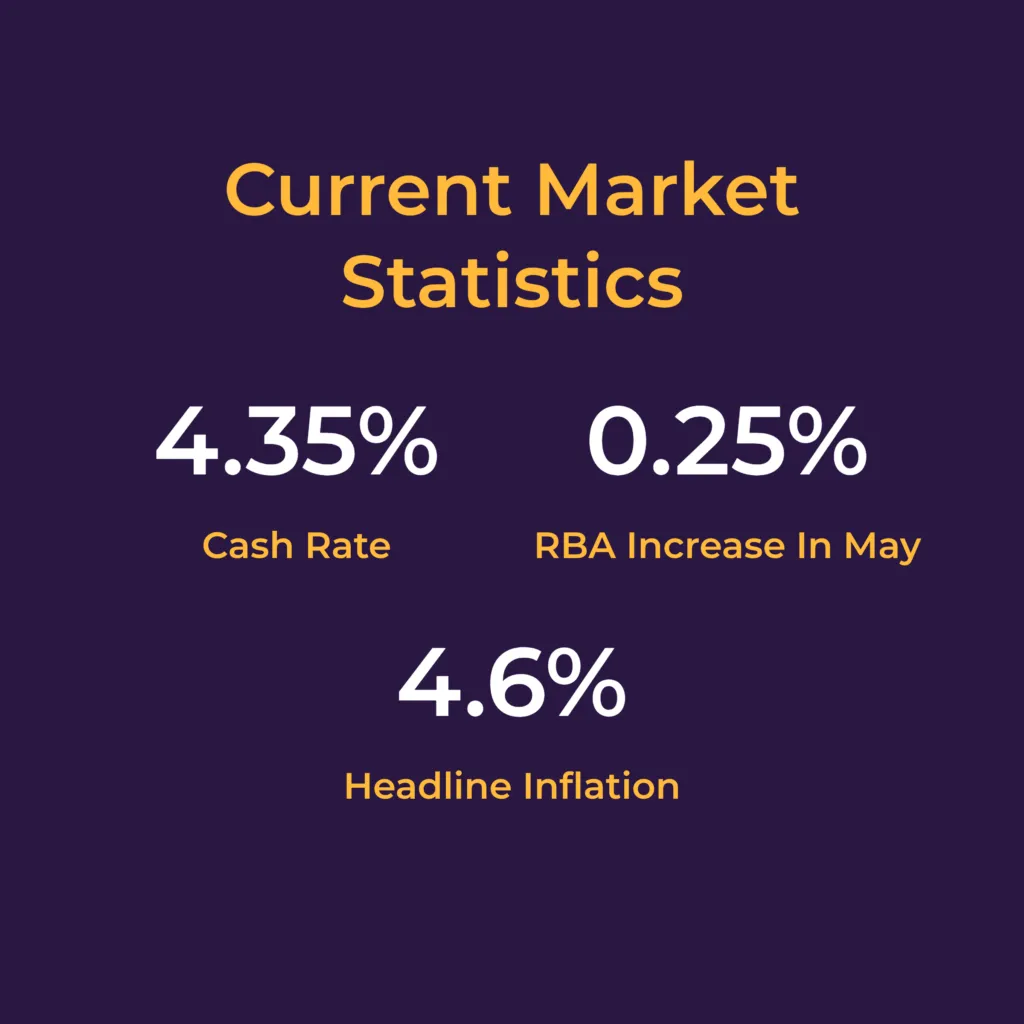
- The Cash Rate: 4.35% (Effective as of May 6, 2026).
- The Latest Move: The RBA raised the rate by 0.25% on May 5, 2026.
- The Inflation Factor: Headline inflation has spiked to 4.6%, primarily driven by global energy costs and service-sector pressure.
The 2026 Outlook
- Next RBA Meeting: June 16, 2026.
- The Trend: This is the third hike of 2026, following the moves from 3.85% in February to 4.10% in March and now 4.35% in May, confirming a “higher-for-longer” cycle.
- The Market Sentiment: CBA and ANZ believe May was the peak; NAB is tipping one more 25 bp move in June and Westpac is forecasting two further hikes to 4.85% by September.
Why the RBA Is Moving Now
Inflation has proven more “sticky” than anticipated, surging in the first quarter of 2026. The combination of stagnant productivity and high unit labour costs has created an inflationary floor that the RBA is determined to break.
By lifting the rate to 4.35%, the Board is attempting to cool domestic demand and return inflation to the 2–3% target band, even as global trade tensions add external price pressure.
What This Means for Your Homebuying Journey
- Borrowing Power: This latest 0.25% increase will effectively reduce the average buyer’s borrowing capacity by approximately 2-3% overnight.
- Pre-Approvals: Most pre-approvals issued in March or April are now subject to reassessment. Banks will likely adjust your maximum loan limit down to account for the new 4.35% floor.
- Repayment Stress: Banks have increased their serviceability “stress tests.” You must now prove you can handle repayments at a rate of roughly 7.35% or higher (current variable rate + 3% APRA buffer).
The Repayment Impact: Counting The Cost Of The 4.35% Rate
Understanding the “why” of a rate hike is only half the battle. As a first homebuyer, you need to know exactly how these changes hit your hip pocket. Following the May 5, 2026, RBA decision, lenders are expected to pass the full 0.25% increase onto variable-rate products almost immediately.
The Real Cost of the May 2026 Increase
Even a small move of 0.25% adds up quickly over a 30-year loan. With the cash rate now at 4.35%, typical owner-occupier variable rates are hovering around 6.90%. Here is how your monthly budget changes:
| Loan Amount | Monthly Increase (+0.25%) | New Monthly Repayment (Est. 6.90% Variable) |
| $500,000 | +$81 | $3,293 |
| $750,000 | +$122 | $4,939 |
| $1,000,000 | +$163 | $6,586 |
Calculations assume a 30-year principal and interest loan. Your specific rate may vary based on your lender, LVR, and credit profile.
The "Buffer Factor": The Hidden Hurdle
The biggest challenge for mid-2026 buyers isn’t just the higher monthly payment—it’s the serviceability buffer.
The Australian Prudential Regulation Authority (APRA) currently requires banks to use a 3% buffer when testing your loan application. This means if you apply for a loan at a 6.90% interest rate, the bank must prove you can still manage the debt if the rate hits 9.90%.
Why this matters for you right now:
- Borrowing Power Crunch: As the cash rate rises, your “stress test” rate also moves up. Since February, the average Australian’s borrowing power has dropped by roughly 5% in total.
- The 7% Floor: Most lenders have now effectively moved their “floor rates” above 7%. They test you against whichever is higher: the floor rate or your actual rate plus 3%.
- DTI Guardrails: With the APRA changes that took effect on February 1, 2026, banks are increasingly wary of Debt-to-Income (DTI) ratios exceeding six times your annual earnings. If the higher interest rates push your total debt costs too high, you may hit these DTI limits sooner than expected.
Expert Forecasts For Australia’s 2026 Rate Hikes

The Inflation Lookout: Adam Boyton (ANZ)
Adam Boyton and the ANZ economics team remain the leading voices of caution following the May 5, 2026, hike to 4.35%. Their latest analysis highlights a dangerous “second-round” inflation effect. While service costs (insurance and health) were the primary concern in early 2026, the focus has shifted to the energy shock caused by Middle East tensions.
The Prediction: ANZ suggests that today’s increase was a pre-emptive strike to prevent these rising fuel and transport costs from “embedding” into broader consumer prices. Boyton notes that while this may be the final hike of the cycle, the RBA’s priority has shifted from a “soft landing” to absolute price stability.
The Property Pulse: Louis Christopher (SQM Research)
In a major update to his 2026 Housing Boom and Bust Report, Louis Christopher has revised his projections to account for the “higher-for-longer” reality. While he remains bullish on specific markets, the rapid ascent to a 4.35% cash rate has tempered growth expectations in the southern capitals.
The Prediction: SQM Research now forecasts a more modest 0% to +3% weighted capital city growth for the remainder of 2026. However, Brisbane continues to defy the trend.
The Driver: Christopher cites a “structural supply deficit” that is essentially rate-proof. Even with higher borrowing costs, Brisbane’s record-low listing volumes and sustained interstate migration act as a “price floor,” with double-digit growth still possible in resource-linked and Olympic-precinct suburbs.
The "Big 4" Consensus: The "Rate Cut" Horizon
The “Big 4” banks—CBA, Westpac, NAB, and ANZ—have reached a rare consensus following today’s 8-1 RBA vote: the era of cheap credit is not returning anytime soon.
CBA & ANZ: Both view May as the peak and have scrapped any remaining 2026 rate-cut forecasts, with easing not expected until 2027.
Westpac & NAB: Both are still in the tightening camp — NAB sees one more 25 bp move in June, while Westpac is forecasting two further hikes to 4.85% by September.
Check to see if you are eligible for a home loan
Steering The Ship: Tactical Steps For Homebuyers

When interest rates rise, you don’t have to just “take it” from the banks. You are the captain of your financial ship. By taking a proactive approach, you can often offset the impact of a hike or even find ways to get ahead.
Here is your action plan to navigate these choppy waters.
Step 1: Fight the "Loyalty Tax" with a Rate Review
Loyalty is an expensive trait. Following today’s 4.35% hike, banks will be quick to raise your rate but slow to offer you their new customer discounts. This gap is known as the Loyalty Tax.
- The 0.25% Rule: If your bank hasn’t reviewed your rate since the February hike, you are almost certainly paying too much. Even a 0.25% difference can save you over $1,500 a year on a $750,000 loan.
- The Strategy: Don’t wait for your statement. Call your lender or ask us to perform a Rate Review immediately. We often find that banks will drop your rate by 0.30%–0.50% just to keep your business, but only if you provide a competitive counter-offer.
Step 2: Make Your Savings Work Harder with an Offset Account
An offset account is your most powerful defence against rate rises. It is a transaction account linked to your mortgage; every dollar in it “offsets” the balance of your loan, so you only pay interest on the difference.
- The 7% Return: With variable rates now pushing 6.90%–7.10%, every dollar in your offset is effectively “earning” you a ~7% tax-free return. You won’t find a standard savings account in 2026 that beats that after-tax.
- The Impact: Parking $20,000 in an offset account on a $500,000 mortgage doesn’t just lower your monthly interest—it can shave over 3 years off your loan term at current rates.
Step 3: Beat the Deposit Hurdle with the First Home Guarantee (FHG)
The biggest barrier for first homebuyers remains the deposit. As the RBA tightens the screws, the Australian Government’s Home Guarantee Scheme has become an essential lifeline.
- 5% Deposit, No LMI: The FHG allows you to buy a home with just a 5% deposit without paying Lender’s Mortgage Insurance (LMI). In the current market, this can save you $20,000 to $35,000 in upfront costs.
- 2026 Price Caps: To reflect the 10-15% growth seen in markets like Brisbane, price caps remain at their elevated levels:
- Sydney/Regional NSW: Up to $1,500,000
- Brisbane/Gold Coast/Sunshine Coast: Up to $1,000,000
- Melbourne/Regional VIC: Up to $950,000
- Unlimited Places: The removal of the “first come, first served” quota means you can focus on finding the right property rather than racing against a government deadline.
Step 4: Navigate the "DTI" Guardrails
The APRA rules that tightened on February 1, 2026, are now in full effect. Lenders are strictly limiting the number of “High Debt-to-Income” (DTI) loans they can approve.
- The 6x Rule: If your total debt exceeds six times your annual gross income, your application will face intense scrutiny.
- The Pre-Approval Pivot: With today’s hike to 4.35%, many buyers who were “on the edge” of their DTI limits in April will now find they no longer qualify for the same loan amount. We recommend an immediate Pre-Approval Refresh to see how your maximum bid has changed before you head to an auction.
The RBA’s Radar: Why Global Winds Still Matter In Australia
While the RBA is hyper-focused on our local economy, they don’t ignore the horizon. For an island nation, Australia is deeply connected to the global market. To understand why your mortgage rate moves, you have to look at the “big picture” of mid-2026.
The Middle East Energy Shock: A New Inflation Driver
The RBA’s primary global concern has shifted from general supply chains to the escalating conflict in the Middle East. With Brent crude oil surmounting US$100/barrel, the “imported inflation” from fuel is hitting Australian households directly at the pump.
- The Risk: A prolonged blockade of the Strait of Hormuz could remove 15% of global oil supply.
- The Impact: This isn’t just about petrol prices; it’s about the “second-round” effects. Higher transport costs mean more expensive groceries and hardware, forcing the RBA to keep rates at 4.35% to prevent an inflationary spiral.
The China Connection: A Fragile Giant
China remains our largest trading partner, but in 2026, the structural cracks in their property sector have widened. Sales of primary homes are forecast to fall by up to 14% this year, signaling a permanent shift away from the old “high-growth” model.
- The Logic: Iron Ore vs. Interest Rates: Australia’s economy relies on Chinese demand for iron ore. While prices have stayed resilient around US$100/t due to demand from India, any significant drop in Chinese steel production would slow our national income.
- The RBA’s Pivot: If China’s economy stumbles further, the RBA may be forced to stop hiking—not because inflation is solved, but to protect Australian jobs from an export-led slowdown.
Productivity: The "Silent" Reason for High Rates
The RBA remains hawkish because Australia is facing a Productivity Cliff. Latest ABS data shows multifactor productivity declined by 0.5%, falling well below the 20-year average.
- The Productivity Problem: We are working more hours but producing less output per hour.
- The Wage Spiral: When wages grow (to keep up with 4.6% inflation) without a matching rise in productivity, “unit labour costs” skyrocket.
- The Result: Companies raise prices to cover these costs. Until we see a technological or efficiency breakthrough in the local economy, the RBA views the 4.35% rate as a necessary “anchor” to keep the economy from overheating.
The 2026 Trade War Factor
Renewed US-led trade tensions and 15% “Section 122” tariffs have added a layer of friction to global trade. For a small, open economy like Australia, these “reconfigurations” of supply chains make imports more expensive. The RBA must remain conservative; they cannot cut rates too quickly while global trade remains this volatile, or they risk a fresh flare-up in the cost of everything from cars to computers.
Frequently Asked Questions About Interest Rate Hikes
When will the next RBA interest rate hike happen?
The RBA hiked to 4.35% on 5 May 2026 — the third 25 bp move of the year. Westpac is currently the most hawkish Big 4, forecasting two further hikes to 4.85% by September; NAB sees one more 25 bp move in June; CBA and ANZ believe May was the peak.
How much notice must my bank give me before raising my rate?
In Australia, lenders are generally required to give you at least 20 to 30 days’ notice before a change in your minimum repayment takes effect.
Does a rate hike affect my pre-approval?
Yes. If rates rise before you find a property, your lender may reassess your borrowing capacity, potentially reducing the maximum amount you can spend.
Is it too late to switch to a fixed-rate mortgage?
While fixed rates have risen, they can still offer “budgetary peace of mind” if you expect more hikes in 2026. However, check for high “break costs” before committing.
How much will a 0.25% hike add to a $600,000 mortgage?
On a typical 25-year principal and interest loan, a 0.25% hike adds approximately $90 to your monthly repayments.
Will interest rates go down in 2026?
No. After three 2026 hikes (Feb, Mar, May) the cash rate is back at 4.35%, and no Big 4 bank is forecasting cuts before 2027. Expect variable rates to stay in the 6–7% band for the rest of 2026.
What is the "3% serviceability buffer"?
It is a safety margin banks use to ensure you can still afford your loan if rates rise 3% above your current rate. Hikes make this test harder to pass for new FHBs
Can I ask my bank to waive the latest rate increase?
You can’t “waive” the hike, but you can request a “rate review.” If your loan-to-value ratio (LVR) has improved, banks often grant a lower base rate to keep your business.
Would you like to learn about your situation?
Your Trusted Mortgage Broker: Hunter Galloway
While the seas are currently choppy, you don’t have to navigate them alone. Interest rate hikes and shifting lending policies can make homeownership feel like a moving target, but we’ve helped thousands of Brisbane families find the right home loan and secure their future.
As the highest-rated mortgage brokers in Brisbane with over 2,300 5-star reviews, we pride ourselves on being more than just a middleman. We are your advocates. Whether the RBA is raising rates or banks are tightening their belts, we help ensure your application has the best possible chance of success.
Why Choose Hunter Galloway?
- Expertise You Can Trust: Our team has a 97% loan approval rate, well above the industry average. We know exactly which lenders are currently “open for business” for first-time buyers.
- We Speak “Bank”: We understand the complex credit policies of over 30 Australian lenders. We’ll find the right fit for your unique situation—even if you’ve been told “no” elsewhere.
- A Relationship, Not a Transaction: We stay with you for the long haul. From your first pre-approval to your tenth-anniversary rate review, we are your partners in property.
Take Control of Your Financial Future Today
Don’t let the 2026 interest rate hikes sink your homeownership dreams. Take proactive steps today to see where you stand.
- Request a 2026 Rate Review: If you already have a mortgage, let us negotiate with your bank to scrap the “Loyalty Tax” and secure a better deal.
- Get a 2026 Pre-Approval Check: Planning to buy? Get a clear picture of your updated borrowing power so you can bid with absolute confidence.
- Book Your Free Assessment: Our service is 100% free for you—the lenders pay us for the work we do.
Give us a call at 1300 088 065 or book your free assessment online. Let’s make your property goals a reality, regardless of the shifting mortgage landscape.
More Resources For Homebuyers
- Calculate your borrowing power
- First home guarantee scheme – buy with 5% deposit
- First home buyer guide 2026
- 23 tips to find the best mortgage broker