


Where I have seen OwnHome make sense
Think of someone who has spent time travelling and just moved back to Australia. They are earning well again but have not rebuilt their savings. OwnHome could help them buy, provided their income and employment meet both lenders' requirements.
Even in that situation, I have found the repayments hard to justify. You need enough left after paying both loans to live comfortably and keep some savings aside.
Potentially no deposit
Eligible buyers may borrow the full purchase price. You still need to fund the applicable fees and buying costs.
A much bigger monthly bill
The deposit loan has a higher rate and shorter term than the main home loan, so its monthly repayment is much larger than you might expect.
Budget for the full term
Refinancing may reduce the cost later, but it depends on your equity and financial position. You need to afford the loans if you keep them for their full terms.
How borrowing up to 100% actually works
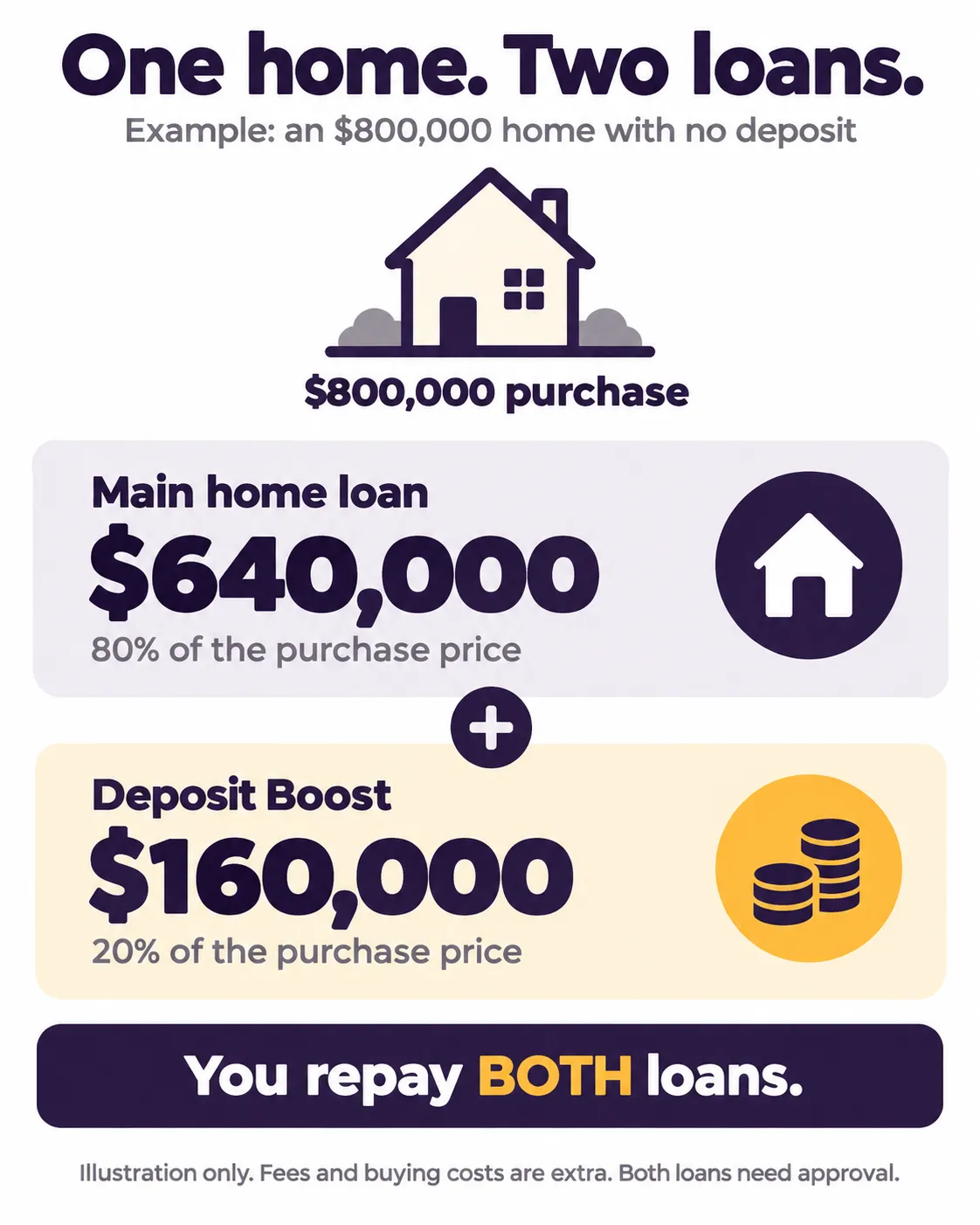
You buy the home in your own name. The main loan normally covers 80% of its value, and Deposit Boost lends you the deposit you are missing. Any savings you put towards the purchase reduce that second loan.
The diagram shows an $800,000 purchase with no deposit, assuming the valuation matches the price. Fees and buying costs are extra.
What changes if you have a 5% deposit?
Put $40,000 towards that home and the deposit loan falls to $120,000. The main loan stays at $640,000, leaving $760,000 to repay.
The combined debt divided by the property's value is your loan to value ratio, or LVR. Here, $760,000 divided by $800,000 is 95%.
Do both loans have to be with OwnHome?
Deposit Boost can be paired with OwnHome Primary or another lender that accepts a borrowed deposit and second mortgage. Both loans need approval, and settlement dates need to line up. OwnHome's broker contact details
Why the repayments can be so high
Borrowing the full price of a $1 million home would cost about $7,499 a month at the illustrative rates below. The main loan runs for 30 years and Deposit Boost for 15 years, with fees and buying costs paid separately.
These rates come from the OwnHome comparison prepared on 29 September 2026. They are illustrative, not a current quote or loan approval. The RBA lifted the cash rate by 0.25 percentage points that same day and lenders are lifting variable rates from early October, so current rates may be higher. We’ll get you a current quote before you decide.
| Loan | Amount borrowed | Illustrative rate and term | Monthly repayment |
|---|---|---|---|
| Main home loan | $800,000 | 6.14% over 30 years | $4,869 |
| Deposit Boost | $200,000 | 13.75% over 15 years | $2,630 |
| Both loans together | $1,000,000 | Two separate loans | $7,499 |
Illustrative repayments on a $1 million purchase with no deposit
Main home loan
- Amount borrowed
- $800,000
- Illustrative rate and term
- 6.14% over 30 years
- Monthly repayment
- $4,869
Deposit Boost
- Amount borrowed
- $200,000
- Illustrative rate and term
- 13.75% over 15 years
- Monthly repayment
- $2,630
Both loans together
- Amount borrowed
- $1,000,000
- Illustrative rate and term
- Two separate loans
- Monthly repayment
- $7,499
- Main home loan$4,869 / month
- Deposit Boost$2,630 / month
Illustration: $800,000 at 6.14% over 30 years plus $200,000 at 13.75% over 15 years. Monthly principal and interest repayments, rounded. Rates from the 29 September 2026 comparison are held unchanged; fees and buying costs are paid separately.
Deposit Boost is 20% of the debt here, but takes about 35% of the monthly repayment. Some of the higher payment reduces your debt faster; you still need to find that money each month.
Would the budget cope with higher rates?
If both rates rose by 2 percentage points to 8.14% and 15.75%, the same starting loans would cost about $8,851 a month, or $1,352 more. This is a stress scenario, not a forecast or the lender's approval test.
Ask for a quote showing each loan's rate, term, fees and repayment, including when any discount ends.
Why I would choose the 5% Deposit Scheme first
If you qualify and have the deposit and buying costs, I would choose the 5% Deposit Scheme ahead of OwnHome. You avoid lenders mortgage insurance (LMI) and the separate deposit loan.
There is no income cap following the changes on 1 October 2025. Property price caps, buyer eligibility and the lender's affordability checks still apply. Eligible single parents and legal guardians may qualify with a 2% deposit. Official scheme information
Same $1 million home, same $150,000 savings
This illustration uses a $1 million NSW home and $150,000 in savings. Allowing $42,372 for duty, registration and conveyancing leaves $107,628 towards the purchase in both options.
OwnHome's loan amounts and rates come from its 29 September 2026 comparison. For the scheme, I have assumed 6.14% over 30 years, matching OwnHome's main-loan rate. The scheme rate is not a lender quote, and the buyer and property must qualify.
| What we are comparing | OwnHome | 5% Deposit Scheme |
|---|---|---|
| Purchase price | $1,000,000 | $1,000,000 |
| Starting savings | $150,000 | $150,000 |
| Illustrative duty, registration and conveyancing | $42,372 | $42,372 |
| Cash towards the purchase | $107,628 | $107,628 |
| Low Deposit Premium added to the loan | $15,000 | $0 |
| Lenders mortgage insurance | $0 | $0 |
| Main home loan | $800,000 at 6.14% over 30 years | $892,372 at an assumed 6.14% over 30 years |
| Deposit Boost | $107,372 at 9.70% over 15 years | No separate deposit loan |
| Total starting debt | $907,372 | $892,372 |
| Monthly repayments for the first 15 years | $6,003 | $5,431 |
OwnHome compared with the 5% Deposit Scheme using the same $150,000 savings
Purchase price
- OwnHome
- $1,000,000
- 5% Deposit Scheme
- $1,000,000
Starting savings
- OwnHome
- $150,000
- 5% Deposit Scheme
- $150,000
Illustrative duty, registration and conveyancing
- OwnHome
- $42,372
- 5% Deposit Scheme
- $42,372
Cash towards the purchase
- OwnHome
- $107,628
- 5% Deposit Scheme
- $107,628
Low Deposit Premium added to the loan
- OwnHome
- $15,000
- 5% Deposit Scheme
- $0
Lenders mortgage insurance
- OwnHome
- $0
- 5% Deposit Scheme
- $0
Main home loan
- OwnHome
- $800,000 at 6.14% over 30 years
- 5% Deposit Scheme
- $892,372 at an assumed 6.14% over 30 years
Deposit Boost
- OwnHome
- $107,372 at 9.70% over 15 years
- 5% Deposit Scheme
- No separate deposit loan
Total starting debt
- OwnHome
- $907,372
- 5% Deposit Scheme
- $892,372
Monthly repayments for the first 15 years
- OwnHome
- $6,003
- 5% Deposit Scheme
- $5,431
- OwnHome$6,003 / month
- 5% Deposit Scheme$5,431 / month
Illustration only. OwnHome: $800,000 at 6.14% for 30 years plus $107,372 at 9.70% for 15 years. Scheme: $892,372 at an assumed 6.14% for 30 years. Same $1 million purchase and $150,000 savings. Monthly principal and interest repayments, rounded; rates held unchanged.
The scheme leaves you paying about $572 less each month, with $15,000 less debt from the start.
You can contribute more than 5% under the scheme. This example uses all the cash left after buying costs, so the buyer would need separate emergency savings.
What does that mean over 5 years?
| After 5 years | OwnHome | 5% Deposit Scheme |
|---|---|---|
| Interest paid, rounded | $285,425 | $265,291 |
| Low Deposit Premium charged at the start | $15,000 | $0 |
| Interest plus premium | $300,425 | $265,291 |
| Remaining debt, rounded | $832,626 | $831,815 |
Illustrative 5-year interest, premium and remaining debt
Interest paid, rounded
- OwnHome
- $285,425
- 5% Deposit Scheme
- $265,291
Low Deposit Premium charged at the start
- OwnHome
- $15,000
- 5% Deposit Scheme
- $0
Interest plus premium
- OwnHome
- $300,425
- 5% Deposit Scheme
- $265,291
Remaining debt, rounded
- OwnHome
- $832,626
- 5% Deposit Scheme
- $831,815
OwnHome costs about $35,134 more in interest and the premium over 5 years under these assumptions. You would also owe about $812 more at that point. Principal repayments are kept separate from interest and fees.
The calculations assume unchanged rates, monthly principal and interest repayments, no extra repayments and no offset balance. The $15,000 premium is financed within OwnHome's starting debt. Other loan fees, reports and any separately charged buyer's agent service are excluded. Check the illustrative NSW buying costs for your purchase.
Why OwnHome looks cheaper in the LMI comparison
OwnHome's comparison shows $6,003 a month against a standard loan at 8.27% costing $6,874, with $20,895 in LMI added to the debt. OwnHome is cheaper against that particular loan. An eligible scheme buyer avoids LMI, so that comparison doesn't tell you which option is best for them.
The online upfront-cost calculator also includes LMI in its standard 5% deposit example. It does not compare the government scheme. Use the costs and rates available to you when weighing up the options.
| Option and guide | Why I would compare it |
|---|---|
| Guarantor home loan | Family property can provide security for a loan with little or no deposit and may avoid LMI. Compare the repayments with OwnHome, but understand the risk to the family member's property. Your income still needs to cover the loan. |
| Gift or other family help | A genuine, non-repayable gift may cover the shortfall without another repayment. The lender needs to accept the source of funds. A family loan must be disclosed and assessed as debt. |
| Professional LMI waiver | Your profession or employer may qualify you for a smaller deposit without LMI, subject to that lender's deposit and income rules. |
| Standard low deposit loan with LMI | If you meet the minimum deposit requirement, a regular loan with LMI may cost less overall. Compare the premium, interest and monthly repayment. |
| Buy within the 5% Deposit Scheme cap | For the Brisbane buyer, a suitable home at or below $1 million could make the scheme available, subject to buyer eligibility, deposit and buying costs. |
| Save longer or lower the purchase budget | A strong income may let you rebuild savings quickly. Compare the time needed with the cost of borrowing the deposit now. |
Alternatives I would compare before OwnHome
- Why I would compare it
- Family property can provide security for a loan with little or no deposit and may avoid LMI. Compare the repayments with OwnHome, but understand the risk to the family member's property. Your income still needs to cover the loan.
- Why I would compare it
- A genuine, non-repayable gift may cover the shortfall without another repayment. The lender needs to accept the source of funds. A family loan must be disclosed and assessed as debt.
- Why I would compare it
- Your profession or employer may qualify you for a smaller deposit without LMI, subject to that lender's deposit and income rules.
- Why I would compare it
- If you meet the minimum deposit requirement, a regular loan with LMI may cost less overall. Compare the premium, interest and monthly repayment.
- Why I would compare it
- For the Brisbane buyer, a suitable home at or below $1 million could make the scheme available, subject to buyer eligibility, deposit and buying costs.
- Why I would compare it
- A strong income may let you rebuild savings quickly. Compare the time needed with the cost of borrowing the deposit now.
Our guarantor vs the 5% Deposit Scheme guide compares the costs and family responsibilities.
Help to Buy is another option for buyers within its separate income and property limits. The government takes an equity share with ongoing obligations, so it may not fit the high-income buyer described here. See the official Help to Buy information.
How much cash do you still need?
OwnHome charges a Low Deposit Premium of up to 2.2% of the purchase price, with a $9,500 minimum. On an $800,000 home, the maximum is $17,600. This fee is separate from your deposit and buying costs.
| Cost | What to allow for |
|---|---|
| Your contribution to the price | Any amount you are putting towards the purchase yourself. |
| Low Deposit Premium | The fee quoted for Deposit Boost, paid upfront or added to the loan if eligible. |
| Transfer duty | Depends on the state, price, property and any concession you qualify for. |
| Legal and government charges | Conveyancing, registration and other settlement costs. |
| Property checks and moving | Confirm which reports the buyer's agent covers and allow for the remaining costs. |
| Money left over | Keep enough for settlement adjustments, immediate repairs and unexpected bills. |
Cash to allow for when buying with OwnHome
Your contribution to the price
- What to allow for
- Any amount you are putting towards the purchase yourself.
Low Deposit Premium
- What to allow for
- The fee quoted for Deposit Boost, paid upfront or added to the loan if eligible.
Transfer duty
- What to allow for
- Depends on the state, price, property and any concession you qualify for.
Legal and government charges
- What to allow for
- Conveyancing, registration and other settlement costs.
Property checks and moving
- What to allow for
- Confirm which reports the buyer's agent covers and allow for the remaining costs.
Money left over
- What to allow for
- Keep enough for settlement adjustments, immediate repairs and unexpected bills.
Buyers contributing at least 5% may choose to add the premium to the loan. That preserves cash upfront but increases the debt and interest. Paying it upfront includes OwnHome's buyer's agent service. OwnHome's fee explanation
What else would I check in the fee quote?
Allow for establishment, valuation, legal, ongoing and discharge charges on both loans, plus possible break costs if a loan is fixed.
OwnHome advertises no exit or early repayment fee on Deposit Boost and says the premium is refundable until exchange. Get the refund conditions and payment date in writing. The main loan has separate terms. OwnHome loan features
Is the buyer's agent service worth paying for?
OwnHome lists its standalone buyer's agent service at $14,300 including GST. That is its advertised price; the value to you depends on how much help you need with the search and negotiations.
Confirm which inspections and reports are included and who manages purchase deadlines. Your solicitor still handles contract and legal advice. OwnHome's buyer's agent service
Will your income and credit history fit?
There is no single salary that makes this work. Your debts, dependants, living costs and loan amount all affect what you can afford.
Primary and Deposit Boost may treat income differently, so we run both assessments using the same household figures. If you have just returned to Australia, your current employment and income history need checking too.
| Your situation | What I would look at |
|---|---|
| Permanent employee | Your payslips, salary deposits and time in the job. A recent move can need a little more explanation. |
| Casual or contract work | How steady your earnings are, your work history and how long the current contract runs. |
| Overtime, allowances or bonuses | How much of that income each lender will count. Your best month may not represent the whole year. |
| Self-employed | Your tax returns and business financials, then how each lender calculates the income available to you. |
| Parental leave | Your income during leave, return-to-work plan and childcare costs, plus savings to cover any temporary shortfall. |
| Existing debts | Credit cards, car and personal loans, HELP debt and other commitments. These all affect the room left for a mortgage. |
Income and debts I would check
Permanent employee
- What I would look at
- Your payslips, salary deposits and time in the job. A recent move can need a little more explanation.
Casual or contract work
- What I would look at
- How steady your earnings are, your work history and how long the current contract runs.
Overtime, allowances or bonuses
- What I would look at
- How much of that income each lender will count. Your best month may not represent the whole year.
Self-employed
- What I would look at
- Your tax returns and business financials, then how each lender calculates the income available to you.
Parental leave
- What I would look at
- Your income during leave, return-to-work plan and childcare costs, plus savings to cover any temporary shortfall.
Existing debts
- What I would look at
- Credit cards, car and personal loans, HELP debt and other commitments. These all affect the room left for a mortgage.
What if you have had credit problems?
Tell me about missed repayments, defaults or hardship before we apply. Borrowing the deposit does not overcome a credit problem.
Citizenship or residency and the proposed owners also need to meet both lenders' rules.
Check the property before you make an offer
An established house, townhouse or apartment in an accepted location is the usual starting point. Check the exact address before making an offer; the building, postcode and valuation can change the deposit required. OwnHome's postcode checker is a starting point, not property approval.
Small apartments, acreage, unusual titles and homes needing major repairs need an early check, before you spend money on the purchase. Flood or bushfire exposure and whether you can insure the home can affect the answer too.
Building, off-the-plan and transportable homes
OwnHome excludes vacant land, construction, off-the-plan and partially completed properties, along with relocatable and transportable homes. For a build, see our construction finance guide. OwnHome's target market document
Can you buy an investment property?
OwnHome advertises investment loans for first-home buyers at up to 98% combined borrowing. On an $800,000 purchase, that means at least $16,000 towards the price, plus fees and buying costs, assuming the valuation matches. Separate investment criteria apply. OwnHome's investor option
Offsets, extra repayments and applying
An offset on Primary reduces interest on that loan only. It does not reduce Deposit Boost interest.
| Feature | Deposit Boost | OwnHome Primary |
|---|---|---|
| Loan term | 15 years advertised | Up to 30 years, subject to approval |
| Interest rate | Variable | Variable and fixed options |
| Repayments | Principal and interest | Check the repayment option in your offer |
| Offset account | No | Offset available on eligible products; check the fixed-rate option in your quote |
| Redraw | No | Available, subject to the product rules |
| Extra repayments | Allowed without an early repayment penalty | Variable loans allow extra repayments; fixed loans have limits to confirm before paying a lump sum |
OwnHome loan features
Loan term
- Deposit Boost
- 15 years advertised
- OwnHome Primary
- Up to 30 years, subject to approval
Interest rate
- Deposit Boost
- Variable
- OwnHome Primary
- Variable and fixed options
Repayments
- Deposit Boost
- Principal and interest
- OwnHome Primary
- Check the repayment option in your offer
Offset account
- Deposit Boost
- No
- OwnHome Primary
- Offset available on eligible products; check the fixed-rate option in your quote
Redraw
- Deposit Boost
- No
- OwnHome Primary
- Available, subject to the product rules
Extra repayments
- Deposit Boost
- Allowed without an early repayment penalty
- OwnHome Primary
- Variable loans allow extra repayments; fixed loans have limits to confirm before paying a lump sum
Before fixing Primary, confirm the offset features and extra-repayment limit. Money in an offset and money paid into the loan can have different rules.
Extra repayments into Deposit Boost reduce the more expensive debt, but cannot be redrawn. Keep emergency savings accessible.
The order I would work through
- Compare the optionsStart with your savings, purchase budget and combined repayments. Check the government scheme and other low deposit loans before committing to a deposit loan.
- Check both loansHave the income, savings and debt checks completed for each loan. Confirm the lender or broker handling the application and each approval's expiry date.
- Check the homeHave the property, valuation and contract conditions reviewed before making an unconditional commitment.
- Confirm the money for settlementObtain formal approvals, final loan offers and the full amount you must contribute. Your solicitor handles the contract and legal work.
Pre-approval is conditional. Missing documents, a property issue or a change in your finances can alter the result, so allow time for both approvals before your finance deadline.
Is OwnHome legit, and what do customers say?
OwnHome is a licensed Australian finance business. You can check the companies behind the loans and the complaints process in its credit guide.
Why do some older reviews talk about rent-to-own?
OwnHome replaced rent-to-own with Deposit Boost in 2023. Check which product an older review describes. OwnHome explains the change
What I take from the customer feedback
OwnHome's Trustpilot profile showed 4.5 out of 5 from 92 reviews on 29 September 2026. These selected reviews cover both buying support and service after settlement.
| Reviewer and date displayed | Rating | What they reported |
|---|---|---|
| Surevibes, 19 March 2026 | 5/5 | Clear guidance, responsive communication and support through the purchase. |
| Nic Beatson, 16 May 2025 | 5/5 | Help checking a property and negotiating within their budget. |
| Reviewer named "customer", 20 May 2025 | 3/5 | Praised purchase support but reported difficulty changing repayments and seeing loan information afterwards. |
| Lucy, 20 March 2026 | 1/5 | Reported problems with inspection timing, paperwork and communication about rates. |
Selected OwnHome Trustpilot reviews
- Rating
- 5/5
- What they reported
- Clear guidance, responsive communication and support through the purchase.
- Rating
- 5/5
- What they reported
- Help checking a property and negotiating within their budget.
- Rating
- 3/5
- What they reported
- Praised purchase support but reported difficulty changing repayments and seeing loan information afterwards.
- Rating
- 1/5
- What they reported
- Reported problems with inspection timing, paperwork and communication about rates.
Ask how you can view balances, change repayments and get help after settlement, and who handles inspection deadlines.
These are customer opinions, not verified HG client outcomes. They may not represent every customer's experience, and older reviews may concern the previous product. Read the linked reviews in full.
Can you refinance out of OwnHome later?
My aim would be to refinance out of the deposit loan within 5 years, much like working towards removing a guarantor. It depends on your equity, financial position and the new lender's approval at the time.
Budget on keeping the loans for their full contract terms: Deposit Boost is advertised over 15 years, and the main loan may run for up to 30 years. Refinancing sooner is the aim, but it cannot be what makes the repayments affordable.
Starting with little equity also leaves less room if property values fall. Selling may leave a shortfall after repaying both loans and sale costs. Both loans are secured against the home.
Watch my OwnHome review

Experience and sources
How this guide was checked
Reviewed 29 September 2026 by Joshua Vecchio.
I checked OwnHome's public product information, broker guides and the government scheme rules. The repayment examples use OwnHome's 29 September 2026 illustrations, with a separately calculated scheme comparison at the stated assumed rate. They are not current quotes or client outcomes.

Jayden has worked in finance since 2006 and joined Hunter Galloway in 2018. His background in commercial and residential lending informs his assessment of loan structure, repayments and refinancing risks.
Sources
- OwnHome loan features
- OwnHome broker contact details
- OwnHome credit guide
- OwnHome buyer's agent service
- OwnHome target market documents
- OwnHome customer reviews on Trustpilot, checked 29 September 2026
- OwnHome Deposit Boost Credit Policy, version 1.9, 10 March 2025, supplied broker document
- OwnHome Primary Loan Owner Occupied factsheet, January 2025, supplied broker document
- Australian Government 5% Deposit Scheme
- OwnHome comparisons, $1 million NSW purchase with $50,000 and $150,000 savings, generated 29 September 2026, supplied illustrations
- OwnHome rate card, effective 11 May 2026, supplied broker document
- Australian Government 5% Deposit Scheme property price caps, checked 29 September 2026
The May rate card lists Primary at 5.90%; the September illustration uses 6.14%. We used the September figures and will confirm current rates, policy and loan terms before an application.
More help with your home loan
- Home loan guide
Guarantor home loans
How family security can help with a small deposit, and the risks to weigh up.
Read guide - Home loan guide
Removing a guarantor
How to plan a lender review and work towards removing the guarantee.
Read guide - Home loan guide
Ways parents can help
Compare a gift, guarantee and other family arrangements.
Read guide - Home loan guide
Low deposit home loans
Compare the main options before borrowing your deposit.
Read guide - Home loan guide
LMI waivers
Check whether your profession or employer could help you avoid LMI.
Read guide - Home loan guide
5% Deposit Scheme
Check buyer eligibility, required cash and property price caps.
Read guide
OwnHome home loan FAQs
Let us compare your low deposit options
Tell us what you have saved, your income and where you want to buy. We can compare OwnHome with the other options and work out the upfront cash and repayments.
or call 1300 088 065
Purchase scenarios and repayment examples are hypothetical, not actual client case studies. General information only, not a recommendation for your situation. If we arrange your loan, the lender pays us an upfront and ongoing commission; our Credit Guide has the details. Your full financial situation and current lending criteria need to be assessed before a loan can be recommended.