


Compare the whole cost of keeping or selling
Compare the sale proceeds with the cost of keeping both properties. Include all loan repayments, rental costs, tax questions and the cash you want left after moving. Keeping a familiar home should still make sense as an investment.
Start with what each option means for your next home
You may want more space, a different location or a home closer to family. Keeping your current property can feel appealing, especially after years of paying the loan down. Selling may give you more money for the next purchase and reduce the debt you need to carry.
Before deciding, put the figures for both plans side by side: the cash available for the move, the repayments afterwards and what you would need to contribute if rent does not cover the rental property's costs.
Compare selling and keeping
Question
Scroll to see more columns
| Question | If you sell | If you keep and rent it out |
|---|---|---|
| What funds the next deposit? | Net sale proceeds and any savings | Savings or approved additional borrowing |
| What happens to the current mortgage? | It is normally paid out through the sale | It remains unless refinanced or otherwise repaid |
| What ongoing costs remain? | Your new home's loan and ownership costs | Both properties' lending and ownership costs |
| What needs a buffer? | Moving costs and unexpected sale or settlement changes | Moving costs, vacancies, repairs and changes to repayments |
| What professional checks matter? | Sale and purchase contracts, loan payout and any tax consequences | Finance, tenancy requirements, loan history and tax consequences |
Neither choice is automatically better. A property you enjoyed living in may or may not fit your investment plans. Would you choose to buy it as an investment today? Think about its condition, costs and likely tenant demand.
Also compare keeping this home with selling it and buying a different investment later. Look at tenant demand, condition, likely maintenance and the amount you can afford to borrow. Include selling costs, another property's buying costs and any tax consequences. A different property is not automatically a better investment, but this comparison helps you judge the home on its merits.
If you sell: use the proceeds after costs
Subtracting the loan balance from the property's value gives you a starting point. Get an estimated selling statement and a mortgage payout figure that includes any applicable fees. Keep money aside for your next purchase costs and the buffer you want after moving.
This is a hypothetical funds example, not a selling-cost quote:
Sale funds
Scroll to see more columns
| Sale funds | Amount |
|---|---|
| Sale price | $900k |
| Mortgage payout | −$400k |
| Selling costs and adjustments allowance | −$30k |
| Proceeds after these deductions | $470k |
| Cash retained for moving and a buffer | −$30k |
| Remaining for the next purchase and its costs | $440k |
Buying costs still need to come from that $440k or another source; it is not all available as the purchase deposit. The example assumes no other deductions or tax withholding. Have your conveyancer confirm the actual settlement funds. If the sale price falls $40k and all else is unchanged, the amount available also falls $40k.
Work out how you will pay the earlier contract deposit if your sale has not settled. Our simultaneous settlement guide explains that timing and the funding checklist.
If you keep it: work out the monthly contribution
Get a rental estimate and quotes for the likely running costs. Include management fees, insurance, rates, maintenance and applicable strata costs. Allow for vacancies and irregular expenses rather than assuming rent arrives every week. Property investment can produce costs and losses as well as income.
List the original mortgage, additional equity loan and new-home loan separately. That makes it easier to see what borrowing the new deposit against your existing home would cost.
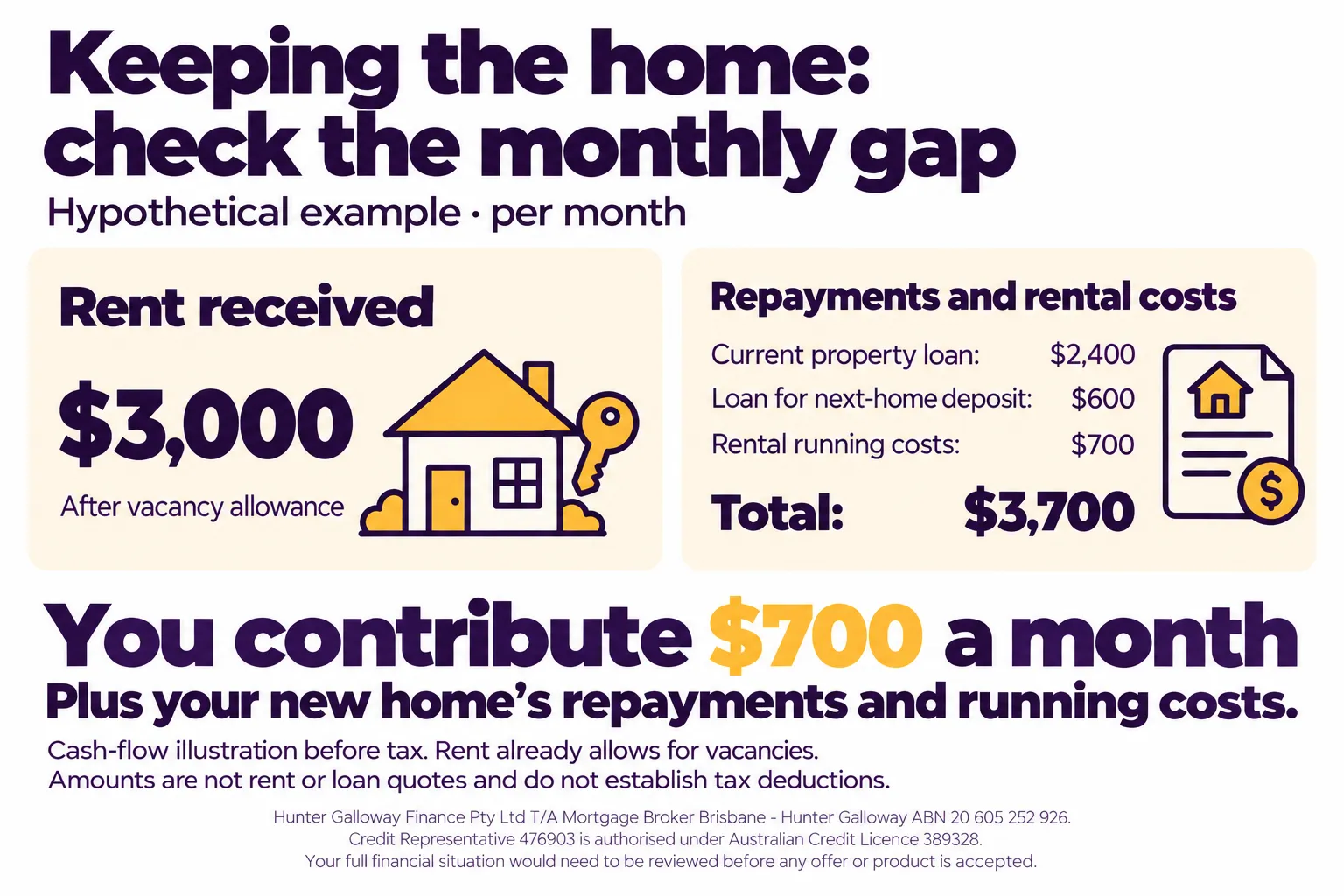
An illustration of the cash flow
These amounts illustrate a budget. They are not market rent, loan quotes or recommended buffers. The monthly rent already allows for vacancies, so do not deduct that allowance again.
Monthly item
Scroll to see more columns
| Monthly item | Amount |
|---|---|
| Rent received after vacancy allowance | $3,000 |
| Current property loan repayment | −$2,400 |
| Additional loan used for the next-home deposit | −$600 |
| Rental running costs allowance | −$700 |
| Cash contribution required | $700 |
If the new-home repayment is $4,000, the household must cover that plus the $700 contribution: $4,700 per month, before the new home's running costs and ordinary living expenses. This is a cash-flow calculation before tax. It does not establish whether any interest or expense is deductible.
Work out how a repair, a longer vacancy or lower income would affect the budget. If it is already uncomfortable under normal conditions, keeping the property may limit what you can spend on your next home.
Check the borrowing separately from the rent estimate
A property manager's estimate is useful information, but it is not a loan approval. Your broker can explain what rental evidence the proposed lender requires and how it will assess both debts and ongoing costs. Do not assume the lender will count every dollar of the estimate.
If you plan to use equity, confirm the additional borrowing amount, its repayment and the deposit release date. Read using equity for your next property to see how the loans fit together.
Review the loan before renting the home out
Tell your lender that the property will become a rental and ask what it needs to update the loan purpose. Confirm the applicable rate, product features and conditions, including what happens to any fixed-rate period. For example, NAB has a specific loan-purpose change process; other lenders have their own requirements.
Compare keeping the existing loan with refinancing, including switching fees and any break cost. Changing the lender's product label does not itself decide whether interest is tax-deductible. Your tax adviser needs the borrowing history and how the funds were used.
Ask about tax before drawing funds or changing ownership
Take the existing loan statements and transaction history to your tax adviser. Include past redraws and any proposed borrowing for the new home. The ATO's rental-interest example explains why the property securing a loan and the purpose of the borrowed money must be considered separately.
Work through these questions with your adviser:
- Which expenses and interest are deductible in our circumstances?
- What records or valuations should we obtain when the property's use changes?
- How could keeping the old home affect the main-residence exemption when either property is sold?
- Are there state land-tax, duty or ownership issues to allow for?
- What capital works or depreciation claims are actually available?
The main-residence rules include provisions for a former home, but "the 6 year rule" is not a blanket promise that both homes are tax-free. Have your adviser check your occupancy, rental use, ownership and tax residency.
Do not change ownership simply because one partner earns more. Changing the title has legal and tax consequences and may involve transaction costs. Have the relevant advisers work through the full result first.
Ask which depreciation and capital works claims apply
Take purchase records, renovation invoices, construction dates and any existing depreciation schedule to your accountant. Ask them to separate building or structural work from fixtures and other depreciating assets, and to check the rules for previously used assets.
A quantity surveyor may be useful when construction costs need estimating. Ask your accountant which records are missing and whether a report would help before paying for one. Changing a home into a rental does not mean every fitting or item of furniture becomes deductible. These deductions also do not put cash in the account for the next mortgage payment.
Cash flow and a tax loss are different measures
Your monthly budget includes the cash you actually pay, including any principal component of loan repayments. A tax calculation uses income and deductible expenses under tax rules. Have your adviser calculate the expected tax position separately. Do not count an unconfirmed tax refund as money available to make the next repayment. Our negative gearing guide explains the distinction between a rental cash shortfall and the tax calculation.
Would you be comfortable becoming a landlord?
If you keep the property, you also need to manage it. Think about who will arrange repairs, how much administration you want to handle and how you would manage periods without a tenant. A property manager can explain their service, fees and local obligations.
Separate your attachment to the home from the budget. Moving does not mean you have to sell. Keeping the property should be a deliberate choice that fits your next stage.
A practical sequence before deciding
- Get a realistic sale estimate and a rental appraisal.
- Confirm current lending, likely selling costs and rental running costs.
- Ask your broker to compare the proposed finance with and without a sale.
- Set your comfortable monthly limit and the cash you want to retain.
- Review the tax and ownership position with the relevant advisers.
- Decide the order of buying, selling or letting before making commitments.
Set a comfortable purchase budget before choosing either path. If you decide to sell but want to buy first, explore bridging finance. If the move itself is still undecided, start with our next-home planning hub.
For the investment side of the decision, see our investment home loans guide, property investment journey and buy-to-let guide. If you have other rentals, review the property portfolio guide. If you plan to rent your next home while keeping an investment, our rentvesting guide explains that arrangement.
Questions about your next home
Experience and sources
How this guide was checked
This guide draws on the public guidance listed below. Original sources were checked on 16 September 2026, with additional checks of rental-property lending, depreciation and interest-only repayments on 18 September 2026.
Worked examples use stated assumptions, not lender quotes or loan approvals. Check the lending, contract and tax details for your own purchase before committing.

Hunter Galloway Finance Pty Ltd is Credit Representative 476903, authorised under Australian Credit Licence 389328.
Sources
General information only. Lender policies, rates and fees can change. Applications are subject to the lender's assessment of your circumstances.
Check your next-home plan
Tell us your current loan balance, estimated property value, savings, target purchase range and timing. We can assess the finance options and explain the numbers to check before you commit.
or call 1300 088 065
Your options depend on your circumstances, the property and the lender's assessment. Ask your solicitor and tax adviser about the contract and tax decisions.