


So before you buy, separate what the property costs you in cash from what you can claim for tax.
Some investment property tax deductions apply in the current year, some spread over time and some payments aren't deductible at all.
Example: what a $1,000 deduction saves
At a hypothetical 30% marginal tax rate, a fully usable $1,000 deduction saves $300 in income tax. You still bear $700 of the expense.
That simplified calculation excludes Medicare levy and your individual circumstances. Your marginal rate is the tax rate on an extra dollar of income.
Three ways a cost can be treated
| Possible treatment if eligible | Examples |
|---|---|
| Claim in the current year | Loan interest, management fees, rates and qualifying repairs |
| Claim over time | Capital works, eligible assets and borrowing costs |
| Not a rental deduction | Private spending, loan principal and the purchase price |
Three ways a cost can be treated
Claim in the current year
- Examples
- Loan interest, management fees, rates and qualifying repairs
Claim over time
- Examples
- Capital works, eligible assets and borrowing costs
Not a rental deduction
- Examples
- Private spending, loan principal and the purchase price
The use of the property, your evidence and the type of cost decide the treatment, not the label on a bank statement.
Eligible running costs can include advertising for tenants, management fees, rates, insurance, interest and qualifying repairs. You must incur the expense and keep evidence.
Exclude private use and check the rental-use requirements. The test isn't simply whether money left your account before 30 June.
Keep a plumber's invoice describing the work, for example, not just the transaction in your banking app. The description helps your accountant distinguish maintenance from replacing or improving an asset.
What about trips to the rental?
For most individual residential landlords, travel to inspect, maintain or collect rent isn't deductible. Exceptions include carrying on a business of letting rental properties.
Check which rules apply before you budget for a claim.
What was the borrowed money used for?
A loan called an investment loan isn't automatically fully deductible. Your accountant needs to know what you used the borrowed money for.
Interest on funds used to buy or improve a rental may qualify. Repaying the principal, the amount you borrowed, doesn't. Nor does using an investment property as security turn a private expense into a rental deduction.
Suppose you redraw from the investment loan to pay for a holiday. Tell your accountant. The interest may need to be split between rental and private use, with that split kept up to date.
Before you refinance or restructure, ask your broker about separate loan splits and the records you'll need. Have your accountant confirm the tax treatment before moving the money.
Our investment property loan guide covers the finance structure, not permission to claim every interest charge.
Repair or improvement?
Fixing damage that arose while the property was rented can be treated differently from improving it. So can repairing defects that were there when you bought it.
Don't put initial repairs or substantial replacements straight into the immediate-deduction column.
Before a renovation, get a detailed scope and itemised invoice from the contractor. An accountant has more to work with than a single line saying "renovation $20,000".
Ask how the work will be treated before relying on a tax saving to fund it.
Would a depreciation schedule help?
A schedule can identify eligible capital works, such as building and structural work, and assets such as appliances and carpets. It doesn't make every building cost or appliance deductible.
Certain second-hand assets in residential rentals have restrictions on decline-in-value deductions. Borrowing expenses can have a separate claim period too.
Ask your accountant whether a qualified quantity surveyor's report is worthwhile, what it would cost and which records you already have. Keep any report for future tax returns and the eventual sale calculation.
A depreciation report for an older property
One rental property was built in 1998, so it was about 26 years old when the report was prepared in 2024. The owner’s records confirm it had been repainted and recarpeted before settlement.
The report identified $4,007 in capital works deductions for 2024–25. The same amount appears in the owner’s tax return. That reduced taxable rental income; it wasn’t a $4,007 tax refund. The report also identified that the existing second-hand plant and equipment didn’t qualify for annual depreciation. New assets bought for a rental property can have different tax treatment.
The report had a one-off upfront fee of $715 including GST, paid in June 2024. Include that cash cost when deciding whether a report is worthwhile. The actual tax saving depends on the owner's circumstances. Capital works deductions can also affect the property's CGT cost base when it is sold.
What changes from July 2027?
As at 29 October 2026, the negative gearing and capital gains tax reforms are law. They take effect from 1 July 2027.
That future start date matters when you're comparing a deduction this year with the property's costs over several years.
Under the changes, negative gearing for residential investments will be limited to new builds and specified property uses. Properties held at 7:30 pm AEST on 12 May 2026 are exempt from the negative gearing changes.
The capital gains tax reforms apply to gains accruing after 1 July 2027. Don't apply the same treatment to every property or every 2026 expense.
Have your accountant check the acquisition timing, property eligibility and detailed legislation before modelling future losses. Our negative gearing guide explains the cash shortfall and transition separately.
Keep the records for your accountant
Keep loan statements, invoices, insurance papers and settlement records. Separate running costs, borrowing costs, improvements and the purchase itself.
Your property manager's annual statement helps, but may miss costs you paid directly.
Record private-use dates and any below-market letting. Check expenses against your ownership share and identify reimbursements and capital items. Those details can change the claim, even when the payment appears on the manager's statement.
Buying or refinancing? Check how the lender counts your rent
Your tax claim and the lender's affordability test answer different questions. Your accountant works out deductions; the lender may count less than the full rent and allow for property expenses. A deduction isn't automatically extra income for a loan.
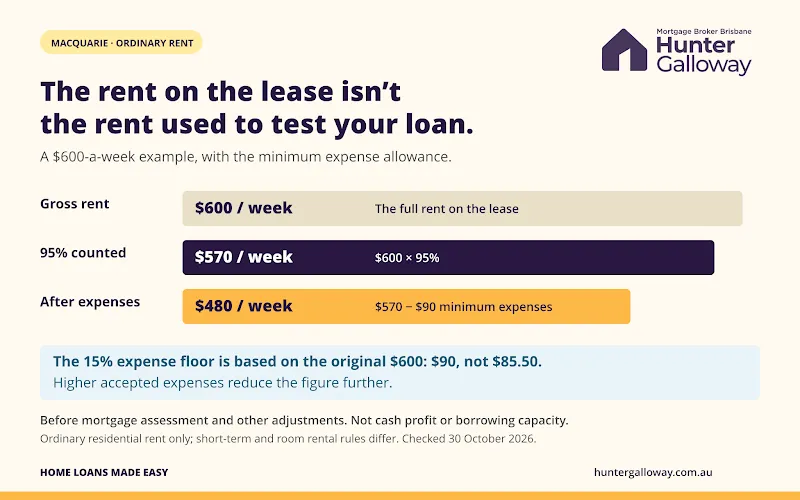
Macquarie counts 95% of ordinary residential rent, then allows for expenses of at least 15% of the original gross rent. The example below shows why that expense base matters. Short-term and room rentals have different rules.
ANZ home loans use the higher of stated residential investment running costs or 10% of gross rent. Westpac and St.George also have a 10% floor for ordinary long-term rentals, not short-term rentals or DHA rental guarantees. The rental type changes the calculation.
Tax-benefit allowances need a separate check. Auswide and MyState use the actual product rate before the servicing buffer to calculate that benefit, while testing repayments at the applicable assessment rate. Their gearing treatment excludes unit and discretionary trusts, vacant land and holiday or secondary homes. Macquarie gives no negative-gearing benefit to company or trust loans, or to foreign income.
A depreciation schedule doesn't automatically increase borrowing capacity. Business depreciation addbacks are a separate policy question, not permission to add every rental deduction back to income.
Bring the rent evidence, property costs, ownership shares and loan-purpose records to us. We can compare the lender's assessment, including any eligible tax benefit, with your accountant's tax estimate. Confirm the lender's treatment for your application.
Questions new investors ask
Broker check: keep loan purposes separate
Before the next tax return, send your accountant the loan-purpose records, invoices and dates of private use. If you're setting up investment borrowing, our Brisbane mortgage broker team can help compare loan structures. Your accountant should confirm what you can claim.
The records to keep before moving loan money
Give your accountant the original loan purpose, each later drawdown and any refinance trail. A separate split can make records easier to follow, but the split's name doesn't establish deductibility. What the borrowed funds paid for still matters.
Keep the bank statements showing where the money went, together with the invoices or settlement documents. Ask about tax treatment before mixing private spending into an investment loan, rather than trying to reconstruct it at tax time.
Call Hunter Galloway on 1300 088 065 or request a free assessment to discuss investment loan structure. Your accountant should confirm the deductions and how the July 2027 changes affect your property.
Related guides: investment property loan guide · negative gearing guide
Experience and sources
How this guide was checked
Reviewed 3 November 2026 by Nathan Vecchio.
Lender rental-expense and tax-benefit examples checked 30 October 2026: Macquarie, ANZ, Westpac/St.George, Auswide and MyState. Confirm the applicable treatment for the individual application.
General information only, not tax advice.

Hunter Galloway Finance Pty Ltd is Credit Representative 476903, authorised under Australian Credit Licence 389328.
Sources
General information only, not personal financial, tax or legal advice. Lender policies and government rules change, so check current criteria before you apply.