


Before choosing it, work out what you'll do with the money you keep each month. Compare the cost over the full loan, including the years when you start paying the debt down.
If the purchase only works while you aren't repaying the balance, test it again without a pay rise, higher rent or property price growth. The later payment needs to fit too.
What are you paying during interest only?
Principal is the amount you borrow. With principal and interest repayments, each scheduled payment covers interest and pays off some of that principal. During interest only, the required payment covers interest without reducing the balance.
You can still make voluntary principal repayments if the product allows them. Check the rules, particularly extra-payment limits on fixed-rate loans. Voluntary payments are separate from what the bank requires you to pay during interest only.
Interest only describes the repayment type, not whether the rate is fixed or variable. Depending on the product, you may have either. Compare the rate and features separately.
Compare the rate as well as the starting payment. ANZ's principal and interest options generally have lower rates than its interest-only options, so get written quotes for the loans you're considering.
What numbers should you compare?
Ask for the interest-only rate, payment and length of the period, followed by the remaining principal and interest term and estimated repayment. Include all fees, extra-payment rules and differences in offset access. An offset is a linked account whose balance can reduce loan interest.
The lender assesses affordability under its own lending requirements. A smaller initial payment doesn't mean you can automatically borrow more. Our borrowing power calculator gives a starting estimate, not an interest-only repayment model.
Can interest only reduce borrowing capacity?
A smaller payment now doesn't necessarily mean the bank will lend you more. The affordability check also needs to cover the payment once you start paying off the debt, using the years left after interest only ends.
With a 30-year loan and 5 interest-only years, that's 25 years of principal and interest payments in the test, not 30. That can make borrowing capacity lower.
Compare the rate as well as the repayment. The example below assumes a higher rate for interest only, not quoted lender pricing.
Ask for current written rates and fees for both repayment options. LVR means the loan as a percentage of the property value.
A hypothetical $500,000 loan
Assume a $500,000 loan over 30 years. One borrower pays principal and interest at 6.50% from the start. The other pays interest only at 6.90% for 5 years, then switches to 6.50% principal and interest over the 25 years left. The 0.40-percentage-point interest-only premium is an assumption. These hypothetical rates aren't quoted lender pricing.
| Repayment plan | First 5 years per month | Remaining 25 years per month | Total interest |
|---|---|---|---|
| Principal and interest at 6.50% from the start | About $3,160 | About $3,160 | About $637,722 |
| 5 years interest only at 6.90%, then principal and interest at 6.50% | $2,875 | About $3,376 | About $685,311 |
What numbers should you compare?
Principal and interest at 6.50% from the start
- First 5 years per month
- About $3,160
- Remaining 25 years per month
- About $3,160
- Total interest
- About $637,722
5 years interest only at 6.90%, then principal and interest at 6.50%
- First 5 years per month
- $2,875
- Remaining 25 years per month
- About $3,376
- Total interest
- About $685,311
Interest only frees up about $285 a month initially. After 5 years, the required payment rises by about $501 a month, or 17%, even though the assumed rate falls.
Total interest is about $47,588 higher, reflecting both the higher interest-only rate during the first 5 years and repayment of the unchanged debt over 25 years afterwards.
If the principal and interest rate at expiry were 7.50% instead, the payment would be about $3,695 a month: about $820 above the initial interest-only payment.
These are hypothetical examples using monthly payments, no fees, no offset and no extra repayments. Rates stay at the stated assumptions for each repayment stage; they aren't forecasts.
Total interest is calculated from unrounded payments, so subtracting the rounded totals can differ by $1. Actual rates and daily-interest calculations will vary. Use Moneysmart's interest-only calculator to test other amounts and rates.
Lower starting payments, but lower borrowing capacity
In a separate hypothetical Quickli comparison, a single existing homeowner refinances $500,000 against a $1 million owner-occupied house (50% LVR). They earn $120,000 gross a year from PAYG employment, spend $3,000 a month and have no dependants, HELP debt, other debts or boarder income.
Macquarie's estimated maximum borrowing capacity was $555,975 on a 30-year principal and interest loan, versus $521,614 with 5 years interest only followed by 25 years principal and interest: $34,361 less.
The starting payment on the actual $500,000 loan went the other way: about $3,092 a month at 6.29% on principal and interest, versus $2,746 at 6.59% on interest only. That is about $346 less a month initially.
Both the rate and the years available to repay principal changed, so the shorter repayment period alone does not explain the capacity gap. Pricing stayed at the $500,000, 50% LVR inputs; it was not recalculated at the estimated maximum loan amounts. These estimates are not approval or money available to draw down. Your income, expenses, debts, property and the lender's assessment can change the result.
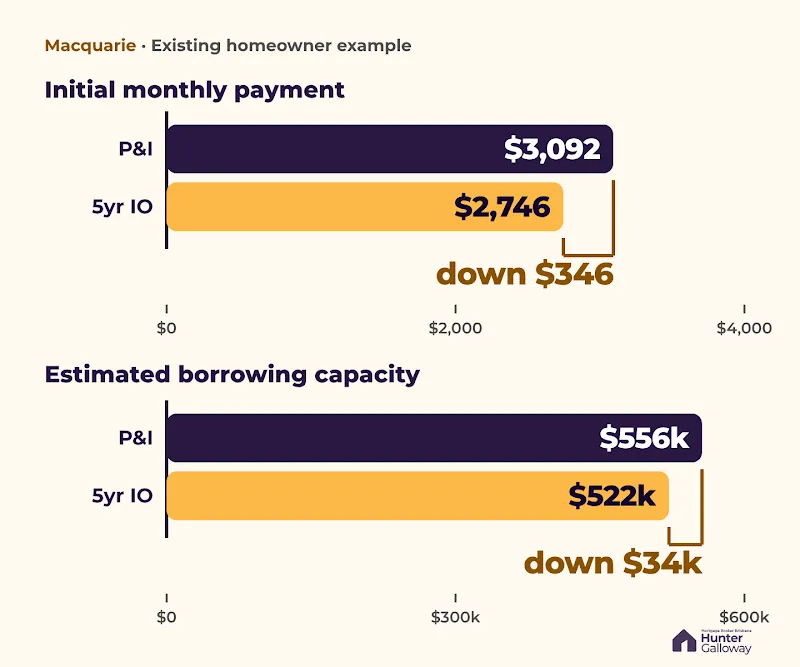
Macquarie inputs: 6.29% for 30-year principal and interest versus 6.59% for 5 years interest only, then 25 years principal and interest. Both the rate and principal repayment period differ. Capacity labels are rounded.
Who can it suit, and what will the cash do?
An investor might want to retain cash for property expenses while following a broader debt strategy. Some short-term construction or bridging arrangements also use interest-only payments.
Bridging finance can cover buying your next home before selling the old one, a timing decision covered in our guide to upgrading your home. Those arrangements need their own lending and cash-flow assessment.
For an investment, work out how interest only helps your plan before choosing it. Some owner-occupiers can use it too. The lender, loan and borrowing purpose determine whether it's available and for how long.
Decide how much you want to set aside and when you'll check the balance. If the plan is to build a reserve for property costs, you should be able to see that reserve growing.
For investment borrowing, speak with your accountant before moving money between loan accounts. The “interest only” label doesn't make interest deductible. That depends on how the borrowed money and property are used.
Our investment property loan guide puts the repayment decision alongside deposits, equity and ongoing costs. Equity is the property's value left after mortgage debt.
Can you manage the payment afterwards?
Your required interest-only payments do not reduce your debt. If property prices fall, your equity can shrink even while you're making those payments. You also need to budget for the higher payment when you start repaying principal.
Ask for the payment after interest only ends at the quoted rate and at a higher rate. Then remove any expected pay rise or rent increase from the budget and test it again.
Ask what the loan will switch to when the period ends. Build your budget around that payment. You may not get another interest-only period.
If your interest-only period is already ending, get your new repayment and contact your lender before the change. The decision now is how to manage that payment, rather than whether to choose interest only for a new loan.
Which interest-only option fits your plan?
Decide how long you need interest only and what you can pay afterwards. Then compare the deposit, product features and approval conditions. A longer advertised period doesn't mean the lender will approve it for your loan.
| Lender | What changes your choice |
|---|---|
| CBA | Up to 5 years per approval, with lifetime limits of 15 years for investors and 5 years for owner-occupiers. No interest only in the final 5 years of the contracted term. A 7-year plan therefore needs another approval along the way. CBA tests the later principal and interest payment; updated income, debts and expenses may be needed, plus guarantor consent for a switch or extension. CBA home loan review. |
| ANZ | Eligible Standard Variable, Fixed and Simplicity PLUS investment loans have published interest-only options of 1 to 5, 7 or 10 years. Land loans have shorter limits. The 7-year option differs from CBA's maximum per approval, but the product features still matter: Simplicity PLUS is ANZ's basic variable loan and has no offset. ANZ home loan review. |
| Westpac | Up to 15 years for eligible investment loans at up to 80% LVR; owner-occupiers can request up to 5 years over the loan's life. On an $800k valuation, 80% LVR means a $640k loan and $160k deposit or equity before costs. Check that funding gap as well as the term. Westpac home loan review. |
| AMP Equity Flex | An initial 6 to 10 years interest only within a 31 to 40-year loan, for investment purposes secured by an investment property, up to 80% LVR. At least one split must use the extended period. AMP assesses the loan upfront using no more than 30 years of principal and interest repayments, with no reassessment during the approved interest-only period. Existing customers need an internal refinance. Extra years can add substantially to total interest: see our 40 year home loan guide and AMP home loan review. |
| Macquarie | Up to 5 years initially; a further period of up to 5 years needs Credit approval and satisfactory repayments over the preceding 6 months. The final 20 years must be principal and interest, so a fresh 5-year IO period will not fit a loan with only 22 years left. Approval and product restrictions still apply. |
Which interest-only option fits your plan?
CBA
- What changes your choice
- Up to 5 years per approval, with lifetime limits of 15 years for investors and 5 years for owner-occupiers. No interest only in the final 5 years of the contracted term. A 7-year plan therefore needs another approval along the way. CBA tests the later principal and interest payment; updated income, debts and expenses may be needed, plus guarantor consent for a switch or extension. CBA home loan review.
ANZ
- What changes your choice
- Eligible Standard Variable, Fixed and Simplicity PLUS investment loans have published interest-only options of 1 to 5, 7 or 10 years. Land loans have shorter limits. The 7-year option differs from CBA's maximum per approval, but the product features still matter: Simplicity PLUS is ANZ's basic variable loan and has no offset. ANZ home loan review.
Westpac
- What changes your choice
- Up to 15 years for eligible investment loans at up to 80% LVR; owner-occupiers can request up to 5 years over the loan's life. On an $800k valuation, 80% LVR means a $640k loan and $160k deposit or equity before costs. Check that funding gap as well as the term. Westpac home loan review.
AMP Equity Flex
- What changes your choice
- An initial 6 to 10 years interest only within a 31 to 40-year loan, for investment purposes secured by an investment property, up to 80% LVR. At least one split must use the extended period. AMP assesses the loan upfront using no more than 30 years of principal and interest repayments, with no reassessment during the approved interest-only period. Existing customers need an internal refinance. Extra years can add substantially to total interest: see our 40 year home loan guide and AMP home loan review.
Macquarie
- What changes your choice
- Up to 5 years initially; a further period of up to 5 years needs Credit approval and satisfactory repayments over the preceding 6 months. The final 20 years must be principal and interest, so a fresh 5-year IO period will not fit a loan with only 22 years left. Approval and product restrictions still apply.
LVR is the loan divided by the property's accepted value. Once an option fits your deposit and timeframe, compare its rate, offset cost and later payment on the same loan amount.
Broker view
Start with the payment after interest only ends. If it only works with a pay rise or higher rent, a longer interest-only period postpones that problem. We would compare the affordable loan amount as well as the repayment type before narrowing down lenders.
How we narrow down the options
Tell us why you want interest only and when you expect to start reducing the debt. We can compare lenders we work with on the same loan amount, including the interest-only premium, offset costs and payment after expiry.
We also test borrowing capacity under each lender's rules. A lender offering the longest period may lend less than you need, or leave you with a later payment you can't comfortably manage.
Get a free interest-only loan assessment with Hunter Galloway. Bring your income, debts, property value and preferred timeframe so we can check which options fit. Approval and access to particular products still need to be confirmed.
Questions worth asking before you apply
Can I keep extending interest only?
Not automatically. Your lender may reassess income, debts, the years already used and the remaining term. AMP's no-reassessment promise applies during its contracted Equity Flex interest-only period, not to a guaranteed renewal afterwards.
Does interest only work with a smaller deposit?
Sometimes, but repayment type can change how much deposit or equity you need. For eligible investors, Westpac allows up to 95% LVR with principal and interest and LMI, compared with up to 80% with interest only. Check that you can fund the gap before choosing the smaller monthly payment.
What should I have ready for a comparison?
Bring income evidence, debt balances and limits, living expenses, property details and your plan for the spare cash. For an existing loan, include the statement and expiry notice. We check the actual product before requesting its application documents.
Get a free interest-only loan assessment with Hunter Galloway or call 1300 088 065. We can compare the repayments, deposit and lender rules before you apply, including what happens when principal repayments begin.
If you are comparing interest-only options with another lender, our refinance guide explains the switching costs and remaining-term checks to include.
Experience and sources
How this guide was checked
Reviewed 3 November 2026 by Nathan Vecchio.
The lender comparison uses public lender information checked on 30 October 2026. Quickli comparison estimates were also checked on 30 October 2026; borrower, loan, pricing and repayment assumptions are retained beside the example.
Macquarie remaining-term and renewal conditions: credit manual dated 22 October 2026, reviewed 30 October 2026.
Lender comparison sources checked 30 October 2026: ANZ investment loan terms, Westpac investor terms and AMP Equity Flex product details. These are eligibility limits, not approval offers.
General information only. Have the structure reviewed against your circumstances before applying.

Hunter Galloway Finance Pty Ltd is Credit Representative 476903, authorised under Australian Credit Licence 389328.
Sources
- CBA switching conditions and consent requirements: CBA switching terms and application form
- ANZ investment loan terms
- Westpac investor terms
- AMP Equity Flex product details
- ANZ repayment types
- ATO interest-expenses guidance
- Moneysmart interest-only guide
- APRA's home-lending guidance
- ING's public home-loan rates
- ING product fees
- Moneysmart's interest-only calculator
- CBA interest-only periods
General information only, not personal financial, tax or legal advice. Lender policies and government rules change, so check current criteria before you apply.