


Your listing says $240 a night. The bank isn't doing that maths.
See our three-lender borrowing-power example for a couple earning $110,000 each, plus the monthly cash-flow charts below.
Buying with projected rent or refinancing with a track record?
Buying to start Airbnb: a nightly-rate estimate, a seller's forecast or future reservations are not the same as income you've earned. ANZ needs actual income rather than prospective rent. Firstmac's purchase route may use a suitable appraisal, while ME has a separate agent-managed holiday-rental purchase route. Neither means every new Airbnb listing qualifies.
Refinancing an established short-stay rental: you can put actual income and costs in front of the lender. Westpac and St.George's short-stay route is for a property already owned and tenanted or available for short-term letting. That is different from buying a new place based only on projected Airbnb rent.
Buying without the required history: have the broker test the loan using accepted ordinary rental income, if that route is available, or your other eligible income. Don't treat a hoped-for Airbnb premium as money the bank has already agreed to count.
Would higher short-stay rent increase your borrowing power?
It can, but higher running costs and the lender's tax treatment can change the result. We tested a fictional couple earning $110,000 each, with two children, refinancing an established investment property.
The ordinary-rental example uses $900 a week rent and $1,085.12 a month in property costs. The short-stay example uses $1,919.42 a week and $3,145.66 a month in costs. These are hypothetical modelling assumptions informed by the records, not a forecast for that property.
| Lender and treatment | Ordinary rent | Short-stay rent | Change |
|---|---|---|---|
| NAB: eligible gearing | $1,022,984 | $1,198,610 | +$175,626 |
| ANZ: eligible gearing | $1,079,933 | $1,191,480 | +$111,547 |
| Westpac: capped short-stay deductions | $1,066,090 | $1,062,103 | −$3,987 |
Would higher short-stay rent increase your borrowing power?
NAB: eligible gearing
- Ordinary rent
- $1,022,984
- Short-stay rent
- $1,198,610
- Change
- +$175,626
ANZ: eligible gearing
- Ordinary rent
- $1,079,933
- Short-stay rent
- $1,191,480
- Change
- +$111,547
Westpac: capped short-stay deductions
- Ordinary rent
- $1,066,090
- Short-stay rent
- $1,062,103
- Change
- −$3,987
NAB's estimate increased by about $176,000 and ANZ's by about $112,000. Westpac's estimate fell slightly in the specific capped-deduction treatment tested. This is why we compare the income, costs and lending rules together rather than assume more bookings always mean more borrowing power.
Westpac's short-stay row caps the investment deductions at rental income; its ordinary-rental row uses eligible full investment gearing. That particular treatment does not apply to every Airbnb property. These are calculator estimates checked on 31 October 2026, not approvals.
The couple has $5,500 monthly living expenses plus $3,000 personal rent, no other debts, and equal ownership of a $1.5 million investment property. The replacement investment loan runs for 30 years with principal-and-interest repayments. We assume all borrowing is for income-producing purposes and the fictional applicants meet each lender's rental-history requirements.
This compares weekly rent inputs, which lenders can annualise differently. It is not an exact replay of the annual property records, and it is separate from the $850,000 cash-flow illustration below. The detailed pricing and cost assumptions are in the model notes at the end.
Four different numbers
Keep these apart:
- Gross bookings before fees.
- Money paid to your bank after platform deductions.
- Operating income after the costs you pay separately.
- The amount the lender accepts.
Prepare platform statements and bank credits that reconcile with each other, plus tax returns or property-manager records where available. Explain refunds, cancellations and changes in how you run the place. If you're refinancing, include your current loan statement so the existing debt can be checked too.
One busy summer month isn't a year. Show the quiet periods and owner-use dates, and ask the lender how much history it needs rather than assuming every bank wants the same period.
Empty nights and running costs
Costs include management, platform fees, cleaning, utilities, insurance, linen and furniture replacement. Rates, maintenance and body corporate bills keep running through empty weeks.
An income percentage is only part of the calculation. A bank can reduce the rent it counts, then allow for property expenses separately. Ask what is left after both, rather than treating the headline percentage as money available for repayments.
Keep records that separate gross rental receipts from deductible expenses. How that income is treated for tax doesn't decide what a lender will count.
A real short-stay comparison
One property had previously rented for $900 a week. After moving to short stays, its 2023–24 tax return recorded $102,684 in gross rent. At the old lease rate, a full year would have been $46,800, although these are different periods, not a like-for-like market comparison.
The higher rent came with costs: $18,962 in agent fees and $8,225 in cleaning, before other expenses. The owner also reported neighbour issues and more wear on the house. Buyers should compare the costs and work involved as well as the extra rent.
Keep a buffer for quieter months and uneven payments
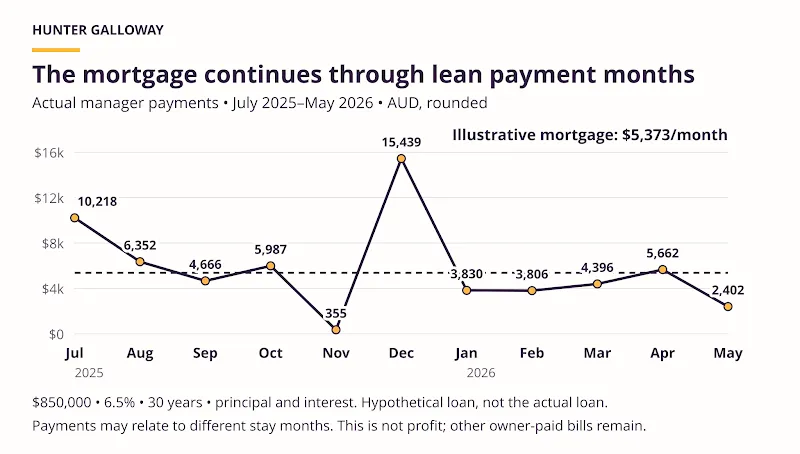
Later records from the same property show why annual rent is not a monthly repayment budget. The table covers July 2025 to May 2026 only, not a full financial year. No June records are included; that does not mean June income was zero.
For the loan comparison, assume an $850,000 loan at 6.5% over 30 years with principal-and-interest repayments of about $5,373 a month. This is an illustration, not the owner's verified loan balance or repayment. It assumes an unchanged rate and no loan fees or tax refund. The final column is before other owner-paid bills, not net profit.
| Month | Recorded stay nights / calendar nights | Manager's owner payment | Owner payment less illustrative repayment |
|---|---|---|---|
| July 2025 | 30 / 31 | $10,218 | $4,845 |
| August 2025 | 22 / 31 | $6,352 | $979 |
| September 2025 | 19 / 30 | $4,666 | −$706 |
| October 2025 | 25 / 31 | $5,987 | $614 |
| November 2025 | 30 / 30 | $355 | −$5,017 |
| December 2025 | 26 / 31 | $15,439 | $10,066 |
| January 2026 | 16 / 31 | $3,830 | −$1,543 |
| February 2026 | 11 / 28 | $3,806 | −$1,567 |
| March 2026 | 19 / 31 | $4,396 | −$976 |
| April 2026 | 22 / 30 | $5,662 | $289 |
| May 2026* | 8 / 31* (incomplete) | $2,402 | −$2,971 |
Empty nights and running costs
July 2025
- Recorded stay nights / calendar nights
- 30 / 31
- Manager's owner payment
- $10,218
- Owner payment less illustrative repayment
- $4,845
August 2025
- Recorded stay nights / calendar nights
- 22 / 31
- Manager's owner payment
- $6,352
- Owner payment less illustrative repayment
- $979
September 2025
- Recorded stay nights / calendar nights
- 19 / 30
- Manager's owner payment
- $4,666
- Owner payment less illustrative repayment
- −$706
October 2025
- Recorded stay nights / calendar nights
- 25 / 31
- Manager's owner payment
- $5,987
- Owner payment less illustrative repayment
- $614
November 2025
- Recorded stay nights / calendar nights
- 30 / 30
- Manager's owner payment
- $355
- Owner payment less illustrative repayment
- −$5,017
December 2025
- Recorded stay nights / calendar nights
- 26 / 31
- Manager's owner payment
- $15,439
- Owner payment less illustrative repayment
- $10,066
January 2026
- Recorded stay nights / calendar nights
- 16 / 31
- Manager's owner payment
- $3,830
- Owner payment less illustrative repayment
- −$1,543
February 2026
- Recorded stay nights / calendar nights
- 11 / 28
- Manager's owner payment
- $3,806
- Owner payment less illustrative repayment
- −$1,567
March 2026
- Recorded stay nights / calendar nights
- 19 / 31
- Manager's owner payment
- $4,396
- Owner payment less illustrative repayment
- −$976
April 2026
- Recorded stay nights / calendar nights
- 22 / 30
- Manager's owner payment
- $5,662
- Owner payment less illustrative repayment
- $289
May 2026*
- Recorded stay nights / calendar nights
- 8 / 31* (incomplete)
- Manager's owner payment
- $2,402
- Owner payment less illustrative repayment
- −$2,971
Payments are recorded in the manager's statement month and can relate to stays in another month. November's 30 recorded stay nights and $355 payment are a clear example of why these columns are not a same-stay profit calculation. Amounts are rounded to the nearest dollar; calculations use unrounded figures.
The stay-night counts are reconstructed from booking dates, not the spreadsheet's reported percentages. They use calendar nights, not nights available for letting; an unrecorded night is not proof of vacancy. *May's booking file was saved on 29 May, so its eight recorded nights may not be the final monthly total.
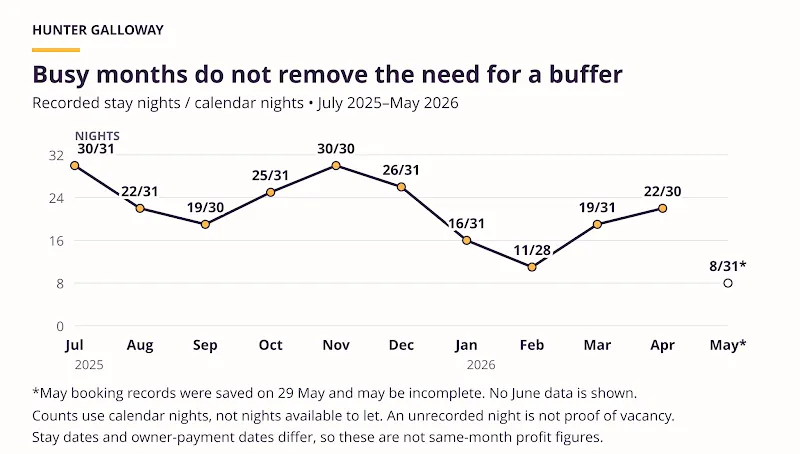
The manager's payments already allow for the management fees, cleaning and other deductions recorded on those statements. Do not subtract those costs again. The final column is still not net profit: internet, electricity, water, rates, insurance, maintenance and other owner-paid bills may still need paying, unless already included in the manager's deductions. It does not include all holding costs or tax.
The owner reported that mortgage payments exceeded receipts in lean months. This illustration shows how that can happen even when annual rent looks strong. Budget for a run of lower-payment months, regular bills and unexpected repairs, rather than relying on the annual average.
Which lenders accept Airbnb income
The rent you can prove matters more than the nightly rate on your listing. Each lender checks the property, short-stay use and income history, then applies its own income percentage, any yield cap and expenses. A higher percentage can still leave less usable income, and some lenders exclude short stays altogether.
Firstmac uses less short-stay rent than standard lease rent
Firstmac counts 65% of confirmed gross short-stay or holiday rent, compared with 80% for a standard tenancy. Bring rental statements, tax returns or bank records to support it; a suitable appraisal may help on a purchase. If the income is volatile, Firstmac can reduce it further or exclude it.
On $40k of accepted annual rent, 65% is $26k and 80% is $32k: a $6k difference in assessed income, not borrowing power. A 90% allowance would count $36k before other caps and expense checks, but only if the property and records qualify. Read our Firstmac home loan review for the broader product and fee considerations.
ANZ uses 80%, with an annual rent cap
ANZ uses 80% of eligible gross short-stay rent, with annual gross rent capped at 7% of the property's value. It looks to actual income over the last 12 months, supported by statements or tax evidence. A shorter history may be used, but cannot be annualised; prospective rent is not a substitute. Our ANZ home loan review covers the broader options.
Bankwest and ubank can use 90%, with important limits
Bankwest generally counts 90% of eligible gross holiday rent, or 80% in restricted regional postcodes. Above 80% LVR, gross rent is capped at a 6% yield. It needs a tax return or recent agent statement with 12 months' rent; shorter history can't be annualised. Boarder income and serviced apartments are excluded.
ubank can count 90% of eligible short-stay income, but excludes shared spaces and individual rooms. To support the income, you can provide the latest full-year tax return and assessment notice, or an agent statement for 12 consecutive months. A whole-home approval doesn't establish eligibility for a spare room.
ME needs the Airbnb tax record; ING excludes short stays
ME uses 70% of gross holiday rent. Airbnb needs a lodged tax return covering 12 months, the tax assessment notice and an Airbnb receipt statement within 120 days. Don't assume its separate purchase route for agent-managed holiday rentals waives those requirements. Our ME Bank home loan review explains the wider products.
ING doesn't count holiday-home or short-term rent. If you need booking income to qualify, that rules out this route regardless of the advertised rate.
A 90% allowance can leave less usable income than 80% once yield caps, ownership shares and expenses apply. We compare the same property and records; a calculator result won't resolve an income treatment the lender hasn't confirmed.
How will you use the property?
Tell your broker how you earn from it: the whole place, a room in your home or a unit in a managed holiday complex, including any time you keep for yourself. A long-term boarder is different from holiday guests.
Renting a room to a long-term boarder is different from taking Airbnb bookings. For a first home buyer who will live in the property, CommBank may count up to $150 a week from one eligible boarder arrangement. A friend or family member can qualify, but a spouse cannot, and investment purposes are excluded. We still need to check the full requirements for your arrangement. Don't assume this allowance applies to Airbnb. Our Commonwealth Bank home loan review explains the broader loan options.
A serviced apartment can have property restrictions that matter regardless of income. The lender has to accept both the property and the income. The property is its security, meaning what backs the loan. Strong bookings don't settle that question.
If a trust or business owns the property or receives the income, say so. The lender may need that entity's ownership and financial records.
Money paid to it isn't automatically your salary. Our trust income home loan guide covers the separate questions about income received through a trust.
Our investment home loan guide covers deposit and equity questions. Equity means the property's value less the loan against it. If you're exploring low-deposit home loans, check that the property and income fit the loan before setting a deposit target.
How we compare the lenders for your property
We check whether each suitable lender accepts the property and short-stay use, what history it needs, and how much income remains after its percentage, yield cap and expenses.
A rental-yield cap limits annual rent to a share of the property's value, even if bookings bring in more. Check it alongside the lender's income percentage.
For an established rental, send a full picture: busy and quiet months, your tax record, platform statements and running costs. For a new purchase, ask which evidence the lender will accept before assuming the seller's income or your forecast can support the loan.
Book a free assessment before choosing a property that depends on Airbnb income. Send the address, booking statements and running costs. We can compare suitable lending options, explain any evidence gaps and show the repayments on the options that fit.
Check local rules before counting on short-stay rent
A property's booking history does not prove you can keep using it for short stays. Check the exact address, whether you will live there, and any approval conditions before budgeting for a full year of bookings.
Brisbane: Council is not proceeding with its proposed Short Stay Accommodation Local Law 2025 at this time. That does not remove existing planning and local-law obligations. Ask Council or your town planner to check the property's approved use, zoning and overlays; confirm the applicable rates category as well. A listing on Airbnb is not evidence of approval.
Byron Shire: Under NSW's exempt-development pathway, non-hosted short stays in most of the shire are capped at 60 days per 365-day registration period. Two mapped precincts around Byron Bay town centre and Brunswick Heads allow 365 days. Hosted accommodation has no statewide day cap, but registration, fire-safety and conduct requirements still apply. Eligible bookings of 21 consecutive days or more are excluded from the non-hosted day count. Check the actual map and any development-consent conditions rather than assuming every Byron property has the same limit.
Overseas rules can be very different. New York City's residential short-stay rules generally require the host to stay in the same home with no more than two guests, excluding children under four, for stays under 30 days; renting out the whole home is not the ordinary permitted model. This is a comparison, not an Australian rule.
Before buying, confirm local planning permission/day limits, strata/body-corporate and insurance requirements, lender acceptance, and a fallback budget if you must switch to a long-term tenancy.
Do you need two years of Airbnb history?
There isn't a universal two-year rule. Lenders often want 12 months, but the documents and exceptions differ. ME's Airbnb route needs a lodged return covering 12 months, a tax assessment notice and a recent Airbnb receipt statement. ANZ may use a shorter actual history without turning it into a full-year forecast. A seller's records can help you assess the property; they do not guarantee the bank will count that income for you.
If you don't have the required Airbnb record, ask whether the application can instead use ordinary long-term market rent. That needs a lender-accepted appraisal or other required evidence, and long-term letting must genuinely be possible at the property. Compare costs and repayments on that lower-rent scenario before committing.
Plans to raise nightly rates aren't existing income, and higher prices can cut bookings. A forecast increase shouldn't go into the application as money already earned.
For a conventional lease, an agent's opinion, a signed agreement and a rise already being paid are different evidence. Ask which counts before adding an increase to your borrowing estimate.
Before you rely on bookings
Check local planning rules, the property's lawful use, body corporate restrictions and insurance for that address with the relevant authorities and advisers. A platform listing isn't proof the use is allowed.
If you're changing an existing property's use, tell the lender and insurer and ask your accountant about tax. Our home or investment property guide can help you work through the broader purchase choice, but doesn't settle the permissions for a particular address.
A made-up short-stay budget
These hypothetical planning figures aren't a forecast or the bank's calculation.
| Short-stay property budget | Example |
|---|---|
| Advertised rate | $240 a night |
| Gross bookings at 180 occupied nights | $43,200 |
| Operating costs | $17,000 |
| Left before mortgage payments and tax | $26,200 |
| Income the bank counts | Not established. Requires lender evidence and policy checks |
| Gross bookings at 140 occupied nights | $33,600 |
A made-up short-stay budget
Advertised rate
- Example
- $240 a night
Gross bookings at 180 occupied nights
- Example
- $43,200
Operating costs
- Example
- $17,000
Left before mortgage payments and tax
- Example
- $26,200
Income the bank counts
- Example
- Not established. Requires lender evidence and policy checks
Gross bookings at 140 occupied nights
- Example
- $33,600
The $26,200 isn't automatically accepted lending income. At 140 nights at the same rate, gross bookings fall to $33,600. Some costs fall with bookings, but rates, insurance and other fixed bills don't.
Test the loan against a quiet year, not just the year you hope for. Our borrowing capacity calculator is a starting estimate, not an Airbnb income assessment. Use Moneysmart's mortgage calculator for repayment comparisons once the income and loan options are checked.
Quick answers
Check the income before committing
Send our Brisbane mortgage brokers the property details, booking statements and expenses. We can check which suitable lenders may accept the arrangement and what income they'd use for a purchase or refinance. Call Hunter Galloway on 1300 088 065 or request a free assessment.
Experience and sources
How this guide was checked
Reviewed 3 November 2026 by Nathan Vecchio.
Quickli comparisons checked 31 October 2026. Reference loan: $1.2 million, 30-year P&I, package variable, 80% pricing LVR. The proposed loan replaced existing investment borrowing; no second existing loan was counted. The fictional standard house was assumed owned and operated since 2023. Qualifying history was assumed for this model, not established by the real annual records or partial later-year attachment.
Actual/assessment rates: NAB 6.71%/9.71%, ANZ 6.49%/9.49%, Westpac 6.66%/9.66%. Both scenarios were checked near their displayed limits with unchanged lender rates and no manual rate override. Pricing remained at the 80% reference setting rather than being recalculated at each final LVR; these are not dollar-precise lending offers.
Ordinary-rental costs assume $9,417.88 annual operating costs plus a hypothetical 7.7% management fee on $46,800 rent, rounded to $1,085.12 a month. Short-stay costs use recorded annual deductions of $37,747.89, rounded to $3,145.66 a month. Recorded deductions are not independently verified cash payments. Costs were entered once; historical interest, depreciation and taxable net rent were not substituted into the calculator.
The short-stay input was $1,919.42 a week. ANZ's observed output annualises using approximately 365.25/7 weeks, producing about $100,153 gross annually; conversion factors for all lenders were not confirmed. Do not describe the model as an exact annual-$99,810.07 comparison. NAB and ANZ used eligible full investment gearing; Westpac short stays used the specifically capped treatment described above.
Lender checks: 30 October 2026. Current application eligibility requires confirmation. Firstmac's comparison uses its September 2026 policy.
General information only, not tax, legal or investment advice.

Hunter Galloway Finance Pty Ltd is Credit Representative 476903, authorised under Australian Credit Licence 389328.
Sources
- Firstmac residential lending policy
- ATO rental income guidance
- ATO rental-expense guidance
- Moneysmart's mortgage calculator
- CBA first home buyer boarder-income guidance (checked 30 October 2026)
- proposed Short Stay Accommodation Local Law 2025
- check the property's approved use, zoning and overlays
- applicable rates category
- capped at 60 days per 365-day registration period
- Hosted accommodation has no statewide day cap
- New York City's residential short-stay rules
General information only, not personal financial, tax or legal advice. Lender policies and government rules change, so check current criteria before you apply.