
With many Australian homeowners adjusting to a higher interest rate environment, the goal remains the same: pay the bank less and keep more money in your pocket. While most Australians simply set and forget their 30-year mortgage, savvy homeowners are using smart debt structures to slash years off their term.
As an experienced mortgage broker in Brisbane, we have seen firsthand how these strategies work. In this guide, we reveal 14 proven strategies—from the ‘split loan’ trick to the ‘fortnightly hack’—to pay off your home loan faster.
Let’s dive in…

How Mortgage Repayments Work
Let’s start by understanding how mortgage repayments are structured. Your mortgage payment isn’t just about paying back the loan. It’s split into two parts: the principal and the interest.
- Principal: This is the amount you borrowed – the actual loan balance.
- Interest: This is the cost of borrowing that money, paid to the lender.
How principal and interest work together
When you take out your mortgage, your principal and interest are combined into one regular repayment.
For example, if you borrow $800,000 over 30 years at an interest rate of 6.67% p.a. (a typical owner-occupier variable rate in 2026), your principal & interest repayment would be roughly:
- About $5,150 per month (around $1,190 per week).
At the start of the loan, most of that $5,150 goes toward interest, not the principal. As time goes on and the balance falls, the interest charge each month gets smaller, so a larger share of your $5,150 goes toward paying down the principal.
What happens in the first few years?

In the first few years, only a small percentage of your repayments reduce the loan balance.
Using the $800,000, 6.67%, 30-year example:
- In Year 1, roughly 14% of your total repayments go to principal and 86% to interest. That’s about $8,660 toward principal and $53,100 in interest in the first 12 months.
- After 5 years, around 16–17% of your total payments so far have gone to principal. Over those first 5 years, you’d have paid roughly $49,700 toward principal and $259,000 in interest, leaving a balance of about $750,000.
Assuming interest rates stay the same, your monthly repayment stays at $5,150, but the mix gradually shifts: less interest, more principal.
When do you start paying more principal than interest?
On a 30-year loan at 6.67%, it typically takes many years before the principal portion of each payment exceeds the interest portion
- In this example, you don’t pay more principal than interest in a single month until around month 236 – almost 19.5 years into the loan.
- Around $1.05 million in interest over the life of the loan, on top of repaying the $800,000 principal.
By the end of the 30-year term, you will have paid:
What if interest rates change?
For simplicity, the numbers above assume interest rates don’t change. In reality:
- If rates go up, your required repayment increases, but the pattern is similar: early payments are still mostly interest.
- If rates go down, you can often choose to keep paying the same amount. That extra money then goes straight to principal, helping you pay off the loan faster and save on interest.
So how can you pay off your loan faster and avoid paying more interest?
That’s exactly what the rest of this article is about – keep reading to see specific strategies that can shave years off your loan and save you tens or even hundreds of thousands in interest.
1. Get The Right Type Of Loan
Here’s the deal, before you can even think about paying your home loan off faster, you need to have a home loan type that will allow additional repayments. It’s important to be informed about the different types of loans available, as well as the pros and cons of each.
For example, a fixed-rate home loan only allows a maximum of $10,000 in extra repayments per year.
If you have committed to a long-term fixed rate, you may be stung with penalties as you can’t pay more than $10,000 in extra repayments per annum. This hinders your ability to pay off your loan faster.
This is a huge problem

Fortunately, there’s a simple solution…
…The split rate home loan.
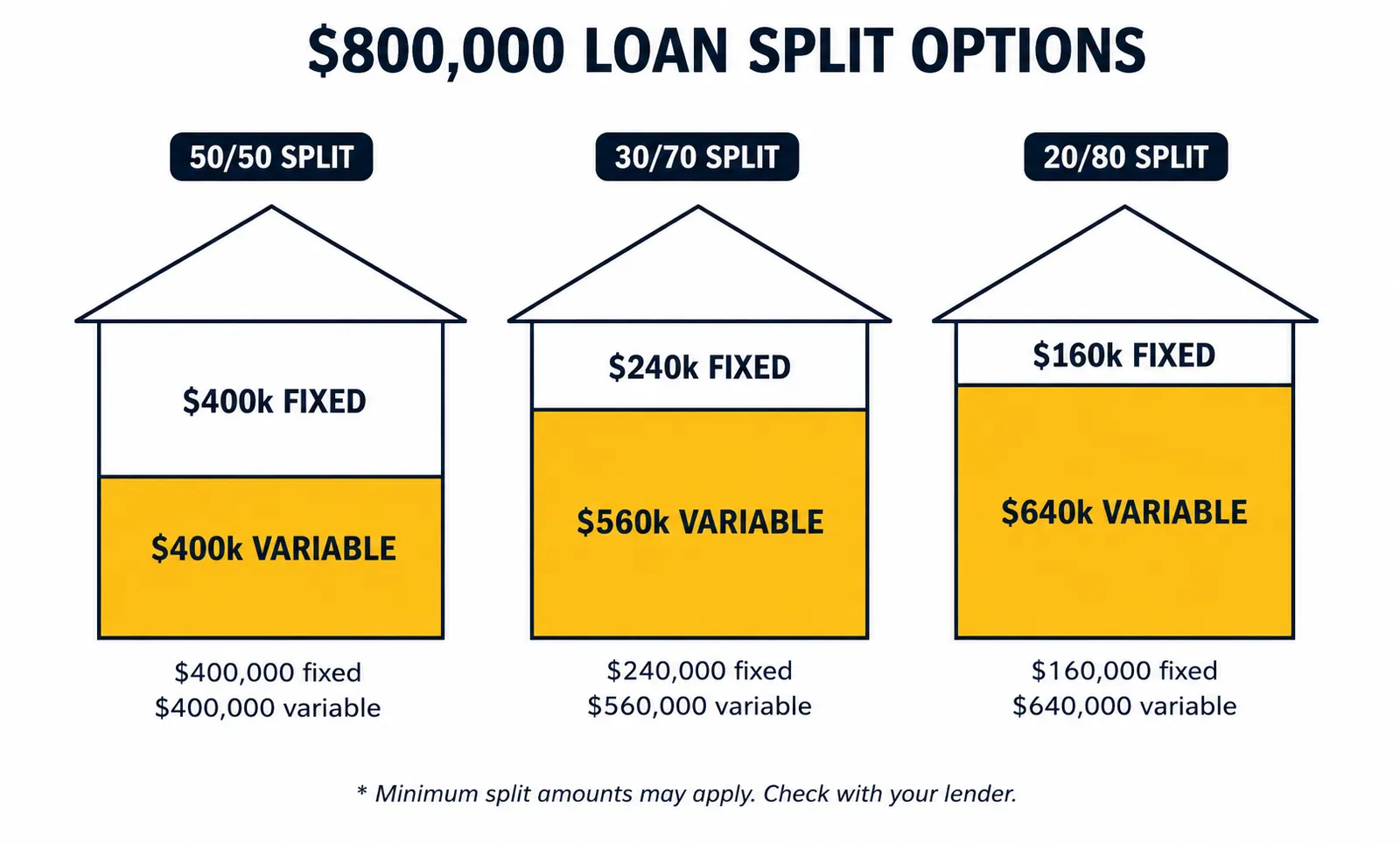
A split rate home loan is a mortgage where one part of the loan has a fixed interest rate, and the other part has a variable interest rate. It gives you the flexibility to pay as much as you like off the variable part and have some certainty when it comes to the fixed loan.
For example, if you have a $800,000 loan, you can split it 50/50. This would mean you have $400,000 in variable and $400,000 fixed. You can split your loan any which way 90/10 or 70/30, or 50/50. The choice of how to split it is ultimately yours.
Step-by-step process to split your home loan:
- Decide how you would like to split your home loan (50/50, 70/30, 80/20, etc.).
- Contact your mortgage broker and let them know you want to split your home loan.
- Complete a variation to split your home loan.
- Double-check with your bank that your 100% offset account is correctly connected to the variable split.
2. Don’t Use Interest-Only Repayments
This is a simple strategy that can literally cut $60,211 in additional interest from your loan:

An interest-only home loan allows you to pay only the interest on the loan for a specified time instead of paying both the principal and interest. This means you are not making any progress towards paying off the actual loan but only towards the interest.
Although less common today, many lenders will offer the opportunity to pay interest only on a loan.
Warning: Interest-only loans become very expensive in the long run.
However, there can be certain times when an interest-only loan makes sense—like for constructing a property or even when buying an investment property. The benefits are that you have a lower repayment over the period of time that you’ve got the interest only repayment.
The downside is that it can cost you tens of thousands of dollars, and you won’t pay down any principal on your loan.
Paying principal and interest at the same time makes sure you can get your loan cleared, reducing the effects of compounding interest and repaying your loan much faster.
As Albert Einstein said, “compound interest is the eighth wonder of the world. He who understands it earns it … he who doesn’t… pays it. Compound interest is the most powerful force in the universe.”
3. Act Like Your Loan Has A Higher Interest Rate.
This is one of the most effective ways to pay off your home loan faster. Instead of waiting for rates to rise, you can choose to pay as if your loan already has a higher interest rate.
The extra amount you pay reduces your loan balance faster, helping you save interest and potentially shave years off your mortgage term.
How it works
1. Start with your actual loan details
For example
- Loan amount: $800,000
- Remaining term: 30 years
- Current interest rate: 6.67% p.a. (an example owner-occupier variable rate in 2026)
2. Choose a “stress test” rate
Pick a higher rate that you could still comfortably afford — for example, 8.67% p.a.
This is not a prediction that rates will rise to 8.67%. Instead, it’s a budgeting strategy that helps you prepare for potential rate increases while paying down your loan faster
3. Calculate the repayment at the higher rate
Using the ASIC MoneySmart mortgage calculator (or your lender’s calculator):
- At 6.67%, an $800,000 loan over 30 years has a principal & interest repayment of roughly $5,150 per month (rounded up from $5,146)
- At 8.67%, the same loan over 30 years would be about $6,248 per month.

4. Pay the higher amount every month
By continuing to pay $6,248 per month instead of $5,150, you’re effectively making an extra repayment of around $1,098 per month towards reducing your loan balance
What difference can this make?
On an $800,000 loan over 30 years:
Paying as if your rate were 8.67% instead of 6.67% (around $1098 extra per month) could help you:
- Cut several years off your loan term, and
- Reduce your total interest costs by tens of thousands of dollars.
The exact savings will depend on your loan balance, interest rate, remaining term, and repayment frequency. You can use a mortgage calculator to compare:
- Your current repayment
- A higher “what if” repayment (such as 7.5%, 8% or 8.5%)
- The potential reduction in your loan term and interest costs
Why this helps if rates rise
Another benefit of this approach is that you’re already used to making larger repayments. If interest rates increase in the future, the higher repayment is less likely to put pressure on your budget because you’ve already built the habit.
If rates stay the same or fall, continuing to make the higher repayment allows you to pay your home loan off even faster.
4. Make Extra Lump Sum Repayments.
They say every cent counts, and it’s certainly true when it comes to your mortgage. Paying above your regular minimum repayments is a surefire way to pay off your home loan faster and can even give you the financial freedom to retire earlier if you want.
The best part is that you don’t need to pay much more to reap the rewards.

Small extras add up
For example, on a 30-year home loan of $800,000 at 6.67% p.a., paying just an extra $25 a week (about $3.60 a day, or roughly $108 a month) could see you become mortgage-free around 1 year and 10 months ahead of schedule.
That might make you think twice before grabbing that daily coffee.
Use tax returns and bonuses
Use tax returns and bonuses
Tax returns or bonuses are a handy source of cash that could help you pay off your home loan sooner. These windfalls are money you’ve already learned to live without, so you’re unlikely to miss them.
Using these windfalls to make extra mortgage repayments can drastically reduce your loan balance and accelerate the time it takes to pay it off.
Using the same $800,000 example, making a $10,000 lump sum repayment in year 2 could cut more than a year off your loan term and save tens of thousands of dollars in interest, depending on your interest rate and remaining loan term
It might even be worth making it an annual habit to use your tax return to pay down your loan.
How much would an extra $1,000 a month impact your mortgage?
Paying an extra $1,000 a month on an $800,000, 30-year loan at 6.67% could:
- Shave roughly 10–11 years off your mortgage, and
- Save you over $400,000 in interest.
Instead of paying back well over $1.8 million to the bank over 30 years (around $800,000 in principal plus more than $1 million in interest), you could be looking at repaying closer to $1.4–1.5 million in total.
The principal you borrow remains the same, but you’re knocking it down much faster, which means there’s far less interest to pay.
The extra $1,000 a month goes straight to reducing your principal. So in the early years, instead of only a small portion of your repayment reducing the loan balance, a much larger share goes towards paying down the debt. Because of how compound interest works, the effects multiply over time.
By the 5-year mark, a significantly higher percentage of each payment is going towards principal compared with making only the minimum repayment.
What if $1,000 a month isn’t realistic?

We realise money can be tight, and the cost of living is high, so an extra $1,000 might not be achievable for everyone at today’s rates.
Even much smaller extra repayments can save you a lot of money in the long run.
- Extra $100 a month: Could save you around 1 year and 8 months and tens of thousands of dollars in interest.
- Extra $500 a month: Could save you roughly 6–7 years and well over $200,000 in interest.
In other words, any extra money you put towards your home loan will save you a lot in the long run.
The bottom line
We’ve crunched the numbers, looked at the scenarios, and seen the undeniable impact extra payments can make on your mortgage. Even an extra little bit each month can make a big difference to the interest you pay over the life of the loan – not to mention cutting down the time it takes to pay it off.
Finding that extra cash can be a challenge with today’s cost of living, but the potential savings are too big to ignore.
Whether it’s an extra $100, $500, or $1,000 each month, every bit helps chip away at your principal faster, saving you tens – if not hundreds – of thousands of dollars over the life of your loan.
5. Use A 100% Offset Account.
It’s no secret that 100% offset accounts are the best way to pay off your home loan faster.

An offset account is similar to your regular savings or transaction account. It works by only charging you interest on the balance of your home loan minus any money you have in the offset account. Put simply, an offset home loan account allows you to pay off your loan quicker by reducing your interest payments.
You can deposit your pay, gifts, bonuses, and tax refunds into your offset account. Every dollar in the offset account is reducing your home loan balance.
That said, there are still heaps of people who do not fully take advantage of a 100% offset.
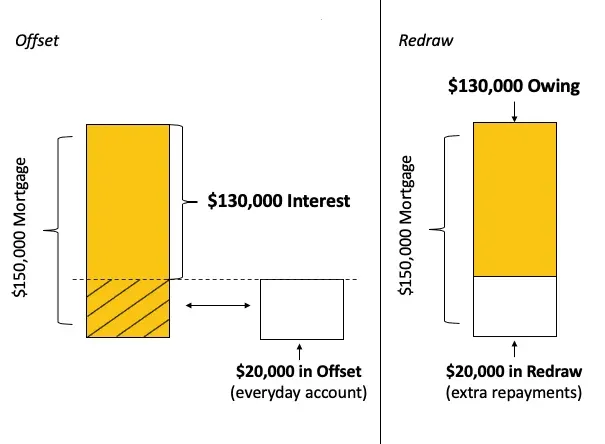
As you can see in the example above, every dollar in the offset reduces how much interest is paid on your home loan.
No Offset? Use "Redraw" Instead (The Poor Man’s Offset)
Not everyone wants to pay the annual “Package Fee” (often around $395) that usually comes with an offset account.
If you are fee-conscious, there is a powerful alternative: The Redraw Facility.
Think of redraw as the “poor man’s offset.” It achieves the exact same interest savings but is often available on basic, low-fee loans.
How it works:
Instead of putting your savings into a separate account linked to the mortgage, you put your extra money directly into the home loan. Just like an offset, this lowers your loan balance, meaning you get charged less interest.
The Catch:
There are two main differences to be aware of:
- Access: Money in an offset is instantly accessible via an ATM card. Money in a redraw is “inside” the loan. To get it back out, you usually have to log into internet banking and transfer it, which can take a day or two.
- Tax Consequences: If you ever plan to turn your current home into an investment property in the future, using redraw can mess up your tax deductibility (talk to your accountant about this!).
The Verdict:
If you are a disciplined saver who doesn’t need instant access to your cash and you hate paying annual bank fees, using your redraw facility is a fantastic way to smash your mortgage interest for free.
If you aren’t using an offset account, contact your mortgage broker today to look at switching your home loan type or at least check if you have a redraw facility available.
Read More: Home loan features – what to choose and what to avoid
Check to see if you are eligible for a home loan
6. Get Your Budget In Order
As the saying goes, ‘money is a cruel master but an excellent servant.’ Make your money work for you to its maximum capacity by doing a budget.
Having a budget in order is essential for achieving your financial goals. A budget helps you stay on top of your expenses, so you can use the ‘extra’ money you save to pay down your loan faster.
Half the battle with budgeting is just being aware of what you are spending.

There are many ways you can do this. One of the best ways is to use a budgeting app. Many apps are available, so you can choose the one that suits your needs best.
All you need to do is:
- Download your chosen app
- Insert your bank account feeds
- Let the app start categorising expenses
- Check it regularly to see what you are spending your money on
Read More: 11 Hidden Costs of Buying a Home in Brisbane
7. Check Out Other Banks
Some banks offer great interest rates for new clients but do not extend these lower rates to existing customers. So if you have been with the same bank for some time, you might be paying a higher interest rate! You can refinance by moving to another lender or refinancing with the existing lender.
Refinancing your loan can cut your interest costs by THOUSANDS.
Does this mean you should go out and refinance your home loan today? No.
Instead, we recommend talking to your mortgage broker to see what deals are available or if your existing bank is willing to reduce your current interest rate.
This strategy works so well that even a small reduction of 0.75% can pay off your home loan 39 months earlier. That’s almost 4 years!!!!!
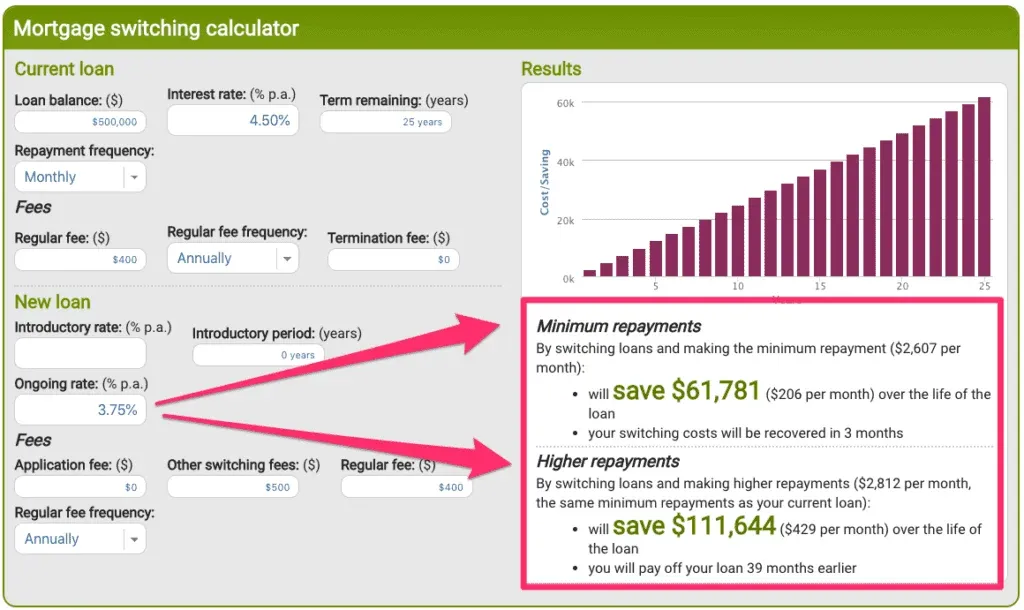
There are also some banks that offer rebates and cover the fees for switching your home loan.
Read More: 7 reasons to refinance your home loan
8. Avoid The “Loyalty Tax” (The Silent Budget Killer)
Here is a hard truth: Being loyal to your bank often doesn’t pay. In fact, it usually costs you money.
We call this the “Loyalty Tax.”
It happens when lenders offer incredible, rock-bottom interest rates to new customers (the “front book”) to get them in the door, while leaving existing customers (the “back book”)—that’s you—on older, higher rates.
Basically, the longer you stay with your bank without asking for a better deal, the more likely you are to be overpaying.

Recent data suggests the gap between what new customers pay and what existing loyal customers pay can be as high as 0.50% to 1.00%.
On a $800,000 mortgage, a 1% difference is an extra $8,000 a year you are donating to the bank simply because you haven’t made a phone call. That is money that should be paying down your principal!
So, how do you fix it without the hassle of refinancing?
You use the “Discharge Form” strategy.
Most people call their bank and just ask for a lower rate. The bank usually says “no” or offers a tiny discount.
Instead, call your bank and ask for a Discharge Form so you can move your loan to another lender.
This is the magic trigger.
Asking for this form often escalates your call immediately to the bank’s “Retention Team.” These guys have the authority to offer much bigger discounts than the standard customer service rep because their only job is to stop you from leaving.
Often, they will match or beat a competitor’s offer on the spot just to keep your business.
Read More: Nine reasons to refinance your home loan
9. Cut Up Your Loan And Make Fortnightly Repayments
One simple way to make extra progress on your mortgage is to switch from monthly repayments to fortnightly repayments.
Instead of making one monthly repayment, you divide your monthly repayment amount by two and pay that amount every fortnight.

For example:
Let’s assume your minimum monthly repayment is $1,000.
Instead of paying:
- $1,000 once per month
You pay:
- $500 every fortnight
Because there are 26 fortnights in a year, you make the equivalent of 13 monthly repayments instead of 12. That means you are effectively making one extra monthly repayment each year without making a large additional payment.
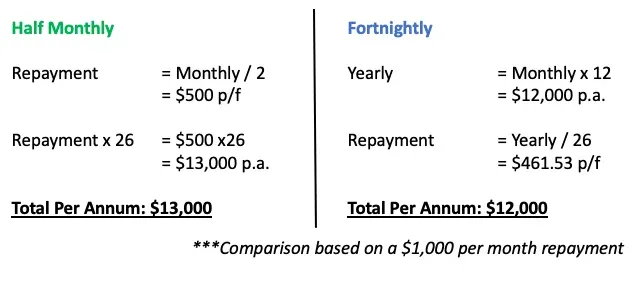
Over time, these extra repayments reduce your loan balance faster, meaning you pay less interest and can shorten your mortgage term.
On a typical 30-year home loan, switching to fortnightly repayments can help reduce your loan term by around 5 years and 8 months, depending on your loan amount, interest rate and repayment structure.
The benefit of this strategy is that the extra repayment is spread throughout the year, making it easier to manage while steadily reducing your mortgage balance.
10. Don’t Add Fees To Your Loan.
Here’s the truth: if you want to get a home loan, you will have to pay some bank fees, and they can add up to $500–$600 (or more) per application. These include:
- Loan application / establishment fees – Some lenders charge a fee when your loan is initially set up.
- Document preparation fees – Lenders may charge this to prepare your home loan contracts before approval
- Bank valuation fees – These are often waived, but you may be charged if the lender requires a formal valuation.
- Other fees, like annual fees – Ongoing package or annual fees can cost up to $400 per year or more.
With that being said, the most expensive fee you can pay when getting a loan is Lenders Mortgage Insurance (LMI).
What is Lenders Mortgage Insurance?
What is Lenders Mortgage Insurance?
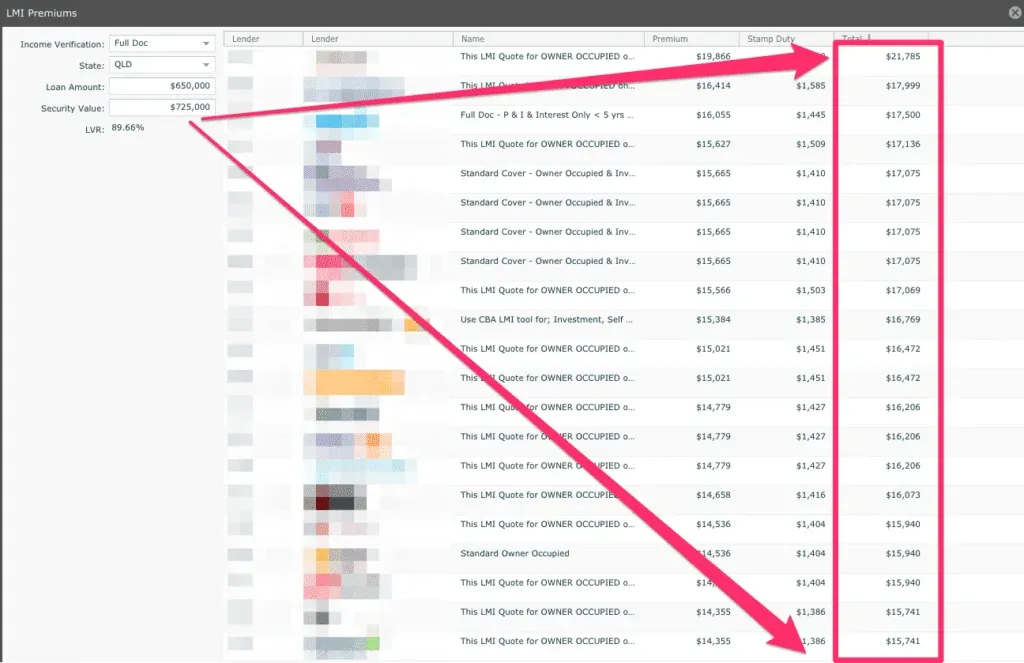
Lenders Mortgage Insurance is a one-off insurance premium that protects the bank (not you) if you default on your loan. It’s usually paid when your loan settles, and sometimes it can be added (or “capitalised”) to your loan.
That means you don’t pay it upfront, but you pay it over time together with your mortgage – with interest.
LMI can run into the tens of thousands of dollars.
LMI varies significantly between lenders. In some cases, simply comparing banks can save you thousands on this cost alone.
The smaller your deposit, the more LMI you’ll typically pay. For example:
- On an $800,000 home with a 10% deposit ($80,000), you might be asked to pay LMI in the vicinity of $12,000–$18,000, depending on the lender and your situation.
Why capitalising LMI is so expensive
If you add LMI to your loan instead of paying it upfront, you end up paying interest on that amount for the life of the loan.
Using the earlier example:
- Say you borrow $800,000 over 30 years at 6.67% p.a.
- If you capitalise $15,000 in LMI, your loan becomes $815,000.
Over 30 years, that extra $15,000 can:
- Cost you an additional ~$19,700 in interest, and
- Make the total cost of that LMI closer to $34,700 when you include both the premium and the extra interest.
In other words, capitalising LMI can almost double its true cost over the life of your loan.
While it might not always be possible to pay LMI upfront, it’s worth considering if you can. Paying it upfront rather than adding it to your loan can save you a substantial amount of money in the long run.
Read more: Lenders Mortgage Insurance calculator
11. Consider Non-Bank Lenders
People often choose the biggest banks because they feel more secure dealing with a household name. One common misconception is that choosing a smaller lender means sacrificing security

Many smaller banks, building societies and credit unions are Authorised Deposit-taking Institutions (ADIs), which means eligible deposits are protected under the Australian Government’s Financial Claims Scheme (FCS).
The FCS protects eligible deposits up to $250,000 per account holder per ADI if an authorised deposit-taking institution fails.
What does that mean for you as a borrower? It means you can consider a wider range of lenders without automatically assuming that only the major banks are reliable. Smaller ADIs can provide competitive home loans while still operating under Australia’s financial regulatory framework.
Smaller lenders often need to compete with the major banks to attract customers, which can mean they offer sharper interest rates, flexible loan features or more personalised service.
The benefit for you is that comparing a wider range of lenders could help you find a home loan that better suits your goals and potentially reduce the interest you pay over time.
Read More: Ethical banks in Australia.
Would you like to learn about your situation?
12. Think About Investing
So you have paid down a big chunk of your home loan. Now what?
It’s time to think about investing.

Keep in mind that investing can be very risky. You should always talk to a professional like a financial adviser first.
If you want to invest in property, consider Rentvesting. Rentvesting is living where you want and investing where you can afford.
Alternatively, you can invest in shares. There are lots of different ways to invest in shares:
- Buying shares directly
- Buying shares using an Exchange Traded Fund (ETC)
- Buying shares using an index-managed fund
- Buying shares using an active fund manager
13. Talk To A Professional

If you are uncertain about how to go about any of the steps we mentioned above, then you can contact an expert mortgage broker who will sit down with you and give you the best option that works for you. At Hunter Galloway, we have helped our clients to refinance and get the home loan that suits their financial goals
If you are looking for the best home loan in Brisbane or want to buy a home or refinance, speak with one of our experienced mortgage brokers to walk through the next steps with you.
At Hunter Galloway, we help clients get the best Home Loans in Brisbane in this competitive market. We give you the strategies that have helped other home buyers like you secure a property when there have been 5 other offers on the table!
Enquire online or give us a call on 1300 088 065.
14. Contractually Shorten Your Loan Term

This is a strategy we call “Forced Discipline.”
Here is the common trap we see all the time: A homeowner decides to refinance to get a better interest rate. They’ve already been paying their mortgage for 5 years, but when they switch banks, they reset their loan term back to 30 years to get the lowest possible monthly repayment.
Warning: While your monthly repayment drops, you have just extended your debt sentence! You are now paying off your house over 35 years instead of 30.
Sure, you might tell yourself, “I’ll just pay the extra money voluntarily.”
But let’s be real—life happens. The car breaks down, the kids need braces, or you just want a holiday. When the extra repayment is voluntary, it’s the first thing to get cut when the budget gets tight.
So, here is the strategy:
When you refinance, don’t take the standard 30-year term. Instead, ask your mortgage broker to set the loan term to 25 years or even 20 years.
By contractually shortening the loan, you are “locking in” a higher repayment. You can’t slack off because the bank requires that higher amount every month.
It forces you to maintain your momentum.
Yes, your committed monthly expense will be higher than if you took the 30-year option, but the result is guaranteed. You will be mortgage-free by that specific date, and you will save tens of thousands in interest that would have otherwise gone to the bank during those “reset” years.
Read more: Home loan extra repayment calculator
Frequently Asked Questions About Paying Off Home Loan Fast
Can I pay off my fixed-rate home loan early?
Yes, but be careful. Most Australian banks limit extra repayments on fixed loans to $10,000–$20,000 per year. If you pay more, you may be charged “break costs.”
Is it better to pay weekly or fortnightly?
Fortnightly is generally better. By paying half your monthly payment every two weeks, you end up making 26 half-payments (or 13 full months) a year, paying off your loan faster without feeling the pinch.
What is the difference between offset and redraw?
An offset account is a savings account linked to your loan (flexible access). A redraw facility is extra money you’ve paid into the loan itself (harder access). Both save you the same amount of interest.
How much interest does an extra $100 a month save?
On a $800,000 loan at 6.67% over 30 years, paying just an extra $100 a month could save you around 1 year and 10 months and tens of thousands of dollars in interest.
Does refinancing really save money?
It depends on the costs. If you can lower your rate by 0.50% or more, the savings usually outweigh the switch fees (discharge and government registration fees) within the first 12 months.
What is the "Loyalty Tax"?
This is the premium existing customers pay compared to new customers. Banks often offer aggressive discounts to win new business while leaving loyal customers on higher variable rates.
Can I use my superannuation to pay off my mortgage?
Generally, no. You cannot access your super to pay off your home loan until you reach your “preservation age” (usually between 55 and 60) and retire.
Does rent-vesting help pay off a home loan?
It can. “Rent-vesting” (renting where you live and buying an investment property elsewhere) allows you to enter the market sooner. The rental income and potential tax benefits can help pay down the investment debt.